COVID-19 Coronavirus Notice

COVID-19 Coronavirus Notice

Updated 2 July 2020

If you are reading this message, please be aware of travel restrictions in place as part of measures to contain the spread of the COVID-19 "Coronavirus" and its symptoms. Japanese authorities are refusing entry to individuals from, or who have been to, a list of over 100 countries (More information). All other visitors must apply for a visa, and undergo a quarantine upon entering the country. Within the Japan, there are no longer any travel restrictions, and most public attractions have re-opened with precautions for sanitation and social distancing. In short, travel to Japan is not recommended at this time, until the situation normalises. I will not be editing my individual articles to reflect this, but again, please keep this in mind when reading them.
Showing posts with label Kamakura. Show all posts

Friday, April 28, 2017

Hase-dera

This article is based on a visit made on Tuesday, 15 November 2016.

Edit 3 October 2019: Updated prices to reflect the increase in Japan's national sales tax.

Previously on Sekai Ichi, I visited Kotoku-in, a temple in Kamakura famous for its giant bronze Buddha statue.  Just down the road, there is yet another temple which attracted me, and its name is Hase-dera (長谷寺).

The temple halls are situated on the side of Mt. Kamakura, with beautiful gardens above and below.  The grounds start at the bottom of the hill, where the main path is flanked by small ponds on either side.

Off on the right (north) side of this garden, there is a small sub-shrine honouring the goddess Benzaiten.  Just beyond that, a torii gate marks the entrance to a cave, inside which are a number of shrines devoted to the same deity.  Some of the chambers in this cave are so small, I had to crawl to get through them!

A short climb up from the lower gardens takes us to the main hall of the temple.  This temple's main icon of worship is a gilded wooden statue of the Buddhist deity Kannon (観音), a.k.a. Avalokitesvara in Sanskrit.  The statue is 9.8 metres (30 feet) tall, making it one of the tallest wooden statues in Japan.  There is a legend that goes with this statue, too.  In the 8th century, there was a Buddhist monk who found a camphor tree so large, he was able to carve two Kannon statues from it.  He gave the first to (a different) Hase Temple near Nara, and cast the second one out to sea, in the hopes of it landing at a place with a karmic connection.  Said place turned out to be near Kamakura, when it was found and a new Hase Temple was built to honour it.  Photography of the statue is prohibited.

To the immediate left of the main hall is the Kannon Museum, a small gallery of Buddhist artifacts.  Entry is not too expensive -- it costs the same amount you paid to get into the temple itself -- and descriptions for the displays are written in Japanese, but English translations are provided on a pamphlet you are given going in.  I neglected to visit this museum, however.
Another small hall, further still to the left, is what's known as a kyozo (経蔵, kyōzō, lit. 'sutra storehouse'), or sutra archive, sutras being Hindu and Buddhist religious texts.  Inside this hall is a large rotating bookshelf, called a rinzo (輪蔵, rinzō, lit. 'wheel storehouse').  It is believed that simply by rotating this rack once around, you will have received the same blessings as if you read through the whole sutras.  The rinzo here is only available for the public to handle on certain days - it was locked when I came there - but there are multiple smaller prayer-wheels lining the room, which serve much the same purpose.

A pond shaped in the form of a manji, or swastika, symbol.  In an earlier article, I briefly touched upon the use of swastikas in Buddhism.  One thing I forgot to mention is what the symbol actually means in this context.  In East Asian traditions, the swastika, or "manji" in Japanese, include "all", "eternity", or "myriad" (literally 10,000).  Buddhist scriptures also tend to start with this character, hence its association with Buddhist temples.  Swastikas were also used in the crests of numerous Japanese clans during the Middle Ages.

There are plenty of secondary prayer points throughout the temple compound.  Jizo-do, or Jizo hall, is a small temple building surrounded by hundreds of small Jizo statues.  They are placed here by the parents of unborn children, as Jizo is meant to comfort the souls of those children.  It is estimated that 50,000 such statues have been placed here since World War II; they are discarded after a year's time to make room for new ones.

I found another, quite larger, Jizo statue elsewhere, decorated with a red bib and a small rainbow of flowers.

There's even a small Shinto Inari shrine here, as well.  Sometimes you don't need a whole forest of torii gates to create the Inari shrine experience; sometimes just one gate and a bunch of red banners will do nicely.

Behind the main hall, a trail winds up through the mountainside.  It isn't long, but it is lined with a pretty variety of plants and flowers...

...a couple of statues to pray at, if you haven't already gotten your fill...

...and some sweeping views of the Sagami Bay.

There are similar views from the terrace in front of the main hall, too.  So here's a panorama shot!  Click here for a larger picture.

There is a small bamboo grove here, too, next to the sutra archive and near the end of the path.  Between Hokoku-ji and this, I couldn't seem to get away from the stuff!

If green's not your thing, Hase-dera has plenty of trees whose leaves turn to red during the fall.  Due to Kamakura's warmer coastal climate, its autumn colours peak in early December, later than in nearby Tokyo, leaving me too early to experience them in full force.  A couple of trees had started to turn, however.

Hase-dera Temple in June - panoramio
By rinia [CC BY-SA 3.0 ], via Wikimedia Commons
Hase-dera has colourful surprises in other seasons, too.  In the months of June and July, there is a lovely array of blue, violet, and pink hydrangea flowers in bloom along the upper path.  I may not be all too well-versed in the many species of flowers, but I think I've fallen in love with hydrangeas from just one look!  Just be sure to expect some extra crowds during this time!  Even more hydrangeas may be seen at Meigetsu-in and Tokei-ji temples, both near Kita-Kamakura Station.

Ten thousand lights prayer - Hasedera - Kamakura, Japan
By maruri24 (CIMG0504) [CC BY 2.1 jp], via Wikimedia Commons
Another recurring festival at Hase-dera takes place on the night of New Year's Day.  Over five thousand candles are lit and arranged in circles on the ground, and prayers are made.  In case "a thousand points of light" aren't enough for you, this'll do nicely.

So that's all I have for Kamakura.  Join me this weekend, when I share with you one last gasp of Tokyo before striking out further afield, next time on Sekai Ichi!


Hours: Open 8:00 AM to 5:00 PM from March through September; closes at 4:30 PM from October through February.  No regular closing days.

Costs: ¥400.  Entry to the Kannon Museum costs an additional ¥300.

Address: 3-11-2 Hase, Kamakura-shi, Kanagawa-ken 〒248-0016

Access: From Kamakura Station, take the Enoshima tram (EN) line to Hase (EN12, 5 minutes, ¥200).  Hase-dera is 4 minutes on foot from Hase Station.

Directions: From Hase Station, turn right onto the main road, and follow it uphill for about 2 minutes.  Turn left at the next traffic light.  The temple entrance will be straight ahead.

Website: (English) (Japanese)

Thursday, April 27, 2017

Kotoku-in and Great Buddha

This article is based on a visit made on Tuesday, 15 November 2016.

Edit 3 October 2019: Updated prices to reflect the increase in Japan's national sales tax.

Of the many temples and shrines in Kamakura, only one seems to have risen above the competition to become the iconic symbol of the city: Kotoku-in (高徳院, Kōtoku-in).  Or, to be more specific, its giant bronze Buddha statue (大仏, Daibutsu).

As described below, the easiest way to get to Kotoku-in is by the Enoshima Electric Railway (江ノ島電鉄, Enoshima Dentetsu) tram line, departing from Kamakura Station.  They use a varied fleet of cars, from newer models to ones dating back to 1960.  This one is a newer, yet retro-styled, model from 2002.

Some of the tram cars have unique liveries, such as this one painted with images of their mascot.  One of them can be seen doing horseback archery, a yearly tradition at the nearby Tsurugaoka Hachiman shrine.

On my way up to the temple, I passed this cafe whose menu offered, among other things, "smile", illustrated by a cute drawing of the Buddha's face.

The entrance gate looks unassuming, but the centrepoint of this temple is not far beyond.

A pair of marble koma-inu (狛犬), or lion-dog statues that symbolically guard the entrances to shrines and some temples.  Yet for some reason, the gate they stand watch over is closed to visitors; instead, you make your way to the left, and pay at the counter, to enter the temple grounds.

You know, I've started to notice that Shinto shrines are usually free to visit, whereas Buddhist temples, at least the larger ones, charge for entry.  They're usually cheap, with Kotoku-in costing only ¥200 (US$1.80) to get in, but if you intend to visit a lot of temples in a day, they can add up.

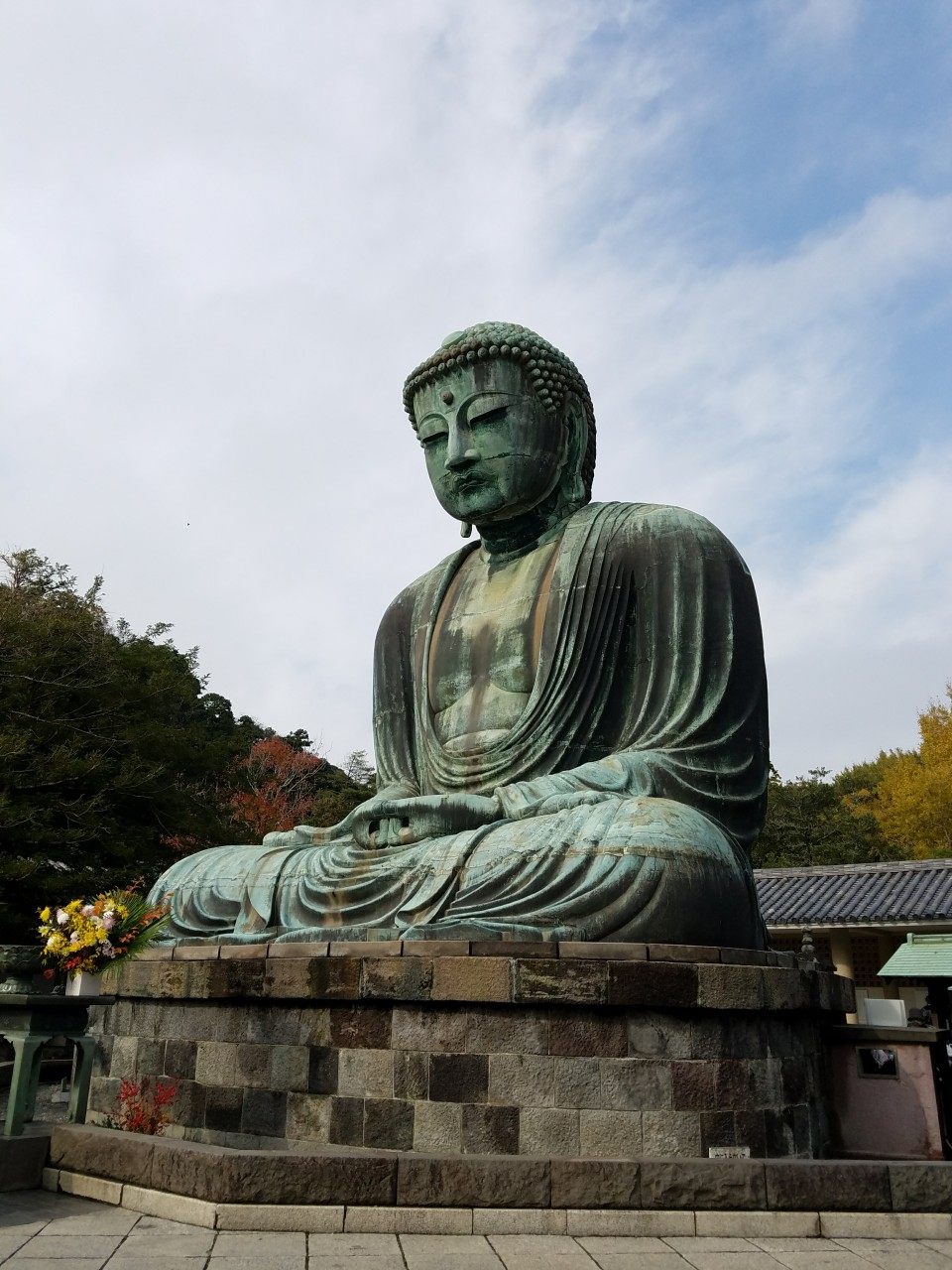
And here it is!  The statue is 13.35 metres (43 feet, 10 inches) tall, including its base, and despite being hollow, weighs 121 thousand kilogrammes (133.3 US tons).  It has been described as the second-tallest bronze statue of a seated Buddha in Japan, before the one at Todai-ji in Nara.  But, I've gone over the list of Daibutsu statues, and... that's not true.  There are quite a few that are taller than either of the two more popular ones.  Most of those, however, were erected more recently, so the first and second-place appellations may have belonged to Nara's and Kamakura's Buddhas at some point, and their reputation stuck.  Still, whatever its ranking, this statue is no less impressive.  Why, the ears alone, at 1.9 metres (6' 3"), are taller than most people!

Today, the statue stands out in the open, but in its earlier years, there used to be a hall sheltering it.  These buildings had a habit of burning or falling down, however; the third and final hall was destroyed in a tsunami in 1498, and no one bothered to rebuild it after that.  Also, if you look really closely at the cheeks, you may also find flecks of gold colouring, suggesting that the statue may have been covered in gold leaf at some point in its history.  Could you imagine that...?

For a tiny fee, you are welcome to go inside the statue.  It's not terribly big in there, and indeed was cramped from the volume of people when I visited.  But doing so gives you a close-up view on the construction of this statue.

A plaque inside describes some of the techniques used in the statue's construction.  Considering that it is over three-quarters of a millennium old, this is an amazing feat of engineering!

Kotoku-in has its own pair of giant o-waraji sandals, just as I saw at Senso-ji a couple of days before.  Each one measures 1.8 by .9 metres (5' 11" by 2' 11") and weighs 45 kilogrammes (99 lbs.).  They were donated to the temple by the Matsuzaka Children's Club of Hitachi-Ota city, Ibaraki prefecture.  The first pair was offered in 1951, with wishes for peace and recovery after World War II, and replacements were sent roughly every three years thereafter.

There were a few flyers posted on the walls of the complex by its staff, including this one for a speech given by the Dalai Lama in Yokohama.  A summary of the speech is included on the poster, translated to Japanese, Chinese, and English.  I thought I'd share it with you because I found it inspiring.

Several kings and princes of Thailand, another majority-Buddhist country, have also made pilgrimages here, and planted commemorative pine trees to mark their visits.

Here's a close-up of an informational plaque in front of one of those pine trees, helpfully translated to Thai, English, and Japanese.  In this case, it states that Thailand's ambassador to Japan replanted a tree in that spot in 2010, replacing the original planted by King Rama VI over a hundred years ago.

I imagine the Buddha must have blessed my visit, too, because as I was about to leave, the sky finally cleared up!  The change cleared up my spirits, too, so I wanted to take another snap of the Daibutsu in the improved lighting before leaving to my next destination: Hase-dera Temple.  Read about it, next time on Sekai Ichi!


Hours: Open 8:00 AM to 5:30 PM from April through September; closes at 5:00 PM from October through March.  The statue interior closes at 4:30 PM.  No regular closing days.

Costs: ¥300.  Entry to the interior of the statue costs an additional ¥20.

Address: 4-2-28 Hase, Kamakura-shi, Kanagawa-ken 〒248-0016

Access: From Kamakura Station, take the Enoshima tram (EN) line to Hase (EN12, 5 minutes, ¥200).  Kotoku-in is 7 minutes on foot from Hase Station.

Directions: From Hase Station, turn right onto the main road, and follow it uphill for about 7 minutes.  The temple entrance will be on the left.

Website: (English) (Japanese)

Wednesday, April 26, 2017

Hokoku-ji

This article is based on a visit made on Tuesday, 15 November 2016.

Edit 3 October 2019: Updated prices to reflect the increase in Japan's national sales tax.

Hokoku Temple (報国寺, Hōkoku-ji) is a Buddhist temple in the hills east of Kamakura.  It is famous for the bamboo grove in its inner garden, to the point that it is sometimes nicknamed the "Bamboo Temple" (竹寺, Take-dera).

The main hall exists in a free area.  However, by paying a small fee of ¥200, you will gain access to the inner gardens, where the temple's most unique sights await you.  Payment is made at a counter to the left side of the main hall; If you have a goshuin-cho book, you may also get it stamped here, and explore the garden while you wait.

Off to the side of the main hall is the bell tower, a common structure among Buddhist temples.  This one is covered by a thatched straw roof.  The main hall used to have a roof like that as well, but the building was damaged during the 1923 Great Kanto Earthquake, and subsequently was rebuilt in its current form.

I also found this pot holding what looked like a miniature koi pond... well, even more miniature than normal.

The star attraction of Hokoku-ji is its bamboo grove, in which grow over 2,000 shoots of bamboo.  I have no idea how tall these stalks are, but this particular species, known in Japanese as moso-chiku (孟宗竹, mōsō-chiku), can grow up to 28 metres (92 feet).  Apparently, when this temple was founded, there used to be an annex hall where the bamboo grove stands today.  It was there that the temple's founder, known posthumously as Butsuji-Zenji, trained as a priest and wrote poetry.

The colour green seems to permeate through this place, reflected not just in the bamboo, but in the moss covering the ground as well as rock statues like these.

In the back of the grove stands a teahouse where visitors can order a cup of green tea and relax with a view of the surrounding green paradise.

There's more to the temple grounds than just bamboo, though.  Far back in the hills, there are a series of small caves.  These are yagura (やぐら), a type of tomb dug into hillsides.  Yagura can be found at temples and other places nearby, were built mostly for members of the samurai class, and more often than not merely serve as empty cenotaphs for people interred elsewhere.  The ones here at Hokoku-ji are inaccessible, but are rumoured to hold the ashes of members of the Ashikaga samurai clan, for whom the temple was built to commemorate.

Hokoku-ji is a Zen Buddhist temple (the Rinzai Zen sect, to be exact), so of course it has a small rock garden.

And here it is, your moment of Zen!


Hours: Open 9:00 AM to 4:00 PM.  Tea service ends 30 minutes before closing time.  Closed 29 December through 3 January.

Costs: ¥300.  Tea service costs an additional ¥600.

Address: 2-7-4 Jōmyōji, Kamakura-shi, Kanagawa-ken 〒248-0003

Access: From Kamakura Station (JR Yokosuka (JO), Shonan-Shinjuku (JS), and Enoshima tram (EN) lines), take Keikyu Bus 鎌23, 鎌24, or 鎌36 (East exit, platform #5), and get off at the 6th stop, Jomyo-ji ("浄明寺", 8 minutes, ¥200).

Website: (English) (Japanese)

Tuesday, April 25, 2017

Tsurugaoka Hachiman-gu

This article is based on a visit made on Tuesday, 15 November 2016.


Tsurugaoka Hachiman Shrine (鶴岡八幡宮, Tsurugaoka Hachiman-gu) is the largest and most important Shinto shrine in Kamakura.  It has almost a millennium of history behind it, having been first consecrated in AD 1063, but moved to its present location in the late 12th century by Minamoto no Yoritomo (源 頼朝, 1147-1199), the warlord who founded the Kamakura shogunate.  Despite serving the Shinto religion, it maintains a few Buddhist and Chinese elements too, namely in its Feng Shui-influenced layout.

This meticulous degree of planning is apparent even before you reach the shrine.  A long boulevard runs almost entirely straight from the entrance of the shrine all the way down to the beach.  The east exit of Kamakura Station puts you mid-way up this road.  There is a pedestrian walkway going down the middle, called the Dankazura (段葛, lit. 'kudzu stairs').  It is bookended by red torii gates and lined by cherry trees, which bloom in late March and early April.

After the Dankazura, a trio of bridges stand in front of the shrine.  Way back during the Kamakura shogunate, there were two bridges: a rounded, red-painted wooden bridge which only the shogun was allowed to cross, and a flat bridge for commoners.  In 1697, they were replaced with the ones you see here.  The stone bridge in the centre is called the Taiko-bashi (太鼓橋, lit. 'big drum bridge'), as its rounded shape evokes a taiko drum.  Nowadays, it is also blocked off, although I would guess it's just to preserve it.  It had collapsed during the Great Kanto Earthquake of 1923, but was rebuilt soon after.

There are two ponds on either side of the entrance, connected under the bridges.  The eastern pond was meant to represent the Minamoto clan, and the western pond to represent the Taira clan, which was defeated by the former.  The Minamoto pond has three islands and the Taira pond has four; as the number 4 has connotations of death in Japanese culture, this was a subtle jab at the Taira clan.

One of the three islands on the eastern pond is connected by a bridge, and atop this island stands a shrine to a Buddhist figure.  The shrine, named Hataage Benzaiten Shrine (旗上弁財天社), honours Benzaiten (弁財天), a.k.a. Benten, the goddess of knowledge and music.  Co-mingling of Shinto and Buddhist facilities used to be common until the Meiji period.  In 1868, a law was passed by the new imperial government forcing the separation of Shinto and Buddhism, called the "Law of separation of Kami and Buddha" (神仏判然令, Shinbutsu Hanzenrei).  As a consequence of the law, Buddhist buildings on the grounds of Shinto shrines were destroyed, including several at Tsurugaoka Hachiman-gu.  Attitudes on the matter have relaxed since then; this shrine was rebuilt in its original form in 1980.

We still have a ways to go before reaching the heart of the shrine.  This broad path takes only a couple of minutes to traverse.  It is used for horseback archery (流鏑馬, yabusame) displays during a festival in September.  Speaking of holidays, as many as two million visitors make their New Year's Day prayers at this shrine, so even this avenue can fill up on such occasions.  But on a cloudy Tuesday morning... not so much.

That said, my visit did coincide with a holiday... sort of.  Shichi-Go-San (七五三, lit. 'seven-five-three') is a religious observance where parents of three and seven-year-old girls, and three and five-year-old boys, pray for their kids' safety and long life at local shrines.  Indeed, the name "shichi-go-san" means "seven-five-three" in Japanese.  The actual date of the holiday is the 15th of November, but most people observe it on the nearest weekend.  It seems there still were some families going out for the occasion on the day itself, however.

Heading along, we eventually come to a plaza in which stands the shimo-haiden (下拝殿, lit. 'lower worship hall'), or maiden (舞殿, lit. 'dance hall').  Various rituals are performed here, including ceremonial music and dance.

Behind the Maiden, a giant ginkgo tree used to stand next to the stairs leading up to the main hall.  It was almost 1,000 years old, and would turn a golden-yellow colour along with the other trees in Kamakura in early December.  Sadly, it was felled during a storm on the morning of 10 March 2010.  The site of its stump has since been marked off with a shimenawa, as the old tree itself was beforehand.

Large ginkgo in Tsurugaoka-hachimangu Shrine
By ja:利用者:S.fukasawa (ja:画像:鶴岡八幡宮大銀杏.jpg) [GFDL or CC-BY-SA-3.0], via Wikimedia Commons
Here is what the tree looked like while it was still standing, by the way.  This picture was taken in November of 2004.

Passing the stump and climbing up the stairs, we finally reach the main hall.  Hachiman Shrines like this one are dedicated to Hachiman (八幡神, Hachiman-jin), the Shinto god of warriors and archery, and also the protector god of the Minamoto clan.  Hachiman shrines are the second-most widespread variety of Shinto shrines in Japan, followed by Inari shrines (described below).

Some of the ema prayer plaques sold here are shaped like ginkgo leaves, in honour of the aforementioned tree.  I don't know, but I wonder if they had those before the tree was toppled.

The grounds of Tsurugaoka Hachiman-gu are quite vast, and hold a number of smaller shrines.  For example, here is the Maruyama Inari Shrine (丸山稲荷社, Maruyama Inari-jinja).  Inari shrines are typified by approaches lined with many torii gates, and are patronised by people praying for good harvests or business.  The Fushimi Inari Shrine in Kyoto is one of the most famous examples, and I would get to that one eventually.

Even on a day as cloudy as this, looking out from the main hall gives impressive views, underscoring just how far we've come along to get there.  With such a wide world in view, I wonder where it might take me...?

...Oh wait, I know.  I'm going to Hokoku-ji Temple, next time on Sekai Ichi!


Hours: Open from 5:00 AM to 9:00 PM, or 24 hours on 1-3 January.  No regular closing days.

Costs: Free.  Entry to the shrine museum on-site costs ¥200, and the garden on the edge of the Genpei pond costs ¥500 (open seasonally in Winter and Spring).

Address: 2-1-31 Yukinoshita, Kamakura-shi, Kanagawa-ken 〒248-8588

Access: The entrance to Tsurugaoka Hachiman Shrine is 10 minutes on foot from Kamakura Station (JR Yokosuka (JO), Shonan-Shinjuku (JS), and Enoshima tram (EN) lines).

Directions: From Kamakura Station, start from the east exit, cross the parking lot, and turn left at the traffic light.  Continue up the boulevard until you reach the shrine entrance at the end of the road.  It takes 10 minutes to walk to the entrance, plus another 5 minutes to the main hall.

Alternately, you may wish to walk up the Komachi-dori shopping street, which runs roughly parallel to the main street.  This road starts from the north corner of the parking lot (to the left, when facing from the station).  At the end of Komachi-dori, turn right; after a minute, the shrine entrance will be on the left.  This takes the same amount of time as the other route.

Website: (English) (Japanese)