COVID-19 Coronavirus Notice

COVID-19 Coronavirus Notice

Updated 2 July 2020

If you are reading this message, please be aware of travel restrictions in place as part of measures to contain the spread of the COVID-19 "Coronavirus" and its symptoms. Japanese authorities are refusing entry to individuals from, or who have been to, a list of over 100 countries (More information). All other visitors must apply for a visa, and undergo a quarantine upon entering the country. Within the Japan, there are no longer any travel restrictions, and most public attractions have re-opened with precautions for sanitation and social distancing. In short, travel to Japan is not recommended at this time, until the situation normalises. I will not be editing my individual articles to reflect this, but again, please keep this in mind when reading them.

Saturday, March 18, 2017

Know Your Trains: Hokkaido Shinkansen

The lead car of a H5-series Shinkansen train approaching Omiya Station.
Rsa [GFDL or CC-BY-SA-3.0], from Wikimedia Commons
The Hokkaido Shinkansen (北海道新幹線, Hokkaidō Shinkansen) is a high-speed rail line linking the islands of Honshu and Hokkaido.  It runs from Aomori, the terminus of the Tohoku Shinkansen, through the undersea Seikan Tunnel, to its current terminus near Hakodate.  Owned and operated by JR Hokkaido, the line is the newest member of the Shinkansen family, opening in March 2016.  Combined with through services on the Tohoku Shinkansen, the two lines link Tokyo and Hakodate in less than four and a half hours.  Its top speed is 260 kilometers per hour (160 miles per hour), except for a limit of 140 km/h (85 mph) inside the Seikan Tunnel.

A map of the Hokkaido Shinkansen, including segments currently under construction.
Two types of services run on the Hokkaido Shinkansen, "Hayate" and "Hayabusa".  Both are through-services from the Tohoku Shinkansen.  The vast majority of services are Hayabusa, with Hayate services running mainly during the early morning or late evening.

Name Start Station End Station(s) Time Max. Frequency*
Hayate Shin-Aomori Shin-Hakodate-Hokuto 65 minutes 2 per day
Morioka (Tohoku) 2 hours 10 minutes
Hayabusa Shin-Aomori Shin-Hakodate-Hokuto 60 minutes 1 per hour
Tokyo (Tohoku) 4 hours 30 minutes
* Departure frequency is based on March 2017 schedules and are subject to change.

All Hayate and half of all Hayabusa services stop at every station, while the other Hayabusa trains run directly between the terminals in Aomori and Hakodate.  At the time of this post, the Hokkaido Shinkansen only includes four stops.  An extension to Sapporo is under construction, and is scheduled to open in 2030-2031.  Much of the line, including the planned extension, goes through various tunnels, so there may not be much to see from your window.

Name (English) Name (Japanese) Prefecture Hayate Hayabusa
Shin-Aomori 新青森 Aomori X X
Okutsugaru-Imabetsu 奥津軽いまべつ X O
Kikonai 木古内 Hokkaido X O
Shin-Hakodate-Hokuto 新函館北斗 X X
Shin-Yakumo* 新八雲
Under construction
Scheduled to open
in 2030-31
Oshamambe 長万部
Kutchan 倶知安
Shin-Otaru* 新小樽
Sapporo 札幌
Legend
X: All trains stop at this station.
O: Some trains stop at this station.
I: No trains stop at this station.
* Shin-Yakumo and Shin-Otaru are tentative names for stations to be newly built.

Notable stops
  • Shin-Aomori: Home of the Nebuta summer festival.
  • Okutsugaru-Imabetsu: The last stop on Honshu, before the Seikan Tunnel.
  • Kikonai: The first stop on Hokkaido.
  • Shin-Hakodate-Hokuto: One of Japan's first ports to open to foreign trade.
A GranClass car on a H5-series train.  The blue carpet in this car represents Hokkaido's seas and lakes.
くるみ1211 (Kurumi 1211) [CC BY-SA 4.0], from Wikimedia Commons
Hokkaido Shinkansen services use the new H5-series trains, a derivative of the E5-series used solely on the Tohoku Shinkansen.  The H5 is largely similar to the E5, except for a few mechanical modifications designed for the harsher Hokkaido winters, and colour and design changes meant to evoke the nature of the island.  Neither of the two services have any non-reserved cars, so seat reservations are mandatory.  If all seats are booked, standing-room tickets may be available.  Both the Hayate and Hayabusa also include one Green Car and one GranClass car.

Service Total Cars Non-Reserved Cars Reserved Cars Green Cars GranClass Cars
Hayate 100 8 (Cars #1-8) 1 (Car #9) 1 (Car #10)
Hayabusa 10 0 8 (Cars #1-8) 1 (Car #9) 1 (Car #10)

Tips
  • All seats on Hayate and Hayabusa services are reserved.  Seat reservations are free when using a Japan Rail Pass or JR East area pass.  In the event that all seats on a train are booked, it may be possible to buy a standing-room ticket.
  • Unlike on the Tokaido, Sanyo, and Kyushu lines, the Japan Rail Pass is valid for ALL services on the Hokkaido Shinkansen.  In addition, the JR East South Hokkaido Area Pass (English) also covers the full line from Tokyo to Shin-Hakodate-Hokuto.
  • The JR Hokkaido Area Pass, on the other hand, does not cover any of the Hokkaido Shinkansen.  Only regular and limited-express trains are covered by it.
  • Shin-Hakodate-Hokuto station is located in the suburb of Hokuto, which is somewhat far away from the more centrally-located Hakodate Station.  The two stations are connected by the Hakodate Line.  A rapid service called the Hakodate Liner travels between them in 20 minutes, costs ¥360, and is timed to arrive and depart with Shinkansen services.
  • The Japan Rail Pass and Hokkaido Rail Pass do not cover the South Hokkaido Railway, a regular line that was transferred to a non-JR company after the opening of the Hokkaido Shinkansen (see the Trivia section below).
  • For those using the Seishun 18 Ticket (more information), which normally does not allow free use of the Shinkansen, it is possible to purchase a supplement ticket, called the "Seishun 18 Kippu Hokkaido Shinkansen Ticket".  It costs ¥2,300, and allows one-way use of the Hokkaido Shinkansen between Oku-Tsugaru-Imabetsu and Kikonai, and the South Hokkaido Railway between Kikonai and Hakodate.
Trivia
  • The Hokkaido Shinkansen travels through the Seikan Tunnel, an undersea tunnel between the islands of Honshu and Hokkaido.  Since the Shinkansen shares this section with regular freight trains, its speed limit is lowered to 140 km/h (85 mph) within the tunnel.  This is to prevent freight trains from being knocked off the rails by the shockwave of fast-moving Shinkansen trains.  JR Hokkaido is developing solutions to allow trains to run faster within the tunnel, such as "Train on Train", which involves loading cars onto transporter wagons designed to withstand higher speeds.
  • There used to be two train stations within the Seikan Tunnel.  Tappi-Kaitei, on the Honshu side, and Yoshioka-Kaitei, on the Hokkaido side, opened in 1988 along with the tunnel.  These stations closed in 2013, while the Hokkaido Shinkansen was under construction.  The line which served these stations, the Kaikyo Line, is today only used by freight trains.
  • Shin-Hakodate-Hokuto Station, formerly known as Oshima-Ono Station, was renamed and renovated in 2016 to coincide with the opening of the Hokkaido Shinkansen.  A statue of Kenshiro, the main character from the manga and anime Fist of the North Star (or "Hokuto no Ken" in Japanese), was added in front of the station.  The new name of the station comes from its location in the town of Hokuto (literally "north star" in English), not from the show.  More information on this development has been posted on the website Rocket News 24.
  • When the Hokkaido Shinkansen was first opened, a section of JR's conventional Esashi Line was sold to a new semi-private company.  The section between Kikonai and Goryokaku was transferred to the new South Hokkaido Railway (道南いさりび鉄道, Dōnan Isaribi Tetsudō).
A full-size mockup of a "Train on Train".
100yen [GFDL or CC BY-SA 3.0], from Wikimedia Commons

Friday, March 17, 2017

Tokyo River Cruise

This article is based on a visit made on 13 November 2016.

Edit 2 October 2019: Updated prices to reflect the increase in Japan's national sales tax.

The city of Tokyo is situated on the coast of a bay, and is divided by numerous rivers, particularly in its eastern suburbs.  So, in addition to its many train lines and roads, there are several companies providing boat services for travel across these waterways.  One such company is Tokyo Cruise, a.k.a. Water Bus (水上バス, Suijō Basu), and their flagships are the Himiko and the Hotaluna.

The Hotaluna (ホタルナ, pictured above) and its sister ship, the Himiko (ヒミコ), were designed by the famous animator Leiji Matsumoto (松本 零士, Matsumoto Reiji, b. 1938).  His works include Space Battleship Yamato, Space Pirate Captain Harlock, Galaxy Express 999, and even some music videos for the EDM band Daft Punk.

The two ships are very similar in form, nearly covered in wide, curving, green-tinted glass.  Among their differences, the two ships have different seating arrangements.  The Hotaluna is larger has more seating, but the Himiko, despite its size, feels a bit more open by contrast.   The Hotaluna also features an open-air deck on top, where the Himiko does not.  I chose the Hotaluna for this reason, but the deck was closed on the first segment of my ride.

Before we leave, the pier at Asakusa has a brilliant view of Tokyo Skytree and the Asahi headquarters, both of which I have written about before.

There's honestly not too much to see during the first leg of the trip.  Besides, the tinting of the ship's windows leaves your pictures with a greenish hue.  Not that it's necessarily a bad thing -- it's like an Instagram filter without the Instagram!

The Hotaluna and Himiko are by no means the only ships operated by Tokyo Water Bus.  While not sharing the same space-age design, the other boats are more frequent, serve other locations, and are even a bit cheaper.

Mid-way through its journey, the Hotaluna makes a detour to Hinode Pier, which is just past the mouth of the Sumida River.  (The Himiko skips this stop and heads directly to Odaiba.)  It was around this point that we were let onto the open-air deck, affording us a better view of the surroundings.  And just in time, too -- the clouds parted in just the right way to give a heavenly illumination to this business district.

We could even see Tokyo Tower from the port!  In fact, it stands only a mile (1.61 km) northwest of Hinode Pier.

After leaving port, the ship then proceeds to cruise under the Rainbow Bridge on its way to the next port, on Odaiba island.

The Odaiba Marine Park covers the northern coast of the island.  Swimming in the bay is prohibited due to pollution, but the beach itself remains popular, even in this mild November weather.  Behind it we can see the Decks mall, where I had gone to before, and would go to again soon after this.

Finally, we reach the Odaiba pier and prepare to disembark.  Here's the Himiko, which arrived a few minutes ahead of us.  As you can see, its design is much the same as the Hotaluna, except it lacks a deck on top.

And after having disembarked, I had my best opportunity to take a picture of the Hotaluna itself.  It may not be the cheapest or fastest way to get to Odaiba (from Asakusa, taking the Ginza or Asakusa subway, followed by the Yurikamome line, takes 40 minutes and costs just over ¥500), but it's certainly one of the most stylish!

The pier at Odaiba Seaside Park stands right in front of another mall, Aqua City.  Behind it is the iconic Fuji TV building, seen in this picture, which we will get to see up close and personal, next time on Sekai Ichi!


Hours: Both the Hotaluna and Himiko depart four times a day in each direction.  The full journey between Asakusa and Odaiba takes about 60 minutes on the Hotaluna (stopping at Hinode), or 50 minutes on the Himiko (direct).  Multiple services on other ships are available between Hotaluna and Himiko departures.

Cost: Fares are ¥860 between Asakusa and Hinode (Hotaluna only), ¥520 between Hinode and Odaiba (Hotaluna only), and ¥1,380 between Asakusa and Odaiba (Hotaluna and Himiko).

Website: (English) (Japanese)
Asakusa Pier

Address: 1-1-1 Hanakawa-do, Taito-ku, Tōkyō-to 〒111-0032

Access: The pier is 1 minute on foot from Asakusa Station (Tokyo Metro Ginza (G) and Tobu Skytree (TS) lines), or 3 minutes from Asakusa Station on the Toei Asakusa (A) line, depending on the line and exit used.  The closest exits are Ginza exits 4 and 5, and Asakusa exit A5.

From Tokyo Station, take the Yamanote (JY) or Keihin-Tohoku (JK) lines to Ueno (JY05/JK30, 7 minutes, ¥160, JR Pass OK), and then take the Ginza line to Asakusa (G-19 4 min, ¥170).

Hinode Pier

Address: 2-7-104 Kaigan, Minato-ku, Tōkyō-to 〒105-0022

Access: The pier is 3 minutes on foot from Hinode Station (Yurikamome (U) line).

From Tokyo Station, take the Yamanote or Keihin-Tohoku lines to Shimbashi (JY29/JK24, 3 minutes, ¥140, JR Pass OK), and then take the Yurikamome to Hinode (U04, 5 minutes, ¥250).

Odaiba Seaside Park Pier

Address: 1-4-1 Daiba, Minato-ku, Tōkyō-to 〒135-0091

Access: The pier is 8 minutes on foot from Daiba and Odaiba-Kaihin-koen stations (Yurikamome line), or 10 minutes on foot from Tokyo Teleport Station (Rinkai (R) line).

From Tokyo Station, take the Yamanote or Keihin-Tohoku lines to Shimbashi (3 minutes, ¥140), and then take the Yurikamome to Daiba (U07, 14 minutes, ¥320).

Tuesday, March 14, 2017

Asakusa and Senso-ji: Off the Beaten Path

This article is based on a visit made on 13 November 2016.

Previously on Sekai Ichi, I made a brief stop in the Asakusa district, walking up from the Kaminari-mon gate to the main hall of Senso-ji (浅草寺, Sensō-ji) temple.  But you probably already know all about them.  Senso-ji is one of the most famous tourist attractions in all of Tokyo, if not Japan.  In fact, I only posted pictures of its main buildings now because I haven't shown you what they look like during the day.  Senso-ji is, however more than just its main hall, so let's strike off the beaten path, shall we?

But let's stay on the topic of the main hall for a bit, if only to swing around and look at it from the side.  This angle in particular shows how brightly-painted and ornate it is, thanks largely to renovations from earlier in the decade.  If you look closely, you may notice the use of swastikas as part of the building's decoration.  This is perfectly normal and well-meant, as the symbol has been used in Buddhism and various other cultures for centuries.  Swastikas are even used to mark Japanese Buddhist temples on maps, although maps made for English-speakers unaware of its distant history may use a different icon for this purpose.

There are actually plenty of buildings which make up the Senso-ji complex.  The Yogo-do (影向堂, Yōgōdō) is a hall off to the west of the main hall, enshrining disciples of the Boddhisatva Kannon, the main deity of this temple.

The Yogo-do is also where I bought my first goshuin-cho (御朱印長, goshuinchō), a sort of book for collecting stamp seals from shrines and temples.  Most of these places include a counter, usually in one of the side halls, where you hand in your goshuin-cho, and a priest or other attendant will write a short prayer and put a stamp on one of these pages.  One of these books usually costs ¥1,000-1,500, and individual stamps cost around ¥300 each.  However, as this is a religious service, please be respectful when you do so.  In fact, it is recommended that you make a prayer and small donation at the shrine or temple first.

Another side hall, this one known as Yakushi-do (薬師堂, Yakushidō).  It was built under the reign of the shogun Tokugawa Ieyasu in 1649, making it one of the oldest surviving buildings of Senso-ji.  Although halls like these may appear closed, they still have open offering boxes up front, so you may choose to address your prayers to a wider variety of deities.

A bright yellow tree.  It was most likely a ginkgo, since its leaves turn a golden yellow colour in autumn.

A pretty young lady going about in her pink kimono was nice enough to pose for some pictures.  If you do wish to take a picture of someone in such attire, you should definitely ask for their permission, in Japanese if you can manage it.  Besides, if you stay in Japan long enough, you'll see this kind of dress often enough that it no longer becomes such a big deal.

This giant sandal, and its pair on the other side, were hung on the back of the Hozo-mon gate.  They are called called o-waraji, "waraji" (草鞋, lit. 'grass sandal') being a type of straw-rope sandal which also used to be offered at temples, as part of prayers for foot health and safety during travel.  The pair at Senso-ji was built in Murayama City, Yamagata Prefecture, with the first one donated in 1941 and replacements arriving roughly every ten years.  Both sandals of this set each stand 4.5 metres (4 feet 9 inches) tall and weigh 2,500 kilogrammes (5,500 pounds).  More information, from The Japan Times: (English)

A mother-and-child Jizo statue.  Jizo (地蔵, Jizō), a Boddhisatva originally known as Kṣitigarbha in Sanskrit, is the guardian of children and travellers, and the patron deity of deceased children.  Jizo statues are common in Japan, and are often decorated with red bibs, kerchiefs, or other small items of clothing.  In fact, if you've ever played Super Mario Bros. 3, you may be interested to know that the statue Mario can transform into in his Tanooki Suit is, in fact, a Jizo statue.  Huh, I'm curious to know how Buddhism made its way into the Mushroom Kingdom...

Back to reality, this is a nison-butsu, literally "two Buddhas" in Japanese.  The statue on the left side is believed to bring mercy to worshipers, and the one on the right, wisdom.

Leaving Senso-ji for a while, we see some local businesses which have crafted unique methods of catching one's eye.  This ramen restaurant has a statue of a man in Edo-period garb sitting on the roof.  There are others like it around the neighbourhood, including right across the street.

And then, there's a cafe with an soybean-shaped mascot whose name, according to the base of this statue, is "Mamezou-kun" (まめぞうくん, Mamezō-kun).  The offerings available at this establishment include varieties of dango (rice dumplings) and parfaits.

Finally, nearby is Hanayashiki (花やしき), a small amusement park.  It has operated since 1853, allegedly making it the oldest running amusement park in Japan.  But alas, I couldn't spend any time there; since I had spent so much time waiting for my goshuin-cho (it was a busy day) that I pretty much had to rush to my next destination: the Tokyo Water Bus pier!


Senso-ji Temple

Hours: The temple grounds are always open.  The main hall is open from 6:00 AM (or 6:30 AM from October to March) to 5:00 PM.

Cost: Free.

Address: 2-3-1 Asakusa, Taito-ku, Tōkyō-to 〒111-0032

Access: The Kaminari-mon gate is only 1-3 minutes from Asakusa Station (Tokyo Metro Ginza (G), Toei Asakusa (A), and Tobu Skytree (TS) lines), depending on the line and exit used.  The closest exits are Ginza exit 1 and Asakusa exit A4.  Either way, turn right under Kaminari-mon onto the Nakamise shopping avenue.  The temple is at the end of the road, about 400 meters (¼ mile) later.

Website: (English) (Japanese)

Monday, March 13, 2017

Asakusa and Senso-ji in Autumn

This article is based on a visit made on Sunday, 13 November 2016.

From front to back: Kaminari-mon, Nakamise-dori, and Senso-ji.
Taken from the observation deck at the Asakusa Culture and Tourism Centre.
After the Koishikawa Koraku garden, my next big adventure in Tokyo was a cruise along the Sumida River and Tokyo Bay on the futuristic Hotaluna ship.  But before that, since the boat was to depart from Asakusa (浅草, lit. 'shallow grass'), I decided to head down early and take another walk down to the Senso-ji temple, and explore more of the temple grounds while I was in the neighbourhood.

The Asakusa Culture and Tourism Centre.
Kakidai [CC BY-SA 4.0], from Wikimedia Commons
But first, I stopped by the Asakusa Culture and Tourism Centre.  Opened in 2012, and designed by the architect Kengo Kuma (隈 研吾, Kuma Kengo, b. 1954), this nifty building's features include a tourism information desk, conference and exhibition spaces, and a free observation deck on the 8th floor.

It was from this vantage point that I took a few pictures such as the wide shot of the Senso-ji complex at the top of this article, and this shot of the Tokyo Skytree and Asahi Brewing Company headquarters.  I never managed to pay Skytree another visit on this trip, but if you'd like to read my thoughts about the first time I went there, here you go.

This visitor centre also has a diorama of the neighbourhood on display, even going as far as Ueno Park and the Skytree, with many destinations labelled.

Back on the ground, I found myself in front of the world-famous (okay, nationally-famous?) gate known as Kaminari-mon (雷門, lit. 'thunder gate'), seemingly floating above a sea of people.  It had been covered up by scaffolding the last time I was around, in 2014, but all that was gone now, allowing me to witness the gate in all its vibrant, if over-crowded, glory.  The entrance is flanked by statues of Fujin (風神, Fūjin, lit. 'wind god') and Raijin (雷神, lit. 'thunder god'), the Shinto gods of wind and thunder, which is a common sight for shrines and Buddhist temples alike in Japan. (NB: In Japanese, the same kanji is used for "lightning" and "thunder", so those words tend to be used interchangeably.)

And a close-up of its giant red lantern.  The name of the gate, in kanji (雷門), is painted on the front of it.  Because this lantern is so fragile, the one you see here is a reconstruction made in 2003, donated in honour of the 400th anniversary of the Edo period.

The Nakamise Shopping Street (仲見世商店街, Nakamise Shōten-gai) is often lined from above by seasonal decorations.  Last time it was decked with (fake) cherry flowers, this time by (fake) maple leaves.

Many of the roads intersecting Nakamise-dori were still buzzing with people, but at least I had some actual walking room.  This street, Dempoin-dori, is about halfway up Nakamise.

Here's a close-up of one of the aforementioned maple leaf decorations, these ones hanging above Dempoin-dori.

An inner gate, Hozo-mon, stands in front of the main hall.  Senso-ji was established in AD 645, making it the oldest Buddhist temple in Tokyo.  However, the actual buildings have been destroyed and rebuilt multiple times over the years.  For example, the current main hall (below) only dates back to 1958, after having suffered damage during WWII bombing raids in March of 1945.

And, finally, the main hall.  I don't know if you can see it from behind all these people, but there is a large bronze cauldron of incense sticks in front of the hall.  It is considered good fortune to waft some of the smoke above your head as you make your prayers.  But don't breathe in too much, because the smoke is quite bitter!


Senso-ji Temple

Hours: The temple grounds are always open.  The main hall is open from 6:00 AM (or 6:30 AM from October to March) to 5:00 PM.

Cost: Free.

Address: 2-3-1 Asakusa, Taito-ku, Tōkyō-to 〒111-0032

Access: The Kaminari-mon gate is only 1-3 minutes from Asakusa Station (Tokyo Metro Ginza (G), Toei Asakusa (A), and Tobu Skytree (TS) lines), depending on the line and exit used.  The closest exits are Ginza exit 1 and Asakusa exit A4.  Either way, turn right under Kaminari-mon onto the Nakamise shopping avenue.  The temple is at the end of the road, about 400 metres / ¼ mile later.

Website: (English) (Japanese)

Asakusa Culture and Tourism Centre

Hours: Open 9:00 AM - 8:00 PM.  No regular closing days.

Cost: Free.

Address: 2-18-9 Kaminari-mon, Taito-ku, Tōkyō-to 〒111-0034

Access: Follow the directions above to Kaminari-mon.  The Asakusa Culture and Tourism Centre is directly across the road from the gate.

Website: (Japanese)

Sunday, March 12, 2017

Know Your Trains: Kyushu Shinkansen

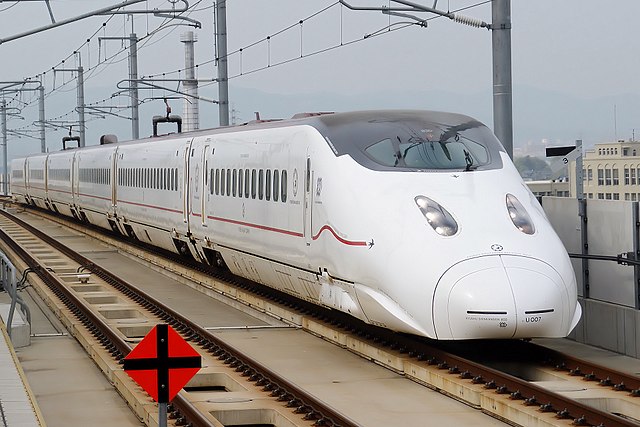
An 800-series "Tsubame" train approaching Kurume Station.
By JKT-c [GFDL or CC BY 3.0], from Wikimedia Commons
The Kyushu Shinkansen (九州新幹線, Kyūshū Shinkansen) is a high-speed rail line running along the west coast of the island of Kyushu, between the cities of Fukuoka (at Hakata Station) and Kagoshima (at Kagoshima-Chuo Station).  Owned and operated by JR Kyushu, the line opened partially in 2004, and fully in 2011, connecting with the Sanyo Shinkansen to provide through-service all the way to Tokyo.  Its top speed is 260 kilometers per hour, or 160 miles per hour.

A map of the Kyushu Shinkansen and its stops, including sections currently under construction.
Three services run on the Kyushu Shinkansen: the local "Tsubame", the semi-express "Sakura", and the express "Mizuho".  The vast majority of services are Sakura, with the other two operating mainly during the morning and evening rush hours.  Mizuho and most Sakura services continue on from Hakata on to the Sanyo Shinkansen, terminating at Shin-Osaka Station.  With only one transfer, it is possible to travel from Tokyo all the way to Kagoshima in 7 (by Nozomi and Mizuho) to 8 (by Hikari and Sakura) hours.

Name Colour* Start Station End Station Time** Max. Frequency***
Tsubame White Hakata Kagoshima-Chuo 2 hours 3-4 per day
Sakura Pink Shin-Osaka (Sanyo)
Hakata
Kagoshima-Chuo 80-90 minutes 1-2 per hour
Mizuho Orange Shin-Osaka (Sanyo) Kagoshima-Chuo 80 minutes 6 per day
* The colour associated with each particular service on signboards, etc.
** Approximate time between Hakata and Kagoshima-Chuo stations.
*** Departure frequency is based on March 2017 schedules and are subject to change.

When the Kyushu Shinkansen first opened in 2004, it only ran between Shin-Yatsushiro and Kagoshima-Chuo stations.  In 2011, it was extended all the way north to Hakata Station.

Name (English) Name (Japanese) Prefecture Tsubame Sakura Mizuho
Hakata 博多 Fukuoka X X X
Shin-Tosu 新鳥栖 Saga X O I
Kurume 久留米 Fukuoka X O I
Chikugo-Funagoya 筑後船小屋 X I I
Shin-Omuta 新大牟田 X I I
Shin-Tamana 新玉名 Kumamoto X I I
Kumamoto 熊本 X X X
Shin-Yatsushiro 新八代 X O I
Shin-Minamata 新水俣 X O I
Izumi 出水 Kagoshima X O I
Sendai 川内 X X I
Kagoshima-Chuo 鹿児島中央 X X X
Legend
X: All trains stop at this station.
O: Some trains stop at this station.
I: No trains stop at this station.

Notable stops
  • Hakata: The main station in Fukuoka, the largest city in Kyushu.
  • Kumamoto: A castle town struck by earthquakes in 2016.
  • Shin-Minamata: A town struck by a mercury poisoning disaster in the 1950s, now a model for environmental recovery.
  • Kagoshima-Chuo: The southernmost city of Japan, with an active volcano in its bay.
A branch line to Nagasaki is currently under construction.  An isolated section of the line, from Nagasaki to Takeo-Onsen, is scheduled to open in 2023/24.  A connection to the trunk line at Shin-Tosu has been put on hold, however, in favour of simply using shuttle services on the existing narrow-gauge tracks.  When the first section opens, connections between Shin-Tosu and Takeo-Onsen will be provided by a relay service.  The table below shows what the Nagasaki branch route is planned to look like.

Name (English) Name (Japanese) Prefecture Tsubame Sakura Mizuho
Hakata 博多 Fukuoka X X X
Shin-Tosu 新鳥栖 Saga
Construction on hold
Saga 佐賀
Takeo-Onsen 武雄温泉 Under construction
Scheduled to open 2023/24
Ureshino-Onsen* 嬉野温泉
Shin-Omura* 新大村 Nagasaki
Isahaya 諫早
Nagasaki 長崎
*Tentative names for stations to be newly constructed.

The interior of an 800-series reserved car, with wider seats making up for the lack of a Green Car.
By TTTNIS [CC0], from Wikimedia Commons
Two kinds of train sets are used on the Kyushu Shinkansen: the 8-car N700-series, also used on the Tokaido and Sanyo Shinkansen, and the 6-car 800-series, which is exclusively used on the Kyushu Shinkansen.  Green Cars on both of these trains are either limited or non-existent, so to make up for this, ordinary reserved seats (and non-reserved seats on 6-car sets) are arranged in a 2+2 layout, making them wider and almost as comfortable as Green Car seats.

Service Total Cars Non-Reserved Cars Reserved Cars Green Cars
Tsubame 8 3 (Cars #1-3) 4½ (Cars #4-8) ½ (Car #6)
6 3 (Cars #1-3) 3 (Cars #4-6) 0
Sakura 8 3 (Cars #1-3) 4½ (Cars #4-8) ½ (Car #6)
6 3 (Cars #1-3) 3 (Cars #4-6) 0
Mizuho 8 3 (Cars #1-3) 4½ (Cars #4-8) ½ (Car #6)

Tips
  • Mizuho services are NOT covered by the Japan Rail Pass. Even if you have a JR Pass active, if you take one of these trains, you must pay the full fare out of pocket. On the Sanyo and Kyushu lines, services are marked by different colours on signboards. If you're using a JR Pass, beware of orange text/backgrounds -- these denote Mizuho trains!
  • In addition to the Japan Rail Pass, the JR Kyushu Area Pass covers all of the Kyushu Shinkansen.  Notably, it also covers Mizuho services, where the nationwide JR Pass does not.  However, it does not cover Green Car fees, and the number of seat reservations that can be made with each pass are limited.  JR Kyushu also sells versions of the pass covering only the north or south of Kyushu, which also cover the Kyushu Shinkansen to the north or south of Kumamoto Station, respectively.  More information: (English)
  • Do not confuse Sendai Station on the Kyushu Shinkansen with the Sendai Station on the Tohoku Shinkansen.  The former (in Kyushu) is written as "川内" in Japanese, the latter (in Tohoku) as "仙台".
  • The Japan Rail Pass and Kyushu Rail Pass do not cover the Hisatsu Orange Railway, a regular line that was transferred to a non-JR company after the opening of the Kyushu Shinkansen (see the Trivia section below).
Trivia
  • The name "Tsubame" (つばめ) means "swallow", as in the bird, in English.  It was previously used for multiple trains: one from Tokyo to Kobe, one from Tokyo to Osaka, one from Osaka to Fukuoka, one from Fukuoka to Kagoshima, and finally the "Relay Tsubame", a limited express from 2004 to 2011 which filled in the gap between the Sanyo and southern Kyushu Shinkansen.
  • The name "Sakura" (さくら) means "cherry blossom" in English.  It was previously used for an overnight limited express service Tokyo and Nagasaki.  It operated from 1959 to 2005.
  • The name "Mizuho" (みずほ) means "harvest", or literally "abundant rice" in English.  It was previously used for an overnight limited express service between Tokyo and Kumamoto.  It operated from 1961 to 1994.
  • When the southern leg of the Kyushu Shinkansen was completed in 2004, a section of JR's conventional Kagoshima Main Line that ran parallel to the Shinkansen was sold to a new semi-public company (co-owned by private companies and local prefecture governments).  The section between Yatsushiro, in Kumamoto prefecture, and Sendai, in Kagoshima prefecture, was transferred to the new Hisatsu Orange Railway.
  • JR Kyushu's original plan for the Nagasaki branch line was to provide nonstop service with "Gauge Change Trains", capable of running on both regular and Shinkansen tracks.  Due to cost and safety issues which arose during testing, in June 2017, they announced that they were cancelling plans to use Gauge Change Trains.  More information: (Japanese)

Saturday, March 11, 2017

Koishikawa Koraku-en

This article is based on a visit made on Sunday, 13 November 2016.

Previously on Sekai Ichi, I embarked upon my latest holiday in Japan with two goals in mind: witnessing autumn leaf colours by daylight, and winter illuminations by moonlight.  Upon the first morning of the trip, I attempted to fulfill the former goal at the Koishikawa Koraku (小石川後楽園, Koishikawa Kōraku-en) garden.

Koishikawa Koraku-en is a garden park situated directly west of the Tokyo Dome area.  Construction on the park was started in 1629 by Tokugawa Yorifusa (徳川 頼房, 1603-1661), the first lord of the Mito clan, and completed decades later by his successor, Tokugawa Mitsukuni (徳川 光圀, 1628-1701).  The name "koraku" means "enjoying afterwards", referring to a Chinese teaching that a ruler should only pursue happiness for himself after securing happiness for his people.  The name was also borrowed by the Koraku-en garden in Okayama (formerly known as Ko-en) in 1871.

This is the intersection in front of the entrance, situated at the southwest corner of the park.  This shot offered me a beautiful gradient of leaf colours, from green on the bottom to red on the top, so my hunt for autumn foliage got off to a good start!

Much of the park is arranged around a lake, with an island in its centre.  In fact, the design of this garden was inspired by the West Lake in Hangzhou, China, southwest of Shanghai.

The cultural connections to China don't stop there.  This bridge, the Engetsu-kyo (円月橋, lit. 'full moon bridge'), is said to have been designed by Zhu Zhiyu (朱之瑜, Zhū Zhīyú, 1600-1682), a.k.a. Shu Shunsui in Japanese, a 17th-century Confucian scholar who lived and studied in both China and Japan.

A grove of pine trees, each with some sort of bamboo sheaths wrapping around their trunks.  I've seen this in other Japanese parks, too, and I wonder why that is...?

At the northern edge of the lake, there is a small waterfall called Shiraito-no-taki (白糸の滝)... normally.  At the time of my visit, there was a bit of renovation going on around the area.  The pedestrian route was diverted onto a short bridge bypassing the path seen in the front of this picture.  And even if we would have been able to walk along the normal path, I don't think the waterfall was actually running when I saw it.

The lake provides for beautifully symmetrical reflections of both the trees within the park and the buildings beyond, including the Bunkyo Civic Centre, seen in the picture at the top of this article.

Other ponds aren't quite clear enough to make for good reflections.  Still, I'd bet those lotus pads would bloom into something beautiful in the right season!  And either way, the landscaping is top-notch.

A few trees about the place had turned a radiant golden colour.  Still, these colours are at their peak from late November to early December, so I kind of jumped the gun a little bit.  Alternatively, during the spring season, the park features sakura cherry trees in bloom from late March to early April.  Other floral highlights include plum trees and iris flowers in the northeast, and ginkgo trees in the southeast.

Did I mention that all this natural beauty is situated right next to the largest stadium in Tokyo?  This juxtaposition is common among parks in Tokyo, such as the Meiji Shrine park I visited last time.

Tropical palm trees in a place like this...?  I don't know why, but they're there!

Upon entry, visitors receive a guide map in their preferred language.  The back of the map includes a blank space that they can stamp, at a station close to the front of the park.


Hours: Open from 9:00 AM to 5:00 PM.  Admission ends 30 minutes before closing time.  Closed from 29 December to 1 January.

Costs: ¥300.  If you present an active subway pass, entry is discounted to ¥240.  More information is available at (English) or (Japanese).  Entry is free on Green Day (4 May) and Tokyo Citizen's Day (1 October).

Address: 1-6-6 Kōraku, Bunkyō-ku, Tōkyō-to 〒112-0004

Access: The main entrance of Koishikawa Koraku-en is approximately 8 minutes on foot from Iidabashi (JR Chuo (JC), Chuo-Sobu (JB), Tokyo Metro Yurakucho (Y), Namboku (N), Tozai (T), and Toei Oedo (E) lines), Korakuen (Tokyo Metro Marunouchi (M) and Namboku lines), and Suidobashi (JR Chuo, Chuo-Sobu, and Toei Mita (I)) stations.

From Tokyo Station, take the Marunouchi subway line to Korakuen (M22, 8 minutes, ¥170).  Alternatively, take the Chuo (Rapid) line to Ochanomizu (JC03, 4 minutes), transfer to a local train, and get off again at Iidabashi (JB18, 4 minutes, total ¥160).  From Shinjuku Station, take either the Chuo-Sobu line (JB18, 11 min, ¥160) or Oedo subway line (E06, 10 min, ¥220) to Iidabashi.

Directions: The closest starting point, by far, is Iidabashi station on the Oedo line, from which it takes as little as 3 minutes on foot.  Simply turn right from exit C3, left at the next intersection, and continue to the park entrance on the right side.

From all other Iidabashi stations (JR: Iidabashi exit, Tokyo Metro: exit A1), walk east along route 405, under the highway overpass, then turn left at the next traffic light, and continue to the park entrance on the right side.

From Korakuen station (exit 1), head south towards Tokyo Dome.  Turn right at the traffic light just before the stadium, left at the next light, and continue to the park entrance on the left side.

From Suidobashi station (JR: West exit, Toei: exit A2), walk west along Route 405, turn left at the third traffic light, and continue to the park entrance on the right side

Website: (English) (Japanese)