COVID-19 Coronavirus Notice

COVID-19 Coronavirus Notice

Updated 2 July 2020

If you are reading this message, please be aware of travel restrictions in place as part of measures to contain the spread of the COVID-19 "Coronavirus" and its symptoms. Japanese authorities are refusing entry to individuals from, or who have been to, a list of over 100 countries (More information). All other visitors must apply for a visa, and undergo a quarantine upon entering the country. Within the Japan, there are no longer any travel restrictions, and most public attractions have re-opened with precautions for sanitation and social distancing. In short, travel to Japan is not recommended at this time, until the situation normalises. I will not be editing my individual articles to reflect this, but again, please keep this in mind when reading them.

Sunday, May 7, 2017

Fuji-Q Highland: Evangelion World

This article is based on a visit made on Wednesday, 16 November 2016.

Edit 3 October 2019: Updated prices to reflect the increase in Japan's national sales tax.
 
Edit 10 May 2021: As of the 9th of May, Evangelion World has been permanently shut down.  A new roller, set to open in Summer 2022, will be constructed in its place.  More information: (English) (Japanese)

Previously on Sekai Ichi, I described my time at the Fuji-Q Highland theme park.  I left off at the entrance to Evangelion World, so let's get right back to it.

For those unaware of the Evangelion franchise, allow me to summarise it for you.  (This description was copied from my article "Know Your Trains: Type-500 Eva".)  In the near future, the city of Tokyo-3 is being beseiged by extraterrestrial monsters called Angels.  Humanity's only defence lies in fighting them with giant robots called Evas.  The main character of this story is one such Eva pilot, a 14-year-old boy named Shinji Ikari.  Unfortunately, Shinji is beset with a fragile, emotional state, fueled partly by his father Gendo -- who just so happens to be his new commanding officer.  Furthermore, their organisation, known as NERV, may have a secret agenda that may forever alter the future of humanity...

Inside the entrance, visitors are greeted by a scale-model of Unit 01, the robot piloted by the main character, Shinji Ikari.

That metal spear hanging overhead is the Lance of Longinus, which was used to take down a space-borne Angel.  It was named after the spear (a.k.a. the Holy Lance) that a Roman soldier stabbed the body of Jesus with during His crucifixion.  Evangelion is filled with such Judeo-Christian symbolism and references, and there has been a long-running discussion among fans as to whether it all means anything.

I see someone's read and/or seen 2001: A Space Odyssey...  Actually no, this is a re-creation of the meeting room of the secret organisation Seele, named after the German word for "soul".  At the start of the series, there were actual people at their meetings, but as the series went on, they were represented simply by the monoliths you see here.

This lit-up table in the Seele room was just the place for me to try out my Gendo Ikari impression.  I've done cosplay of Gendo on previous occasions, such as when I went to New York Comic-Con a couple of years ago.  In fact, that's how I got my current beard: I shaved it to match Gendo's chin-strap, and I liked it so much that I kept it that way.

Deep within the back of the exhibit space, there is a life-size bust of Unit 01.  Every so often, a light show plays where the Eva "faces off" against original Angel monsters based on the other rides at Fuji-Q.

asdf

One of the rooms is a museum of screenshots, concept sketches, and other images.  There's even a map of events from the franchise, and their corresponding real-life locations (in the Hakone area, only 35 km / 20 miles away).  Also, up front in this picture is a model of an Eva pilot's cockpit.  According to (translations of) the FAQ on their website, you may be able to have your picture taken in it, for ¥500, but I didn't see anything to that effect.  If you're there, maybe you could ask about it...

Much of the fun to be had at Evangelion World is in recreating scenes from the show and movies, by way of character statues, standees, and such.  There are plenty of opportunities to take pictures with your friends, or if you're like me and you're travelling alone, ask someone else to take your picture for you.  For example, here's me breaking through an AT Field, a protective barrier deployed by both Evas and Angels.

If you've watched the original series, you'll know that they had some creative solutions for getting around budget constraints.  And by "creative", I mean, "sequences with little to no animation going on for a minute or more".  This scene, with Rei Ayanami (left) and Asuka Langley (right) standing in an elevator, was one of them.

Here I find myself in an awkward moment with Ryoji Kaji, whose role in the series is working behind so many people's back that he can be described as a "double reverse quadruple agent".  This was based on a scene from Evangelion 2.0: You Can (Not) Advance, where he puts the moves on Shinji for some reason.  I forget why, because he's not usually this gay.

Also, UCC coffee is a real brand that is used in later episodes.

Speaking of awkward moments, I seem to have walked in on Rei-chan putting on her plugsuit.  I'll just (pretend to) cover my eyes...

One of the rooms was focused on the most recent movie, Evangelion 3.0: You Can (Not) Redo.  It took its sweet time coming to video in North America, almost 4 years after its Japanese debut, but it finally did and we are happy for it.  Anyway, here's Asuka as she appears in that film, punching a glass wall.

Another room had a focus on the character Kaworu Nagisa.  This mysterious white-haired boy joins in late in the series as one of the Eva pilots, and I don't want to spoil his role in the plot, but I will say he has a large fanbase for someone with so short a role.  (Although, in the new Rebuild canon, he does have a bigger part in Evangelion 3.0.)  So I thought I'd mess with him a bit...

...then share a more earnest moment with him.

Of course, Evangelion World has its own gift shop.  Among my purchases, I bought a T-shirt with Asuka on it, and it fits and feels so nice.  I even wore it when I rode on the Evangelion Shinkansen near the end of my trip.  For a more unique souvenir, you can even create your own NERV ID badge with your name and picture.  It costs just ¥500, and there are even a few accessories you can put on for your photo!

If you can't get enough Eva merch, you can also visit the other official Evangelion Stores around the region.  There's one in the Parco P' mall at Ikebukuro in Tokyo, and another at Hakone-Yumoto Station.  But, the connection with Fuji-Q Highland means there is exclusive Eva/Fuji-Q crossover merchandise you can't find anywhere else, such as this lenticular 3-D poster of the gang in front of Evangelion World and Fuji-san itself!  Truly, this is an experience not to be missed by Evangelion fans!


Hours: Open from 9:00 AM to 5:00 PM, or to 6:00 PM on weekends and holidays. No regular closing days.

Costs: ¥800, plus admission to Fuji-Q Highland itself.  If you bought the one-day free pass (¥5,900), you can get into Evangelion World for no extra cost.

Directions: From the south entrance, head straight, then turn left after you pass "Fujiyama".  Throughout the park, coloured lines along the ground mark the routes to certain major attractions.  Follow the red, yellow, or blue lines from the south entrance, and it will be on your way.

From the north entrance, pass "Cool Jappaan" on the left side and head straight.  At the dead-end, turn right, and you should see it.  Follow the yellow line from "Eejanaika", near the north entrance, and it will be on your way.

Website: (Japanese)


Friday, May 5, 2017

Fuji-Q Highland

This article is based on a visit made on Wednesday, 16 November 2016.

Edit 3 October 2019: Updated prices to reflect the increase in Japan's national sales tax.

On the fourth morning of my holiday, it was finally time for me to leave Tokyo.  The next phase of my trip was an overnight stay in the Fuji Five Lakes region, and my adventure would start with a visit to the Fuji-Q Highland (富士急ハイランド, Fujikyū Hairando) theme park.  This park is famous among thrill-seekers for its four fearsome, record-breaking roller-coasters.  But despite the attention its mega-coasters may draw, Fuji-Q Highland has enough attractions for people seeking all levels of thrills.

I started in the morning by taking a highway bus from Tokyo Station, which stopped directly at Fuji-Q on its way around the Fuji Five Lakes.  Unfortunately, the bus I had intended to take was fully booked, so I had to wait about two hours for the next available one, despite frequent departures.  So, my time at my destination was cut short a bit, but I still managed to do almost everything I set out to.  At the very least, the bus ride was comfortable, there was free Wi-Fi on board, and I even got to see a better variety of tree colours as we headed up into the mountains!

After stepping off the bus, I walked past this sign on my way to the entrance gates, saying that Fuji-Q was "JUST" 229 steps from that point.  For some reason, the sign also lists the distances to Yakushima (off the coast of Kagoshima, on Kyushu), Oshamambe (on Hokkaido), Edo (150 years ago, since they then went by the name Tokyo), and Kamui-Wakka (also on Hokkaido).  I guess those are just some funny names by Japanese standards.  Whether that theory is true or not, it clues you in to the sense of humour that Fuji-Q exhibits from time to time.

With my schedule pushed out of sorts, my first objective was to find some lunch.  There are plenty of choices for both Japanese and Western dining at Fuji-Q, including the domestic fast-food chains Mos Burger and Pizza-La.  The latter has a few Fuji-themed specialty slices, such as what I had: the Fujiyama Pizza.  This wide slice includes pepperoni, tomatoes, onions, and cream cheese to simulate the snow cap of the eponymous mountain.  I really liked it; in fact it was, quite frankly, the first halfway decent slice of pizza I had in Japan.

Fuji-Q Highland is perhaps most famous for its roller-coasters, which have each set some sort of record at the time they opened.  First is Fujiyama, and no points for guessing what it's named after.  Fujiyama opened in 1996, has a top height of 79 metres (259 feet), and a top speed of 130 km/h (81 mph), but does not go upside-down.  It was a former record holder for the tallest and fastest roller-coaster in the world.  (Although, I should say that the real Japanese name of Mt. Fuji is "Fuji-san".  The character for "mountain" (山) is read either as "san" or "yama", and "san" is the correct reading in this context.  Although, I suppose the use of "yama" could have been done ironically.  But, grammar lectures aside...)

The hump (left) of the old Dodonpa coaster, taken in 2005.
Dodonpa (ドドンパ) was a coaster that uses a compressed-air mechanism to launch cars from a stand-still to great speeds.  It opened in 2001 and has a maximum speed of 172 km/h (107 mph), a former world record, and reaches that speed in only 1.8 seconds.  It was closed for renovation when I visited, not that I would've wanted to ride it anyway.  Dodonpa broke up its ludicrous speed with a straight-up-and-down hump (on the left in the above picture).  It was closed for renovation during my visit, but in July 2017, it was re-opened as Do-Dodonpa (ド★ドドンパ), replacing the hump with a straight-up loop.

Eejanaika (ええじゃないか) is a "4th-dimension roller coaster", where the seats hang from either side of the track and rotate forwards and backwards separately.  It opened in 2006, has a top height of 76 metres (249 feet), and a top speed of 126 km/h (78 mph).  The track itself only inverts 3 times, but the seats go upside-down 14 times, a current (but disputed) world record.

A wide view of Takabisha, with its 121-degree drop at the right.
By Alex Brogan [CC BY 3.0], from Wikimedia Commons
Finally, we have Takabisha (高飛車, lit. 'high flying car').  It opened in 2011, has a top height of 43 metres (141 feet), a top speed of 100 km/h (62 mph), and a whopping 7 inversions.  That does not include its centrepiece: near the end of the ride, the cars climb up a vertical ascent, stop at the top, then fall down a beyond-vertical, 121° drop, sort of like the shape of the letter "R".  This has earned Takabisha a world record for the steepest drop on a roller coaster.  Of the many ways this park offers to view Mt. Fuji, this has to be the most nerve-racking yet!

I should note that I did not actually ride any of those "big four" coasters.  I'm actually afraid of heights, although not so much for just being flipped upside-down.  Thus, PaniClock (also translated as "Panic Rock" because... Japanese) was the most intense ride I went on.  It basically rolls you in loops backwards and forwards, or vice-versa, and was just within my comfort zone.  Who knows, it may even train you for bigger and badder coasters!

Fuji-Q also has plenty of other, less... acrobatic rides.  For example, this is the entrance to "Fuji Airways" (富士飛行社, Fuji Hikōsha), a motion-theatre ride similar to "Soarin'" from Disney's California Adventure and Epcot, but with Mt. Fuji.  Lots of Mt. Fuji.  They even made up a backstory for this ride, about a family who set up bird-powered flights around the area since the Edo period.

Fuji-Q also has a number of amusement park mainstays, including a Ferris wheel, a merry-go-round, a Double Shot-style tower ride, and a log flume.  The log flume is officially called "Cool Jappaan", and I have no idea why they spelled it like that.

They even have an ice-skating rink opened during the winter season, which apparently includes mid-November.  As you can see, there wasn't much in the way of crowds on this weekday.  This was a far cry from my previous experience at Tokyo DisneySea, and once again, I'm not complaining.

Fuji-Q even has a couple of haunted attractions, and like their coasters, they've turned them up to eleven.  The "Super Scary Labyrinth of Fear" (絶凶・戦慄迷宮, Zekkyō Senritsu Meikyū), with a route length of 900 metres (2,950 feet), is the longest haunted house in the world.  The "GeGeGe Haunted Mansion" (ゲゲゲの妖怪屋敷, Gegege no Yōkai Yashiki, pictured above), based on the anime/manga GeGeGe no Kitaro (ゲゲゲの鬼太郎, Gegege no Kitarō), is not.  In fact, it looks quite tamer.

Even tamer is Thomas Land, a sort of "park within a park" based on Thomas the Tank Engine, a British children's book and TV series.  There are smaller rides here well-suited for smaller guests.  For everyone else, there are photo spots with some of the main characters.  Locations from the show have been integrated into some of the rides as well, such as the main station seen here.

I didn't go on any of the rides in Thomas Land, partly because I couldn't fit them into my now-abbreviated schedule, and partly because I felt myself too old, especially as a solo traveller.  But since I grew up with the Thomas the Tank Engine stories, that didn't stop me from snagging a few photo ops with my childhood pals!

Another world that the young ones might like is "La Ville de Gaspard et Lisa" (The Village of Gaspard and Lisa), based on a French childrens' book series about the eponymous dog/rabbit creature couple, seen above in standee form.  "La Ville" is designed like a French townscape, complete with a miniature Eiffel Tower here because... France.  It has a few restaurants, shops, a museum about Gaspard and Lisa, and a double-decker merry-go-round ride.  This world lies outside of Fuji-Q Highland itself, so it is free to walk around in.  And you will, if you're coming in by bus, since it stands in front of the south entrance.

Other facilities around the premises include the Highland Hotel and Spa, the Fujiyama Onsen public hot springs, and the Fujiyama Museum, devoted to artistic depictions of Mt. Fuji.  They are located near each other directly south of the park.  Admission to these facilities is separate from Fuji-Q Highland.

And finally, we come to Evangelion World, an indoor exhibit on the Neon Genesis Evangelion anime franchise.  But, being the fan that I am, I took so many pictures there that I'll have to give it its own article.  Until next time!


Hours: Open from 9:00 AM to 5:00 PM, or to 6:00 PM on weekends and holidays. No regular closing days.

Costs: Free to enter; rides are ¥400-2,000 each.  A one-day free pass and unlimited rides costs ¥5,900.  Credit cards including MasterCard, Visa, Discover, and JCB are accepted.

Address: 5-6-1 Shin-Nishihara, Fujiyoshida-shi, Yamanashi-ken 〒403-0017

Access: Virtually all highway buses to the Fuji Five Lakes area stop at Fuji-Q Highland on their way to the region.  From central Tokyo, buses depart from Shinjuku (2 hours, ¥1,850), Tokyo (2 hours, ¥2,000), and Shibuya (2½ hours, ¥2,000) stations, among others.  Buses embark and disembark near the park's southern entrance.

The park is also directly adjacent to Fujikyu Highland Station on the Fujikyu line.  From both Kawaguchi-ko and Fuji-san stations, it is only 2 minutes and ¥170 to Fujikyu Highland.  The station is at the park's northern entrance.

Website: (English) (Japanese)


Thursday, May 4, 2017

Introduction to: Fuji Five Lakes

This article is based on a visit made on Wednesday, 16 November 2016.

Edit 3 October 2019: Updated prices to reflect the increase in Japan's national sales tax.

Mount Fuji (富士山, Fuji-san, lit. 'wealthy warrior mountain') is a dormant volcano, and the tallest (at 3,776m / 12,388 ft.) and most sacred mountain in Japan.  Apart from the mountain itself, which attracts thousands of hikers during the summer climbing season, most sites of interest are clustered around a set of five lakes which form an arc around the north side of the mountain.  These are the Fuji Five Lakes (富士五湖, Fuji Go-ko).  Some of them are larger and have more hotels and attractions surrounding them, while others are smaller and have fewer facilities, but make great sites for camping.  And when the weather's right, you can see Mt. Fuji from any one of them.

Major Attractions

The west end of Yamanaka-ko.
Taken by the author on Thursday, 17 November 2016.
1) Lake Yamanaka-ko: The largest of the Fuji Five Lakes.

Shops and cafes across the Waku Pond at Oshino Hakkai.
By zengsx [CC BY-SA 3.0], via Wikimedia Commons
2) Oshino Hakkai: A tourist-oriented historical village centred around eight small ponds.

The view behind Churei-to Pagoda, looking at Mt. Fuji.
By https://www.flickr.com/photos/reggiepen/ [CC BY 2.0], via Wikimedia Commons
3) Arakura Sengen Shrine / Chureito Pagoda: A Shinto shrine with a view combining Mount Fuji, cherry trees, and a pagoda.

The north entrance of Fuji-Q Highland.
Taken by the author on Wednesday, 16 November 2016.
4) Fuji-Q Highland: A theme park with record-setting roller-coasters.

The east end of Kawaguchi-ko.
Taken by the author on Wednesday, 16 November 2016.
5) Lake Kawaguchi-ko: The most accessible and developed of the Fuji Five Lakes.

The west end of Sai-ko.
Taken by the author on Friday, 11 May 2018.
6) Lake Sai-ko: A slightly less-developed lake west of Kawaguchi-ko.

Thatched-roof houses at Iyashi no Sato.
Taken by the author on Friday, 11 May 2018.
7) Iyashi no Sato: A historical village and open-air museum.

Looking out across Shoji-ko from the west end.
Taken by the author on Friday, 11 May 2018.
8) Lake Shoji-ko: The smallest and least developed of the Fuji Five Lakes.

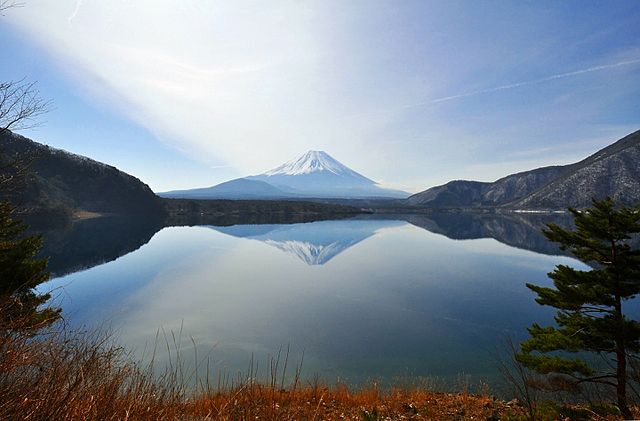
Looking out across Motosu-ko from the northwest end.
Captain76:Nikon D90+TAMRON SP10-24mm [CC BY-SA 3.0], from Wikimedia Commons
9) Lake Motosu-ko: The westernmost of the Fuji Five Lakes, seen on the back of the ¥1,000 bill.

A field of flowers at the 2018 Fuji Shibazakura Festival.
Taken by the author on Friday, 11 May 2018.
10) Fuji Shibazakura Festival: The site of an annual springtime festival centred around vast fields of pink moss flowers.

Shops and restaurants at Fuji-Subaru 5th Station.
Taken by the author in May 2010.
11) Fuji-Subaru 5th Station: One of the starting points for climbing Mount Fuji, and a tourist destination of its own.

Orientation and Transportation

The centre-most of the five lakes is Lake Kawaguchi.  The two main train and bus stations in the region are Kawaguchi-ko Station, just south of Lake Kawaguchi, and Fuji-san Station, just two stops away from Kawaguchi-ko.  Many buses depart from these stations, most notably the three Omni-bus lines.
  • The Kawaguchi-ko Sightseeing Bus, or "Red Line", departs every 15 minutes, and travels north across the shore of Lake Kawaguchi.
  • The Sai-ko Sightseeing Bus, or "Green Line", departs every 30 minutes, and covers the southern shore of Lake Kawaguchi as well as Lake Sai.
  • The Narusawa/Shoji-ko/Motosu-ko Sightseeing Bus, or "Blue Line", departs every 2 hours, and heads west to lakes Shoji and Motosu.
Timetables and route maps of these lines are available on Fujikyu's website (English) (Japanese), while individual fares are only listed on their Japanese website (Japanese).  A two-day pass for unlimited use of the Red, Green, and Blue Line buses costs ¥1,500.

Another useful sight-seeing bus, the Fujikko-go, covers the eastern areas around Lake Yamanaka.  These buses depart once every one to two hours from Fuji-san Station.  Timetables and fares are available on Fujikyu's website (English) (Japanese).  A two-day pass for unlimited use of Fujikko-go buses costs ¥1,500.

Access

The easiest way to access the Fuji Five Lakes area is by bus.  Highway buses travel between central Tokyo and Kawaguchi-ko Station, departing from Shinjuku (2 hours, ¥1,850 online / ¥2,000 at station), Tokyo (2 hours, ¥2,000), and Shibuya (2½ hours, ¥2,000) stations.  Most highway buses also stop at Fuji-Q Highland and/or Fuji-San Station.  The Japan Rail Pass is not valid for any of these buses.  As these buses require reservations and are a popular way to visit a popular destination, I would recommend booking your tickets at least a day ahead of time, if possible.  Bus tickets may be reserved online and in English, through sites such as Japan Bus Online (English).

There is also a train route connecting Lake Kawaguchi with central Tokyo.  From Shinjuku Station, take the JR Chuo (JC) line to Otsuki (limited express: 70 min / ¥2,540 reserved, local: 90-100 minutes / ¥1,520).  At Otsuki Station, transfer and take the Fujikyu Line to Kawaguchi-ko (limited express: 45-50 minutes / ¥1,770 reserved, local: 55-65 minutes / ¥1,170).  This method is longer, but is fully covered by the JR Tokyo Wide Area pass, and partially covered (Shinjuku - Otsuki) by the Japan Rail Pass and other JR East passes.  IC cards (Suica, Pasmo, etc.) are accepted on the Fujikyu Line trains, but not for buses.

If you are coming in from cities to the west (Nagoya, Kyoto, Osaka, etc.), take the Tokaido Shinkansen to Mishima (Kodama and some Hikari trains only), then take an express bus to Kawaguchi-ko (90 minutes, ¥2,300).  Seat reservations are required for the bus.  If you cannot make it on this bus, or if you want to save a little money with the Japan Rail Pass, there is an alternate method.  From Mishima Station, take the JR Tokaido line to Numazu (5 minutes), transfer to the Gotemba line and ride it to Gotemba (35 minutes, ¥590), and take a local bus to Kawaguchi-ko (75 minutes, ¥1,510).  The Japan Rail Pass is valid for all trains on this route.

There is a regional airport called Mt. Fuji Shizuoka Airport (IATA code: FSZ), but it is 95km (60 mi.) southwest of the Fuji Five Lakes area.  It handles a few domestic (Fukuoka, Sapporo, Okinawa, etc.) and international (Seoul, Taipei, Shanghai, etc.) flights.  To get to the Fuji Five Lakes by public transportation, start by taking a bus to Shizuoka Station (50 minutes, ¥1,000).  From there, go to Mishima by either the Tokaido Shinkansen (15-25 minutes, ¥1,980 unreserved, JR Pass OK) or local trains (60 minutes, ¥990), and then take the above express bus to Kawaguchi-ko.  More information: (English) (Japanese)

Monday, May 1, 2017

Know Your Trains: Kinu, Kegon, and Spacia

Edit 16 April 2018: Added information on the new Tobu World Square station.

Edit 3 October 2019: Updated prices to reflect the increase in Japan's national sales tax.

Touhoku main line Spacia
A 100-series Spacia train (before the 2012 refurbishment).
By toshinori baba (投稿者が撮影) [CC0], via Wikimedia Commons
Nikko (日光, Nikkō) is a town 70 miles (113 km) north of Tokyo that is famous, even regarded as sacred, for its various shrines, temples, and natural features.  It also stands near the town of Kinugawa Onsen (鬼怒川温泉), home to hot spring hotels and unique amusement parks, such as Edo Wonderland.  Both places are served by the Tobu railway company, and in addition to regular services, they run limited-express trains to make the journey to Nikko and Kinugawa faster and more comfortable.

Name Start Station End Station(s) Time* Max. Frequency**
Kinu Asakusa Kinugawa-Onsen 2 hours 1 per 1-2 hours
Kegon Asakusa Nikko 1 hour 50 minutes 1 per 1-2 hours
*Approximate time between start and end stations.
**Departures are based on May 2017 schedules and are subject to change.

These two services are called the "Kinu", to Kinugawa Onsen, and the "Kegon", to Nikko; both are grouped under the "Spacia" brand name.  They both start from Tobu's Asakusa station, and head north along the Skytree (TS) and Nikko (TN) lines.  At Shimo-Imaichi Station, Kegon trains continue on to Tobu-Nikko Station, whereas Kinu trains diverge onto the Kinugawa branch line to Kinugawa-Onsen Station.  One-way fare to either destination is just shy of ¥3,000. Kegon services used to be far less frequent, with only 3 services per day during the morning and late evenings, but departure frequency has increased since 2017.  For the most up-to-date timetables, visit Tobu's web site (English).

Num. Name (English) Name (Japanese) Prefecture Kegon Kinu
TS01 Asakusa 浅草 Tobu Skytree (TS) X X
TS02 Tokyo Skytree とうきょうスカイツリー X O
TS09 Kita-Senju 北千住 X X
TS27 Kasukabe 春日部 X X
TS30 Tobu Dobutsu-Koen* 東武動物公園 I I
Tobu Nikko (TN)
TN11 Tochigi 栃木 X X
TN18 Shin-Kanuma 新鹿沼 X X
TN23 Shimo-Imaichi 下今市 X X
TN25 Tobu-Nikko 東武日光 X I
TN55 Tobu World Square 東武ワールドスクウェア Tobu Kinugawa (TN) I O
TN56 Kinugawa-Onsen 鬼怒川温泉 I X
Legend
X: All trains stop at this station.
O: Some trains stop at this station.
I: No trains stop at this station.
*Tobu Dobutsu-Koen Station is the junction between the Tobu Skytree and Nikko lines.  Kegon and Kinu trains do not stop here.

Notable stops
  • Asakusa: One of Tokyo's oldest and best-preserved temple districts.
  • Tokyo Skytree: The world's tallest broadcast tower.
  • Kita-Senju: A railway hub in the north of Tokyo.
  • Shimo-Imaichi: Where the Nikko and Kinugawa lines meet.
  • Tobu-Nikko: Famous shrines, temples, and woodland hiking.
  • Tobu World Square: A theme park of world landmark miniatures.  This station was newly opened on 22 July 2017.
  • Kinugawa-Onsen: Hot springs and unique theme parks.
A private compartment on a 100-series Spacia train (before the 2012 refurbishment).
By ​Japanese Wikipedia user L,t,d,express [GFDL or CC-BY-SA-3.0]
Spacia services run using Tobu's 100-series trains, which were introduced in 1990.  In 2012, coinciding with the opening of Tokyo Skytree (also co-sponsored by Tobu Railway), the fleet was renovated with new interiors and exterior colours.  Seats are arranged 2+2 across with a seat pitch of 110 cm (43 inches).  The sixth and final car contains private compartments, each seating up to four passengers.

Service Total Cars Non-Reserved Cars Reserved Cars Green Cars
Kinu
Kegon
6 0 5
(Cars #1-5)
1
(Car #6)


An E253-1000-series "Nikko" train, on the JR Utsunomiya line.
By 駅弁 [GFDL or CC BY 3.0]

Name Start Station End Station(s) Time* Max. Frequency**
Nikko Shinjuku Nikko 2 hours 1 per day
Kinugawa Shinjuku Kinugawa-Onsen 2 hours 10 minutes 3 per day

*Approximate time between start and end stations.
**Departures are based on May 2017 schedules and are subject to change.  Additional services may be added for peak travel times.

As an alternative to the Kinu and Kegon, JR East and Tobu also run joint limited-express services from Shinjuku Station.  These are called the "Kinugawa" and "Nikko", obviously named after their termini.  One-way fare on these trains is ¥4,080.  They are slower and more expensive than Tobu's own trains from Asakusa, but they are partially covered by the Japan Rail Pass (users must pay for the section beyond Kurihashi Station), and fully covered by JR East area passes.  A few services use the same train models as the Spacia Kinu and Kegon, and are called "Spacia Kinugawa" or "Spacia Nikko".

Num. Name (English) Name (Japanese) Line Nikko Kinugawa
JA11 Shinjuku 新宿 JR Saikyo (JA) X X
JA12 Ikebukuro 池袋 X X
JU05 Urawa 浦和 X X
JR Utsunomiya (JU)
JU07 Omiya 大宮 X X
TN04 Kurihashi* 栗橋 I I
Tobu Nikko (TN)
TN11 Tochigi 栃木 X X
TN18 Shin-Kanuma 新鹿沼 X X
TN23 Shimo-Imaichi 下今市 X X
TN25 Tobu-Nikko 東武日光 X I
TN55 Tobu World Square 東武ワールドスクウェア Tobu Kinugawa (TN) I O
TN56 Kinugawa-Onsen 池袋 I X
Legend
X: All trains stop at this station.
O: Some trains stop at this station.
I: No trains stop at this station.
*Kurihashi is the junction between the JR Utsunomiya and Tobu Nikko lines.  Nikko and Kinugawa trains do not stop here.

Nikko and Kinugawa trains use JR East's 253-1000-series trains, which were refurbished after being used for the Narita Express.  All seats are regular-class and reserved.  Seat pitch is also 110 cm (43 in), to match the Tobu Spacia trains.

Service Total Cars Non-Reserved Cars Reserved Cars Green Cars
Nikko
Kinugawa
6 0 6
(Cars #1-6)
0


Tobu 500 series 505-3 Hanyu Station 20170130
A 500-series train, used on Revaty and other limited-express services by Tobu.
© DAJF / Wikimedia Commons, via Wikimedia Commons
Since 21 April 2017, the Kinu and Kegon have been supplemented by a new series of limited express services, the "Revaty".  The Revaty Kegon and Revaty Kinu are similar to their Spacia counterparts, with only a couple of additional stops added to their schedules.  Most Revaty Kegon services are coupled with a Revaty Aizu train, which splits off at Shimo-Imaichi onto the Tobu Kinugawa line, and continues north into Fukushima Prefecture on two additional lines: the Yagan Railway Aizu-Kinugawa line, and the Aizu Railway Aizu line.  Revaty services use new 500-series trains, which come in sets of three cars each.  More information: (English)

Name Start Station End Station(s) Time* Max. Frequency**
Revaty Kegon Asakusa Tobu-Nikko 1 hour 55 minutes 1 per 2 hours
Revaty Kinu Asakusa Shin-Fujiwara 2 hours 5 minutes 1 per day
Revaty Aizu Asakusa Aizu-Tajima 3 hours 25 minutes 3 per day
*Approximate time between start and end stations.
**Departures are based on May 2017 schedules and are subject to change.


Tips
  • Nikko offers various travel passes in the Nikko and/or Kinugawa Onsen area which include round-trip travel from Asakusa.  This only covers regular fares; if you wish to use a Spacia train, you must pay the supplement fees.  However, the passes do entitle holders to a 20% discount on these fees; for example, the fee for a weekday ticket from Asakusa to Nikko will cost ¥1,090, down from ¥1,360.  These passes are not valid for the Nikko and Kinugawa limited-express trains to/from Shinjuku.  More information: (English)
  • Another option to get to Nikko from Tokyo is to take the Tohoku Shinkansen (50 minutes, Nasuno or Yamabiko services) to Utsunomiya, and transfer to a local train (45 minutes) on the Nikko Line ⬛ to JR's Nikko station (separate from Tobu's Nikko station).  It is more expensive, at over ¥5,000 for non-reserved tickets, but it is fully covered by the Japan Rail Pass and JR East area passes.
  • Nikko and Kinugawa trains switch between JR and Tobu lines at Kurihashi station.  For those using a Japan Rail Pass, supplement fees are based on fares from Kurihashi to the given destination.  As of October 2019, for trains to/from Nikko and/or Kinugawa-Onsen, the base fare for this section is ¥990, and the supplement seat fare is an additional ¥520.
Trivia
  • The "Kegon" (けごん) service is named after the Kegon Falls (華厳滝, Kegon-taki) in Nikko.  This waterfall can be reached by bus from (JR) Nikko and Tobu-Nikko stations (50 minutes, ¥1,150).
  • Two of the three livery colours introduced as part of the 2012 Spacia refurbishment are based on the lighting of the Tokyo Skytree, which opened in the same year: "iki", or white with blue stripes, and "miyabi", or white with violet stripes.
  • Another colour style was introduced to Spacia trains in 2015.  It is called "Nikko Spacia Moude", and is gold with red and black stripes.
  • The name "Revaty" (リバティ, Ribati) is derived from the English words "liberty" and "variety".