COVID-19 Coronavirus Notice

COVID-19 Coronavirus Notice

Updated 2 July 2020

If you are reading this message, please be aware of travel restrictions in place as part of measures to contain the spread of the COVID-19 "Coronavirus" and its symptoms. Japanese authorities are refusing entry to individuals from, or who have been to, a list of over 100 countries (More information). All other visitors must apply for a visa, and undergo a quarantine upon entering the country. Within the Japan, there are no longer any travel restrictions, and most public attractions have re-opened with precautions for sanitation and social distancing. In short, travel to Japan is not recommended at this time, until the situation normalises. I will not be editing my individual articles to reflect this, but again, please keep this in mind when reading them.

Wednesday, April 26, 2017

Hokoku-ji

This article is based on a visit made on Tuesday, 15 November 2016.

Edit 3 October 2019: Updated prices to reflect the increase in Japan's national sales tax.

Hokoku Temple (報国寺, Hōkoku-ji) is a Buddhist temple in the hills east of Kamakura.  It is famous for the bamboo grove in its inner garden, to the point that it is sometimes nicknamed the "Bamboo Temple" (竹寺, Take-dera).

The main hall exists in a free area.  However, by paying a small fee of ¥200, you will gain access to the inner gardens, where the temple's most unique sights await you.  Payment is made at a counter to the left side of the main hall; If you have a goshuin-cho book, you may also get it stamped here, and explore the garden while you wait.

Off to the side of the main hall is the bell tower, a common structure among Buddhist temples.  This one is covered by a thatched straw roof.  The main hall used to have a roof like that as well, but the building was damaged during the 1923 Great Kanto Earthquake, and subsequently was rebuilt in its current form.

I also found this pot holding what looked like a miniature koi pond... well, even more miniature than normal.

The star attraction of Hokoku-ji is its bamboo grove, in which grow over 2,000 shoots of bamboo.  I have no idea how tall these stalks are, but this particular species, known in Japanese as moso-chiku (孟宗竹, mōsō-chiku), can grow up to 28 metres (92 feet).  Apparently, when this temple was founded, there used to be an annex hall where the bamboo grove stands today.  It was there that the temple's founder, known posthumously as Butsuji-Zenji, trained as a priest and wrote poetry.

The colour green seems to permeate through this place, reflected not just in the bamboo, but in the moss covering the ground as well as rock statues like these.

In the back of the grove stands a teahouse where visitors can order a cup of green tea and relax with a view of the surrounding green paradise.

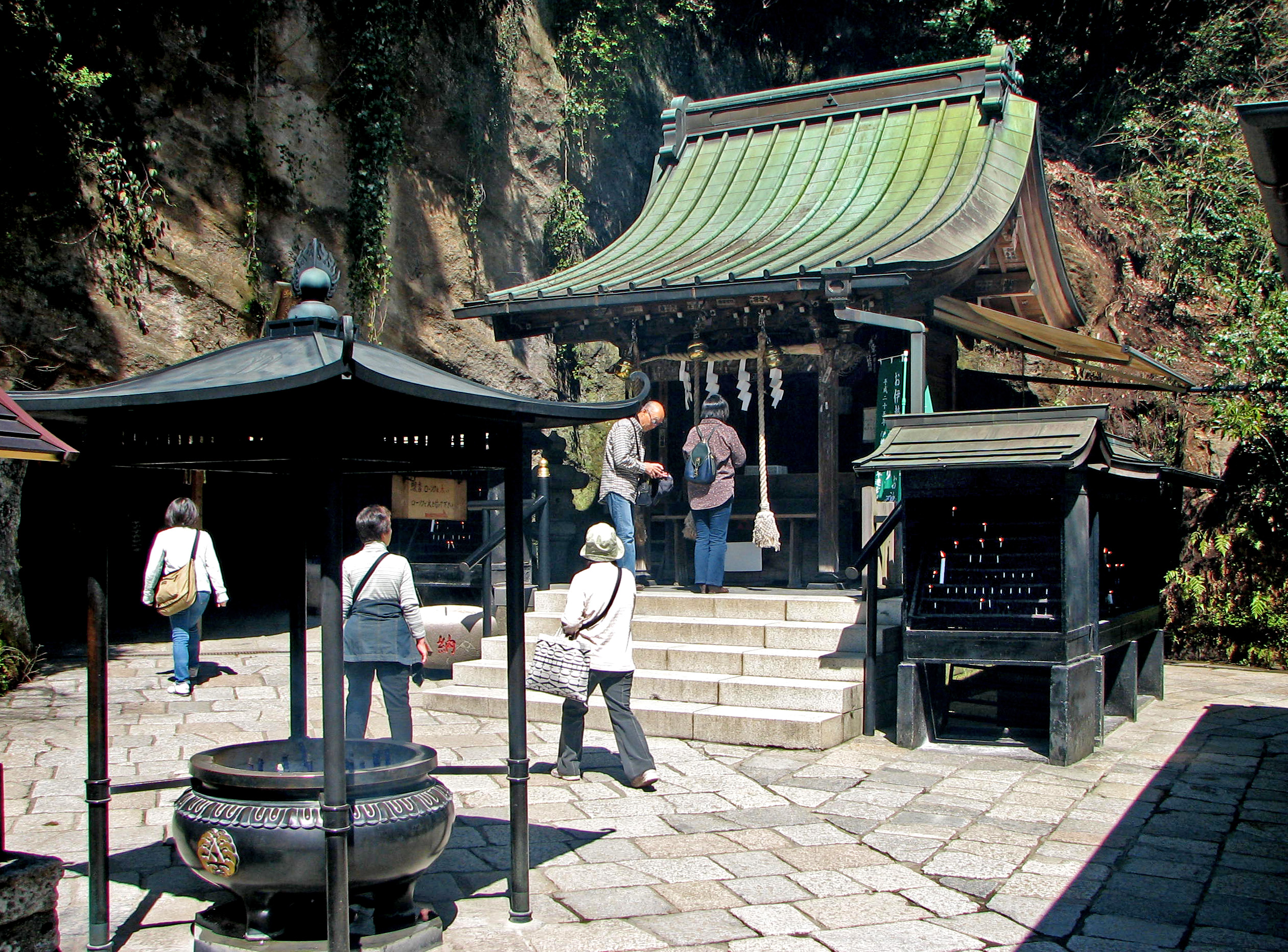
There's more to the temple grounds than just bamboo, though.  Far back in the hills, there are a series of small caves.  These are yagura (やぐら), a type of tomb dug into hillsides.  Yagura can be found at temples and other places nearby, were built mostly for members of the samurai class, and more often than not merely serve as empty cenotaphs for people interred elsewhere.  The ones here at Hokoku-ji are inaccessible, but are rumoured to hold the ashes of members of the Ashikaga samurai clan, for whom the temple was built to commemorate.

Hokoku-ji is a Zen Buddhist temple (the Rinzai Zen sect, to be exact), so of course it has a small rock garden.

And here it is, your moment of Zen!


Hours: Open 9:00 AM to 4:00 PM.  Tea service ends 30 minutes before closing time.  Closed 29 December through 3 January.

Costs: ¥300.  Tea service costs an additional ¥600.

Address: 2-7-4 Jōmyōji, Kamakura-shi, Kanagawa-ken 〒248-0003

Access: From Kamakura Station (JR Yokosuka (JO), Shonan-Shinjuku (JS), and Enoshima tram (EN) lines), take Keikyu Bus 鎌23, 鎌24, or 鎌36 (East exit, platform #5), and get off at the 6th stop, Jomyo-ji ("浄明寺", 8 minutes, ¥200).

Website: (English) (Japanese)

Tuesday, April 25, 2017

Tsurugaoka Hachiman-gu

This article is based on a visit made on Tuesday, 15 November 2016.


Tsurugaoka Hachiman Shrine (鶴岡八幡宮, Tsurugaoka Hachiman-gu) is the largest and most important Shinto shrine in Kamakura.  It has almost a millennium of history behind it, having been first consecrated in AD 1063, but moved to its present location in the late 12th century by Minamoto no Yoritomo (源 頼朝, 1147-1199), the warlord who founded the Kamakura shogunate.  Despite serving the Shinto religion, it maintains a few Buddhist and Chinese elements too, namely in its Feng Shui-influenced layout.

This meticulous degree of planning is apparent even before you reach the shrine.  A long boulevard runs almost entirely straight from the entrance of the shrine all the way down to the beach.  The east exit of Kamakura Station puts you mid-way up this road.  There is a pedestrian walkway going down the middle, called the Dankazura (段葛, lit. 'kudzu stairs').  It is bookended by red torii gates and lined by cherry trees, which bloom in late March and early April.

After the Dankazura, a trio of bridges stand in front of the shrine.  Way back during the Kamakura shogunate, there were two bridges: a rounded, red-painted wooden bridge which only the shogun was allowed to cross, and a flat bridge for commoners.  In 1697, they were replaced with the ones you see here.  The stone bridge in the centre is called the Taiko-bashi (太鼓橋, lit. 'big drum bridge'), as its rounded shape evokes a taiko drum.  Nowadays, it is also blocked off, although I would guess it's just to preserve it.  It had collapsed during the Great Kanto Earthquake of 1923, but was rebuilt soon after.

There are two ponds on either side of the entrance, connected under the bridges.  The eastern pond was meant to represent the Minamoto clan, and the western pond to represent the Taira clan, which was defeated by the former.  The Minamoto pond has three islands and the Taira pond has four; as the number 4 has connotations of death in Japanese culture, this was a subtle jab at the Taira clan.

One of the three islands on the eastern pond is connected by a bridge, and atop this island stands a shrine to a Buddhist figure.  The shrine, named Hataage Benzaiten Shrine (旗上弁財天社), honours Benzaiten (弁財天), a.k.a. Benten, the goddess of knowledge and music.  Co-mingling of Shinto and Buddhist facilities used to be common until the Meiji period.  In 1868, a law was passed by the new imperial government forcing the separation of Shinto and Buddhism, called the "Law of separation of Kami and Buddha" (神仏判然令, Shinbutsu Hanzenrei).  As a consequence of the law, Buddhist buildings on the grounds of Shinto shrines were destroyed, including several at Tsurugaoka Hachiman-gu.  Attitudes on the matter have relaxed since then; this shrine was rebuilt in its original form in 1980.

We still have a ways to go before reaching the heart of the shrine.  This broad path takes only a couple of minutes to traverse.  It is used for horseback archery (流鏑馬, yabusame) displays during a festival in September.  Speaking of holidays, as many as two million visitors make their New Year's Day prayers at this shrine, so even this avenue can fill up on such occasions.  But on a cloudy Tuesday morning... not so much.

That said, my visit did coincide with a holiday... sort of.  Shichi-Go-San (七五三, lit. 'seven-five-three') is a religious observance where parents of three and seven-year-old girls, and three and five-year-old boys, pray for their kids' safety and long life at local shrines.  Indeed, the name "shichi-go-san" means "seven-five-three" in Japanese.  The actual date of the holiday is the 15th of November, but most people observe it on the nearest weekend.  It seems there still were some families going out for the occasion on the day itself, however.

Heading along, we eventually come to a plaza in which stands the shimo-haiden (下拝殿, lit. 'lower worship hall'), or maiden (舞殿, lit. 'dance hall').  Various rituals are performed here, including ceremonial music and dance.

Behind the Maiden, a giant ginkgo tree used to stand next to the stairs leading up to the main hall.  It was almost 1,000 years old, and would turn a golden-yellow colour along with the other trees in Kamakura in early December.  Sadly, it was felled during a storm on the morning of 10 March 2010.  The site of its stump has since been marked off with a shimenawa, as the old tree itself was beforehand.

Large ginkgo in Tsurugaoka-hachimangu Shrine
By ja:利用者:S.fukasawa (ja:画像:鶴岡八幡宮大銀杏.jpg) [GFDL or CC-BY-SA-3.0], via Wikimedia Commons
Here is what the tree looked like while it was still standing, by the way.  This picture was taken in November of 2004.

Passing the stump and climbing up the stairs, we finally reach the main hall.  Hachiman Shrines like this one are dedicated to Hachiman (八幡神, Hachiman-jin), the Shinto god of warriors and archery, and also the protector god of the Minamoto clan.  Hachiman shrines are the second-most widespread variety of Shinto shrines in Japan, followed by Inari shrines (described below).

Some of the ema prayer plaques sold here are shaped like ginkgo leaves, in honour of the aforementioned tree.  I don't know, but I wonder if they had those before the tree was toppled.

The grounds of Tsurugaoka Hachiman-gu are quite vast, and hold a number of smaller shrines.  For example, here is the Maruyama Inari Shrine (丸山稲荷社, Maruyama Inari-jinja).  Inari shrines are typified by approaches lined with many torii gates, and are patronised by people praying for good harvests or business.  The Fushimi Inari Shrine in Kyoto is one of the most famous examples, and I would get to that one eventually.

Even on a day as cloudy as this, looking out from the main hall gives impressive views, underscoring just how far we've come along to get there.  With such a wide world in view, I wonder where it might take me...?

...Oh wait, I know.  I'm going to Hokoku-ji Temple, next time on Sekai Ichi!


Hours: Open from 5:00 AM to 9:00 PM, or 24 hours on 1-3 January.  No regular closing days.

Costs: Free.  Entry to the shrine museum on-site costs ¥200, and the garden on the edge of the Genpei pond costs ¥500 (open seasonally in Winter and Spring).

Address: 2-1-31 Yukinoshita, Kamakura-shi, Kanagawa-ken 〒248-8588

Access: The entrance to Tsurugaoka Hachiman Shrine is 10 minutes on foot from Kamakura Station (JR Yokosuka (JO), Shonan-Shinjuku (JS), and Enoshima tram (EN) lines).

Directions: From Kamakura Station, start from the east exit, cross the parking lot, and turn left at the traffic light.  Continue up the boulevard until you reach the shrine entrance at the end of the road.  It takes 10 minutes to walk to the entrance, plus another 5 minutes to the main hall.

Alternately, you may wish to walk up the Komachi-dori shopping street, which runs roughly parallel to the main street.  This road starts from the north corner of the parking lot (to the left, when facing from the station).  At the end of Komachi-dori, turn right; after a minute, the shrine entrance will be on the left.  This takes the same amount of time as the other route.

Website: (English) (Japanese)

Monday, April 24, 2017

Introduction to: Kamakura

This article is based on a visit made on Tuesday, 15 November 2016.

Edit 3 October 2019: Updated prices to reflect the increase in Japan's national sales tax.

You may have noticed that most of my articles on Sekai Ichi thus far have been about destinations in Tokyo.  Indeed, I have spent most of my holiday time in Japan within the greater Tokyo area.  But in keeping with the chronological documentation of my vacations, I must eventually write about places further afield.  To introduce these cities and towns, I am starting a new series of articles to give them a high-level overview.  These articles will provide basic information on their major sites of interest, plus how to get into and around them.  As I visit more of the locations listed in each overview and write specific articles on them, I will update their listings with links to those articles.

So, to kick off this series, we will start with Kamakura.  Kamakura (鎌倉, lit. 'sickle warehouse') has a high density of Shinto shrines and Buddhist temple, to such the degree that it has been called by some as the Kyoto of eastern Japan.  And like Kyoto, it also has a rich history.  In the late 12th century, war hero Minamoto no Yoritomo was appointed as shogun by the Emperor in Kyoto, and set up the capital of his new shogunate in Kamakura.  Thus, Kamakura became a "second capital" of Japan for over a century, and still retained influence afterwards.  That was, until a siege in 1526 burnt down much of the city, and the capital of the shogunate was eventually moved to Edo, known in the future as Tokyo.

Major Attractions

1) Tsuruoka Hachiman-gu Shrine: The most-important and most-visited shrine in Kamakura, Tsuruoka Hachiman-gu is dedicated to the Shinto warrior god Hachiman.

2) Hokoku-ji Temple: A secluded Zen Buddhist temple with a bamboo grove.

By Fg2 [Public domain], via Wikimedia Commons
3) Engaku-ji Temple: The second-most important Zen temple in Kamakura, and a popular site for autumn colours in December.

No machine-readable author provided. Urashimataro assumed (based on copyright claims). [Public domain], via Wikimedia Commons
4) Meigetsu-in Temple: A Zen Buddhist temple known for its hydrangea flowers, in bloom every June.

By Wiiii [GFDL or CC BY-SA 3.0], from Wikimedia Commons
5) Kencho-ji Temple: The oldest and most important of Kamakura's Zen temples.

By Bernard Gagnon [GFDL or CC BY-SA 3.0], from Wikimedia Commons
6) Zeniarai Benten Shrine: A secluded but popular shrine where people wash their money.

Zeniarai Benten shrine
By Gulhelm Vellut [CC BY 2.0], via Flickr
7) Daibutsu Hiking Trail: An hour-long hiking trail winding down through the hills and ending at...

8) Kotoku-in Temple and Great Buddha: A temple with a large, bronze, open-air statue of a seated Buddha.

9) Hase-dera Temple: A temple dedicated to the Buddhist goddess Kannon, with wide views over the town from its rear gardens.

10) Enoshima Electric Railway: A tram line running along the coast from Kamakura to...

AMANO Jun-ichi [CC BY 3.0], via Wikimedia Commons
11) Enoshima: An island just off the coast west of Kamakura, with shrines, an aquarium, and more.

By Nagara373 (日本語: 投稿者本人が撮影) [Public domain], via Wikimedia Commons
12) Shonan Monorail: A hanging monorail line linking Enoshima with the JR Tokaido line.

Orientation


Kamakura lies about 50 kilometres (30 miles) south of Tokyo, on the coast of the Pacific Ocean.  It is split from north to south by the JR Yokosuka (JO) line, with two stations in the immediate area: the central Kamakura Station, and Kita-Kamakura Station one stop before it to the north.  A tram line called the Enoshima Electric Railway (EN), or EnoDen for short, departs west from Kamakura Station and travels along the coast.  A great deal of sites are within walking distance of Kamakura, Kita-Kamakura, or the EnoDen's Hase stations.

Access


From Tokyo Station, take the JR Yokosuka line to Kamakura (JO07, 60 minutes, ¥940, JR Pass OK).  Green Car seats are available on these trains; they cost an additional ¥1,000.

From Shinjuku Station, take the JR Shonan-Shinjuku (JS) line to Kamakura (55 minutes, ¥940, JR Pass OK).  Only every alternate train stops at Kamakura; the others diverge onto the Tokaido (JT) line at Ofuna Station.  If your train is not bound for Zushi, you can transfer to another Yokosuka or Shonan-Shinjuku train at Ofuna.  Again, Green Car seats are available for an extra ¥1,000.

Alternately, from Shinjuku Station, take an Odakyu express or rapid-express (OH) train bound for Fujisawa (OE16, 60-65 minutes, ¥600).  Limited express trains, branded as "Romancecar", are a couple of minutes faster and have more comfortable reserved seats; they cost an additional ¥630 one-way.  At Fujisawa Station, transfer to the Enoshima tram line and ride it to Kamakura (EN15, 35 minutes, ¥310).  This method is slower than using the JR lines, but is cheaper, especially when using the Enoshima-Kamakura Freepass.  This pass covers a round-trip on Odakyu's lines from Shinjuku to Fujisawa, and unlimited use of the Odakyu Enoshima and EnoDen lines from Fujisawa on, all for one day.  It costs ¥1,520, not including Romancecar supplement fees.  More information: (English)

Trains on the Yokosuka (shown) and Shonan-Shinjuku lines carry Green Car seats in double-decker cars.

Tuesday, April 18, 2017

Know Your Trains: Greater Tokyo Area

Tokyo is big.  How big is it?  By its broadest definition, it was home to 37.8 million people in 2016, making it the largest metropolitan area in the world by population.  To get all of its people where they need to go, there are a multitude of public and personal transportation options, but by far, rail travel is king.  There are over a dozen rail companies operating in the greater Tokyo area, and even more dozens of lines among them.  One look at a railway map (such as this one for the subway network) could be enough to make your head spin from it all.  But if you simply take it slow, break down the network line by line, and just focus on where you want to go, it is easy to understand after all.

First, we'll talk about the train lines owned by JR East, the major rail company of eastern Japan.

A map of the Yamanote Line and surrounding JR East lines.
RailRider [CC BY-SA 3.0 or GFDL], via Wikimedia Commons
Name (English) Name (Japanese) Colour Areas Served
Yamanote 山手線 Light green Tokyo Station, Shimbashi, Shinagawa, Shibuya,
Shinjuku, Ikebukuro, Ueno, Akihabara
Chuo (Rapid) 中央線快速 Orange Tokyo Station, Shinjuku, Nakano,
Ghibli Museum, Mt. Takao
Chuo-Sobu (Local) 中央・総武緩行線 Yellow Akihabara, Tokyo Dome, Shinjuku,
Nakano, Ghibli Museum
Keihin-Tohoku 京浜東北線 Light blue Saitama, Ueno, Akihabara, Tokyo Station,
Shimbashi, Shinagawa, Kawasaki, Yokohama
Saikyo 埼京線 Dark green Shibuya, Shinjuku, Ikebukuro, Saitama
Tokaido Main Line 東海道本線 Orange Tokyo Station, Shimbashi, Shinagawa,
Kawasaki, Yokohama
Keiyo 京葉線 Red Tokyo Station, Tokyo Disney Resort, Chiba
Sobu (Rapid) 総武快速線 Dark blue Tokyo Station, Chiba, Narita Airport
Yokosuka 横須賀線 Dark blue Tokyo Station, Shimbashi, Shinagawa,
Kawasaki, Yokohama, Kamakura
Shonan-Shinjuku* 湘南新宿ライン Red Kamakura, Yokohama, Kawasaki, Shibuya,
Shinjuku, Ikebukuro, Saitama
*The Shonan-Shinjuku line does not run on its own tracks, but shares sections of the Yamanote, Tokaido, Yokosuka, Utsunomiya, and/or Takasaki lines.

Of these, the most useful to beginner tourists will be the Yamanote (JY) line, which runs in a loop around central Tokyo and has stations at many of the city's major points of interest.  If you can't memorise the name, you can identify it by its bright green label colour.  It is cheap, with tickets starting at 140 for the first few stations, and frequent, with trains arriving every 3-5 minutes.  Most of JR East's lines in the area connect with the Yamanote line at certain points, as do all of the subway lines and other private railways.  This includes the JR-run high-speed Shinkansen; the Tokaido line stops at Tokyo and Shinagawa, and the northern lines (Tohoku, Joetsu, Hokuriku, etc.) stop at Tokyo and Ueno.  So, not only is the Yamanote line a good way to get around, but serves as a useful starting point for understanding the area itself.

The other lines head outwards from the Yamanote loop to suburban regions and beyond.  All of the above lines are free to use with the Japan Rail pass and other area passes offered by JR East.  One other line I'd like to point out is the Chuo Line, which bisects the Yamanote loop from east to west.  There are actually two kinds of services which run on the Chuo Line: the Rapid (JC) trains make fewer stops in city limits and end at Tokyo Station, and the Local (JB) trains stop at every station and diverge from the Chuo line proper, crossing the Yamanote loop at Akihabara station, and later merging onto the Sobu line east of Tokyo.  Fortunately, it is easy to tell them apart, as the Rapid and Local trains are labelled with different colours (orange for Rapid, yellow for Local), and stop at separate platforms on stations which serve both.

The problem is that there are a number of destinations which cannot be accessed by the Yamanote loop or even other JR lines.  For that, our next step is to layer on the subway lines.

A map of the Tokyo Metro and Toei subway networks.
User: (WT-shared) Dguillaime at wts wikivoyage [Public domain], from Wikimedia Commons
Name (English) Name (Japanese) Operator Colour Transfers with Yamanote Line
Ginza 銀座線 Tokyo Metro Orange Ueno, Okachimachi/Ueno-Hirokoji,
Akihabara/Suehirocho, Shimbashi, Shibuya
Marunouchi 丸ノ内線 Tokyo Metro Red Shinjuku, Tokyo, Ikebukuro
Hibiya 日比谷線 Tokyo Metro Grey Ueno, Okachimachi/Naka-Okachimachi,
Akihabara, Yurakucho/Hibiya, Ebisu
Tozai 東西線 Tokyo Metro Light blue Takadanobaba, Tokyo/Otemachi
Chiyoda 千代田線 Tokyo Metro Green Harajuku/Meiji Jingu-mae, Tokyo/Otemachi,
Nishi-Nippori
Yurakucho 有楽町線 Tokyo Metro Yellow Yurakucho, Ikebukuro
Hanzomon 半蔵門線 Tokyo Metro Violet Tokyo/Otemachi, Shibuya
Namboku 南北線 Tokyo Metro Teal Meguro, Komagome
Fukutoshin 副都心線 Tokyo Metro Brown Shibuya, Harajuku/Meiji Jingu-mae, Ikebukuro
Asakusa 浅草線 Toei Pink Gotanda, Hamamatsu-cho/Daimon, Shimbashi/Shiodome
Mita 三田線 Toei Blue Meguro, Sugamo
Shinjuku 新宿線 Toei Light green Shinjuku, Akihabara/Iwamoto-cho
Oedo 大江戸線 Toei Dark pink Shinjuku, Okachimachi/Ueno-Okachimachi,
Hamamatsu-cho/Daimon, Yoyogi

Two companies operate subway lines in Tokyo: the private Tokyo Metro, and the city government Toei, but both companies' lines are usually shown on maps together.  Their fares are comparable to the Yamanote and other such lines.  At some stations it is possible to transfer between Tokyo Metro and Toei lines, but a second ticket or a special transfer ticket is required.  If you are using an IC debit card like Suica or Pasmo, this is handled automatically.  Some subway trains also continue onto other JR or private lines.  For example, the "Airport Limited Express" service on the Toei Asakusa (A) line has through-service to Narita Airport on one end, via Keisei's lines, and Haneda Airport on the other, via Keikyu's lines.

The JR Pass cannot be used with any subway lines, but both Tokyo Metro and Toei sell their own free passes.  The best value for foreign tourists is the Tokyo Subway Ticket, which allows free use of all 13 subway lines across both companies.  Unlike most passes, they are sold in 24-hour (¥800), 48-hour (¥1,200), and 72-hour (¥1,500) varieties, which means you can start using one at 6:00 PM, for example, and it would be valid until 6PM the next day.  This can be a major advantage, especially if you're coming into the city in the afternoon.  The Tokyo Subway Ticket pass is available for purchase at Narita and Haneda Airports, and at Bic Camera, Sofmap, and Don Quijote stores across the city.  Like the Japan Rail Pass, this pass is only sold to overseas visitors, so please have your passport on hand before purchasing.  More information: (English)

Next, we'll cover the other private rail companies.

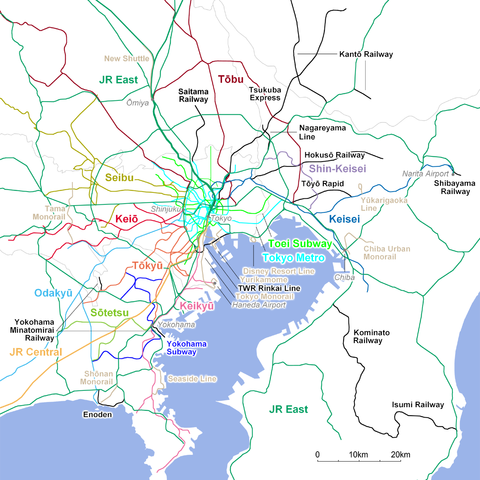
A map of all rail lines in the greater Tokyo area.
FML [GFDL or CC BY-SA 3.0], from Wikimedia Commons
Name (English) Name (Japanese) Transfers with
Yamanote Line
Areas Served
Keikyu 京急 Shinagawa Haneda Airport, Yokohama,
Kanagawa Prefecture
Keio 京王 Shibuya, Shinjuku Mt. Takao, Western Tokyo
Keisei 京成 Ueno, Nippori Narita Airport, Chiba Prefecture
Odakyu 小田急 Shinjuku Odawara, Enoshima
Rinkai Line りんかい線 Osaki Odaiba
Seibu 西武 Shinjuku, Ikebukuro Kawagoe, Western Tokyo
Tobu 東武 Asakusa, Ikebukuro Nikko, Kinugawa Onsen,
Kawagoe, Saitama Prefecture
Tokyo Monorail 東京モノレール Hamamatsu-cho Haneda Airport
Tokyu 東急 Shibuya Yokohama, Kanagawa Prefecture
Tsukuba Express つくばエクスプレッス Akihabara Tsukuba, Ibaraki Prefecture
Yurikamome ゆりかもめ Shimbashi Odaiba

For the most part, these lines serve commuters in suburban regions of Tokyo.  A few of these lines, however, also provide convenient access to outlying tourist destinations, such as Yokohama, Kamakura, and Nikko, as well as Narita and Haneda Airports.  There are even limited express services available on certain Keisei, Odakyu, and Tobu lines for additional speed and comfort.  JR Passes cannot be used on these private lines, with a few exceptions.  For example, the Tokyo Monorail is covered by the Japan Rail Pass, and the Tokyo Wide Area Pass covers it, the Rinkai Line, and Tobu trains to Nikko and Kinugawa Onsen.  Please review the coverage details of each pass to determine which one is right for you.

Tips
  • JR East offers a few one-day passes covering the central Tokyo area, specifically the main 23 metropolitan wards.  The Tokyo Metropolitan District Pass (a.k.a. Tokunai Pass) covers regular JR East lines within the area, including the whole Yamanote line loop.  However, a few tourist destinations lie just outside of its reach, such as Tokyo Disney Resort, the Ghibli Museum, and Asakusa.  It costs ¥750, which will pay for itself in 4 to 5 rides, and is available from reserved-seat ticket machines.  More information: (English)
  • Another day pass offered by JR East is the Tokyo 1-Day Ticket (a.k.a. Tokyo Free Kippu), which covers all JR East, Tokyo Metro, and Toei lines within the 23 wards area.  It costs ¥1,590, however, making it a bit too expensive to be of value.  More information: (English)
  • Just as cars drive on the left side of the roads in Japan, so do trains run on left-hand tracks.  This is a good rule-of-thumb to keep in mind, to make sure the train you board is heading in your desired direction.
  • The Oedo (E) line is the deepest subway line in all of Tokyo (48m / 157.5ft at most), so if you will be using it, give yourself an extra couple of minutes to head down to and back from the platforms.
Trivia
  • The Ginza (G) line was the first subway line opened in Asia.  The first section, between Ueno and Asakusa, opened in 1927.  It was extended to its current length in 1941, terminating at Shibuya,
  • The Oedo (E) line was fully opened on 12 December 2000.  On the Japanese imperial calendar, which restarts at year one when a new emperor ascends to power, this date can also be written as 12/12/12.  AD 2000 was the 12th year of the Heisei era, which began with the reign of Emperor Akihito in 1989.

Monday, April 17, 2017

Little TGV

This article is based on a visit made on Monday, 14 November 2016.

In the 2000s, the first "maid cafes" sprung up in Akihabara.  These are restaurants where light meals are served by waitresses in French-maid-style uniforms, who greet customers with phrases like "welcome home, master" and other such respectful language, and chat with and even play small games with them in between delivering their food.  In recent years, not only has this trend expanded to other cities in Japan, but the concept has evolved into other themes.

After a long afternoon at Nakano Broadway and the Ghibli Museum, I returned to Akihabara to have dinner at Little TGV (鉄道居酒屋LittleTGV, Tetsudō Izakaya LittleTGV), a "railway tavern".  The theme is based on a fictional line called the "New Akiba Electric Railway (NAER)", the waitress uniforms are "moe"-fied versions of train conductor attire, and the walls are decked out with pictures of trains, line maps, schedules, number plates, and other train-related artifacts.  Even the name of the restaurant is a railway reference, to the TGV high-speed network in France.

Little TGV sets itself apart from other maid cafes not only from its decor, but from its menu.  As per its name, it is an izakaya, a type of Japanese pub.  The food menu is not terribly long, but has an even balance of fried and grilled dishes, salads, and more, most of it common Japanese fare.  Their drink menu includes a wide list of cocktails, both alcoholic and not, named after trains and train lines.  For example, a Screwdriver (vodka and orange juice) is here called a "Sobu-sen", after the Sobu Main Line.  Expect to pay between ¥400 to ¥800 per item.  There is an extra cover charge of ¥500 added to your bill, but even with that, this place is not terribly expensive.

Little TGV is still a maid cafe at heart.  Some special menu items come with a little performance; for example, if you order the "Gata-Goto Fries", your waitress puts the fries in a paper bag with your choice of seasoning, then shakes up the bag while the both of you chant "gata-goto", the Japanese sound effect for a train chugging along.  As can be seen above, she even made an origami papercraft thing (it looks kind of like a plane, counter-intuitively...) for me to rest my chopsticks on!  The ticket near the top of this picture is a receipt for the cover charge I mentioned earlier.

It wouldn't be a railway-themed establishment without a model train display set up!  There were, of course, a few trains running laps around it, such as the green train (from the Yamanote line?) barely visible on the right side.  Still others were parked below the tracks, including a few Shinkansen models and a "Doctor Yellow" maintenance train (should be easy to guess which one).

If trains aren't your thing, or even if they are, there are other kinds of concept restaurants out there in Akihabara.  For example, there's "Little BSD", a fantasy-demon-themed cosplay pub, "Little PSX", a maid cafe where you can play darts with the maids, and "Akiba CIA", a spy-themed bar.  Come to think of it, all those three examples, plus Little TGV, are affiliates run by the same company. But there are sure to be more of these concept restaurants all over Japan, so keep on searching!


Hours: Open from 6:00 PM to 11:00PM on Tuesdays to Fridays, from 4:00 PM on Saturdays, and from 12:00 PM on Sundays.  Closed on Mondays.

Access: The closest station is Suehirocho (Tokyo Metro Ginza (G) line), followed by Akihabara (JR Yamanote (JY), Keihin-Tohoku (JK), Chuo-Sobu (JB), Tokyo Metro Hibiya (H), and Tsukuba Express (TX) lines).

Directions: From Suehirocho Station (exit 3), walk down two blocks and turn right, at the Excelsior Caffe.  Walk down two more blocks and turn left, at the Cafe Euro.  The restaurant entrance will be on the left.

From Akihabara Station (Electric Town exit), turn right out of the ticket gates, then left.  Cross Chuo-dori and turn right.  Walk down five blocks (300 m / 1,000 ft.) and turn left, at the Excelsior Caffe.  Walk down two more blocks and turn left, at the Cafe Euro.  The restaurant entrance will be on the left.

Address: Isamiya #3 Building 4F, 3-10-5 Sotokanda, Chiyoda-ku, Tōkyō-to 〒101-0021

Website: (Japanese)


Tuesday, April 4, 2017

Ghibli Museum

This article is based on visits made on Tuesday, 14 November 2016, and Wednesday, 9 May 2018.

The Ghibli Museum (三鷹の森ジブリ美術館, Mitaka no Mori Jiburi Bijutsukan) is the official museum of Studio Ghibli, a studio which has produced many well-loved anime films, such as My Neighbor Totoro [1988], Kiki's Delivery Service [1989], Princess Mononoke [1997], Spirited Away [2001], and Ponyo [2008].   The museum was designed and curated by none other than Hayao Miyazaki, the studio's star director, who was responsible for the films I listed above and more.  The museum lies in the southern end of Inokashira Park, where there are also some pretty sakura spots in early April.

The whimsical fantasy vibe of Ghibli's movies is echoed by the museum building, whose exterior is covered in curvy shapes and wavy multi-colour patterns.

The museum was designed to be well-integrated with the surrounding park.  This is not surprising, because Miyazaki-san has included environmental themes in some of his movies (most notably Nausicaa of the Valley of the Wind [1984] and Princess Mononoke [1997]).  For example, some of the walls are covered in vines or moss.  There is even a rooftop garden, presided over by a statue of a guardian robot from Laupta: Castle in the Sky [1986].

I hadn't managed to find my way up there myself, not to mention it got dark soon, but from what I've seen, it's like being transported far away from the museum into a secluded forest grove.

Sadly, this is ticket booth is not real; tickets are not sold at the museum itself.  The process to purchase tickets is described later in this article.  What a shame, too, since I bet kids would be thrilled to buy theirs from Totoro (from My Neighbor Totoro [1988]) over here!  Nonetheless, our tour group assembled over here before queueing up to get into the museum.

The Straw Hat Café stands in a separate building from the museum.  The menu includes a variety of sandwiches, soups, desserts, and drinks, including a latte with a straw-hat drawing made with foam on top!  The outdoor seating, nestled in just snugly enough against the other buildings, gives it a European town sort of vibe.

Unfortunately, I do not have any pictures of inside the museum.  Photography is not allowed inside the building, as visitors are encouraged to "experience the museum with your own eyes and senses, instead of through a camera's viewfinder", and to make and take home their own memories.  The museum's website, listed at the end of this article, does have a few pictures to give you an idea of what lies inside.

I can describe for you what I found in there, however.  As you might expect, there are exhibits describing Ghibli's animation process, and displays of concept sketches and artwork from their movies. But what you might not expect is that these rooms are designed as an old home studio, decorated with books and toys that Miyazaki-sama and his peers may have drawn inspiration from.  There is also a theatre that plays short films created by Studio Ghibli.  They are voiced in Japanese and do not have subtitles in other languages, but they are not that dependent on dialogue anyway, so anyone can enjoy them regardless of language background.

The museum is also something of a challenge to get into, since tickets are not sold directly at the museum itself.  Instead, you must purchase them ahead of time, either online or at a Lawson convenience store.  More information is listed below, under "Cost".  You should definitely pay attention to when the tickets will go on sale for your desired time of visit, and buy them as soon as they do so, since the Ghibli Museum is apparently a very popular destination.  For my first visit, I made the mistake of waiting to the end of August to buy my tickets for November, at which point they were sold out.  (This was before they opened up online overseas sales.)

Fortunately, there are other options if you miss this opportunity.  In addition to being the official international seller of tickets, JTB, Inc. runs tours to the Ghibli Museum.  Tours meet at the Keio Plaza Hotel in Shinjuku (accessed by Shinjuku and Tocho-mae stations), and then travel to the museum by bus, where a tour guide will describe the museum before letting you off to explore on your own.  Bookings for this tour cost ¥6,000 (about US$55 as of this posting), which is considerably more than the normal ticket price, but isn't that much in the context of what you're already spending on your holiday.  Plus, you'll get to meet new people on the bus ride there, such as I did below.  But in the end, whether you manage to buy your tickets at the regular rate or have to pay extra for a tour, the Ghibli Museum is totally worth it!


Hours: Open 10:00 AM to 6:00 PM.  The museum is closed on Tuesdays (except holidays) and for periodic maintenance.  If purchasing tickets from Lawson (see below), you will have to specify a date and time of arrival.  The times you can choose from are 10:00 AM, 12:00, 2:00, and 4:00 PM.

Cost: ¥1,000.  Tickets are also sold at Lawson convenience stores, via their Loppi automated ticket machines, or online for overseas, English-reading visitors.  Tickets for each month go on sale on the 10th of the previous month, starting at 10:00 AM JST.  For example, tickets for the month of April go on sale on the preceding 10th of March.  More information: (English)

Additional tickets are sold online by JTB, Inc. (United States), and tickets for each month go on sale 3 months in advance.  For example, tickets for April go on sale on the preceding 1st of January.  More information: (English)

Access: The Ghibli Museum is best accessed from Mitaka and Kichijoji stations.  From Shinjuku, take the the JR Chuo (Rapid) (JC) line to Mitaka (JC12, 18 minutes, ¥220); Chuo-Sobu (Local) (JB) trains take an extra 5 minutes.  From Tokyo Station, take the Chuo (Rapid) line to Mitaka (30 minutes, ¥390).

From Mitaka Station, the museum can be reached in 15-20 minutes on foot, or by bus.  The loop bus stopping at Ghibli Museum departs from bus stop #9.  It takes about 5 minutes (the return trip is about 15 minutes) and costs ¥210 one-way, or ¥320 round-trip.

The museum can also be reached by foot or by bus from Kichijoji Station (JC11), the stop before Mitaka on the Chuo lines.  It is also the terminus of the Keio Inokashira (IN) line; from Shibuya, this takes 18 minutes and ¥200 by express train, or 30 minutes by local trains.  From the south exit of the station, take any of the buses and get off at the fourth stop, Myojo Gakuen Iriguchi (明星学園入口).  It takes about 5 minutes and costs ¥220 one-way.  These buses are operated by Odakyu Bus (Japanese).

Website: (English) (Japanese)