Edit 9 October 2019: Updated prices to reflect the increase in Japan's national sales tax.
Edit 24 March 2020: Updated to reflect the International Terminal's renaming to Terminal 3.
 |
The departure lobby of Haneda Airport's Terminal 3, formerly the International Terminal.
Taken on Monday, 21 May 2018. |
Haneda Airport (羽田空港,
Haneda Kūkō, IATA code: HND), officially known as Tokyo International Airport (東京国際空港,
Tōkyō Kokusai Kūkō), is one of two major airports serving the Tokyo metropolis, the other being
Narita Airport to the east. Originally serving both domestic and international flights, Haneda started serving domestic destinations only when Narita was opened in 1978. This focus changed once again in 2010, when a new international terminal was opened at Haneda, and some overseas flights returned to the airport. This includes the new Tokyo-New York route which brought me into Japan for my new voyage this past May.
Compared to Narita, Haneda is far closer to central Tokyo. Located in the Ota ward of Tokyo city, it is 15km (9 miles) south of Tokyo Station. Because of the shorter travel times, there are no limited-express services from Haneda. Rather, there are two local train services, the Tokyo Monorail and the Keikyu line, both of which end at different stops on the JR Yamanote line within 15 to 25 minutes.
Times and prices are calculated between Haneda Airport Terminal 2 and Hamamatsucho (Tokyo Monorail) or Shinagawa (Keikyu) stations, unless otherwise specified. Subtract 5 minutes if leaving from / stopping at Terminal 3 Station.
Tokyo Monorail
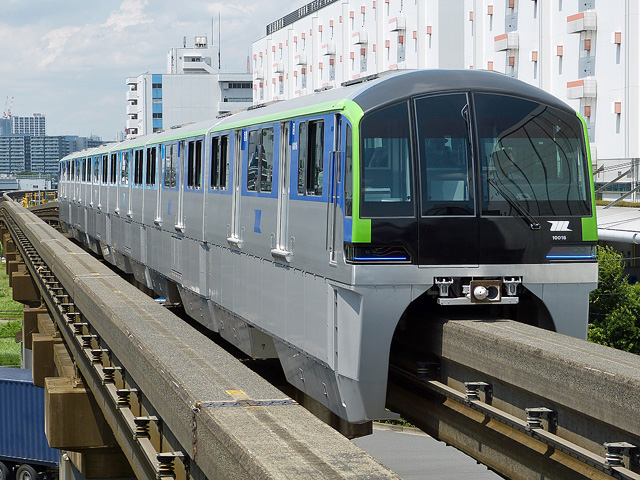
The first of these trains I wish to cover is the Tokyo Monorail (東京モノレール,
Tōkyō Monorēru)
(MO), which opened in 1964 for the first Olympics in Tokyo. Among its twelve stations, there is one stop for each of the three terminals. On the other end, it terminates at Hamamatsucho Station, allowing for transfers to the JR Yamanote
(JY) line. In addition, Hamamatsucho is also adjacent to Daimon Station, serving the Toei Asakusa
(A) and Oedo
(E) subway lines. There are three types of service on the Monrail: local trains take 26 minutes end-to-end, rapid trains take 21 minutes, and the Haneda Express takes 19 minutes, stopping only at each of the terminals and at Hamamatsucho Station. All services cost ¥500 between the terminals and Hamamatsucho. Despite not being fully owned by Japan Railways, the Monorail is nonetheless free to use with the Japan Rail Pass and JR East area passes. On Monorail cars, there are multiple open compartments for passengers to leave their luggage.
| Num. |
Name (English) |
Name (Japanese) |
Local |
Rapid |
Haneda Express |
| MO01 |
Monorail Hamamatsucho |
モノレール浜松町 |
X |
X |
X |
| MO02 |
Tennozu Isle |
天王洲アイル |
X |
X |
I |
| MO03 |
Oi Keibajo-mae |
大井競馬場前 |
X |
X |
I |
| MO04 |
Ryutsu Centre |
流通センター |
X |
X |
I |
| MO05 |
Showajima |
昭和島 |
X |
I |
I |
| MO06 |
Seibijo |
整備場 |
X |
I |
I |
| MO07 |
Tenkubashi |
天空橋 |
X |
I |
I |
| MO08 |
Haneda Airport Terminal 3 |
羽田空港第3ターミナル |
X |
X |
X |
| MO09 |
Shin-Seibijo |
新整備場 |
X |
I |
I |
| MO10 |
Haneda Airport Terminal 1 |
羽田空港第1ターミナル |
X |
X |
X |
| MO11 |
Haneda Airport Terminal 2 |
羽田空港第2ターミナル |
X |
X |
X |
Website:
(English) (Japanese)
Keikyu Lines
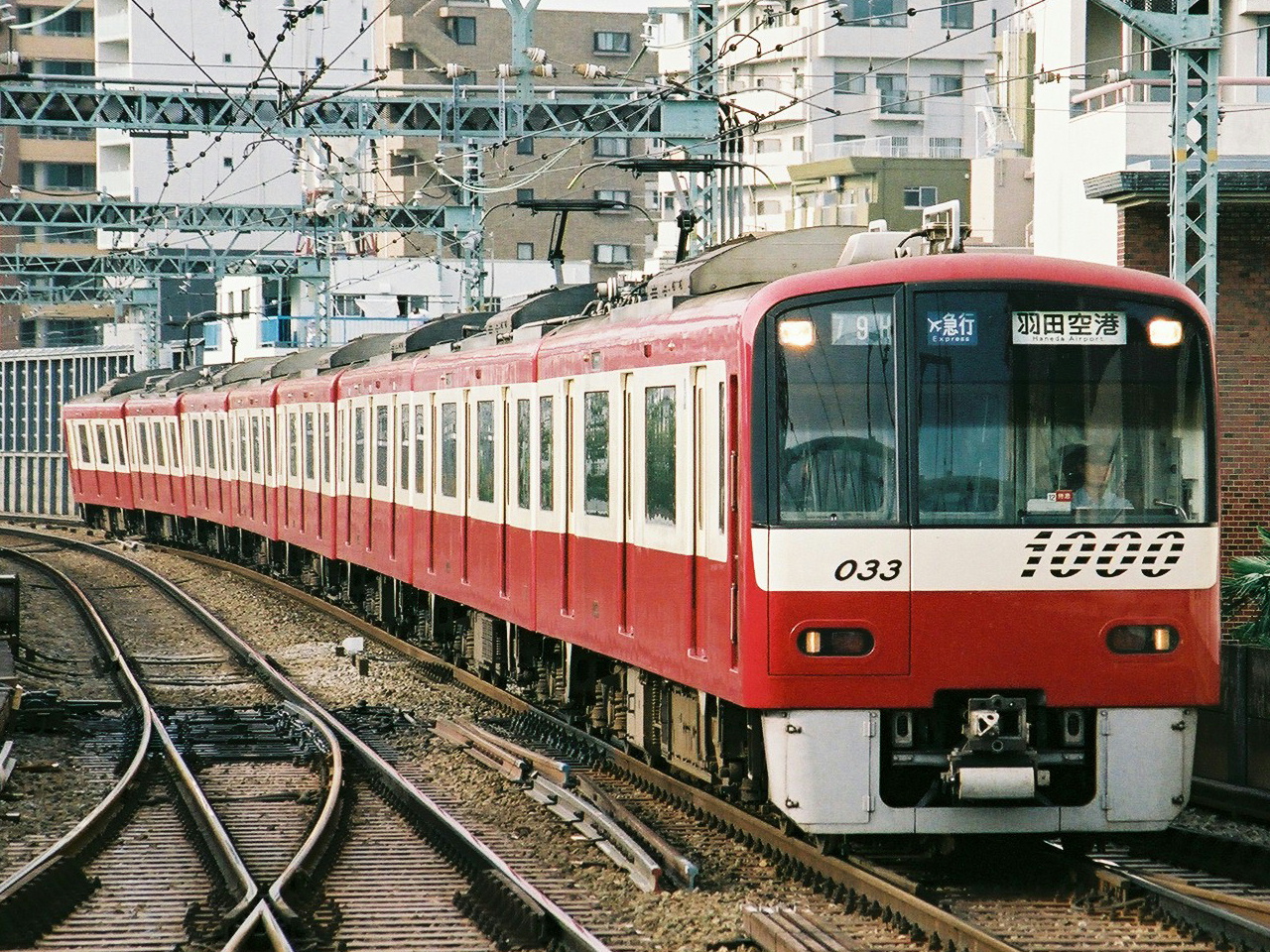
The other railway serving Haneda Airport is the Keikyu (京急,
Keikyū) network, short for "Keihin Kyūkō" (京浜急行, lit. 'Tokyo-Yokohama Express'). Their Airport Line connects to their Main Line
(KK), providing through-services to Shinagawa Station and the Toei Asakusa
(A) subway. Shinagawa is also a stop on the
Tokaido Shinkansen, the JR Yamanote Line, and others. On the airport side, Keikyu has one station for Terminals 1 and 2, and another for Terminal 3. Of all the through-services available, Airport Express (エアポート急行,
Eapōto Kyūkō) trains take 23 minutes from the domestic terminals to Shinagawa, limited-express trains take 17 minutes, and Airport Limited Express (エアポート快特,
Eapōto Kaitoku) trains take 15 minutes; all cost ¥300. Unlike on the Tokyo Monorail, this is a regular commuter line, so cars do not have dedicated spaces for luggage storage.
| Num. |
Name (English) |
Name (Japanese) |
Airport
Express |
Limited
Express |
Airport
Ltd. Exp. |
Through service to Toei Asakusa (A) line
|
| A07 |
Sengakuji |
泉岳寺 |
X |
X |
X |
| KK01 |
Shinagawa |
品川 |
X |
X |
X |
| KK02 |
Kitashinagawa |
北品川 |
I |
I |
I |
| KK03 |
Shinbanba |
新馬場 |
I |
I |
I |
| KK04 |
Aomono-Yokocho |
青物横丁 |
X |
I |
I |
| KK05 |
Samezu |
鮫洲 |
I |
I |
I |
| KK06 |
Tachiaigawa |
立会川 |
X |
I |
I |
| KK07 |
Omorikaigan |
大森海岸 |
I |
I |
I |
| KK08 |
Heiwajima |
平和島 |
X |
I |
I |
| KK09 |
Omorimachi |
大森町 |
I |
I |
I |
| KK10 |
Umeyashiki |
梅屋敷 |
I |
I |
I |
| KK11 |
Keikyu-Kamata |
京急蒲田 |
X |
X |
I |
| KK12 |
Kojiya |
糀谷 |
X |
I |
I |
| KK13 |
Otorii |
大鳥居 |
X |
I |
I |
| KK14 |
Anamori-Inari |
穴守稲荷 |
X |
I |
I |
| KK15 |
Tenkubashi |
天空橋 |
X |
I |
I |
| KK16 |
Haneda Airport Terminal 3 |
羽田空港第3ターミナル |
X |
X |
X |
| KK17 |
Haneda Airport Terminal 1-2 |
羽田空港第1・第2ターミナル |
X |
X |
X |
Website:
(English) (Japanese)
Buses
Because the train options are somewhat limited in what places they serve, the various bus services may be attractive for those seeking a more direct route to/from their hotel or other destination. Operators include Tokyo Airport Limousine, which also serves Narita Airport, and Keikyu's "Haneda Airport Limousine" brand. Outgoing buses depart first from the Terminal 3, followed by Terminals 1 and 2, and vice-versa for incoming buses. (Subtract 10 minutes from the times listed if leaving from Terminal 1, and 15 minutes from Terminal 2.) Below are some sample routes for both Airport Limousine and Keikyu buses:
- T-CAT: 45 minutes, 1-2 per hour, ¥840
- Tokyo Disney Resort*: 40 minutes, every 10-15 minutes, ¥850
- Yokohama*: 50 minutes, every 10 minutes, ¥590
- Tokyo Station: 55 minutes, 1-2 per hour, ¥950
- Ikebukuro Station: 55 minutes, 1-2 per hour, ¥1,250
- Shinjuku Station Bus Terminal: 60 minutes, 1-2 per hour, ¥1,250
- Tokyo Skytree: 60 minutes, 1 per hour, ¥940
- Shibuya: 60 minutes, 1-2 per hour, ¥1,050
- Narita Airport: 90-100 minutes, 1-3 per hour, ¥3,200
- Hakone (Togendai): 2 hours 45 minutes, 5 per day, ¥2,300
- Kawaguchiko/Fuji-san Stations: 2 hours 50 minutes, 6 per day, ¥2,520
* Most marked buses skip Terminal 3.
Websites
Airport Limousine:
(English) (Japanese)
Keikyu Airport Limousine:
(English) (Japanese)
Taxis
While not quite as prohibitively expensive as from Narita, taking a taxi from Haneda Airport directly into Tokyo still costs a pretty penny ("pretty yen"?). Expect to pay anywhere between ¥5,000 and ¥10,000, depending on your destination. A surcharge of 20% is applied between the hours of 10 PM and 5 AM.
So now you’ve decided your mode of transportation for leaving Haneda Airport. The question now is, how do you actually get to that mode of transportation? If you are arriving at Terminal 3, the arrival lobby will be on the second floor. After going through customs, the Tokyo Monorail gates will be ahead on your left, the Keikyu gates across that to the right, and the bus platforms beyond both. There will be a JR East Travel Center beside each of the Monorail gates. Use the Travel Center if you need to exchange a voucher for a pre-purchased pass, such as the Japan Rail Pass; otherwise, the ticket windows will suffice. For those riding to the airport, both lines will put you out at the departure lobby, on the third floor.
In both Terminal 1 and Terminal 2, the arrival lobby is on the first floor. If you are departing by bus, the bus stops are right outside at street level. The train platforms, on the other hand, lie on the basement floor, so find a set of stairs or escalators and go downwards. On floor B1, you will find the Monorail and Keisei gates. You cannot pick up a JR pass at terminals 1 and 2; only from Terminal 3.
If you are taking the Tokyo Monorail to or from Hamamatsucho, it is easier to go through the World Trade Centre building as opposed to JR's Hamamatsucho station, which is poorly-equipped for passengers with luggage. As for Keikyu services, they primarily end at Shinagawa Station. It is relatively straightforward to navigate. The gates for the Keikyu lines are on the western end of the concourse, near the Takanawa exit, opposite from the JR lines on the east side. If leaving from Shinagawa, remember to check your train's terminal stop to make sure you're going down the right line; it should say Haneda Airport (羽田空港).
One last thing: you can also pick up your JR Pass at Tokyo and Shinagawa stations, among others, so if you don’t want to wait at the airport for longer, you can do so afterwards. A full list of exchange locations is available here:
(English)
Edit 24 March 2020: In March 2020, further upgrades have been made to the airport and its schedules. The International Terminal was renamed to "Terminal 3", with some international flights by All Nippon Airlines being handled at Terminal 2. Because of this, and the approval of a new air route for planes to arrive and take off along, Haneda Airport has expanded its selection of international flights, some of them having moved from Narita Airport. The following flights will be added in the coming months as part of this expansion:
| Airline |
Country |
Alliance |
Airports |
| All Nippon Airways (ANA) |
Japan |
Star Alliance |
Delhi*, Ho Chi Minh City, Houston*, Istanbul, Milan,
Moscow-Domodedovo, Qingdao, San Francisco, San Jose*,
Seattle/Tacoma*, Stockholm, Washington-Dulles* |
| Japan Airlines |
Oneworld |
Chicago-O'Hare*, Dalian*, Dallas/Fort Worth*, Delhi*, Helsinki*,
Honolulu, Los Angeles, Moscow-Sheremetyevo, Sydney* |
| Qantas |
Australia |
Oneworld |
Melbourne* |
| Virgin Australia |
N/A |
Brisbane |
| Scandinavian Airlines (SAS) |
Denmark/
Norway/
Sweden |
Star Alliance |
Copenhagen* |
| China Eastern Airlines |
China |
Skyteam |
Beijing-Daxing |
| China Southern Airlines |
N/A |
Beijing-Daxing |
| Alitalia |
Italy |
Skyteam |
Rome-Fiumicino |
| Finnair |
Finland |
Oneworld |
Helsinki |
| Aeroflot |
Russia |
Skyteam |
Moscow-Sheremetyevo* |
| S7 Airlines |
Oneworld |
Vladivostok |
| American Airlines |
United States |
Oneworld |
Dallas/Fort Worth |
| Delta Air Lines |
Oneworld |
Atlanta*, Detroit*, Honolulu*, Portland*, Seattle/Tacoma* |
| United Airlines |
Oneworld |
Chicago-O'Hare*, Los Angeles, Newark, Washington-Dulles* |
*Marked flights have been moved from Narita Airport.