COVID-19 Coronavirus Notice

COVID-19 Coronavirus Notice

Updated 2 July 2020

If you are reading this message, please be aware of travel restrictions in place as part of measures to contain the spread of the COVID-19 "Coronavirus" and its symptoms. Japanese authorities are refusing entry to individuals from, or who have been to, a list of over 100 countries (More information). All other visitors must apply for a visa, and undergo a quarantine upon entering the country. Within the Japan, there are no longer any travel restrictions, and most public attractions have re-opened with precautions for sanitation and social distancing. In short, travel to Japan is not recommended at this time, until the situation normalises. I will not be editing my individual articles to reflect this, but again, please keep this in mind when reading them.
Showing posts with label Nagoya. Show all posts

Wednesday, May 17, 2017

Toyota Techno Museum

This article is based on a visit made in May 2010.

Previously on Sekai Ichi, I took a detour to bring back some memories of my first-ever trip to Japan.  In addition to Nagoya Castle, our tour guide took us to one of the city's sites involving Toyota, the largest car manufacturer in Japan, and second-largest in the world, behind the Volkswagen group.  In particular, we visited the Toyota Commemorative Museum of Industry and Technology (トヨタ産業技術記念館, Toyota Sangyō Gijutsu Kinenkan), sometimes called the "Toyota Techno Museum" (トヨタテクノミュージアム, Toyota Tekuno Myūjiamu) for short.

This museum guides you through the history of the company, which began not with cars, but with weaving looms.  A circular loom, shown here, stands front-and-centre in the entrance lobby, and the first of two wings of the museum, the Textile Machinery Pavilion, is is a collection of weaving machines demonstrating the evolution of the textile industry.

The Type-G Automatic Loom, pictured here, was invented by the company's founder, Sakichi Toyoda (豊田 佐吉, Toyoda Sakichi, 1867-1930), in 1924.  Among its innovations, it was fully automated, could change the shuttle without stopping, and shut itself down automatically in case of a problem.  In the following years, Sakichi founded the Toyoda Automatic Loom Works, and sold the patent to the Type-G loom to a British textile-machinery maker.  This sale put Japan on the map as part of its industrial revolution, and also provided Toyoda with the capital to diversify into the automobile business.

Toyota Industries still does business in the textile market today, since I'm pretty sure this more advanced model didn't exist in the 1920s.

From the Textile Machinery Pavilion, the next stop for visitors is the Automotive Pavilion.  There is a small collection of Toyota cars on display, spanning their history from the 1930s to today.  Exhibits along the far side of the hall go into workings and evolution of car components and the assembly line process.  There's even a continually-running short film (subtitled in Japanese, English, and Chinese) that shows the assembly process.  For those who cannot make it onto a Toyota factory tour (described below), this makes for a convenient alternative.

One of the vehicles that may be on display in the Automotive Pavilion is a replica of the Toyota Model AA, the first car model made by Toyota, in 1936.  Development on this car was led by Kiichiro Toyoda, son of Sakichi and the founder of Toyota's automotive division.  Back then, the car only cost ¥3,350 [1], which adjusted for inflation would cost about 1.65 million yen, or US$13,667, today (based on (English)).

Also in the above picture, you can see an old logo with the name "Toyoda", as opposed to "Toyota".  One of the things we learned on the tour was the evolution of the company's name.  It started off as "Toyoda", written in katakana as "トヨダ", after the name of its founding family.  Not long after, this name was changed to "Toyota", or "トヨタ".  Among the reasons are that it is simpler to write, sounds clearer, and is written with 8 strokes instead of 10, 8 being a lucky number in Sino-Japanese culture.

They also had this concept vehicle on display.  Basically, it's just a seat on wheels.  You could take turns sitting in it, too.  I can't remember if I got on it, but if it ever makes it into production, I'm certain it would be interesting to drive!

From the exit of the Automotive Pavillion, we were greeted by the Toyota Partner Robot, which gave a little musical performance.  I believe it enthralled my grandmother the most out of everything on our trip!

Finally, there is the "Technoland", an area with kid-friendly, hands-on exhibits to help reinforce the concepts taught elsewhere in the museum.

The Toyota Techno Museum may have been the only Toyota-related place we visited before moving on to Inuyama, but there are other places around the city that will interest car fans.  The Toyota Kaikan Museum is an exhibition hall of new car models, and also the starting point for tours of the factory.  (Open 9:30 AM to 5:00 PM, free, tours require free pre-registration.)  Elsewhere, the Toyota Automobile Museum is a collection of cars from Japan, the US, and Europe, spanning over a century of history.  (Open 9:30 AM to 5:00 PM, closed Mondays, entry ¥1,000.)

Well, that's all I have for Nagoya.  My 2010 self ventured on to the nearby town of Inuyama, where I experienced my first kimono dressing and tea ceremony, and climbed up the more authentically-preserved Inuyama Castle.  Unfortunately, our camera's batteries ran out by then, so I don't have any pictures from there.  As for my 2016 self, I continued on to Osaka and set up at my next hotel there.  But, I may meet up with my past self again in Kyoto...!


Hours: Open from 9:30 AM to 5:00 PM.  Admission ends 30 minutes before closing time.  Closed on Mondays and New Year's Day.

Costs: ¥500.  Audio guides in multiple languages (Japanese, English, Chinese, and Korean) can be downloaded as free apps for iPhone and Android devices.  More information: (App Store) (Google Play)

Address: 4-1-35 Noritake Shinmachi, Nishi-ku, Nagoya-shi, Aichi-ken 〒451-0051

Access: From Nagoya Station, take the Meitetsu Nagoya (NH) line to Sako (NH37, 2 minutes, ¥170).  You can also take the Me~guru loop bus to the museum (8 minutes, ¥210), or you can walk from Nagoya Station to the museum in about 20 minutes.

Directions: From Sako Station, cross at the intersection and turn right onto Meieki-dori.  The museum will be on the left side, before the next traffic light.

From Nagoya Station, exit via the Sakura-dori Exit and turn left onto Meieki-dori.  Continue straight ahead for 20 minutes.  The museum will be on the right side, after the 4th traffic light.

Website: (English) (Japanese)

Tuesday, May 16, 2017

Nagoya Castle

This article is based on a visit made in May 2010.

Edit 15 June 2018: Updated article regarding the closing of the main keep and the full re-opening of the Honmaru palace.

Previously on Sekai Ichi, I visited the SCMaglev and Railway Park museum in Nagoya, as a brief stopover on my way from the Fuji Five Lakes to Osaka.  Well, since I'm in the area, I might as well share some stories from my first trip to Japan, which also included a stopover in Nagoya.

I had graduated from college in May of 2010, and right afterwards I went on a week-long tour with my grandmother.  We started with a couple of nights in Tokyo, then a visit to Mount Fuji and the nearby onsen resort of Hakone.  I'll never forget the first onsen bath I had there... so good...  Anyway, the next day was another first: my first ride on the Shinkansen, which we took to Nagoya for a day trip in the city.  And one of the places we went to was Nagoya Castle (名古屋城, Nagoya-jō).

Construction on Nagoya Castle began in 1610 (that means it was the city's 400th anniversary at the time, epic), under the order of shogun Tokugawa Ieyasu (徳川家康, 1543-1616), and each building was completed separately over the next decade.  He and his descendants lived in the castle until 1893, when ownership was transferred to the Imperial Household Ministry, and again to the city of Nagoya in 1930.  During World War II, the castle was used as an army headquarters.  This made it one of the targets for Allied firebombing raids on the city, and so on 14 May 1945, the castle buildings were bombed and burned down.  The main keep was re-constructed with concrete and steel in 1959.

Today, Nagoya Castle is in the middle of an ambitious renovation project.  The buildings of the Honmaru Palace, also destroyed in the air raids, have been rebuilt and reopened in stages.  As of 1 June 2018, the Honmaru palace has been fully reopened to the public.  Beyond that, there are plans to tear down and rebuild the main keep in wood, making it more authentic and also earthquake-resistant.  As such, the main keep has closed to visitors since May 2018.  The keep will be torn down some time in 2019, and completion of this work is scheduled for late 2022.

The moat surrounding the keep was drained out, and all the grass that had grown at the bottom attracted the attention of some deer.  Also in this shot are the stone walls forming the base of the keep.  Uniquely among Japanese castles, the walls curve upward instead of sloping at a straight angle.  This technique, called ogi-kobai (扇勾配, ōgi kōbai) or "fan sloping" for its fan-like shape, helps balance the weight of the structure more evenly.

The Nagoya Castle keep, before its closure in 2018.
By Photo by Gnsin [GFDL or CC-BY-SA-3.0], from Wikimedia Commons
Another unique feature of Nagoya Castle is that its keep consists of not one, but two towers.  The main keep consists of 8 floors, and the sub-keep is 4 floors.  However, from the outside they only appear to have five and two floors respectively.  This was a common trait among Japanese castles, and served to confuse spies who wanted to break in to a specific floor.

The two keeps are joined by a walkway walled on both sides, called the "wall of swords" (剣塀, tsurugi-bei, lit. 'spear fence'), perhaps named because a row of spearheads lining the outside of one of the walls kept invaders from climbing up and into the castle.  As part of the flow of traffic through the modern castle, visitors will enter the sub-keep and walk across this path on their way to the main keep.

The modern-day Nagoya Castle houses a museum, focusing on the history of its development and the society it grew up in.  This is a common use for castles these days, but no less interesting for it.  One of the floors contains re-creations of the old town that grew around the castle, both in life-size and model-size forms.

The museum also displays a rotating collection of weapons and armour from its history, such as this selection of katana swords.  You know, I've always wondered why Japanese swords have curved blades, so I looked it up.  It has something to do with the slurry mixture used to harden the blade during the forging process.  The edge receives less of a coating than the sides and the back, so when the sword is heated, the slurry expands and pushes out more on the dull sides.

One of Nagoya Castle's iconic architectural features are the two golden "dolphins", or kinshachi (金鯱, lit. 'gold tiger-carp') that line its roof.  The folklore creature they were based on, the shachihoko (鯱鉾), was a sort of tiger-headed carp.  They were believed to cause rain, so people placed models of them atop castles as talismans to protect them from fire.  The kinshachi atop Nagoya Castle are plated with 18-karat gold.  The one on the north end is male and the one on the south is female; the male one is slightly bigger.  (And feminism marches on... without them.)  As part of the museum, you can even sit atop a mockup of one of these kinshachi.  Which I did.

The exterior of the Honmaru Palace, upon its reopening in 2018.
By Bariston [CC BY-SA 4.0], from Wikimedia Commons
There's more to Japanese castles than just their keep, though.  Palace buildings around the main keep were used to house visiting dignitaries.  As mentioned above, the Honmaru palace at Nagoya Castle was destroyed in the WWII air raids, but had been reconstructed during the 2010s.  At the time of my visit, it had not yet reopened, so I was unable to check it out.  But, thanks to the many people who have donated pictures to Wikimedia Commons, I can give you an idea.  Here is one of the finished buildings.

The interior of the "Jodan-no-Ma" room, an audience chamber for the daimyo.
By Bariston [CC BY-SA 4.0], from Wikimedia Commons
Visitors may view the Honmaru Palace's rooms from adjacent passageways to witness the artistry of the rooms and their accouterments.  The interiors glow gold from the lacquered sliding doors and panels.  Most of the paintings and sliding doors adorning the palace were put into storage during WWII, thankfully sparing them from the bombings.  Everything else has been reconstructed using the same kinds of materials and techniques as 400 years ago.

Other structures that make up the castle grounds include gates along the outer walls, turret towers at the corners of those walls, warehouses (such as the ones which saved the palace paintings from destruction) and in the case of Nagoya castle, the foundation stones preserved from long-gone buildings.  Perhaps they may be reconstructed some day, just as the Honmaru Palace is today.

There are also vast park grounds within the castle compound.  Here, in one of them, costumed storytellers put on a show whose story escapes me all these years later.

Here I am (left), with my grandmother (right) and Hachimaru (はち丸), the mascot character of Nagoya.  Such a friendly little fellow!


Hours: Open from 9:00 AM to 4:30 PM.  Admission ends 30 minutes before closing time.  Closed on 29-30 December.

Costs: ¥500.

Address: 1-1 Honmaru, Naka-ku, Nagoya-shi, Aichi-ken 〒460-0031

Access: From Nagoya Station, take the Sakura-dori (S) subway line to Hisaya-Odori (S05, 5 minutes), then take the Meijo (M) subway line to Shiyakusho (M07, 2 minutes, ¥240).

You may also take the Me~guru loop bus from Nagoya Station to Nagoya Castle (22 minutes, ¥210).  If you buy a one-day bus pass (¥500), you can get a ¥100 discount for castle admission when you show it at the ticket counter.

Directions: From Shiyakusho Station, head up the road from exit 7.  The Ninomaru entrance is just two minutes away on your left.  From there, it is an additional five minutes to the central area, including the keep and Honmaru palace.

Website: (English) (Japanese)

Sunday, May 14, 2017

SCMaglev and Railway Park

This article is based on a visit made on Thursday, 17 November 2016.

Edit 7 October 2019: Updated prices to reflect the increase in Japan's national sales tax.

Previously on Sekai Ichi, I had wrapped up my overnight stay at the Fuji Five Lakes.  As the morning rose, and I finally caught a glimpse of the elusive Mount Fuji, I embarked on the journey to my next base of operations, Osaka.  But on the way, I made an afternoon stopover at Nagoya to visit the SCMaglev and Railway Park (リニア・鉄道館, Rinia Tetsudōkan), a train museum managed by JR Central, which also owns the Tokaido Shinkansen.  This museum was opened in 2011, replacing an open-air train museum also run by JR Central, the Sakuma Rail Park, which stood east of Nagoya in Shizuoka prefecture.

The entrance hall of the museum is dominated by three locomotives that have set world speed records on test runs.  On the left is the JNR Class C62, a steam engine which reached 129 km/h (80 mph) in 1954.  Next to that is the 300X prototype bullet train, which reached 443 km/h (275 mph) in 1996, a still-standing record for electric trains.  And on the right is the MLX01, a prototype maglev-powered train that set a record of 581 km/h (361 mph) in 2003, only for it to be broken by future maglev prototypes, which we'll see more of later.

Beyond that is the vast main hall, where all manner of production train cars are on display for guests to look at and enter.  Shinkansen models are on the left, and other electric trains are on the right.  As always, click here it in full size.

Did you know that some bullet trains used to have restaurant cars?  When the Sanyo Shinkansen was completed in 1975, and trains started running continuous journeys between Tokyo and Fukuoka, dining cars like these were added to accommodate passengers on those longer trips.  They were used until the mid-1990s, when faster trains had become available, and having to serve full meals was no longer necessary.

There even used to be double-decker cars on the Tokaido and Sanyo Shinkansen, too!  They were used on Series 100 trains, which ran from 1985 to 2012.  The upper deck of this car included a dining area.  Nowadays, those cars have been retired from the Tokaido and Sanyo lines, but double-decker cars are still used on the Joetsu Shinkansen, albeit only for extra seating capacity.

This is one of the "Doctor Yellow" (ドクターイエロー, Dokutā Ierō) trains which are used for conducting maintenance work on Shinkansen lines.  While still operating at the same high speeds as passenger trains, they have special equipment to monitor the condition of the rails below and the power lines above.

Exhibits along the left-side wall provide further insights into the workings of the Shinkansen, including its safety mechanisms which automatically slow down trains to keep them from colliding with other trains ahead, and shut them down completely when an earthquake is detected.  It's systems like these which have maintained the network's impressive safety record.  In over 50 years of the Shinkansen's history, there have only been two derailment incidents, and no fatalities due to accidents.

There's more to this museum than just the Shinkansen.  Various electric, diesel, and steam train cars are preserved here as well.  This is the lead car of a 381-series train, introduced in the 1970s for the "Shinano" limited-express between Nagoya and Nagano.  The Shinano still runs to this day, but with newer cars.

When Japan started using electric power for trains in the 1920s, they imported train cars from the USA, the UK, and other countries before they were able to build their own.  This model was originally built by the American company General Electric.

Even more trains are lined up in the back, including this rather odd-looking one.  This is called a Structure Gauging Train.  What are all those spikes for, you may ask?  Well, they are for measuring the distance between the train's hull and tunnels or other obstructions, to make sure that trains will pass by them safely.

Other exhibits are situated in rooms lining the main hall, including one dedicated to the maglev (magnetic levitation), or "linear motor" (リニアモーター, rinia mōtā), line that JR Central is building between Tokyo, Nagoya, and Osaka.  There are displays of how the maglev system works, miniatures of the different test cars used over the years, including the latest L0-series model (shown on the bottom), and even a small theatre that simulates the experience of riding one of these trains.

Another big draw to the museum is its train-driving simulators.  There are regular train-driving simulators; admission for these costs ¥100, and tickets are available from a vending machine.  Admission on the Shinkansen driving simulator and train crew simulator is handled by lottery.  You are given numbered tickets for both along with your museum ticket, and you can drop them into the lottery boxes in the main hall before any of the multiple drawings per day.  If you are selected, pay an additional ¥500 and you can use the simulator at the allotted time.  If you don't get in to those, you can always try out the conventional train-driving simulator, which I did.  It was tricky; I overshot one of my stops, but otherwise I did fine.

Finally, there is the "Greatest Railway Diorama Room"  (鉄道ジオラマ, Tetsudō Jiorama), a large model railway re-creating the Tokaido Shinkansen and landmarks from cities along the line, in particular Tokyo (pictured), Nagoya, Kyoto, and Osaka.  I believe that bridge in the left background is supposed to be part of the Yamanashi Test Track, where test runs of the maglev trains are being conducted.

The lighting in the diorama room cycles from day to night at regular intervals.  Here, the "sun" sets on famous locales in the Kansai region.  In the lower left is Mount Yoshino, where 30,000 cherry trees bloom in intervals from late March to early May.  In the centre is the main hall of Todai-ji temple in Nara, which houses a giant bronze Buddha statue.  And in the far right is the main hall of Kiyomizu-dera temple in Kyoto, standing atop its famous wooden scaffolding and surrounded by orange maple trees.  I would soon see the real thing, but that's a story for another day...!


Hours: Open from 10:00 AM to 5:30 PM.  Admission ends 30 minutes before closing time.  Closed on Tuesdays, and between 28 December and 1 January.

Costs: ¥1,000.  The Shinkansen driving and train crew simulators cost ¥500 each per turn, if selected.  The regular driving simulator costs ¥100 per turn.  Audio guides cost ¥500 per visit to rent, and are available in the following languages: Japanese, English, Chinese, Korean, French, German, Spanish, and Portuguese.

Address: 3-2-2 Kinjōfutō, Minato-ku, Nagoya-shi, Aichi-ken 〒455-0848

Access: From Nagoya Station, take the Aonami (AN) line to Kinjofuto (AN11, 25 minutes, ¥360).

Directions: The museum is just across the street from the exit to Kinjofuto Station.

Website: (English) (Japanese)

Saturday, May 13, 2017

Introduction to: Nagoya

This article is based on a visit made on Thursday, 17 November 2016.

Edit 13 June 2018: Added excursions.
Edit 5 October 2019: Updated prices to reflect the increase in Japan's national sales tax.

Nagoya (名古屋, lit. 'distinguished old house') is the fourth-largest city in Japan by population (third-largest if you count Tokyo and Yokohama together), and the largest city in the central Chubu region.  The city is a major industrial centre of Japan, with auto manufacturers such as Toyota and Mitsubishi based in the area.

Nagoya was founded by the warlord Tokugawa Ieyasu in 1610, who sought a more strategic location for the regional capital.  It played a major role in Japan's industrial revolution during the late 19th and early 20th centuries.  Since it also fueled the nation's military during World War II, it was subject to Allied air raids from 1942 to 1945, which destroyed many of the city's buildings.  As with many such cities across Japan, it has more than rebuilt itself since then, even hosting the World Expo in 2005.

Main Attractions

By Alpsdake [CC BY-SA 3.0], from Wikimedia Commons
1) Nagoya Station / JR Central Towers: The world's largest train station by floor space, thanks to the twin towers standing atop it.

2) Toyota Commemorative Museum of Industry and Technology: A museum dedicated to Toyota's history in the textile and automotive industries.

By 名古屋太郎 (投稿者が撮影。PENTAX K10D + smc PENTAX-A 1:2.8 28mm) [GFDL or CC BY-SA 3.0], via Wikimedia Commons
3) Nagoya Castle: A castle from the Edo period, reconstructed after being destroyed in WWII.

Roman SUZUKI [CC BY 3.0], via Wikimedia Commons
4) Sakae: A commercial and transportation hub, with landmarks including the Nagoya TV Tower.

5) Osu Kannon Temple: A Buddhist temple near a major shopping district.

By Saigen Jiro [CC0], from Wikimedia Commons
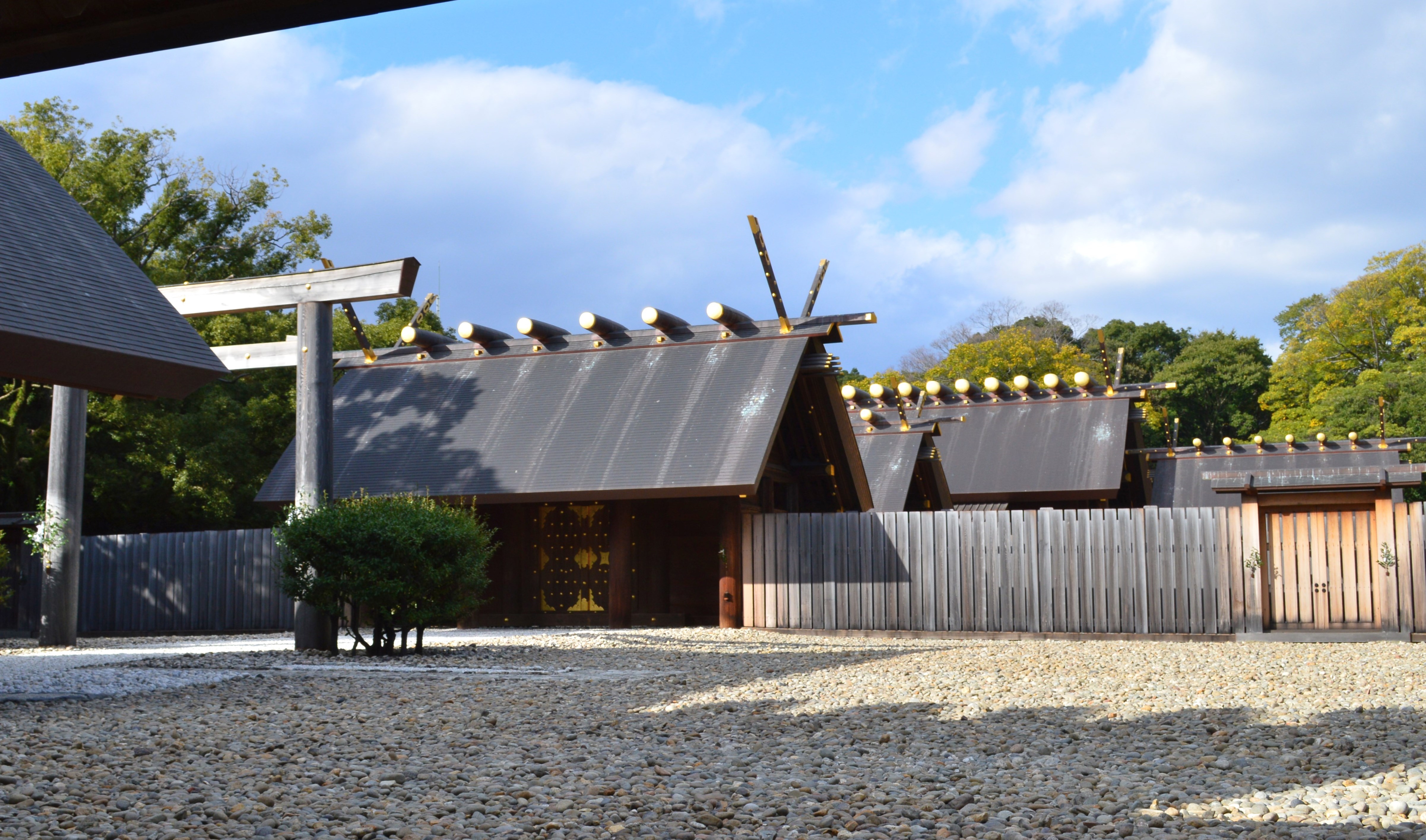
6) Atsuta Shrine: A very sacred Shinto shrine where part of the Japanese Imperial Regalia is held (but not visible to the public).

7) Port of Nagoya: A redeveloped port area with an aquarium, an amusement park, and some museums.

8) SCMaglev & Railway Park: A train museum run by JR Central, with special focus on the Shinkansen and future Maglev systems.

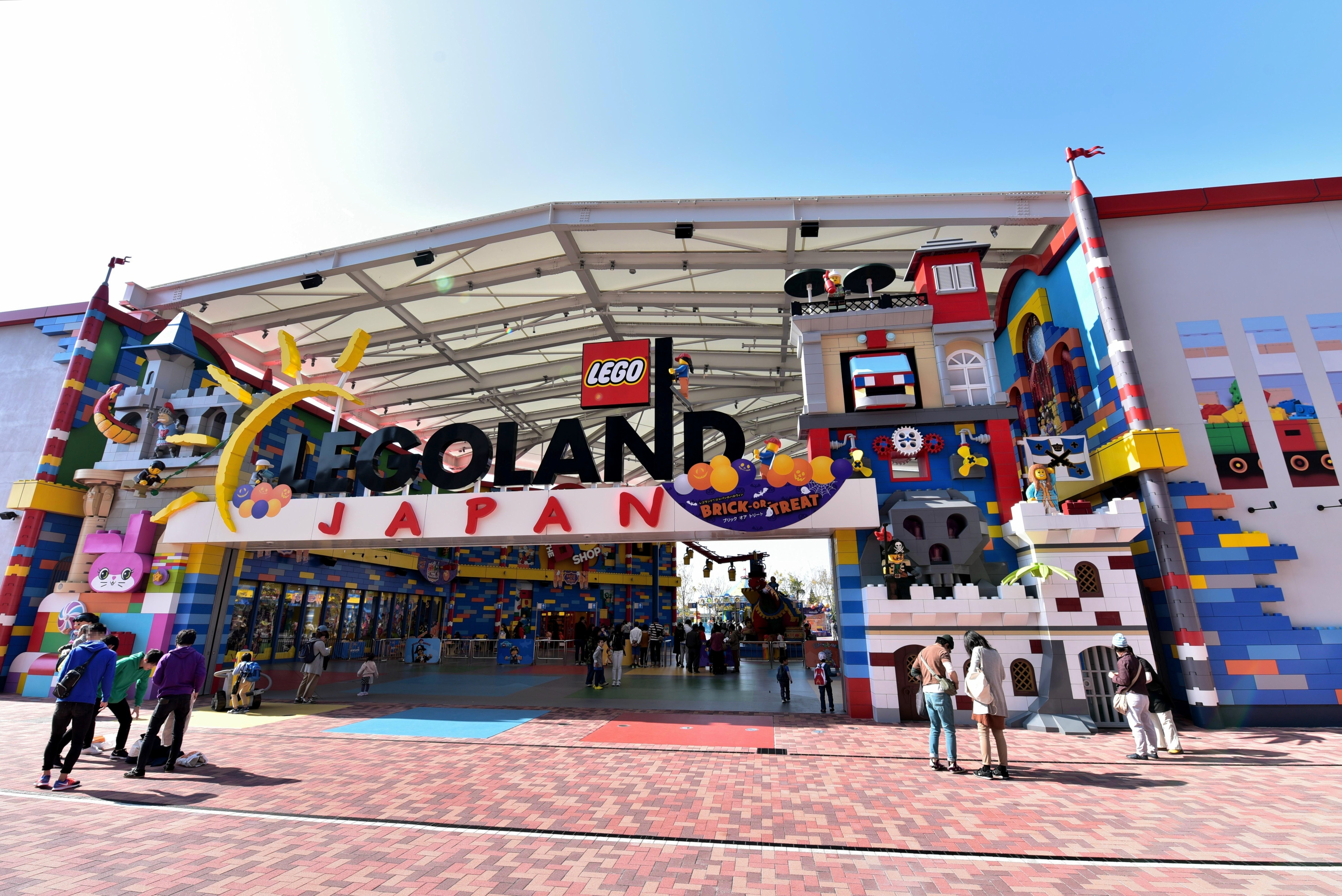
9) Legoland Japan: A new theme park dedicated to the Lego construction toy.

Orientation & Transportation

The main station, Nagoya Station, lies in the centre-west of the city, with most rail lines running through the station to the north and south. It serves the Tokaido Shinkansen and other JR lines, the Higashiyama (H) and Sakura-dori (S) subway lines, and the Aonami (AN) line.  Meitetsu and Kintetsu own stations directly adjacent to the Nagoya Station.  Other major junctions include the adjacent Sakae (Higashiyama and Meijo (M) subway lines) and Hisaya-odori (Sakura-dori and Meijo subway lines), both east of Nagoya Station, and Kanayama (JR Tokaido (CA), Chuo (CF), Meitetsu Nagoya (NH), Subway Meijo, and Meiko (M) lines), southeast of Nagoya Station.

 The following railway companies operate in the Nagoya area:
  • JR Central, or known in Japanese as JR Tokai, operates the high-speed Tokaido Shinkansen (all services), along with a few regular lines: the Tokaido (CA) and Chuo Main Lines (CF) to the east, and the Kansai Main Line (CJ) to the west.  The Japan Rail Pass is valid on these lines (except for Nozomi Shinkansen trains).
  • Meitetsu, a.k.a. Nagoya Railroad, is a private company operating a dense network of lines throughout Aichi Prefecture.  They provide the most convenient access to certain locations, such as the castle town of Inuyama (via the Inuyama (IY) line), and the Chubu Centrair airport (via the Airport (TA) line).
  • Kintetsu is a private company that operates mostly in the Kansai region to the west.  However, their Nagoya (E) line does terminate at Nagoya Station.
  • The Nagoya Municipal Subway network consists of six lines throughout the city.  The Higashiyama (H), Tsurumai (T), and Sakura-dori (S) lines travel east-west through the city centre, the Meijo (M) line loops around the city, and the Meiko (M) and Kamiida (K) lines spur off of the Meijo loop.
  • The Aonami (AN) line is a private line running from Nagoya Station to the southern port area.  For tourists, the line provides access to the SCMaglev & Railway Park museum and the Legoland amusement park, both at the end of the line.
  • The Linimo (L) is a short maglev-powered train line built for Expo 2005.  It starts at the eastern end of the Higashiyama subway line.
In addition, there are local buses operated by the city's Transportation Bureau, Meitetsu, and Mie Kotsu.  One of the most useful buses for tourists is the Me~guru loop bus, which stops at the city's more famous destinations such as the Toyota Techno Museum, Nagoya Castle, and Nagoya TV Tower.  Me~guru buses depart from Nagoya Station every 30-60 minutes on weekdays, or every 20-30 minutes on weekends and holidays.  Rides are ¥210 each, and a one-day pass, which also includes discounts to attractions, costs ¥500.  More information: (English) (Japanese)

Access

The easiest way to get to Nagoya from other cities in Japan is by the Tokaido Shinkansen high-speed train.  All three Tokaido services stop at Nagoya Station.  Travel times and fares from major cities on the Tokaido and Sanyo Shinkansen are as follows:

City Time (Kodama) Time (Hikari) Time (Nozomi)Fare (Reserved)
Tokyo 170 minutes 105-125 minutes 100 minutes ¥11,090
Kyoto 50 minutes 35-55 minutes 35 minutes ¥5,700
Osaka
(Shin-Osaka)
65 minutes 50-70 minutes 50 minutes ¥6,470
Hiroshima 200 minutes* 150-170 minutes* 135 minutes ¥14,070
Fukuoka (Hakata) 315 minutes* 220-240 minutes* 65 minutes ¥18,360
*Selected trains require a transfer at Shin-Osaka Station.
Times and fares are based on October 2019 schedules and are subject to change.

For air traffic, Nagoya is served by Chubu Centrair International Airport, a.k.a. Central Japan International Airport (IATA code: NGO) (English) (Japanese).  The only train service to the airport is by the Meitetsu Airport (TA) line.  In addition to regular services, there are faster limited-express trains with both non-reserved and reserved seating, and the even-faster "μSky Limited Express" (read "Myu Sky") trains, with only reserved seating.  Both kinds of limited-express trains continue on from Nagoya Station to other destinations, including Inuyama and Gifu.

Service Time* Fare
(Non-Reserved)
Fare
(Reserved)
Frequency*
μSky Limited Express 28 minutes N/A ¥1,250 2 per hour
Limited Express 37 minutes ¥890 ¥1,250 2 per hour
Semi-Express 48 minutes ¥890 N/A 2 per hour
*Time and frequency of departures from Central Japan International Airport to Meitetsu-Nagoya Station.

Nagoya's secondary airport is Nagoya Airfield, a.k.a. Komaki Airport (IATA code: NKM), which serves only domestic destinations via Fuji Dream Airways.  Buses between the airport and Nagoya Station take 20 to 40 minutes and cost ¥700.  More information: (Japanese)

There is also a limousine bus service which stops at several hotels on its way to/from the Meitetsu Bus Centre, adjacent to Nagoya Station.  Ride times range from 50 minutes (to/from the Nagoya Tokyu Hotel, near Sakae) to 80 minutes (to/from Meitetsu Bus Centre).  Buses depart once an hour, and the fare is ¥1,200.  More information: (English/Japanese)

Excursions

1) Inuyama: A northern suburb with its own castle and open-air museum.
Access: Meitetsu Inuyama line from Meitetsu-Nagoya to Inuyama (Limited Express: 25 minutes, ¥930; Express: 30 minutes, ¥570).

2) Hikone: A lakeside town with one of Japan's remaining original castles.
Access: Tokaido Shinkansen (Hikari/Kodama) from Nagoya to Maibara (30 minutes), followed by the JR Tokaido line to Hikone (5 minutes, ¥3,280 reserved, JR Pass OK).

3) Ise-Shima Peninsula: Site of Ise Shrine, the most sacred shrine in all of Shinto.
Access: JR Mie Rapid from Nagoya to Ise-shi Station (90 minutes, ¥2,570, JR Pass OK*), or Kintetsu Limited Express from Kintetsu-Nagoya to Ise-shi (80 minutes, ¥2,810).
*Note: Due to the Mie Rapid's use of non-JR tracks, JR Pass holders must pay an extra ¥520 when using this train.

4) Kiso Valley: A collection of preserved post towns along the old Nakasendo highway, which one may hike across.
Access: JR Shinano Limited Express from Nagoya to Nakatsugawa Station (50 minutes, ¥3,070 reserved, JR Pass OK), followed by a bus to Magome (25 minutes, ¥570) (Schedule).

5) Matsumoto: A mountain city with another of Japan's remaining original castles.
Access: JR Shinano Limited Express from Nagoya to Matsumoto (125-140 minutes, ¥6,140 reserved, JR Pass OK).

6) Takayama: A city with a well-preserved old town.
Access: JR Hida Limited Express from Nagoya to Takayama Station (150 minutes, ¥6,140 reserved, JR Pass OK).