COVID-19 Coronavirus Notice

COVID-19 Coronavirus Notice

Updated 2 July 2020

If you are reading this message, please be aware of travel restrictions in place as part of measures to contain the spread of the COVID-19 "Coronavirus" and its symptoms. Japanese authorities are refusing entry to individuals from, or who have been to, a list of over 100 countries (More information). All other visitors must apply for a visa, and undergo a quarantine upon entering the country. Within the Japan, there are no longer any travel restrictions, and most public attractions have re-opened with precautions for sanitation and social distancing. In short, travel to Japan is not recommended at this time, until the situation normalises. I will not be editing my individual articles to reflect this, but again, please keep this in mind when reading them.
Showing posts with label tutorials. Show all posts

Sunday, April 8, 2018

Onsen Baths and How to Take Them

The Japanese archipelago lies on top of fault lines, so it is subject to all kinds of volcanic activity.  The people of this country have managed to harness that geothermal activity, and use it to heat up water for hot-spring baths, known as onsen (温泉, lit. 'warm water').  Onsen are differentiated by the kinds of minerals their waters are infused with, and what health benefits they are meant to possess.  Soaking and indulging in this kind of bath is an integral part of Japanese life and culture, and one I myself have been hooked on whenever I go there.

Really, wherever there's water and a way to heat it, just about any place can serve as a good bath.  Even a private bath room in a regular home can be used in such a style.  Full-scale onsen are often encountered at ryokan inns or other hotels, and as stand-alone public baths known as sento (銭湯, sentō, lit. 'coin bath').  Some baths are placed outside in the open air, and in such cases are known as rotenburo (露天風呂, lit. 'open-air pool').  The layouts of different onsen may vary, but at a common level, are laid out something like this:

Public baths are used while naked, and are separated by gender for obvious reasons.  This precludes wrapping a towel around yourself, although there are often small washcloth-style towels, called tenugui (手拭い, lit. 'hand wipe'), which may be used, among other purposes, for some level of modesty while walking about.  There are a few onsen, mainly in rural areas, which offer mixed-gender baths.  (And yet, Japanese women, who tend to be more sensitive about sexual advances, prefer to avoid mixed baths altogether.)

In order to keep the water sanitary for everyone else, people who have any open cuts wounds are advised not to bathe in an onsen.  Also, especially for foreign visitors, it is important to note that many onsen do not allow customers with tattoos on their bodies to use the facilities.  This may have to do with deterring Yakuza mobsters who, as a stereotype, wear large-scale tattoos themselves.  If this affects you, you would do well to find out in advance whether or not your desired onsen will accept tattooed customers.  According to a survey conducted in 2015, just over half of onsen owners said they had a policy of turning away customers with tattoos, although acceptance of foreigners with small tattoos has slowly been rising in recent years. [1]  Onsen that are willing to allow guests with smaller tattoos may provide patches to cover them up with.

So with all that set up, there are a few customs you should observe during your onsen bath.  Here are the steps to take in doing so:

  1. Enter the appropriate changing room.  The doors or curtains leading to the mens' side are marked by English words, the kanji "男", and/or the colour blue.  Likewise, for the ladies' side, look out for the kanji "女" and/or the colour red.
  2. Inside the changing room, remove all your clothes and belongings and store them, either in a locker or a basket, whatever is provided.  If there are lockers, take the key and pull the cord onto your wrist or ankle.
  3. Enter the bath room.  Before you to into the main bath, you must rinse yourself off first, since the bath is shared by many people.  Many onsen these days will have shower stations lined low along the walls.  It is enough just to wash yourself with water, but many people, especially younger bathers, choose to use the body wash, shampoo, and other amenities that may be provided.
    1. In older onsen, there may only be a tap or a basin of water to rinse with.  Simply fill up a bucket of water and pour it over your head.
  4. Once you're cleaned up, enter the bath itself.  The temperature of the bath will be hot, anywhere from 35 to 45 degrees Celsius (95 to 113 degrees Fahrenheit), so you may not be able to stand it for too long.  Up to five minutes at a time should be enough.  It helps if you soak your hand-towel with cold water and lay it atop your head, and if you do not move around.
  5. Exit the bath and rinse yourself again at one of the showers.  If you did not already wash yourself fully, now would be a good time to do so.
  6. If you wish, re-enter the bath for another soak.  If the facilities have multiple baths, such as an indoor and an outdoor one, now would be a good time to try out the other ones.
  7. After finishing your last soak, do not rinse yourself off.  This will keep the minerals of the water within your body.
  8. Return to the changing room, dry off, retrieve and put on your clothes.
If you are enjoying a bath as part of a stay at a ryokan, you will usually take a bath right before dinner.  These dinners, served either in your room or a communal dining room, will often feature many Japanese-style dishes using local and seasonal ingredients.  It is not recommended to use the bath after eating, but some people like to use them again right before bed and/or after waking up in the morning.

Now that you know how to take a bath at an onsen, you may want to learn the best places to experience them.  I shall address them with a list of the top ten onsen resorts in Japan, next time on Sekai Ichi!

[1] Ryall, Julian (6 November 2015). "Japanese owners of famous 'onsen' hot springs soften their stance on tattoo ban to appease foreign visitors". Archived from the original on 17 January 2016.

Thursday, November 23, 2017

Holidays and Festivals of Japan

Edit 12 May 2020: Updated certain holiday dates that have been moved for the 2020 Summer Olympics in Tokyo.

When planning a vacation in Japan, or any other country for that matter, it is highly advisable to know when its holidays take place.  Sometimes it is not a good idea to travel during such times.  Businesses may be closed, and planes, trains, and automobile routes may be more crowded with people commuting to meet with their loved ones.  But, on the other hand, these celebrations are unique experiences which may enhance your voyage.

The three busiest travel periods in Japan are:
  • New Year's Day, from the end of December to the beginning of January,
  • Golden Week, from the end of April to the beginning of May, and
  • O-bon, in the middle of August.
Travel density tends to be busiest going from the big cities at the start of these periods, and going back to the cities at the end.  In addition, school vacation periods may also see increased crowds in places of interest.  In addition to the three periods listed above, students also get off from the end of March to the beginning of April (in between school years), and six weeks from the end of July to the end of August (overlapping with O-bon).


The following are all of Japan's national holidays.  With the exception of New Year's Day, commercial businesses are often open on the holidays themselves, even when they would otherwise be closed.  In such cases, they will instead be closed on the day after.

New Year's Day - 1 January
Unlike other East Asian cultures, Japan officially uses the Gregorian calendar, hence, the new year (元日, Ganjitsu) starts on the 1st of January.  The kadomatsu (門松, "gate pine"), a decoration including three cross-cut bamboo stalks (shown below), is put up in many places for New Year's.
Nesnad [GFDL or CC BY 3.0], from Wikimedia Commons

Coming-of-Age Day - 2nd Monday of January
Coming-of-Age Day (成人の日, Seijin no Hi) is a celebration of men and women who are entering adulthood (age 20).  From 1948 to 1999, it was held on the fixed date of 20 January.  Toshiya (shown below), an archery exhibition held at Sanjusangen-do in Kyoto, is held on the Sunday before Coming-of-Age Day.
No machine-readable author provided. Peter 111 assumed (based on copyright claims). [Public domain], via Wikimedia Commons

National Foundation Day - 11 February
National Foundation Day (建国記念の日, Kenkoku Kinen no Hi) is a celebration of the founding of Japan.  Emperor Jimmu, the first Emperor of Japan, is believed to have ascended to his position in 660 BC, on the first day and month of the lunar calendar (or, 11 February).  Modern-day celebrations of this holiday are more muted than they were before World War II, when it was known as Empire Day (紀元節, Kigensetsu).

Spring Equinox Day - 20/21 March
Spring Equinox Day (春分の日, Shunbun no Hi) is the first day of Spring.  Before 1948, this date was a Shinto holiday known as Shunki Kōresai (春季皇霊祭), a day of ancestor worship.  Even nowadays, this holiday is a time when Japanese visit the graves of their ancestors.

Showa Day - 29 April
Showa Day (昭和の日, Shōwa no Hi) was the birthday of Emperor Hirohito (reigned 1926-1989), posthumously known as the Showa Emperor.  Its purpose is for the public to reflect on the legacy of the emperor, which led to the events of World War II, but also Japan's economic growth after the war.  Part of Golden Week.

Constitution Day - 3 May
Constitution Day (憲法記念日, Kenpō Kinenbi) is a celebration of the Japanese postwar constitution, which came into effect on this day in 1947.  Negotiated after Japan's defeat in World War II, the new constitution uniquely prohibits Japan's military from engaging in offensive wars.  Part of Golden Week.

Greenery Day - 4 May
Greenery Day (みどりの日, Midori no Hi) is celebration of nature.  Before 2007, Greenery Day was celebrated on 29 April; afterwards, it was replaced with Showa Day and moved to 4 May.  Its original date was chosen due to Showa's own love of nature.  Part of Golden Week.

Children's Day - 5 May
Children's Day (こどもの日, Kodomo no Hi) is a celebration of children.  Also known as Boy's Day (端午の節句, Tango no Sekku), this holiday used to focus on boys and their fathers, to contrast with Girl's Day (雛祭り, Hina-matsuri) on 3 March.  After 1948, the holiday was re-defined to also honour girls and their mothers.  A popular decoration of Children's Day is the koinobori (鯉のぼり), a set of carp-shaped wind streamers (shown below).  Part of Golden Week.
663highland [GFDL, CC-BY-SA-3.0 or CC BY 2.5]

Marine Day - 3rd Monday of July / 23 July
Marine Day (海の日, Umi no Hi) is a celebration of Japan's seas and waters.  On this day in 1876, the Meiji Emperor returned from a steamship voyage to Hokkaido.  Marine Day also roughly corresponds with the end of the rainy season in much of Japan.  From 1996 through 2002, it was held on the fixed date of 20 July.  This holiday will be moved to 23 July to coordinate with the 2020 Summer Olympics's opening ceremonies.  Despite the games having been delayed to next year, these new holiday dates will still take effect in 2020.

Mountain Day - 11 August / 10 August
Mountain Day (山の日, Yama no Hi) is a celebration of Japan's mountains.  It is Japan's newest official holiday, having been drafted in 2014 and first observed in 2016.  Mountain Day roughly corresponds with the Bon Festival, a traditional holiday period in mid-August.  This holiday will be moved to 10 August to coordinate with the 2020 Summer Olympics's closing ceremonies.  Despite the games having been delayed to next year, these new holiday dates will still take effect in 2020.

Respect for the Aged Day - 3rd Monday of September
Respect for the Aged Day (敬老の日, Keirō no Hi) is a celebration of senior citizens and long life.  From 1966 to 2002, it was held on the fixed date of 15 September.

Autumn Equinox Day - 22/23 September
Autumn Equinox Day (秋分の日, Shūbun no Hi) is the first day of Fall.  Before 1948, this date was a Shinto holiday known as Shūki Kōreisai (秋季皇霊祭).  As with the Spring Equinox, many Japanese also visit their ancestor's graves around this time.

Health and Sports Day - 2nd Monday of October / 24 July
Health and Sports Day (体育の日, Taiiku no Hi) is a celebration of sports and physical activity.  Many schools and businesses hold sports competitions on this day.  From 1966 to 1999, it was held on the fixed date of 10 October, the day the first Summer Olympics in Tokyo were opened, in 1964.  This holiday will be moved to 24 July to coordinate with the 2020 Summer Olympics's opening ceremonies.  Despite the games having been delayed to next year, these new holiday dates will still take effect in 2020.

Culture Day - 3 November
Culture Day (文化の日, Bunka no Hi) is a celebration of artistic and academic endeavour.  Many local and prefecture governments hold culture fairs around this time.  On this day in 1946, the Emperor officially approved Japan's new post-war constitution.  3 November was also the birthday of the Meiji Emperor (reigned 1868-1912).

Labour Thanksgiving Day - 23 November
Labour Thanksgiving Day (勤労感謝の日, Kinrō Kansha no Hi) is a celebration of workers, and of giving thanks for their work.  Before 1948, this date was a harvest festival known as Niiname-sai or Shinjō-sai (新嘗祭).

Emperor's Birthday - 23 December
The birthday of the standing Emperor (天皇誕生日, Tennō Tanjōbi) is celebrated as a national holiday.  Currently, this is the 23rd of December, the birthday of Emperor Akihito (reigned 1989-present).  In the event of Akihito's death or abdication, this holiday will move to 23 February, the birthday of the heir-apparent Prince Naruhito.  This, along with 2 January, are the only two days when the public are allowed into the inner grounds of the Imperial Palace in Tokyo, where the Emperor and his family make public appearances (shown below).
Nesnad [GFDL or CC BY-SA 4.0], from Wikimedia Commons


In addition to the above, there are other festivals and holidays which do not have official status, but are commonly celebrated in various ways.

Setsubun - 3 February
Setsubun (節分) is the traditional beginning of Spring in the lunar calendar.  Its customs involve driving bad luck out of one's household and good luck in.  The big one is mamemaki, where roasted soybeans are thrown out of the door, or into crowds at a shrine or temple, amidst chants of "Oni wa soto! fuku wa uchi!" (鬼は外! 福は内!, "Demons/bad luck out; good luck in!").

Valentine's Day - 14 February
Valentine's Day (バレンタインデー, Barentain Dē) is a celebration of love and romance, as it is in the western world.  A unique custom in Japan is that women give chocolates or other such gifts to their boyfriends or other male colleagues.

Girls' Day - 3 March
Girls' Day (雛祭り, Hina matsuri) is a day of honouring young girls, although that function has also been merged into Children's Day (described above) in more recent times.  The trademark decoration of the Hina festival is an a display of dolls, depicting members of an imperial court, arranged on a multi-tiered shelf (shown below).
Daderot [CC0], from Wikimedia Commons

White Day - 14 March
White Day (ホワイトデー, Howaito Dē) is a variation of Valentine's Day, unique to eastern Asia.  On this day, one month after Valentine's Day, men give chocolates or other such gifts to their girlfriends or other female colleagues.

Okinawa Memorial Day - 23 June
Okinawa Memorial Day (慰霊の日, Irei no Hi, lit. 'the day to console the dead') commemorates all who passed away during the Battle of Okinawa from World War II (1 April - 22 June 1945).  This was the deadliest battle in the war's Pacific theatre, with an estimated 160,000 casualties on both Japanese and Allied sides, plus 40-150 thousand more civilian death.  Okinawa Memorial Day is observed as a national holiday in Okinawa Prefecture, but is not observed elsewhere in Japan.

Tanabata - 7 July/August
Tanabata (七夕), also known as the Star Festival, is based on a folktale of two gods in love, who are only able to meet once a year.  It is based on the Chinese festival Qixi, which is held on the 7th day of the 7th lunar month, usually in August.  Different communities in Japan will celebrate it either in July or August.  A common tradition of Tanabata is people writing their wishes down on strips of paper, and hanging them onto bamboo trees (shown below).  Whilst observed nationwide, one of Japan's largest and most famous Tanabata festivals is held in Sendai, in the Tohoku region.
★Kumiko★ from Tokyo, Japan [CC BY-SA 2.0], via Wikimedia Commons

Bon Festival - 13-15 August
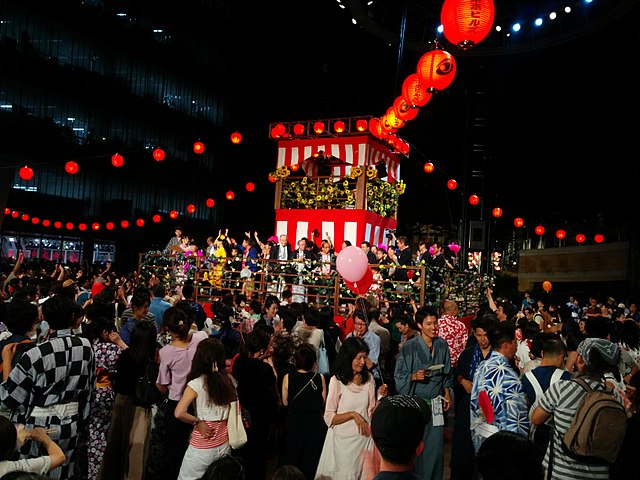
The Bon Festival (お盆, O-bon) is a Buddhist-based celebration of one's ancestors.  Held over a period of three days, its customs include setting tiny boats with candles adrift in the water, and the Bon O-dori (盆踊り), a folk dance around a small tower with taiko drummers (shown below).  Some regions, most notably in the Kanto Plain, celebrate it in July instead of August.  Similar festivals, such as the Ghost Festival in China, are observed at this time in other Asian cultures.
Pocsywe [CC BY-SA 4.0], from Wikimedia Commons

Shichi-Go-San - 15 November
Shichi-Go-San (七五三), meaning "seven-five-three", is a celebration to honour three and five-year-old boys, and three and seven-year-old girls.  They are dressed up in formal kimonos and taken to visit a local Shinto shrine, often for the first time in their lives.

Christmas Day - 25 December
Christmas (クリスマス, Kurisumasu) is a Christian holiday celebrating the birth of Jesus Christ.  In Japan, Christmas is not commonly observed with the same religious significance as in the western world.  Its secular, commercial aspects have crossed over, however.  Christmas is also a popular time for couples to go dating.


In addition to all those, many communities in Japan celebrate their own local festivals (祭 / 祭り, matsuri) .  Many of them are centred around a particular shrine.  Parades start and/or end at those shrines, and are led by mikoshi (神輿), hand-carried floats bearing the shrine's patron god.  One can also expect to find yatai (屋台), small stalls selling food and/or souvenirs, or hosting carnival-style games.  Here are some notable festivals from the bigger cities:
  • Wakakusa Yamayaki (若草山焼き) in Nara, on the fourth Saturday of January
  • Sapporo Snow Festival (さっぽろ雪まつり, Sapporo Yuki-matsuri) in Sapporo, for one week in February
  • Takayama Spring Festival (高山祭) in Takayama, on 14-15 April
  • Aoi-matsuri (葵祭) in Kyoto, on 15 May
  • Kanda-matsuri (神田祭) in Tokyo, on the weekend of 15 May, in odd-numbered years
  • Sanja-matsuri (三社祭) in Tokyo, on the third weekend of May
  • Sanno-matsuri (山王祭, Sannō-matsuri) in Tokyo, for one week in June, in even-numbered years
  • Gion-matsuri (祇園祭) in Kyoto, in July
  • Hakata Gion Yamakasa (博多祇園山笠) in Fukuoka, on 1-15 July
  • Tenjin-matsuri (天神祭) in Osaka, on 25 July
  • Aomori Nebuta-matsuri (青森ねぶた祭り) in Aomori, on 2-7 August
  • Kanto-matsuri (秋田竿燈まつり, Akita Kantō-matsuri) in Akita, on 3-7 August
  • Awa-odori (阿波踊り) in Tokushima, on 12-15 August
  • Takayama Autumn Festival (高山祭) in Takayama, on 9-10 October
  • Jidai-matsuri (時代祭) in Kyoto, on 22 October
In addition to the above, festival-style installments are frequently set up in spots with lots of cherry blossoms in the spring (for example, Ueno Park in Tokyo), or maple leaves in the fall (for example, the Maple Corridor at Lake Kawaguchi).  With some of the larger festivals, especially the ones in Takayama, Aomori, and Akita, there is a risk of hotel rooms filling up or just being more expensive.  If you are interested in visiting those festivals, you are strongly advised to book your hotels as early as they become available, or consider staying a bit farther away and commuting by train.  Other than that, festivals are a lively way to enhance your stay in Japan, so be on the lookout for something good!

Wednesday, February 22, 2017

The Japan Rail Pass and How to Use It

Edit 2 October 2019: Updated prices to reflect the increase in Japan's national sales tax.
Edit 11 May 2020: Updated to reflect the updated Japan Rail Pass and the new online reservation website, both taking effect on 1 June 2020.

A Green Car version of the Japan Rail Pass, issued in 2016.

For overseas visitors looking to travel between multiple faraway destinations across Japan, the Japan Rail Pass is an ideal investment. It allows holders to ride local, express, and high-speed Shinkansen trains run by the Japan Railways (JR) Group without needing to buy tickets or use an IC debit card.

Before reading any further, pay attention to the following requirement.  The Japan Rail Pass is only available for foreign residents coming to Japan on a "Temporary Visitor" visa.  Japanese nationals living outside of Japan, and/or married to a non-Japanese spouse, are also unable to purchase a JR Pass.

The JR Pass is available for 7, 14, and 21 day periods.  These periods are measured in consecutive calendar days, measured from midnight to midnight.  It is also available in two versions: the regular pass allows free use of non-reserved and regular reserved seats, and the Green pass allows free use of upper-class Green Car seats on top of that. Official prices are quoted in Japanese yen, so actual prices in your local currency may vary among vendors.

Length Price (Regular) Price (Green Car)
7 days ¥29,650 ¥39,600
14 days ¥47,250 ¥64,120
21 days ¥60,450 ¥83,390

As you can see, the JR Pass can be a hefty investment.  It is easily possible to save even more money by using it instead of paying for tickets directly, especially if you plan to use Shinkansen and/or limited express trains frequently, but you will need to do some research to determine whether or not the JR Pass is right for you.  If you're just staying within a certain city, the JR Pass would not be for you.  As a frame of reference, the 7-day pass costs roughly as much as a round-trip Shinkansen ride between Tokyo and Osaka, Kanazawa, or Morioka.

The JR Pass is accepted on all Japan Railways (JR) Group lines, which accounts for about 70% of track mileage in Japan.  It does NOT cover trains run by non-JR companies, including city subway lines. There are a few exceptions which are covered by the JR Pass, however, generally to access isolated JR lines:
  • The Tokyo Monorail, for access to Haneda Airport.
  • The Aoimori Railway between Aomori, Noheji, and Hachinohe, for access to the JR Ominato line.
  • The Ishikawa Railway between Kanazawa and Tsubata, for access to the JR Nanao line.
  • The Echigo Tokimeki Railway between Toyama and Takaoka, for access to the JR Himi and Johana lines.
Note: With the exception of the Tokyo Monorail, you cannot get off except at the stations listed above.

The JR Pass is also not generally valid on non-train transportation, hence the name "Japan Rail Pass".  There are a few exceptions, however.
  • Buses: The JR Pass is valid on a few local buses run by the JR Group, such as the "Maple-oop" tourist loop bus in Hiroshima.  It is not valid on long-distance highway buses, even those run by the JR Group.
  • Ferries: The JR Pass is valid on the short ferry ride to Miyajima island near Hiroshima.  It is not valid on the ferry between Fukuoka and Busan, South Korea, despite also being run by the JR Group.
A few notices about using the JR pass for limited express and Shinkansen trains:
  • Japan Rail Passes issued after 1 June 2020 will have a magnetic strip, allowing them to be used with automated gates like regular tickets.  Passes issued before than cannot be used with these gates.  However, nearly all gates have an attendant on either side. Simply show your pass (and reserved seat tickets as necessary) to them, and they will let you through.  They may ask for you to show your passport as well to confirm your identity.
  • Seat reservations may be made for free.  You may do this at reserved-ticket vending machines by scanning the QR code on your pass, entering your passport number, and searching for your train by start/end stations, date, and time.
    • You may also reserve tickets at "Midori no Madoguchi" ticket counters. These staff may speak English in addition to Japanese.  I found it handy to write down the information needed to reserve tickets beforehand (including train name/number, date, time, start/end stations, and seat type), and show it to the staff.
    • If you have made seat reservations on the new website, launching on 1 June 2020, you may pick up your seating tickets by using your pass at the appropriate ticket vending machine or service counter.  Insert both your pass and seat ticket into the ticket gates, as you would with regular tickets.
  • On the Tokaido, Sanyo, and Kyushu Shinansen, the JR pass is NOT valid for any seats on Nozomi and Mizuho express services. If you wish to use these trains when you have a pass, you must pay the full price out of pocket as normal. The fastest services available with the pass, the Hikari and Sakura respectively, only differ by half an hour at most.
  • A few JR trains, including limited express services, travel on both JR and non-JR lines. When using these trains, you will need to pay a supplement fee for the non-JR sections.  The fee varies between services, but works out to the cost of taking the non-JR segment alone.  Generally, it is still far less than paying for the whole trip out-of-pocket.
So, let’s say you've worked out your itinerary and decided the JR Pass is right for you. How do you get it, then? It’s not as easy as simply buying one in Japan. Here’s what you need to do:
  1. Buy the JR Pass overseas, either directly or through a travel agency.  This can be done easily over the Internet, through many different websites.  Shop around to find the lowest price and most reliable vendor, but be aware that prices will not vary much from the official rates listed above.
  2. You will not receive the pass itself in the mail, but an exchange order. You will use this order to pick up the actual pass upon arrival in Japan.
  3. When you arrive in Japan, go to a JR Travel Centre, found in most major airports and train stations. A full list of offices may be found here: (English)
  4. Hand in your exchange order, along with the Temporary Visitor stamp in your passport, and receive your Japan Rail Pass.  This is necessary to confirm that you are an overseas visitor.  Note that the exchange order must be exchanged for the actual JR Pass within three months after the issue date marked on the exchange order.
  5. If you wish for your pass to take effect on a later date, you may do so at this time.  Even before the period takes effect, you may still reserve tickets for within that period.
But that's not all!  From 1 June 2020, a new website will launch allowing users to not only purchase Japan Rail Passes, but also reserve train seats online.  The catch is that passes bought from this site are more expensive, and online reservations can only be made if you've bought the pass from this site.  More information: (English)  Furthermore, the Japan Rail Pass is also being sold directly within Japan on a trial basis.  The same eligibility requirements apply, so only temporary foreign visitors need apply.  However, the pass will be more expensive if purchased in this fashion, as opposed to the traditional method of buying an exchange order before arriving in Japan.  Prices for buying the JR Pass both within Japan and from the new website are as follows.  I have also included the differences between the direct purchase and pre-order prices for your reference.

Length Price (Regular) Price (Green Car)
7 days ¥33,610 (+¥3,960) ¥44,810 (+¥5,210)
14 days ¥52,960 (+¥5,710) ¥72,310 (+¥8,190)
21 days ¥66,200 (+¥5,750) ¥91,670 (+¥8,280)

As with many things involved in travel planning, it pays -- almost literally in this case -- to get these sorts of things in order as soon as possible.  But it's nice to know there's another option available if you can't manage those preparations in time!

More information on the Japan Rail Pass is available on the following website: (English)