COVID-19 Coronavirus Notice

COVID-19 Coronavirus Notice

Updated 2 July 2020

If you are reading this message, please be aware of travel restrictions in place as part of measures to contain the spread of the COVID-19 "Coronavirus" and its symptoms. Japanese authorities are refusing entry to individuals from, or who have been to, a list of over 100 countries (More information). All other visitors must apply for a visa, and undergo a quarantine upon entering the country. Within the Japan, there are no longer any travel restrictions, and most public attractions have re-opened with precautions for sanitation and social distancing. In short, travel to Japan is not recommended at this time, until the situation normalises. I will not be editing my individual articles to reflect this, but again, please keep this in mind when reading them.
Showing posts with label festivals. Show all posts

Wednesday, May 6, 2020

Sanja Matsuri

This article is based on a visit made on Sunday, 20 May 2018.


The Sanja Matsuri (三社祭, lit. "three shrines festival") is a Shinto festival held annually in Tokyo, on the third weekend of May.  For 2020, this would fall on the 15th to 17th of May; however, due to the... you-know-what, this year's festival has currently been rescheduled to the weekend 16-18 October.  It is one of Tokyo's most popular festivals, drawing in as many as 2 million visitors over the course of the weekend.  As my latest time in Japan drew to a close, I happened to be in town during the 2018 Sanja Matsuri.  So after coming down from the Tokyo Skytree, I set aside some time to check it out.

Sanja Matsuri is based at Asakusa Shrine (浅草神社, Asakusa-jinja), an auxiliary shrine alongside the Buddhist temple Senso-ji.  Dating to 1649, Asakusa Shrine is the oldest standing shrine in Tokyo, having survived the air raids of World War II.  If you've seen a tall red pagoda behind Senso-ji, that's part of the shrine.  This festival was set up to honour the three founders of Senso-ji: Hinokuma Hamanari (檜前浜成), Hinokuma Takenari (檜前竹成), and Hajino Nakatomo (土師真中知), whose souls are enshrined at Asakusa-jinja.  In the picture above, which my grandmother took from atop the Asakusa Tourist Information Centre, Senso-ji's main hall is to the right and Asakusa-jinja's pagoda is to the left.

The festival starts at 1:00 PM on Friday, with the Daigyōretsu (大行列, lit. "large parade") parade along the Nakamise shopping street.  Whilst I don't have any pictures of this, I understand it looks quite similar to the Aoi Matsuri we saw in Kyoto.  On Saturday afternoon, nearly 100 small mikoshi are carried out to receive a blessing at the shrine at around noon.  They are then taken back out to spread that blessing around the Asakusa neighbourhood.  Although I wasn't around for the festival on Saturday, I imagine they would look much like this, in terms of size.

Sunday, meanwhile, is the main event.  Three larger mikoshi set off from Asakusa-jinja at 6:00 in the morning, where hundreds of guests scramble for the honour of carrying them about.  After a couple of hours, they leave the temple grounds and set off around Asakusa and back.  We were lucky enough to spot one of them as soon as we set foot outside the subway station, along with a veritable sea of people holding it aloft.

They need all those people; each mikoshi weighs a ton, and with all the gold leaf and other decorations, costs ¥40 million to produce.  This model on display at the visitor's centre shows what they look like; I imagine this one is smaller, but not by much.

Many small drum-and-flute bands were set up all over the place.

Some of them had moving floats for a stage.  This one was even decorated with what looks to be purple wisteria which, along with catching different views of Mout Fuji, had grown into a running theme of my particular holiday.

It seems not only the performers and shrine priests dress up, but also other regular people take festivals as an excuse to break out their traditional clothing.  I even saw a guy  wearing a happi coat and loincloth with no pants.  No, I don't have a picture of that.  You're welcome.

The Sanja Matsuri was the last new experience we had in Japan, but before I wrap this holiday up once and for all, I'd like to share one final set of pictures in a separate article.  Look out for it, next time on Sekai Ichi!


Asakusa Shrine

Hours: The shrine grounds are always open.  The main hall is open from 6:00 AM (or 6:30 AM from October to March) to 5:00 PM.

Cost: Free.

Address: 2-3-1 Asakusa, Taito-ku, Tōkyō-to 〒111-0032

Access: The Kaminari-mon gate is only 1-3 minutes from Asakusa Station (Tokyo Metro Ginza (G), Toei Asakusa (A), and Tobu Skytree (TS) lines), depending on the line and exit used.  The closest exits are Ginza exit 1 and Asakusa exit A4.  Either way, turn right under Kaminari-mon onto the Nakamise shopping avenue.  The temple is at the end of the road, about 400 metres (¼ mile) later.

Website: (English) (Japanese)

Friday, October 18, 2019

Takayama Festival Museum

This article is based on a visit made on Friday, 18 May 2018.

Previously on Sekai Ichi, I embarked on a day-trip to Takayama, starting with the Hida Folk Village just outside of town.  Now, the city of Takayama is especially famous for its festivals, held twice-yearly: the Sannō Matsuri (山王祭り) in spring (14-15 April), and the Hachiman Matsuri (八幡祭り) in autumn (9-10 October).  From what I have gathered, it is supposed to be a stunning experience, especially in the presence of the massive shrine-floats, or yatai (屋台), that are carried about the old town.  But, as you can tell from the dateline at the top of this article, I obviously missed out on either of the festivals.  Fortunately, there are places where one can witness glimpses of the festival experience year-round, and one such place is the Takayama Festival Hall (高山祭屋台会館, Takayama Matsuri Yatai Kaikan), where some of the actual yatai used in the processions are stored when not in use.

This museum is located in the grounds of Sakurayama Hachiman-gu (櫻山八幡宮), the Shinto shrine which serves as the base of the autumn festival.  The spring festival is based at Hie Shrine in the south side of town.  The bus from Takayama Station drops you off near this wooden torii gate.  It's one of the larger toriis I've yet seen in person, and it would have to be in order for the festival floats to fit underneath (which I'm not sure if they do).

For a shrine in a city of this size, Sakurayama Hachiman-gu has a nice bit of woods surrounding it to the back.  I think the unpainted wooden tones of its main hall fit in nicely.

As a Hachiman shrine, also related to the one in Kamakura, it is dedicated to the Shinto war god of the same name.  Hachiman is the second-most prevalent deity out of all the Shinto shrines in Japan, second only to Inari-Okami (as in Kyoto's Fushimi Inari Shrine) [1].  As such, the bronze horse statue near the entrance does fit the theme of cavalry soldiers or archers.

Paying your way into the museum, you will enter a giant hall, and follow the path around the windowed-off centre of the room where the floats are parked.  The floats on display in this museum are the same ones that are used in the festivals every year.  The selection is rotated three times a year, in March, July, and November; the rest are privately stored elsewhere around the city.  When it's time for them to be moved out, one of the room's walls has a massive sliding door big enough to move the floats out through.

The shorter golden float shown above is the mikoshi (神輿), which temporarily houses the patron deity of the shrine.  In essence, a mikoshi is a portable shrine.  The one here weighs in at a massive 2 and a half tons (2,267 kg), and takes 80 people to move it!

The other yatai are much taller than the mikoshi --  the "Jinma-tai" (神馬台), shown above, is the tallest at 8 metres (26 feet and 3 inches) -- but come equipped with wheels and require fewer people to pull them about, about 20 to 30.  A hidden fifth wheel is used to turn the yatai in place.

Another testament to the intricate adornments of these yatai are the moving puppets that occupy the upper tiers.  For example, on the "Hotei-tai" (布袋台), a larger figure stands out and waves, while a smaller figure swings itself across the bars hanging out to the side, one at a time, before ending up on the bigger guy's shoulder!  The whole thing is operated by eight puppeteers, and even if I can't say whether or not they were working the thing in person while the float was at rest in the museum, it was impressive to watch!

Another fun thing to watch would be the video that plays on loop in a back room.  It shows footage and explanations about both festivals, with Japanese narration and English subtitles.  Visitors may check it out on their way up and around the museum, culminating with close-ups with a few more artifacts from the festivals such as yatai wheels or happi coats (shown), before reaching the exit.


Also located in the shrine complex, and included with admission to the Yatai-kan, is the Nikko-kan (桜山日光館, Sakurayama Nikkō-kan).  This large hall contains scale models of Tosho-gu Shrine (東照宮, Tōshō-gū).  The real Tosho-gu is located in Nikko, all the way back in the Kanto region.

Tosho-gu (the real one, that is) serves as the mausoleum of Tokugawa Ieyasu (徳川家康, 1543-1616), a successful warlord who kicked off the Tokugawa Shogunate, the shogun dynasty which effectively ruled Japan from Edo (modern-day Tokyo), for over 250 years.  In respect to his grand status, his initially-simple mausoleum was expanded upon by his grandson, Tokugawa Iemitsu (徳川家光, 1604-1651).  Pictured above is the Yomei-mon (陽明門), the giant gate which stands in front of the shrine's main hall.

To end this article, let's appreciate the detail of the miniature Tosho-gu with a close-up shot.  The full-sized counterpart is no less ornate.  After all, it is the origin of the famous "three wise monkeys" woodcarving.  I hope to see it myself in person some day, along with the rest of Nikko.  But for now, I have another one of Japan's must-see places to cross off my bucket list.  Next time on Sekai Ichi, I shall venture into Takayama's old town!


Hours: Open from 9:00 AM to 5:00 PM; closes at 4:30 PM from December through February.  No regular closing days.

Cost: ¥900; includes entry to both the Yatai Kaikan and Nikko-kan.

Address: 178 Sakura-machi, Takayama-shi, Gifu-ken 〒506-0858

Access: From the Takayama Bus Centre, take the Machinami loop bus to Sakurayama Hachiman-gu (¥100).  The Counterclockwise route takes 12 minutes to get to this stop, while the Clockwise route takes 17 minutes.

Website: (English) (Japanese)


[1] Motegi, Sadazumi. "Shamei Bunpu (Shrine Names and Distributions)" (in Japanese). Encyclopedia of Shinto. Retrieved 17 October 2019.  http://k-amc.kokugakuin.ac.jp/DM/detail.do?class_name=col_eos&data_id=22988

Wednesday, April 3, 2019

Aoi Matsuri

This article is based on a visit made on Tuesday, 15 May 2018.

Edit 10 October 2019: Updated prices to reflect the increase in Japan's national sales tax.


The Aoi Matsuri (葵祭, lit. 'hollyhock festival'), also known as Kamo-no-Matsuri (賀茂祭), is an annual festival procession held in central Kyoto on the 15th of May.  It is one of Kyoto's three biggest festivals, alongside the Gion Matsuri in July and the Jidai Matsuri in October.  The festival's origins, although unclear, date to the 7th century AD, even before Kyoto became the capital city of Japan.  According to ancient texts, it came about in order to appease the Shinto gods of the Shimogamo and Kamigamo Shrines, who were believed to be responsible for a stretch of disastrous weather.


The procession starts from the Kyoto Imperial Palace (京都御所, Kyōto Gosho) at 10:30 in the morning.  At 11:15 AM it reaches Shimogamo Shrine (下鴨神社, Shimogamo Jinja), where it stays for ceremonies until 2:20 PM.  At this point, it departs for Kamigamo Shrine (上賀茂神社, Kamigamo Jinja), arriving at 3:30 PM and ending there.  It takes 45 to 60 minutes for the parade to pass by any given spot from its start to end.  There is paid seating at each of the three main destinations; for more information, read the Cost section at the end of this article.

For our part, we stayed at Kyoto Imperial Palace park to watch the parade there, and after it left the area, we went on our own way from Kyoto to our next destination.  The palace itself is the former home of the Emperor of Japan, until Emperor Meiji moved the seat of power to Tokyo in 1868.  Since then, the former palace has been open to the public.  Until recently, you could only visit as part of a free guided tour; whilst it is now possible to explore the complex without prior arrangement, English-language tours are still conducted today.  It is nestled in the middle of a vast, 89-hectare (220-acre) public park, which also includes a couple of Shinto shrines and the secondary Sento Imperial Palace.

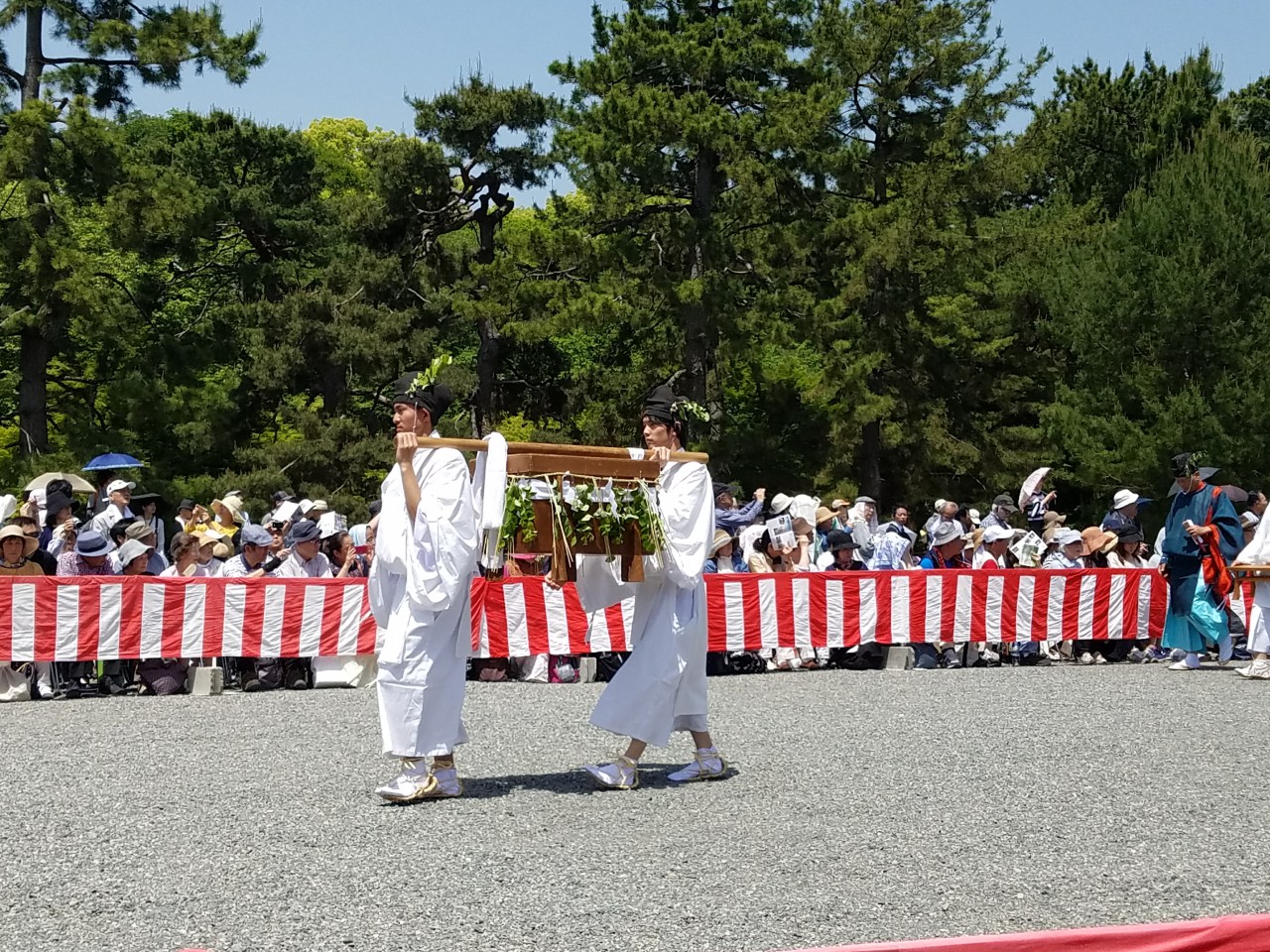
The Aoi Matsuri parade starts from the palace complex down this long avenue, on its way through the park.  It consists of over 500 people, and the occasional draft animal, dressed in costumes of the Imperial court from the Heian period (AD 9th-12th centuries).  From the signs on these saddles, it looks like some real police officers joined in to help lead the procession in-character.

The rituals at the Kamo shrines include horse races and horseback archery.  I wonder if these men are taking part in any of that...?

The equipment and costumes of the procession incorporate leaves and petals of the hollyhock flower (shown atop this basket), for which the festival is named.

Hollyhock petals are also featured in the emblem of the Tokugawa clan (shown in the middle of this drum), the shoguns who ruled Japan during the Edo period.

Not all of the flowers featured during the procession were hollyhocks, but they still coordinated well with the many colours of the marchers' robes, from yellow...


...to white.

The weather that day was clear, sunny, and unusually warm, with temperatures in Kyoto reaching highs of over 30°C (86°F).  I'm sure this young lady appreciated the shade.  On the other hand, we in the paid seats were instructed to take down our own umbrellas when the parade started, so as not to block other peoples' views.  Good thing we had hats!

The centrepiece of the procession is a maiden known as the Saio (斎王, saiō).  In early traditions, the Saio was a young female member of the Imperial family who pulled double-duty as the priestess of the two Kamo shrines.  Nowadays, since 1956, the Saio selected for this function can be any unmarried woman from Kyoto.  The kimono worn by the Saio for this event is called a Junihitoe (十二単), named after the twelve pieces it is (nominally) comprised of.

Now that the role of Saio is open to the public, any one of these young girls could earn this prestigious honour.  I'd bet that's something to look forward to...!

Finally, on our way out, we met this charming fellow who, although not taking part in the parade itself, was dressed for the occasion and let us take his picture.  I have no idea whom he was, but I do hope he enjoyed himself that day!

Well, that's it for me for Kyoto.  Find out where we set up camp next, and how we got there, next time on Sekai Ichi!


Hours: The festival parade takes place on the 15th of May, at the times listed earlier in this article.  In the event of inclement weather, the event will be held on the following 16th, and if that date gets rained out too, it will be cancelled for that year.

Cost: Paid seating is available at the Imperial Palace and Shimogamo Shrine for ¥2,700, and at Kamigamo Shrine for ¥1,000.  Tickets for the Imperial Palace and Shimogamo Shrine can be purchased through convenience stores and certain websites.  Tickets for Kamigamo Shrine must be purchased at the shrine itself, at noon on the festival day.  Seating with an English audio guide included is available only for the Imperial Palace, for ¥4,300.  These tickets can be purchased at the tourist information centres at Kyoto Station and Kyoto Tower.

When I attended the festival in 2018, I bought my tickets online from Voyagin (English).  For 2019, they cost US$31 for regular seating at the Imperial Palace and US$50 for seating with audio guides.  Tickets for Kamigamo Shrine go on sale at noon on the day of the festival, at the shrine itself.

Kyoto Imperial Palace

Address: 3 Kyōto-gyoen, Kamigyō-ku, Kyōto-shi, Kyōto-fu 〒602-0881

Access: The front gate of the Kyoto Imperial Palace park is 3 minutes on foot from Marutamachi Station, exit 1.  From Kyoto Station, take the Karasuma (K) subway line to Marutamachi (K07, 7 minutes, ¥260).

Shimogamo Shrine

Address: 59 Shimogamo Izumigawachō, Sakyō-ku, Kyōto-shi, Kyōto-fu 〒606-0807

Access: From Kyoto Station (stand A2), take bus #4 or #205 (anti-clockwise) to Shimogamo Jinja-mae (下鴨神社前, 30 minutes, ¥230).  Upon exiting the bus, the entrance to the shrine grounds will be on the left-hand side.

You can also walk to Shimogamo Shrine in 10-15 minutes from Demachi-Yanagi Station.  From Kyoto Station take the JR Nara (D) line to Tofukuji (D02, 2 minutes, ¥150, JR Pass OK), followed by the Keihan Main Line to Demachi-Yanagi (KH42, 11 minutes, ¥270).

Kamigamo Shrine

Address: 339 Kamigamo Motoyama, Kita-ku, Kyōto-shi, Kyōto-fu 〒603-8047

Access: From Kyoto Station, take bus #4 (stand A2) or #9 (stand B1) to Kamigamo Misonohashi (上賀茂御薗橋, 40-50 minutes, ¥230).  The shrine entrance is directly in front of the bus stop.

You can also walk to Kamigamo Station in 25 minutes from Kitayama Station.  From Kyoto Station, take the Karasuma subway line to Kitayama (K03, 15 minutes, ¥290).

Monday, August 20, 2018

Danjiri Museum

This article is based on a visit made on Sunday, 13 May 2018.

Edit 10 October 2019: Updated prices to reflect the increase in Japan's national sales tax.

Previously on Sekai Ichi, I visited the ninja museum and castle in Iga City.  Afterwards, I wrapped up our excursion with a museum we passed on the way back to the train station.  That would be the Danjiri Museum (だんじり会館, Danjiri Kaikan), which is dedicated to the local Ueno Tenjin Festival.

The Ueno Tenjin Festival (上野天神祭, Ueno Tenjin Matsuri) is held annually on 23-25 October, and dates back over 400 years.  The parade procession starts from and ends at the nearby Ueno Tenman Shrine (上野天満宮, Ueno Tenman-gu), on the east side of town.  This shrine is one of over 10,000 Tenman shrines in Japan, all of which are dedicated to the soul of the 9th-century scholar Sugawara no Michizane (菅原 道真, 845-903), posthumously deified as the god Tenjin (天神, lit. 'sky god').  In between festivals, its nine shrine floats are put on display at this museum.  A video depicting and explaining the festival plays on the screens in the back of the hall every half-hour.  It is narrated in Japanese without subtitles, but if you ask the staff, you can get a headset device to listen to it in English, and possibly other languages.

"Floats" used in Japanese festival parades are called mikoshi (神輿, lit. 'divine palanquin') or o-mikoshi (お神輿).  During festivals, the kami (for the uninitiated, a Shinto god) of a particular shrine is transferred into one of these mikoshi, effectively making them portable shrines.

Smaller mikoshi can be lifted and supported by the shoulders of carriers.

Larger mikoshi, on the other hand, need to be pulled by their supporters.

Lanterns are common decorations for mikoshi, and pretty much everywhere else, come festival time.

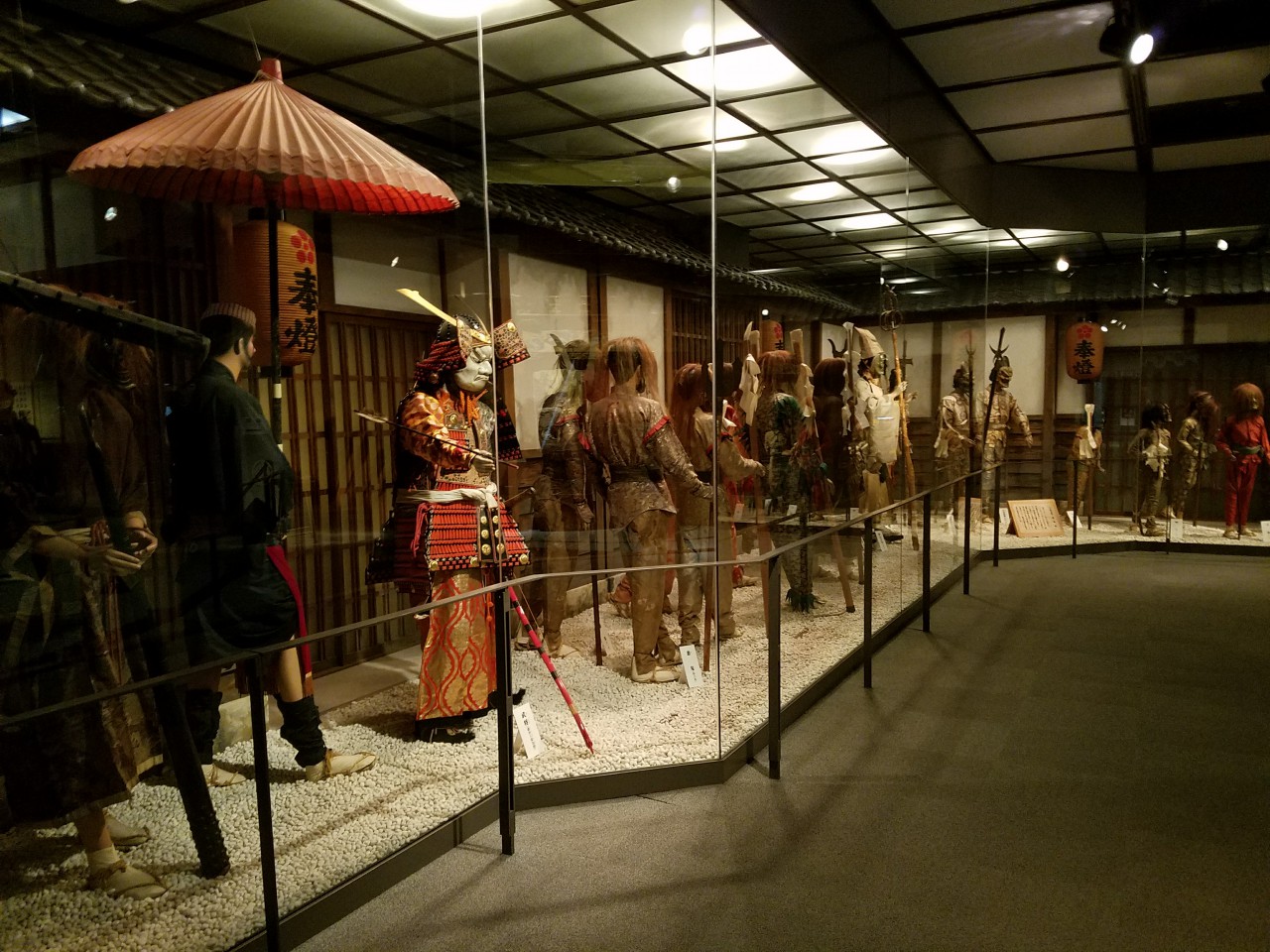
The Ueno Tenjin procession also includes a hundred paraders dressed in costumes with oni masks.  Oni (鬼) are demons in Japanese folklore.  They serve as the bad guys in many folktales, but for festivals, they instead protect the town from bad luck by scaring away evil spirits... and children, most likely.

Speaking of costumes, the Danjiri Kaikan is also the place where you can rent ninja costumes to dress up in for the day!  This service is available from 10:00 AM to 4:00 PM, and costs ¥1,080 per person.  The colours available include black, blue, red, and pink, so historical accuracy is not as important here as is the simple fun of dressing up, which has its merit I'll admit.  It's popular with the kids, although I'm sure there are adult sizes available as well.

I would have been willing to try on a ninja costume, but it was late, it was rainy, and I had a bus to catch.  So, in contrast to the complicated train journey we took on the way up, the bus was a one-shot, ninety-minute (actually two hours with highway traffic) hop back to Kyoto Station.  With barely anybody else on board, it was just what I needed to dry off and relax as we drove through the other ninja town, Koka, and on the Meishin Expressway back to Kyoto.  Indeed I would have taken a bus into Iga-Ueno also, but A) its only viable departure time wouldn't have worked out as well, and B) I had a Japan Rail Pass and wanted to use it.  Bit of a short day, but I've got lots more coming on Kyoto itself.  All this and a new Know Your Trains, next time on Sekai Ichi!


Hours: Open 9:00 AM to 5:00 PM.  Admission ends 30 minutes before closing time.  Closed on one day in the 2nd or 3rd weekend in April, 23-25 October, and 29 December-1 January.

Costs: ¥600.

Address: 122-4 Ueno Marunouchi, Iga-shi, Mie-ken 〒518-0873

Access: Danjiri Kaikan is five minutes on foot from Ueno-shi Station.

Directions: From the exit of Ueno-shi Station, head across the parking lot, turn left, and cross the tracks.  The museum is at the corner of the second traffic light, on the right side.

Website(Japanese)

Friday, July 27, 2018

Fuji Shibazakura Festival

This article is based on a visit made on Friday, 11 May 2018.

Previously on Sekai Ichi, I spent the day on a private guided tour of the Fuji Five Lakes, stopping at many lesser-known, out-of-the-way spots that managed to leave a big impression on me.  However, it was all leading up to one place I was anticipating most above all else: the Fuji Shibazakura Festival.

But first, we stopped at Lake Shoji (精進湖, Shōji-ko) along the way.  Shoji-ko is the smallest of the Fuji Five Lakes, and also the least developed, but nonetheless attracts people interested in outdoor activities, like the kayakers paddling across here.  I think this is my second-favourite view of Mount Fuji, behind only the one from Lake Sai.  From this shot, taken from the northwestern corner of Shoji-ko, the centre of Fuji-san appears cut out by another mountain in front, namely Mt. Omuro (大室山).

Did you know that Shoji-ko, Sai-ko, and Motosu-ko used to be one combined lake?  It's true -- at least, it was until the mid-9th century AD, when an eruption from Fuji-san divided this lake into the three lakes we have today.  However, they all maintain the same surface elevation of 900m (2952 ft.) above sea level, so they must still be connected by underground tunnels somewhere.

An unexpected sight greeted me as we left the coast: a bunch of cherry trees still partially in bloom.  Which brings us to...

Fujishibazakura
By 白鳥 (Own work) [Public domain], via Wikimedia Commons
...the Fuji Shibazakura Festival.  Every year from mid-April to May/June, a park near Lake Motosu (本栖湖, Motosu-ko) is transformed by carpets of pink phlox moss flowers.  This is an example of the flowers at peak bloom...


...and this is what it was like when I arrived.  The unusually warm season had also accelerated the blooming period ahead of our arrival, but since this place was higher up elevation-wise, it wasn't quite as bad as I had seen elsewhere.  This year (2018), the festival ran from 15 April to 27 May, ending earlier than usual.

Luckily, some spots were more densely-blooming than others.

Here's a close-up of the flowers.  Their species name is Phlox subulata, and they are known in Japanese as shibazakura (芝桜 / シバザクラ).  Despite their name using the kanji for cherry blossoms ("sakura"), the two plants are technically unrelated.

Five different varieties of shibazakura and various other flowers are planted throughout the festival grounds to create patchworks of pink, white, and violet.

One of the most unique features is a mound formed into a model of Mount Fuji, coloured with pink and white shibazakura.  Here it is next to the real thing.

And here it is again, as seen from a viewing platform at the back of the festival grounds.  It is certainly a commanding view, but I had to wait a bit for a space to become available.

The event consists of a food festival to go along with the flower festival.  The stands set up here serve all sorts of dishes made with ingredients which the region is famous for.  Mainstays include Shizuoka-style yakisoba noodles, and pork from Yamanashi prefecture.  New items get introduced every year, such as croquettes made from potatoes grown in Mishima, Shizuoka prefecture.

I myself tried, and enjoyed, a pork bun and a malasada (shown above.)  A malasada is a kind of powdered doughnut originating from Portugal (the name is Portuguese for "poorly-cooked"), but especially popular in Hawaii.  I first heard about them from, of all things, Pokémon Sun and Moon, whose game world is a fictional version of Hawaii.  This one here was not only cherry-flavoured, but came with a scoop of cherry ice cream and a shibazakura-leaf garnish.

I also purchased a box of sakura senbei crackers, which I took a pic of when I got back home.


As an added bonus, here are a few pictures we took on our drive back to Kawaguchi-ko.  We took a detour into the Asagiri Highlands (朝霧高原, Asagiri Kōgen), due south of Motosu-ko and west of Mt. Fuji.  This plateau is famous for two things: one, their dairy cows, and two, their paragliding activities.  Can you spot both of those things in this picture?  (The paraglider is in the upper-right corner.  See the parachute?)

We also stopped at an overlook point to catch this glimpse of Motosu-ko.  And with that, I can officially state that I have borne personal witness to all of the Fuji Five Lakes.

Chris took us on these detours in order to stay off the main roads, as traffic can be a big problem coming to or from the festival site.  Our detour took us right through the middle of Aokigahara.  Eventually we did meet up with the main road, and a minor traffic jam along with it, but got to see this big bloom of white wisteria during our delay.

One last look at Kawaguchi-ko.  As we were driving back to the station, Chris helped us arrange our transportation back to Tokyo, which I hadn't booked since I didn't know when we would finish.  He called up Fujikyu, the bus company, and tried to reserve one of the buses back to Tokyo.  The Tokyo Station line (which we had taken up that morning) was fully booked for the evening, and while there was an available bus to Shinjuku Station, it wasn't due to leave for a while, and there was a risk of running into traffic on the highway.

In the end, we wound up taking trains instead: the local Fujikyu line, followed by the Kaiji limited express (pictured above, at Otsuki Station) to Shinjuku, and that wound up working much better.  We didn't have to worry about getting seats on either, and we had our Japan Rail Passes with us, so the latter train was free.  We even got seats in the Green Car, and that extra leg space was just what we needed after exploring the Fuji Five Lakes!

For my sign-off selfie, of course I had to take one at the festival's viewing platform.  All things considered, the Fuji Shibazakura Festival is a wonderful, one-of-a-kind experience.  Given the condition I saw it in, I did feel a tad disappointed, but then again I had also been taken to so many unique and impressive places I would not have considered otherwise.  Chris was wise to hold off on taking us here until the end of the day.  Looking back, I would call this my favourite time of my entire holiday, although some stiff competition for that title would present itself later on.  Keep reading Sekai Ichi to find out what and where I could possibly be referring to!


Hours: Open from 8:00 AM to 5:00 PM, during the festival period.  In 2018, the festival ran from 15 April to 27 May.

Address: 212 Motosu, Fujikawaguchiko-machi, Minamitsuru-gun, Yamanashi-ken 〒401-0337

Costs: ¥600.

Access: From Kawaguchiko Station, "Shibazakura Liner" shuttle buses make direct trips to the festival site, taking 35 minutes and departing once or twice an hour.  A one-way ticket costs ¥1,230, while a round-trip ticket costs ¥2,000 and includes admission to the festival.  Additionally, select regular buses bound for Shin-Fuji Station (新富士駅, Shinfuji-eki) stop at the site during the festival period (50 minutes, once every 2 hours, ¥1,230).

Note: None of the Omni-Bus lines go to the festival venue.  The nearest stop, Lake Motosu-ko on the Blue Line, is 3km (2 mi.) away.

Website(English) (Japanese)