COVID-19 Coronavirus Notice

COVID-19 Coronavirus Notice

Updated 2 July 2020

If you are reading this message, please be aware of travel restrictions in place as part of measures to contain the spread of the COVID-19 "Coronavirus" and its symptoms. Japanese authorities are refusing entry to individuals from, or who have been to, a list of over 100 countries (More information). All other visitors must apply for a visa, and undergo a quarantine upon entering the country. Within the Japan, there are no longer any travel restrictions, and most public attractions have re-opened with precautions for sanitation and social distancing. In short, travel to Japan is not recommended at this time, until the situation normalises. I will not be editing my individual articles to reflect this, but again, please keep this in mind when reading them.
Showing posts with label museums. Show all posts

Tuesday, May 26, 2020

Top Ten Anime and Manga Museums

Edit 10 October 2019: Updated prices to reflect the increase in Japan's national sales tax.
Edit 26 May 2020: Replaced entry #9.

Previously on Sekai Ichi, I spent a day in Kyoto, including the Toei Kyoto Studio Park.  In addition to live-action productions, Toei is famous as one of Japan's most prolific animation studios.  Kyoto also happens to be the home of the Kyoto International Manga Museum.  With experience of both under my belt, I think now would be the best time to list ten of the best places one can learn about and experience the popular arts of manga, Japanese comic books, and anime, Japanese animated films and TV shows.


In the interest of fairness, and because I have not yet experienced many of these places in person, this list is ordered not by quality, but by geographic location, going from north/east to south/west.  I also wish to give special thanks to the website Anime Tourism 88, proprietors of Japan's 88-site Anime Pilgrimage list, for additional research used in this article.  More information:  (English) (Japanese)

1) Yokote Masuda Manga Museum, Yokote
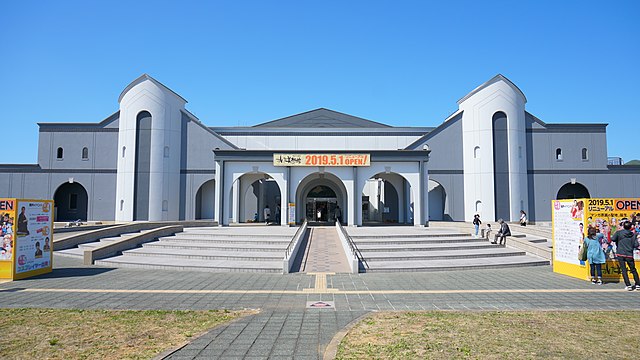
The Yokote Masuda Manga Museum, after its 2019 refurbishment.
掬茶 / CC BY-SA
Opened in 1995, the Yokote Masuda Manga Museum makes claim to being the first manga-related museum in Japan.  Its unique, nature-inspired interior houses a manga library, galleries of illustrations by manga artists, and a recreated studio of local author Takao Yaguchi (矢口 高雄, Yaguchi Takao, b.1939).  He was best known in the 1970s for writing the manga series Fisherman Sanpei (釣りキチ三平, Tsurikichi Sanpei), about the adventures of a young fisherman.  Yokote, located in eastern Akita prefecture, is also famous for the annual Kamakura Festival, where dozens of snow huts in various sizes are erected throughout the city.

285 Shinmachi, Masuda-chō, Yokote-shi, Akita-ken, 〒019-0701.  Open from 9:00 AM to 5:00 PM.  Admission ends 30 minutes before closing time.  Closed Mondays.  Costs ¥800.  More information: (Japanese)

2) Ishinomori Manga Museum, Ishinomaki
gleam_df / CC BY
Also known as the Ishinomori Mangattan Museum (a play on "Manhattan"), this museum is dedicated to and named after Shotaro Ishinomori (石ノ森 章太郎, 1938-1998), who was born in the vicinity.  Ishinomori-san holds a Guinness World Record for the most comics published by one author; his career has produced a total of 128,000 pages in 500 volumes across 770 titles, the most famous being Cyborg 009 (1963).  He also developed live-action hero TV shows such as Kamen Rider (1971) and Himitsu Sentai Goranger (1975), the first in the Super Sentai franchise.  This museum, along with the rest of Ishinomaki city, suffered damage from the Great East Japan Earthquake and tsunami of March 2011, but reopened, arguably better than ever, within a couple of years.

2-7 Nakaze, Ishinomaki-shi, Miyagi-ken 〒986-0823.  Open from 9:00 AM to 6:00 PM.  Closed on the third Tuesday of March to November.  Costs ¥840.  More information: (English) (Japanese)

3) Niigata Manga Animation Museum & Niigata City Manga House, Niigata
The Niigata City Manga House.
DAI-nk / CC BY-SA
Niigata is the hometown of many famous manga authors and animators, including Rumiko Takahashi (Ranma ½, Inuyasha), Takeshi Obata (Hikaru no Go, Death Note), and One (One Punch Man, Mob Psycho 100).  So in its honour, I have not one, but two sites to represent it with!  First is the paid-entry Niigata Manga Animation Museum, which has interactive exhibits about making anime and manga, and childrens' play areas with characters from some of the above creators.  And second is the free-entry Niigata City Manga House, whose reading room carries over 10,000 books.  Additionally, like the Comiket in Tokyo, Niigata hosts a bimonthly fan-comic convention called the Niigata Comic Market, or "Gataket" for short, which is the largest of its kind on the Sea of Japan coast.

Niigata Manga Animation Museum: 2-5-7 Yachiyo, Chūō-ku, Niigata-shi, Niigata-ken 〒950-0909.  Open from 11:00 AM to 7:00 PM; opens at 10:00 AM on weekends and holidays.  Closed on 1 January.  Costs ¥200.  More information: (English) (Japanese)

Niigata City Manga House: 971-7 Furumachi-dōri 6-banchō, Chūō-ku, Niigata-shi, Niigata-ken 〒951-8063.  Open from 11:00 AM to 7:00 PM.  Closed on Wednesdays, and from 29 December to 3 January.  Free to enter.  More information: (English) (Japanese)

4) Ghibli Museum, Tokyo
The exterior of the Ghibli Museum.
Taken by the author on Wednesday, 9 May 2018.
The Ghibli Museum, the official museum of Studio Ghibli, was personally designed by Hayao Miyazaki (宮崎 駿, b. 1941), the director of many of Ghibli's highly-acclaimed films.  Their list of works includes such beloved titles as My Neighbor Totoro, Kiki's Delivery Service, Princess Mononoke, Spirited Away, and many more.  Since I first reported on the Ghibli Museum, they have opened up online ticket sales to overseas, English-reading visitors, making this place no less competitive to get in, but far more accessible, and in some cases affordable, than ever before.

1-1-83 Shimorenjaku, Mitaka-shi, Tōkyō-to 〒181-0013.  Open from 10:00 AM to 6:00 PM.  Closed on Tuesdays.  Costs ¥1,000; advance reservations required.  More information: (English) (Japanese)

Elsewhere in Tokyo, I also recommend:
  • Suginami Animation Museum: A small, but free, general exhibition of animation, with some hands-on activities.  Open from 10:00 AM to 6:00 PM.  Closed on Mondays, and from 28 December to 4 January.  Free to enter.  More information: (English) (Japanese)
  • One Piece Tower: An indoor theme park with a specific focus on One Piece, located at the base of Tokyo Tower.  Open from 10:00 AM to 10:00 PM.  Costs ¥2,300, or ¥3,300 with admission to a live show.  More information: (English) (Japanese)
5) Fuji-Q Highland, Fujiyoshida
Evangelion World at Fuji-Q Highland.
Taken by the author on Wednesday, 16 November 2016.
The Fuji-Q Highland theme park has a couple of anime-themed attractions, such as the GeGeGe no Kitaro Haunted Mansion, but the big one, almost worth the price of admission alone, is Evangelion World.  Replacing a similar Godzilla-themed attraction, this museum-esque attraction features re-creations of sets from Neon Genesis Evangelion (新世紀エヴァンゲリオン, Shin Seiki Evangerion), the titular giant-robot anime franchise.  The centrepiece is a life-size bust of the Unit-01 robot, which features in a regular light show.  You may read my report from Fuji-Q Highland here, and my separate report from Evangelion World here.

5-6-1 Shin-Nishihara, Fujiyoshida-shi, Yamanashi-ken 〒403-0017.  Open from 9:00 AM to 5:00 PM, or to 6:00 PM on weekends and holidays.  No closing days.  Costs ¥800 for Evangelion World, or ¥5,900 for unlimited rides throughout Fuji-Q Highland.  More information: (English) (Japanese)

For more official Evangelion shopping, I also recommend:
  • Evangelion Store.  Open from 11:00 AM to 9:00 PM.  Located immediately north of Ikebukuro Station (JR Yamanote, Saikyo, etc. lines).
  • Eva-ya.  Open from 9:00 AM to 6:00 PM.  Located directly below Hakone-Yumoto Station (Hakone-Tozan line).
6) Go Nagai Wonderland Park, Wajima
Indiana jo / CC BY-SA
Go Nagai (永井 豪), born Kiyoshi Nagai (永井 潔, b. 1945), whose manga career has just marked its 50th anniversary, is influential, iconoclastic, often controversial, and highly productive.  His most famous works include Devilman, Mazinger Z, and Cutie Honey, with the latter two series codifying the giant-robot and magical-girl subgenres of anime.  This museum dedicated to his many manga creations is located in his hometown of Wajima, a city on the Noto Peninsula, along the city's famous Morning Market.

1-123 Kawaimachi, Wajima-shi, Ishikawa-ken 〒928-0001.  Open from 8:30 AM to 5:00 PM.  No closing days.  Costs ¥520.  More information: (English) (Japanese)

7) Kyoto International Manga Museum, Kyoto
The courtyard of Kyoto International Manga Museum.
Taken by the author on Friday, 18 November 2016.
A particular favourite haunt of mine whenever I'm in town, the Kyoto International Manga Museum was established in 2006 in a former school building.  The museum boasts a collection of 50,000 manga books that are free for visitors to read, and uniquely for these types of museums, a fair selection of them are in English and other languages.  In good weather, the courtyard (shown above) is a pleasant place to read the books, or even meet up for cosplaying. You may read my report from the Kyoto International Manga Museum here.

Kinpuki-cho, Nagagyo-ku, Kyoto-shi, Kyoto-fu 〒604-0846.  Open from 10:00 AM to 6:00 PM.  Closed on Mondays and 1 January.  Costs ¥800.  More information: (English) (Japanese)

Elsewhere in Kyoto, I also recommend Toei Kyoto Studio Park.  The theme park and studio of this major film/TV company also has content related to its many anime productions.  You may read my report from Toei Kyoto Studio Park here.

8) Osamu Tezuka Manga Museum, Takarazuka
DVMG / CC BY
Osamu Tezuka (手塚 治虫, Tezuka Osamu, 1926-1989) is often likened as Japan's Walt Disney.  Of course there have been comics and animation made in Japan long before Tezuka-san's heyday in the 1950s and '60s, but his success shaped these industries into the juggernauts they are today.  His manga stories, including Astro Boy, Kimba the White Lion, Princess Knight, and Black Jack, were adapted into some of the earliest and most popular TV anime series.  After his death, this museum was built in his honour in his home city of Takarazuka, a suburb of Osaka and Kobe.  If the name Takarazuka rings a bell to visitors, it may also be because of the all-female Takarazuka Revue theatre troupe.  They are, of course, named after the city, and perform there as well as across the country.

7-65 Mukogawa-chō, Takarazuka-shi, Hyogo-ken 〒665-0844.  Open from 9:30 AM to 5:00 PM.  Closed on Wednesdays, 29-31 December, and 20-28/29 February.  Costs ¥700.  More information: (Japanese)

9) Shigeru Mizuki Memorial Museum, Sakaiminato
Aimaimyi / CC BY-SA
Shigeru Mizuki (水木 しげる), born Shigeru Mura (武良 茂, 1922-2015), was the author of GeGeGe no Kitaro (ゲゲゲの鬼太郎).  Its titular hero, Kitaro, is a young lad who helps out humans in their affairs with yokai (妖怪), folklore monsters, both friend or foe.  Even the walk up to the museum along the aptly-named Mizuki Road, with murals, statues, and other decorations of his yokai-inspired characters dotted liberally along the way, makes for part of the experience.  All this is located in Mizuki's hometown of Sakaiminato, as little as 40 minutes away by bus from the castle city of Matsue.

5 Honmachi, Sakaiminato-shi, Tottori-ken 〒684-0025.  Open from 9:30 AM to 6:30 PM.  No closing days.  Costs ¥300.  More information: (English) (Japanese)

Elsewhere in Tottori Prefecture, I also recommend the Gosho Aoyama Manga Factory, devoted to the series Detective Conan (名探偵コナン, Meitantei Konan), known in English as Case Closed, and its author.  Open from 9:30 AM to 5:30 PM.  No closing days.  Costs ¥700.  More information: (English) (Japanese)

10) Kitakyushu Manga Museum, Kitakyushu
Asai1920 / CC BY-SA
Just across the street from Kitakyushu's main train station, Kokura, stands the AruAru City mall, a manga, anime, and pop-culture marketplace in the vein of Tokyo's Akihabara district.  On top of that, in more ways than one, is the Kitakyushu Manga Museum, occupying the two upper-most floors of the building.  Among its regular exhibits, there is a special focus on local manga artists, and in particular Leiji Matsumoto (松本 零士, Matsumoto Reiji), born Akira Matsumoto (松本 晟, Matsumoto Akira, b. 1938), one of the many artists to have originated from this city.  Matsumoto-san is best known for the space-opera series he created in the 1970s: Space Battleship Yamato, Galaxy Express 999, and Space Pirate Captain Harlock.  As with the manga museums in Kyoto and Niigata, there is a wide selection of manga books for visitors to read freely, although note that there is limited English content throughout this museum.

Aruaru City 5F, 2-14-5 Asano, Kokurakita-ku, Kitakyushu-shi, Fukuoka-ken 〒802-0001.  Open from 11:00 AM to 7:00 PM; closes at 8:00 PM during Summer holidays.  Closed on Tuesdays and New Year holidays.  Costs ¥480.  More information: (English) (Japanese)

Wildcard) World Cosplay Summit
A presentation for World Cosplay Summit 2014, held at Chubu Centrair Airport.
M338 / CC BY-SA
For my wildcard slot, rather than another museum, I thought I'd pick out a regular event related to anime and manga.  There are lots to choose from, from trade shows like AnimeJapan to fan-comic marketplaces like Comiket and the aforementioned Gataket.  But the one that has impressed me the most is the World Cosplay Summit, held in late July/early August in Nagoya.  Cosplay, the art of making and wearing costumes of characters anime, video games, etc., is already a popular sight at related conventions, both in Japan and abroad.  The World Cosplay Summit takes this hobby to an all-new level.  The cosplayers, selected by preliminary contests held all over the world, take part in a parade around the Osu Kannon temple and shopping district, which is already a popular choice for anime-related shopping year-round.  Then comes the main event, the World Cosplay Championship, where teams from each participating country perform skits as the characters they portray.  The costume details, the players' performance, and the special effects all make it feel like your favourite characters have come to life!

More information: (English) (Japanese)

Thursday, October 24, 2019

Takayama Showa-kan

This article is based on a visit made on Friday, 18 May 2018.

Previously on Sekai Ichi, I visited the Sakurayama Hachiman shrine, home to a museum about the city's semi-annual festivals.  Its location proved to be a fine starting point for walking into another of Takayama's most famous attractions, the old town.  However, on the way there, we stopped at a museum offering a more recent slice of history: the Takayama Showa-kan (高山昭和館) museum.

What is Showa?  In Japan, the reign of each Emperor is given a unique title, which is also bestowed upon that Emperor himself after his death.  For example, the reign that started this year (2019) is called the Reiwa era (令和, lit. 'fair peace').  The Showa era (昭和, lit. 'enlightened peace'), then, was the period ruled over by Emperor Hirohito, lasting from 1926 to 1989.  This holds the record for the longest reign of a Japanese Emperor, and indeed, much happened to Japan during these 64 years, some of it infamously unfortunate.  But most Japanese who were alive back then associate Showa more strongly with its post-war half, from the mid-1950s on, when the country embraced democracy and capitalism, and its economy grew at a meteoric rate.

The halls of this museum are done up to resemble a cityscape that may have been seen in 1955 or so, and are lined with rooms which re-create different kinds of homes or businesses.  The car seen above is a Daihatsu Midget, a three-wheeled mini-truck first manufactured in 1957.  They came in one-seater and two-seater varieties; the model in this museum is the latter, and you can even sit inside it.

This room is the living quarters behind a general store; the store's counters are out of frame.  It would be interesting to compare these to the model homes in, say, the Fukugawa Edo Museum.  Maybe this is just one room out of many in the house, maybe it isn't.  Living standards had certainly improved since the Edo period, but space has always been precious in urban Japan.  One thing's for sure: there was a wider variety of stuff available in the Showa period.  The TV in back plays a loop of vintage shows, and there is a shogi (a Japanese strategy game which evolved from chess) board which these two 21st-century ladies are happily chatting over.

Moving on to the restaurant, and -- hel-lo, whom do we have up there...?

I'll try to ignore that temptation, and instead take a closer look at the food models adorning the restaurant's shopfront, which is common in Japan even today.  The advent of plastic manufacturing gave restaurateurs the ability share their menus beyond the barriers of language.  I, and many others, I'm sure, are thankful for that.

One of the rooms you can enter from the main hall is an appliance store.  Electric appliances like these became status symbols of the post-war Japanese.  Junichiro Koizumi, the Prime Minister from 2001-2006, compared the most sought-after home goods of a given time to the three treasures that make up the Imperial Regalia of Japan; for example, the washing machine, refrigerator, and black-and-white TV.  I mentioned this comparison in detail before, on my article on the Edo Tokyo Museum.

Next door is a toy store.  I described the evolution of Japanese toy trends in another article, on the Arima Toys and Automata Museum.  The collection on display here encapsulates the transition period I described then.

The second floor offers more to explore, such as rooms from a private home and a school.  I honestly doubt that every student in a given class would use their own typewriter, but having them here does help to show the evolution of technology that took place during this time.

Speaking of technology, video games also helped define the late Showa period.  Japanese arcade games like Space Invaders and Pac-Man became worldwide phenomena in the late '70s and early '80s, and Nintendo and Sega both launched their first home consoles in 1983.  Here, on the second floor of the Showa-kan, you can play on a couple of Nintendo's Famicom and Super Famicom systems.  (The latter was actually launched in 1990, after the Showa period ended, but... eh, close enough.)

However, an even more widespread pasttime in Japan, both then and now, is pachinko (パチンコ).  To play, you shoot little metal marbles into a vertical board lined with pegs.  The balls bounce around these pegs on their way down, and if they fall into the right holes, you'll get additional balls to keep playing with.  It bears resemblance to pinball, but the player's only control is how rapidly the balls are shot into play.  The balls you earn can be exchanged for prizes, and even though most gambling is illegal in Japan, there is a booming grey market of exchanging those prizes back for cash.  At the Showa-kan, you can try out some old-style pachinko machines for free.  No prizes, though.  As for the real thing, pachinko parlours are very widespread across Japan, but the experience of being in one is extremely loud, like a casino on steroids.  I think I'll stick to video game centres if that's all the same to you.

Or, I could just go out and visit Takayama's old town.  Join me there, next time on Sekai Ichi!


Hours: Open from 9:00 AM to 6:00 PM.  No regular closing days.

Cost: ¥800.

Address: 6 Shimo-Ichinomachi, Takayama-shi, Gifu-ken 〒506-0858

Access: From the Takayama Bus Centre, take the Machinami loop bus to Betsu-in Temple (別院前) (¥100).  The Counterclockwise route takes 11 minutes to get to this stop, while the Clockwise route takes 21 minutes.  From the bus stop, head west, downhill along the main road, and take the third right, at the traffic light.  The museum will soon be on your left.

You can also reach the museum in about 15 minutes on foot from Takayama Station.  Turn left out of the station's East Exit, then take the second right at the traffic light.  Continue on up the main road for about 850m (½ mile).  After crossing the river, turn left at the next traffic light.  The museum will soon be on your left.

Website(English) (Japanese)

Friday, October 18, 2019

Takayama Festival Museum

This article is based on a visit made on Friday, 18 May 2018.

Previously on Sekai Ichi, I embarked on a day-trip to Takayama, starting with the Hida Folk Village just outside of town.  Now, the city of Takayama is especially famous for its festivals, held twice-yearly: the Sannō Matsuri (山王祭り) in spring (14-15 April), and the Hachiman Matsuri (八幡祭り) in autumn (9-10 October).  From what I have gathered, it is supposed to be a stunning experience, especially in the presence of the massive shrine-floats, or yatai (屋台), that are carried about the old town.  But, as you can tell from the dateline at the top of this article, I obviously missed out on either of the festivals.  Fortunately, there are places where one can witness glimpses of the festival experience year-round, and one such place is the Takayama Festival Hall (高山祭屋台会館, Takayama Matsuri Yatai Kaikan), where some of the actual yatai used in the processions are stored when not in use.

This museum is located in the grounds of Sakurayama Hachiman-gu (櫻山八幡宮), the Shinto shrine which serves as the base of the autumn festival.  The spring festival is based at Hie Shrine in the south side of town.  The bus from Takayama Station drops you off near this wooden torii gate.  It's one of the larger toriis I've yet seen in person, and it would have to be in order for the festival floats to fit underneath (which I'm not sure if they do).

For a shrine in a city of this size, Sakurayama Hachiman-gu has a nice bit of woods surrounding it to the back.  I think the unpainted wooden tones of its main hall fit in nicely.

As a Hachiman shrine, also related to the one in Kamakura, it is dedicated to the Shinto war god of the same name.  Hachiman is the second-most prevalent deity out of all the Shinto shrines in Japan, second only to Inari-Okami (as in Kyoto's Fushimi Inari Shrine) [1].  As such, the bronze horse statue near the entrance does fit the theme of cavalry soldiers or archers.

Paying your way into the museum, you will enter a giant hall, and follow the path around the windowed-off centre of the room where the floats are parked.  The floats on display in this museum are the same ones that are used in the festivals every year.  The selection is rotated three times a year, in March, July, and November; the rest are privately stored elsewhere around the city.  When it's time for them to be moved out, one of the room's walls has a massive sliding door big enough to move the floats out through.

The shorter golden float shown above is the mikoshi (神輿), which temporarily houses the patron deity of the shrine.  In essence, a mikoshi is a portable shrine.  The one here weighs in at a massive 2 and a half tons (2,267 kg), and takes 80 people to move it!

The other yatai are much taller than the mikoshi --  the "Jinma-tai" (神馬台), shown above, is the tallest at 8 metres (26 feet and 3 inches) -- but come equipped with wheels and require fewer people to pull them about, about 20 to 30.  A hidden fifth wheel is used to turn the yatai in place.

Another testament to the intricate adornments of these yatai are the moving puppets that occupy the upper tiers.  For example, on the "Hotei-tai" (布袋台), a larger figure stands out and waves, while a smaller figure swings itself across the bars hanging out to the side, one at a time, before ending up on the bigger guy's shoulder!  The whole thing is operated by eight puppeteers, and even if I can't say whether or not they were working the thing in person while the float was at rest in the museum, it was impressive to watch!

Another fun thing to watch would be the video that plays on loop in a back room.  It shows footage and explanations about both festivals, with Japanese narration and English subtitles.  Visitors may check it out on their way up and around the museum, culminating with close-ups with a few more artifacts from the festivals such as yatai wheels or happi coats (shown), before reaching the exit.


Also located in the shrine complex, and included with admission to the Yatai-kan, is the Nikko-kan (桜山日光館, Sakurayama Nikkō-kan).  This large hall contains scale models of Tosho-gu Shrine (東照宮, Tōshō-gū).  The real Tosho-gu is located in Nikko, all the way back in the Kanto region.

Tosho-gu (the real one, that is) serves as the mausoleum of Tokugawa Ieyasu (徳川家康, 1543-1616), a successful warlord who kicked off the Tokugawa Shogunate, the shogun dynasty which effectively ruled Japan from Edo (modern-day Tokyo), for over 250 years.  In respect to his grand status, his initially-simple mausoleum was expanded upon by his grandson, Tokugawa Iemitsu (徳川家光, 1604-1651).  Pictured above is the Yomei-mon (陽明門), the giant gate which stands in front of the shrine's main hall.

To end this article, let's appreciate the detail of the miniature Tosho-gu with a close-up shot.  The full-sized counterpart is no less ornate.  After all, it is the origin of the famous "three wise monkeys" woodcarving.  I hope to see it myself in person some day, along with the rest of Nikko.  But for now, I have another one of Japan's must-see places to cross off my bucket list.  Next time on Sekai Ichi, I shall venture into Takayama's old town!


Hours: Open from 9:00 AM to 5:00 PM; closes at 4:30 PM from December through February.  No regular closing days.

Cost: ¥900; includes entry to both the Yatai Kaikan and Nikko-kan.

Address: 178 Sakura-machi, Takayama-shi, Gifu-ken 〒506-0858

Access: From the Takayama Bus Centre, take the Machinami loop bus to Sakurayama Hachiman-gu (¥100).  The Counterclockwise route takes 12 minutes to get to this stop, while the Clockwise route takes 17 minutes.

Website: (English) (Japanese)


[1] Motegi, Sadazumi. "Shamei Bunpu (Shrine Names and Distributions)" (in Japanese). Encyclopedia of Shinto. Retrieved 17 October 2019.  http://k-amc.kokugakuin.ac.jp/DM/detail.do?class_name=col_eos&data_id=22988

Monday, September 30, 2019

Hida Folk Village

This article is based on a visit made on Friday, 18 May 2018.

Previously on Sekai Ichi, I introduced the city of Takayama, which is where I went on the tenth full day of my vacation.  To get there from Toyama, I took the Wide View Hida express, which I have written about before in a Know Your Trains article, for a 90-minute ride south into the heart of Honshu.

As I described in the above article, the Wide View trains live up to their name not only with extra-large windows along the sides, but also with a wrap-around front window on the end car.  It is ordered at the front of the train when heading from Nagoya/to Toyama, and at the back in the other direction.  We got seats in that car both ways, and since it is designated as a Green Car, we had it almost all to ourselves.

The Wide View Hida is officially my favourite train journey ever, in terms of scenery.  Despite the cloudy weather, the hues of the brilliant green forests and clear blue streams shone through.  Some of the best scenery can be found in the section between Inotani and Hida-Furukawa, which the Hida covers in over half an hour without any stops.

Occasionally a cloud of mist would hover over the swiftly-flowing streams, which I also found pleasantly atmospheric.  Yet, all good things must come to an end, and we did have to leave the train eventually, but the best was yet to come.

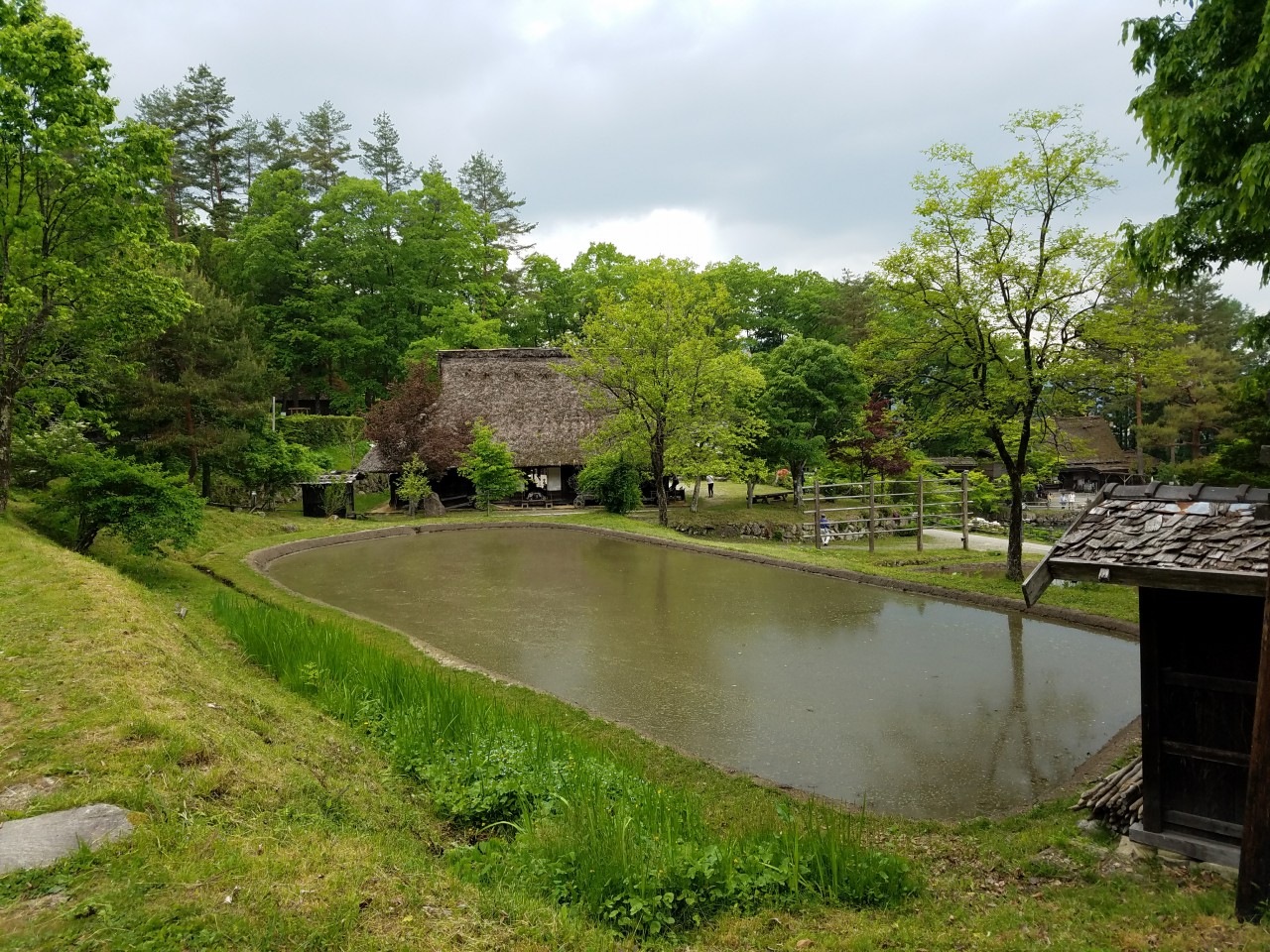
From Takayama Station, we took a bus to Hida Folk Village (飛騨の里, Hida no Sato), an open-air museum which has collected and preserved houses from farming towns across the region.  As soon as you enter the park, you are greeted with a splendid viewpoint of some of those houses from across a lake.  Many come from Shirakawa-go, which has become popular in its own right after becoming a UNESCO World Heritage Site.  Indeed, I had also planned a day trip there, since there are also direct buses that go there from Toyama, where I was staying, but ultimately I decided that it would be more convenient just to get the same experience here.

There are a few free small activities put out around here for visitors to try out.  You can put on the coat, hat, and back-mounted basket of a farmer, or even try out an Edo-period water gun.  It's one of those straight rod-like things where you push a plunger in and it shoots the water by pressure alone.  It was surprisingly hard to hit the targets posted above the lake.

There are multiple styles of houses, all grouped under the term minka (民家, lit. "house of the people"), on display at Hida-no-Sato.  They date from the Edo or Meiji periods, and most of them are open for visitors to walk in.  As you explore the houses, you'll be taking your shoes on and off a lot, and there are quite a few staircases, both inside and out.  Visitors with mobility needs should be aware of that ahead of time.

Hida no Sato holds seasonal events throughout the year.  They celebrate festivals like Girls' Day (3 March) and Boys' Day (5 May), and also some agricultural activities.  In these fields, rice is planted in the late Spring, and harvested in the following Autumn.

There were so many houses present that I didn't manage to visit nearly all of them, but the ones I did each presented different aspects of life in old rural Japan.  Inside, you will find elements like irori (囲炉裏), which are sunken fire pits used for cooking, located in the middle of the main room.  Pots are hung above the fire pit by hooked steel rods called jizaikagi (自在鉤).

When you climb up to the top levels, you will get a better look at how these homes are constructed. They are typically made without using any nails; instead, wooden beams are lashed together with rope.  The roofs are thatched with straw; the thickness (up to a metre/3 feet) and the steeply-sloped shape (up to 60 degrees) of the roofs makes them strong enough to withstand the heavy snowfalls this region is infamous for, as well as slough off rain that would cause it to rot.

The families who used to own these homes were involved in various trades, and the methods of their labour are represented here.  Exhibits within the houses show how products like silk, paper, or tofu were made back in the day, and include artifacts involved in those processes.  You may also see volunteer artisans making these crafts first-hand.

While you're there, don't forget to check out the Hida-Takayama Crafts Experience Centre, just across the road from the main entrance.  They hold paid courses, with instructions available in English, for making things like sarubobo cloth dolls and senbei rice crackers.  These courses cost ¥600 to ¥1600, and you can get discount if you present a paid ticket for Hida no Sato itself.

We went for the senbei baking experience, not only because it was the cheapest and quickest, but because I had developed a serious taste for the things in trips before.  How it works is you hold the raw crackers by a pair of tongs and hold them in the kiln-like oven in front of you.  The goal is to rotate them at regular intervals so that, as they bake and expand, they grow as flat and evenly as possible.  You get to bake ten crackers in total, alternating between lighter ones flavoured with salt, and darker ones flavoured with soy sauce.  Although it took us some time to get the routine down pat, they all came out delicious!  So for my sign-off selfie, allow me to demonstrate the fruits of my labour.  No time to bask, though, since I still have much more to cover from Takayama, including the Yatai Kaikan festival museum, next time on Sekai Ichi!


Hours: Open from 8:30 AM to 5:00 PM.  No regular closing days.  The Crafts Experience Centre is open from 10:00 AM to 4:00 PM, and is closed on Thursdays.

Cost: ¥700.

Address: 1-1-590 Kamioka Motomachi, Takayama-shi, Gifu-ken 〒506-0031

Access: From the Takayama Bus Centre, take the Sarubobo loop bus to Hida no Sato (9 minutes, ¥210).  The return trip takes about 15 minutes, but be aware that every third bus takes a detour out to the Festival Forest museum, adding 20 minutes onto the trip back to downtown Takayama.

Website: (English) (Japanese)


Thursday, September 12, 2019

Top Ten: Contemporary Art Museums

Edit 15 October 2019: Updated prices to reflect the increase in Japan's national sales tax.
Edit 25 June 2020: Replaced entry #3 and the Wildcard.

Previously on Sekai Ichi, I visited the 21st Century Museum of Contemporary Art in Kanazawa.  Whilst I very much enjoyed my time there, Japan has so many more places to experience cutting-edge modern art.  These museums, ten of which I have selected and listed below, bring together the works of avant-garde artists from within and beyond Japan alike.


In the interest of fairness, and because I have not yet experienced many of these places in person, this list is ordered not by quality, but by geographic location, going from north/east to south/west.

1) Aomori Museum of Art
The entrance of the museum, designed by Jun Aoki.
yisris / Yuichi / CC BY-SA
Aomori, the city at the far-northern tip of Honshu, is the site of our first museum.  The Aomori Museum of Art stands across from the Sannai Maruyama Archaeological Site, a park of reconstructed Jomon-era (13000-300 BC) structures, and the museum reflects its neighbour in several distinct fashions.  For example, certain outdoor works are displayed in deep concrete trenches to evoke the excavation trenches dug in the Jomon site.  This museum's signature piece is "Aomori-ken" by Yoshitomo Nara (奈良 美智, b. 1959), a giant, stark-white statue of a stylised dog.

185 Chikano, Yasuta, Aomori-shi, Aomori-ken 〒038-0021.  Open from 9:30 AM to 5:30 PM, or from 9:00 AM to 6:00 PM between June and September.  Closed on the 2nd and 4th Monday each month, and on 28-31 December.  Costs ¥510.  Website: (English) (Japanese)

Elsewhere in Aomori, I also recommend the Aomori Contemporary Art Centre.  Part of the Aomori Public College and surrounded by nature, this museum and workshop hosts different artists-in-residence every so often.  Open from 10:00 AM to 6:00 PM.  Free to enter.  Website: (English) (Japanese)

2) Towada Art Centre, Aomori Prefecture
"Flower Horse" by Jung-hwa Choi.
Angaurits / CC0
Not that far from Aomori and the popular Lake Towada, the city of Towada host its own art museum.  The museum campus is a scattered collection of multiple white, cube-like buildings connected by glass-lined halls.  Many rooms incorporate giant windows that allow some works to be seen from outside.  Additional works, cleverly-designed benches called "Street Furniture", are placed at spots along the roads outside.  This museum's signature work is "Flower Horse", by Jeong-hwa Choi (b. 1961), a five-and-a-half metre (18 feet) tall horse statue covered in colourful floral shapes.

10-9 Nishi 2-ban-chō, Towada-shi Aomori-ken 〒034-0082.  Open from 9:00 AM to 5:00 PM, closed Mondays.  Costs ¥520, or ¥1,200 for special exhibits.  Website: (English) (Japanese)

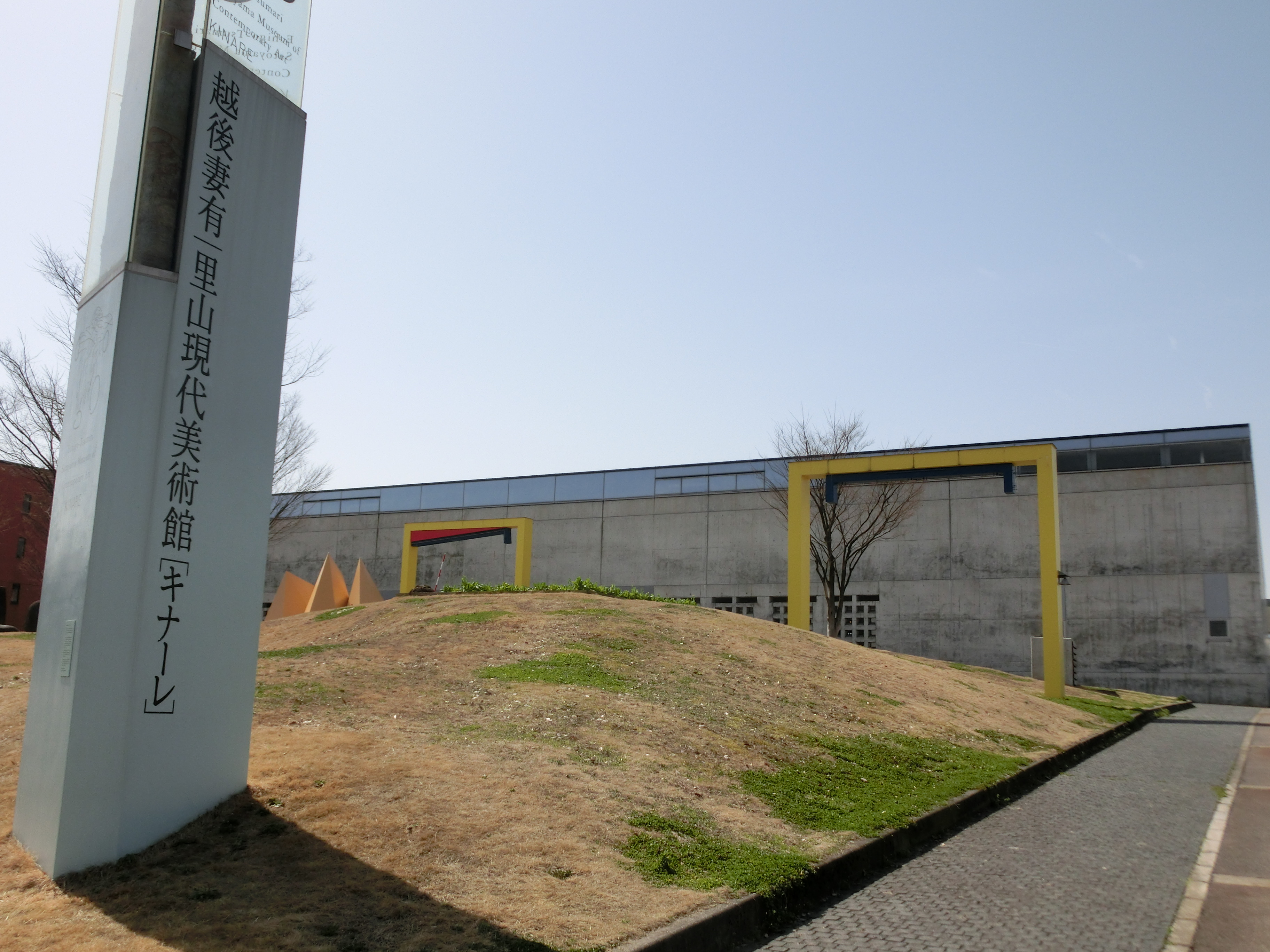
3) Echigo-Tsumari Satoyama Museum of Contemporary Art - KINARE, Niigata Prefecture
The main building of the Satoyama Museum of Contemporary Art.
Abasaa / Public domain
The Satoyama Museum of Contemporary Art, or "KINARE", is the unofficial headquarters of the Echigo-Tsumari Art Triennale, an art festival held across the area every three years.  The Echigo-Tsumari region, part of Niigata Prefecture, is surrounded by neatly-terraced rice fields, and is often besieged by heavy snowfalls in the winter.  This region is known for "satoyama", the concept of living in harmony with nature, a term which was borrowed for the name of the museum.  Even though the Triennale is held only every three years around August (next scheduled for 2021), many of its artworks have become permanent installations, both around the countryside and in this museum.

71-2 6-1 Hon-chō, Tōkamachi-shi, Niigata-ken, 〒948-0003.  Open from 10:00 AM to 5:00 PM, closed Wednesdays.  Costs ¥800.  Website: (English) (Japanese)

4) Mori Art Museum, Tokyo
The entrance to the Mori Art Museum, from within the Mori Tower building.
Wing1990hk / CC BY
The Mori Museum is located near the top of the iconic Mori Tower in Roppongi.  It holds no artworks on a permanent basis, but instead hosts multiple periodic exhibitions from Japanese and international artists alike.  For example, one of their current (June-October 2019) exhibitions, called "The Soul Trembles" by Chiharu Shiota (塩田千春, b. 1972), features works involving dense networks of red or black thread connecting chairs, boat frames, and other objects, nearly filling their entire rooms.  The Mori Museum's entry price is a little steep compared to the rest of this list, but also includes admission to the Tokyo City View, an observatory with open-air decks.

Roppongi Hills Mori Tower 53F, 6-10-1 Roppongi, Minato-ku, Tokyo-to 〒106-6108.  Open from 10:00 AM to 10:00 PM (Tuesdays to 5:00 PM).  Costs ¥1,800, including entry to Tokyo City View.  Website: (English) (Japanese)

Elsewhere in Tokyo, I also recommend:
  • National Art Centre.  Part of the "Roppongi Art Triangle" which also includes the Mori Museum.  Open from 10:00 AM to 6:00 PM (Fridays/Saturdays to 8:00 PM), closed Tuesdays.  Costs vary by exhibition, typically ¥1,000.  Website: (English) (Japanese)
  • Museum of Contemporary Art, Tokyo.  Located at Kiba Park in Tokyo's eastern wards.  Open from 10:00 AM to 6:00 PM, closed Mondays.  Costs ¥500, additional exhibition costs vary.  Website: (English)
  • Yayoi Kusama Museum.  The first museum dedicated to the stylish works of this prolific Japanese artist.  Open from 11:00 AM to 5:30 PM; timed tickets required.  Costs ¥1,000.  Website: (English) (Japanese)

5) Hakone Open-Air Museum
"Spheric Theme" by Naum Gabo.
leon&mae / CC BY
Hakone has no shortage of art museums, some of which I visited the last time I was there, and perhaps the most striking is the Hakone Open-Air Museum.  Comprising much of the grounds is the Sculpture Garden, where many twisting, imaginative works are set amidst the rolling landscape. Some installations, such as "Woods of Net" and the towering "Symphonic Sculpture", also double as play-places for children.  Another highlight is the Picasso Pavilion, a separate building dedicated to sketches and paintings by the famous Spanish artist Pablo Picasso.

1121 Ninotaira, Hakone, Ashigarashimo-gun, Kanagawa-ken 〒250-0407.  Open from 9:00 AM to 5:00 PM.  Costs ¥1,600.  Website: (English) (Japanese)

6) Matsumoto City Art Museum
The main building of the museum, with flower sculptures by Yayoi Kusama to the left.
663highland / CC BY-SA
Note: The Matsumoto City Art Museum is set to close for renovations, starting in 2021 and lasting for about a year's time.

The Matsumoto City Art Museum pays a special focus to artists born in the city and surrounding prefecture.  Chief among them is Yayoi Kusama (草間彌生), born in Matsumoto in 1929 and still active into her 90s.  She is one of Japan's most prolific living artists (as of this post) due in large part to her distinctive style, commonly involving lots of bright colours and polka-dots.  This museum's other permanent exhibitions are more on the traditional side, including sculptures by Munehide Hosokawa (細川宗英, 1930-1994), calligraphy by Kamijo Shinzan (上條信山, 1907-1997), and landscape paintings by Kazuo Tamura (田村一男, 1904-1997).

4-2-20 Chuo, Matsumoto-shi, Nagano-ken 〒390-0811.  Open from 9:00 AM to 5:00 PM.  Closed Mondays and from 29 December to 2 January.  Costs ¥410.  Website: (English) (Japanese)

7) Kanazawa 21st Century Museum of Contemporary Art
The main building of the museum, with "Colour Activity House" by Olafur Eliasson in front.
Taken by the author on Thursday, 17 May 2018.
Kanazawa's 21st Century Museum of Contemporary Art was established to collect and share "works produced since 1980 that propose new values", as per its mission statement.  Said works are shown  in rotating paid exhibitions, and as free permanent installations inside and outside the museum building.  Speaking of which, the circular-shaped building was designed with multiple entrances to encourage discovering its art from more than one angle, and also features a library and public spaces to integrate itself with the community.  Its most famous work is "The Swimming Pool" by Leandro Erlich, which does indeed look like a swimming pool from above, but...  Well, you should just see it for yourself.  Or read my report here.

1-2-1 Hirosaka, Kanazawa-shi, Ishikawa-ken 〒920-8509.  Open from 10:00 AM to 6:00 PM, or to 8:00 PM on Fridays and Saturdays.  Costs ¥1,200.  Website: (English) (Japanese)

8) Inujima Seirensho Art Museum
The refinery ruins outside the Seirensho Art Museum.
KimonBerlin / CC BY-SA
Inujima (犬島, lit. "dog island") is a small island in the Seto Inland Sea, just off the coast of Honshu.  It used to be known for exporting granite during the feudal era, and copper during the early 20th century.  Unfortunately, within a mere decade of the copper refinery's establishment, the price of copper plummeted, and the refinery was no longer able to make a profit and had to shut down.  Its buildings were left standing, however, and in 2008 their ruins were incorporated into the Seirensho Art Museum (犬島精錬所美術館, lit. "Inujima Refinery Art Museum").  Also part of the island's art initiative is the Art House Project, a collection of five artistically-redesigned houses scatted about the main village.

327-5 Inujima, Higashi-ku, Okayama-ken 〒704-8153.  Open from 10:00 AM to 4:30 PM.  Closed Tuesdays, or Tuesdays to Thursdays between December and February.  Costs ¥2,100, including entry to Inujima Art House Project and Inujima Life Garden.  Website: (English) (Japanese)

9) Benesse Art Site, Naoshima
The exterior of the Benesse House Museum.
663highland / CC BY-SA
Benesse is a Japan-based education company which funded the creation of art museums on Naoshima, another island in the Seto Inland Sea.  They are all characterised by their architecture, courtesy of Tadao Ando (安藤 忠雄, b. 1941).  The design of these museums are brutalist, employing large slabs of bare concrete in simple geometric shapes, but are harmoniously incorporated into the surrounding nature.  The grounds of the Benesse Museum include a public park, dotted with works like the aforementioned Yayoi Kusama's iconic "Yellow Pumpkin", and even a small hotel, whose guests have the privilege of visiting the museum after-hours.

Gotanchi, Naoshima, Kagawa-gun, Kagawa-ken 〒761-3110.  Open from 8:00 AM to 9:00 PM.  Costs ¥1,050.  Website: (English) (Japanese)

Elsewhere on Naoshima, I recommend:
  • Art House Project.  A collection of houses in the port town, re-purposed for art installations.  Open from 10:00 AM to 4:30 PM; closed Mondays.  Costs ¥420 per site, or ¥1,050 for all six.  Website: (English) (Japanese)
  • Lee Ufan Museum.  Zen-like works from the Korean-born artist, set among stark concrete surroundings.  Open from 10:00 AM to 6:00 PM (October-February to 5:00 PM); closed Mondays.  Costs ¥1,050.  Website: (English) (Japanese)
  • Chichu Art Museum.  Monet paintings and full-room installations in naturally-lit settings.  Open from 10:00 AM to 6:00 PM (October-February to 5:00 PM); closed Mondays; reservations required.  Costs ¥2,100.  Website: (English) (Japanese)
10) Hiroshima City Museum of Contemporary Art
The main building of the museum.
Taisyo at Japanese Wikipedia / CC BY
The Hiroshima MOCA was established in 1989, which makes it, depending on your definition, "the first public art museum in Japan devoted exclusively to contemporary art".  Its regular collection includes copies of Andy Warhol's (1928-1987) "Marilyn" screen-print, and Henry Moore's (1898-1986) "The Arch" and "Atom Piece" sculptures.  It is situated in the middle of Hijiyama Park, a hilltop park which also boasts additional outdoor sculptures, a manga library, and plenty of cherry blossoms for springtime.

1-1 Hijiyama-koen, Minami-ku, Hiroshima-shi, Hiroshima-ken 〒732-0815.  Open from 10:00 AM to 5:00 PM.  Closed Mondays and from 27 December to 1 January.   Costs ¥300 for regular exhibitions, ¥1,030 for special exhibitions.  Website: (English) (Japanese)

Elsewhere in Hiroshima, I also recommend the Peace Memorial Park.  This area below the epicentre of the atomic bomb detonation was cleaned up afterwards and preserved as a public park.  It is decorated all over by sculptures designed to represent the emotions of its survivors.  You may read my report from the park here.

Wildcard) Setouchi Trienalle
"Yellow Pumpkin" by Yayoi Kusama, looking out in the direction of Takamatsu.
KimonBerlin / CC BY-SA
For my Wildcard slot, I once again present a recurring event in lieu of another museum.  The Setouchi Triennale is a festival, held every three years, intended to draw artists and tourists alike to one of Japan's poorer dwindling-population regions, much in the vein of the Echigo-Tsumari Art Triennale mentioned above.  Even though the Setouchi Trienalle occurs only every so often, most of the installations presented each year are left standing afterwards, and can be visited year-round.  This festival is held across numerous islands in the Seto Inland Sea, accessible by ferries from Takamatsu (on Shikoku) or Uno (on Honshu), and is held every three years in three sessions during the Spring, Summer, and Autumn.  The main sites such as Naoshima, Inujima (both listed above), Teshima, and Shodoshima participate in all three sessions.  Additional sites, mainly west of the Seto Ohashi bridge, are active only during the Spring or Autumn sessions.  As of this post, the Setouchi Trienalle was last held in 2019, with the next occurence taking place in 2022.  More information: (English) (Japanese)