COVID-19 Coronavirus Notice

COVID-19 Coronavirus Notice

Updated 2 July 2020

If you are reading this message, please be aware of travel restrictions in place as part of measures to contain the spread of the COVID-19 "Coronavirus" and its symptoms. Japanese authorities are refusing entry to individuals from, or who have been to, a list of over 100 countries (More information). All other visitors must apply for a visa, and undergo a quarantine upon entering the country. Within the Japan, there are no longer any travel restrictions, and most public attractions have re-opened with precautions for sanitation and social distancing. In short, travel to Japan is not recommended at this time, until the situation normalises. I will not be editing my individual articles to reflect this, but again, please keep this in mind when reading them.
Showing posts with label anime and manga. Show all posts

Tuesday, May 26, 2020

Top Ten Anime and Manga Museums

Edit 10 October 2019: Updated prices to reflect the increase in Japan's national sales tax.
Edit 26 May 2020: Replaced entry #9.

Previously on Sekai Ichi, I spent a day in Kyoto, including the Toei Kyoto Studio Park.  In addition to live-action productions, Toei is famous as one of Japan's most prolific animation studios.  Kyoto also happens to be the home of the Kyoto International Manga Museum.  With experience of both under my belt, I think now would be the best time to list ten of the best places one can learn about and experience the popular arts of manga, Japanese comic books, and anime, Japanese animated films and TV shows.


In the interest of fairness, and because I have not yet experienced many of these places in person, this list is ordered not by quality, but by geographic location, going from north/east to south/west.  I also wish to give special thanks to the website Anime Tourism 88, proprietors of Japan's 88-site Anime Pilgrimage list, for additional research used in this article.  More information:  (English) (Japanese)

1) Yokote Masuda Manga Museum, Yokote
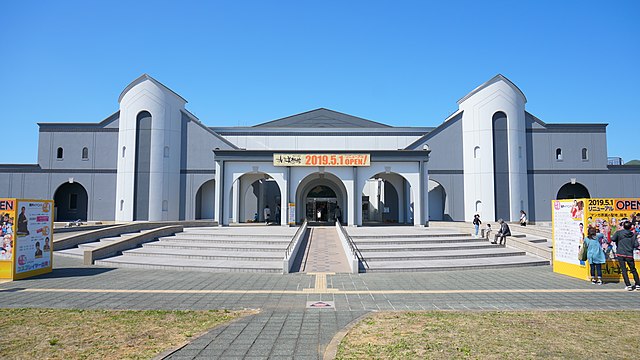
The Yokote Masuda Manga Museum, after its 2019 refurbishment.
掬茶 / CC BY-SA
Opened in 1995, the Yokote Masuda Manga Museum makes claim to being the first manga-related museum in Japan.  Its unique, nature-inspired interior houses a manga library, galleries of illustrations by manga artists, and a recreated studio of local author Takao Yaguchi (矢口 高雄, Yaguchi Takao, b.1939).  He was best known in the 1970s for writing the manga series Fisherman Sanpei (釣りキチ三平, Tsurikichi Sanpei), about the adventures of a young fisherman.  Yokote, located in eastern Akita prefecture, is also famous for the annual Kamakura Festival, where dozens of snow huts in various sizes are erected throughout the city.

285 Shinmachi, Masuda-chō, Yokote-shi, Akita-ken, 〒019-0701.  Open from 9:00 AM to 5:00 PM.  Admission ends 30 minutes before closing time.  Closed Mondays.  Costs ¥800.  More information: (Japanese)

2) Ishinomori Manga Museum, Ishinomaki
gleam_df / CC BY
Also known as the Ishinomori Mangattan Museum (a play on "Manhattan"), this museum is dedicated to and named after Shotaro Ishinomori (石ノ森 章太郎, 1938-1998), who was born in the vicinity.  Ishinomori-san holds a Guinness World Record for the most comics published by one author; his career has produced a total of 128,000 pages in 500 volumes across 770 titles, the most famous being Cyborg 009 (1963).  He also developed live-action hero TV shows such as Kamen Rider (1971) and Himitsu Sentai Goranger (1975), the first in the Super Sentai franchise.  This museum, along with the rest of Ishinomaki city, suffered damage from the Great East Japan Earthquake and tsunami of March 2011, but reopened, arguably better than ever, within a couple of years.

2-7 Nakaze, Ishinomaki-shi, Miyagi-ken 〒986-0823.  Open from 9:00 AM to 6:00 PM.  Closed on the third Tuesday of March to November.  Costs ¥840.  More information: (English) (Japanese)

3) Niigata Manga Animation Museum & Niigata City Manga House, Niigata
The Niigata City Manga House.
DAI-nk / CC BY-SA
Niigata is the hometown of many famous manga authors and animators, including Rumiko Takahashi (Ranma ½, Inuyasha), Takeshi Obata (Hikaru no Go, Death Note), and One (One Punch Man, Mob Psycho 100).  So in its honour, I have not one, but two sites to represent it with!  First is the paid-entry Niigata Manga Animation Museum, which has interactive exhibits about making anime and manga, and childrens' play areas with characters from some of the above creators.  And second is the free-entry Niigata City Manga House, whose reading room carries over 10,000 books.  Additionally, like the Comiket in Tokyo, Niigata hosts a bimonthly fan-comic convention called the Niigata Comic Market, or "Gataket" for short, which is the largest of its kind on the Sea of Japan coast.

Niigata Manga Animation Museum: 2-5-7 Yachiyo, Chūō-ku, Niigata-shi, Niigata-ken 〒950-0909.  Open from 11:00 AM to 7:00 PM; opens at 10:00 AM on weekends and holidays.  Closed on 1 January.  Costs ¥200.  More information: (English) (Japanese)

Niigata City Manga House: 971-7 Furumachi-dōri 6-banchō, Chūō-ku, Niigata-shi, Niigata-ken 〒951-8063.  Open from 11:00 AM to 7:00 PM.  Closed on Wednesdays, and from 29 December to 3 January.  Free to enter.  More information: (English) (Japanese)

4) Ghibli Museum, Tokyo
The exterior of the Ghibli Museum.
Taken by the author on Wednesday, 9 May 2018.
The Ghibli Museum, the official museum of Studio Ghibli, was personally designed by Hayao Miyazaki (宮崎 駿, b. 1941), the director of many of Ghibli's highly-acclaimed films.  Their list of works includes such beloved titles as My Neighbor Totoro, Kiki's Delivery Service, Princess Mononoke, Spirited Away, and many more.  Since I first reported on the Ghibli Museum, they have opened up online ticket sales to overseas, English-reading visitors, making this place no less competitive to get in, but far more accessible, and in some cases affordable, than ever before.

1-1-83 Shimorenjaku, Mitaka-shi, Tōkyō-to 〒181-0013.  Open from 10:00 AM to 6:00 PM.  Closed on Tuesdays.  Costs ¥1,000; advance reservations required.  More information: (English) (Japanese)

Elsewhere in Tokyo, I also recommend:
  • Suginami Animation Museum: A small, but free, general exhibition of animation, with some hands-on activities.  Open from 10:00 AM to 6:00 PM.  Closed on Mondays, and from 28 December to 4 January.  Free to enter.  More information: (English) (Japanese)
  • One Piece Tower: An indoor theme park with a specific focus on One Piece, located at the base of Tokyo Tower.  Open from 10:00 AM to 10:00 PM.  Costs ¥2,300, or ¥3,300 with admission to a live show.  More information: (English) (Japanese)
5) Fuji-Q Highland, Fujiyoshida
Evangelion World at Fuji-Q Highland.
Taken by the author on Wednesday, 16 November 2016.
The Fuji-Q Highland theme park has a couple of anime-themed attractions, such as the GeGeGe no Kitaro Haunted Mansion, but the big one, almost worth the price of admission alone, is Evangelion World.  Replacing a similar Godzilla-themed attraction, this museum-esque attraction features re-creations of sets from Neon Genesis Evangelion (新世紀エヴァンゲリオン, Shin Seiki Evangerion), the titular giant-robot anime franchise.  The centrepiece is a life-size bust of the Unit-01 robot, which features in a regular light show.  You may read my report from Fuji-Q Highland here, and my separate report from Evangelion World here.

5-6-1 Shin-Nishihara, Fujiyoshida-shi, Yamanashi-ken 〒403-0017.  Open from 9:00 AM to 5:00 PM, or to 6:00 PM on weekends and holidays.  No closing days.  Costs ¥800 for Evangelion World, or ¥5,900 for unlimited rides throughout Fuji-Q Highland.  More information: (English) (Japanese)

For more official Evangelion shopping, I also recommend:
  • Evangelion Store.  Open from 11:00 AM to 9:00 PM.  Located immediately north of Ikebukuro Station (JR Yamanote, Saikyo, etc. lines).
  • Eva-ya.  Open from 9:00 AM to 6:00 PM.  Located directly below Hakone-Yumoto Station (Hakone-Tozan line).
6) Go Nagai Wonderland Park, Wajima
Indiana jo / CC BY-SA
Go Nagai (永井 豪), born Kiyoshi Nagai (永井 潔, b. 1945), whose manga career has just marked its 50th anniversary, is influential, iconoclastic, often controversial, and highly productive.  His most famous works include Devilman, Mazinger Z, and Cutie Honey, with the latter two series codifying the giant-robot and magical-girl subgenres of anime.  This museum dedicated to his many manga creations is located in his hometown of Wajima, a city on the Noto Peninsula, along the city's famous Morning Market.

1-123 Kawaimachi, Wajima-shi, Ishikawa-ken 〒928-0001.  Open from 8:30 AM to 5:00 PM.  No closing days.  Costs ¥520.  More information: (English) (Japanese)

7) Kyoto International Manga Museum, Kyoto
The courtyard of Kyoto International Manga Museum.
Taken by the author on Friday, 18 November 2016.
A particular favourite haunt of mine whenever I'm in town, the Kyoto International Manga Museum was established in 2006 in a former school building.  The museum boasts a collection of 50,000 manga books that are free for visitors to read, and uniquely for these types of museums, a fair selection of them are in English and other languages.  In good weather, the courtyard (shown above) is a pleasant place to read the books, or even meet up for cosplaying. You may read my report from the Kyoto International Manga Museum here.

Kinpuki-cho, Nagagyo-ku, Kyoto-shi, Kyoto-fu 〒604-0846.  Open from 10:00 AM to 6:00 PM.  Closed on Mondays and 1 January.  Costs ¥800.  More information: (English) (Japanese)

Elsewhere in Kyoto, I also recommend Toei Kyoto Studio Park.  The theme park and studio of this major film/TV company also has content related to its many anime productions.  You may read my report from Toei Kyoto Studio Park here.

8) Osamu Tezuka Manga Museum, Takarazuka
DVMG / CC BY
Osamu Tezuka (手塚 治虫, Tezuka Osamu, 1926-1989) is often likened as Japan's Walt Disney.  Of course there have been comics and animation made in Japan long before Tezuka-san's heyday in the 1950s and '60s, but his success shaped these industries into the juggernauts they are today.  His manga stories, including Astro Boy, Kimba the White Lion, Princess Knight, and Black Jack, were adapted into some of the earliest and most popular TV anime series.  After his death, this museum was built in his honour in his home city of Takarazuka, a suburb of Osaka and Kobe.  If the name Takarazuka rings a bell to visitors, it may also be because of the all-female Takarazuka Revue theatre troupe.  They are, of course, named after the city, and perform there as well as across the country.

7-65 Mukogawa-chō, Takarazuka-shi, Hyogo-ken 〒665-0844.  Open from 9:30 AM to 5:00 PM.  Closed on Wednesdays, 29-31 December, and 20-28/29 February.  Costs ¥700.  More information: (Japanese)

9) Shigeru Mizuki Memorial Museum, Sakaiminato
Aimaimyi / CC BY-SA
Shigeru Mizuki (水木 しげる), born Shigeru Mura (武良 茂, 1922-2015), was the author of GeGeGe no Kitaro (ゲゲゲの鬼太郎).  Its titular hero, Kitaro, is a young lad who helps out humans in their affairs with yokai (妖怪), folklore monsters, both friend or foe.  Even the walk up to the museum along the aptly-named Mizuki Road, with murals, statues, and other decorations of his yokai-inspired characters dotted liberally along the way, makes for part of the experience.  All this is located in Mizuki's hometown of Sakaiminato, as little as 40 minutes away by bus from the castle city of Matsue.

5 Honmachi, Sakaiminato-shi, Tottori-ken 〒684-0025.  Open from 9:30 AM to 6:30 PM.  No closing days.  Costs ¥300.  More information: (English) (Japanese)

Elsewhere in Tottori Prefecture, I also recommend the Gosho Aoyama Manga Factory, devoted to the series Detective Conan (名探偵コナン, Meitantei Konan), known in English as Case Closed, and its author.  Open from 9:30 AM to 5:30 PM.  No closing days.  Costs ¥700.  More information: (English) (Japanese)

10) Kitakyushu Manga Museum, Kitakyushu
Asai1920 / CC BY-SA
Just across the street from Kitakyushu's main train station, Kokura, stands the AruAru City mall, a manga, anime, and pop-culture marketplace in the vein of Tokyo's Akihabara district.  On top of that, in more ways than one, is the Kitakyushu Manga Museum, occupying the two upper-most floors of the building.  Among its regular exhibits, there is a special focus on local manga artists, and in particular Leiji Matsumoto (松本 零士, Matsumoto Reiji), born Akira Matsumoto (松本 晟, Matsumoto Akira, b. 1938), one of the many artists to have originated from this city.  Matsumoto-san is best known for the space-opera series he created in the 1970s: Space Battleship Yamato, Galaxy Express 999, and Space Pirate Captain Harlock.  As with the manga museums in Kyoto and Niigata, there is a wide selection of manga books for visitors to read freely, although note that there is limited English content throughout this museum.

Aruaru City 5F, 2-14-5 Asano, Kokurakita-ku, Kitakyushu-shi, Fukuoka-ken 〒802-0001.  Open from 11:00 AM to 7:00 PM; closes at 8:00 PM during Summer holidays.  Closed on Tuesdays and New Year holidays.  Costs ¥480.  More information: (English) (Japanese)

Wildcard) World Cosplay Summit
A presentation for World Cosplay Summit 2014, held at Chubu Centrair Airport.
M338 / CC BY-SA
For my wildcard slot, rather than another museum, I thought I'd pick out a regular event related to anime and manga.  There are lots to choose from, from trade shows like AnimeJapan to fan-comic marketplaces like Comiket and the aforementioned Gataket.  But the one that has impressed me the most is the World Cosplay Summit, held in late July/early August in Nagoya.  Cosplay, the art of making and wearing costumes of characters anime, video games, etc., is already a popular sight at related conventions, both in Japan and abroad.  The World Cosplay Summit takes this hobby to an all-new level.  The cosplayers, selected by preliminary contests held all over the world, take part in a parade around the Osu Kannon temple and shopping district, which is already a popular choice for anime-related shopping year-round.  Then comes the main event, the World Cosplay Championship, where teams from each participating country perform skits as the characters they portray.  The costume details, the players' performance, and the special effects all make it feel like your favourite characters have come to life!

More information: (English) (Japanese)

Thursday, September 6, 2018

Toei Kyoto Studio Park

This article is based on a visit made on Monday, 14 May 2018.

Edit 10 October 2019: Updated prices to reflect the increase in Japan's national sales tax.

Toei is one of Japan's major film and TV production companies.  They own studios in Tokyo and Kyoto, with the latter also serving as a theme park known as Toei Kyoto Studio Park (東映太秦映画村, Tōei Uzumasa Eigamura).

Toei's animation division is one of the most prolific production companies in the anime scene.  Starting life as Japan Animated Films in 1948, and purchased by Toei in 1956, they've been responsible for many of the world's most popular anime shows.  These range from early yet highly influential giant-robot (Mazinger Z) and magical-girl (Cutie Honey) shows, to the anime versions of Dragon Ball, Sailor Moon, and One Piece.   Pictured here are the lead heroines of Pretty Cure / PreCure, a magical-girl franchise which has been on-going for over 15 years.

One of the first things you'll see in the Studio Park's entrance hall is a small yet densely-packed exhibit showcasing their works through posters and figurine cases.  I even recognised a figure or two which I had copies of myself at home!

Toei is also famous for its tokusatsu, or live-action special-effects, hero shows.  The first of their two big ones is Kamen Rider (仮面ライダー, Kamen Raidā, lit. 'Masked Rider'), whose first season aired in 1971.  Created by manga author Shotaro Ishinomori, each of Kamen Rider's thirty seasons (so far) have their own stories and aesthetics, but they all share common elements, namely a protagonist who fights evil by transforming into a masked hero with an insect aesthetic and a motorcycle.  In the Hero Land permanent exhibit, there are mannequins of all the different Kamen Riders, starting with (pictured) the two heroes of the first season.

The other big tokusatsu show in Toei's repertoire, also represented in Hero Land, is Super Sentai (スーパー戦隊, Sūpā Sentai, lit. 'Super Fighting Force'), which began with the series Himitsu Sentai Goranger in 1975.  In contrast to Kamen Rider's solo heroics, Super Sentai stars teams of heroes who fight on the ground and pilot giant combining robots.  One common element about Super Sentai is that the red ranger serves as the team's leader, so the exhibit here includes mannequins of all the red rangers thus far in the franchise's history.

I'm not as familiar with Kamen Rider as Super Sentai, but these costumes lit up, which is always cool.

If you can manage to tear yourself away from the entry hall's exhibits, you'll get to explore the rest of the park, which consists of many mock-historical townscapes.  These places serve as sets for the filming of jidai-geki (時代劇, lit. 'era drama') movies, which refer to any story set in Japan's history, usually the Edo period.  Visitors are allowed to watch the filming of these scenes as they pop up.

I didn't catch any filming during my time there (that I was aware of), but I did get to watch some kids join in on a samurai sword fighting lesson.

You can also rent jidai-geki costumes of your own.  Plans start at ¥4,500 for simpler costumes, and go up to ¥12,000 for ones with full wig and makeup.

If you prefer your entertainment to be more regularly-scheduled, there's a theater where free stint shows are held.  Compared to the demonstration we saw the day before at the Iga-Ryu Ninja Museum, this one is more about showing off a narrative tale.  It's all in Japanese, but the action, character designs, and effects all help the play speak for itself.

This lake is inhabited by a mechanical monster which bobs its head above the surface every so often.  It's not Godzilla -- those rights are owned by another studio, Toho -- but Toei has made their share of kaiju monster movies themselves.

Facsimilies of specific locations have also been created.  This was taken atop a copy of the old Nihonbashi bridge in Edo.  Last mentioned in the Edo-Tokyo Museum article, the Nihonbashi (日本橋, lit. 'Japan bridge') was a bridge that served as the starting point for all roads leading from Edo.  I don't know what the original was really like, but this version was quite steeply-humped.

And this is Yoshiwara (吉原), based on the former pleasure quarter of Edo.  Courtesan women would sell themselves by sitting pretty behind the grated windows along the... storefronts, shall we say.  Geisha also worked in the teahouses there, but not -- let me make this perfectly clear -- not as prostitutes.  Of course, this park's depiction of Yoshiwara, and the history of what would've went on here, are sanitised for general audiences.

 Even among the generic townscapes, the detail is impressive.

There are even a few interior sets kept for good measure.  Not as many details as in the Fukagawa Edo Museum, but all the better to keep things uncluttered for filming.

Some buildings in the park reflect more recent periods.  This turn-of-the-century-style building is a museum of Japan's filmmaking history.

The park also has its own trick art museum.  Many of the pieces were the same as what I saw last time in Odaiba, but this time I got the size-illusion room to work.  This museum is one of several paid attractions within the park.  I also tried out the "Escape the Castle" obstacle course (I beefed it at the laser maze) and the shuriken-throwing range (which I also beefed -- it takes a lot of power just to get them to stick in the back wall, let alone hit the target).

Which brings me to my sign-off selfie, taken next to the red ranger from Kyoryu Sentai Zyuranger, the Super Sentai season from 1992.  Why this one?  It was the first show adapted by Power Rangers, the American version of Super Sentai.  Power Rangers was absolutely huge when I was young, and while I'm not quite the fan I once was, I've come back to this fandom every once in a while, so there was still a thrill to be had posing next to its star hero!  My next destination that day would also have given me a thrill as a kid, but more so as an adult.  Find out where, next time on Sekai Ichi!


Hours: Varies; typically open from 9:00 AM to 5:00 PM.  Entry ends 60 minutes before closing time.  No regular closing days.

Costs: ¥2,400.  Paid attractions cost an additional ¥500-1,000 each.

Address: 10 Uzumasa, Higashi Hachioka-chō, Ukyō-ku, Kyōto-shi, Kyōto-fu 〒616-8161

Access: Toei Kyoto Studio Park is 5 minutes on foot from Uzumasa-Koryuji Station (Keifuku Arashiyama (A) tram), or 15 minutes from Hanazono Station (JR Sagano (E) line).  The park also has a rear exit which is 2 minutes from Satsueisho-mae Station (Keifuku Kitano (B) tram), or 5 minutes from Uzumasa Station (JR Sagano line).

From Kyoto Station, take the JR Sagano line to Hanazono (E06, 10 minutes, ¥200, JR Pass OK), and walk 15 minutes to the park's front entrance.  Alternately, take Kyoto Bus 73 or 75 (Stand C6) to Uzumasa Higashi-guchi (30 minutes, ¥230), and walk 3 minutes to reach the park.

Directions: From Uzumasa-Koryuji Station, turn right at the traffic light, continue up the hill, then turn left at the next traffic light.  The park entrance will be on your left, before the train overpass.

From Hanazono Station, turn left onto Marutamachi-dori.  At the third traffic light, turn left, then right at the dead-end immediately after.  Continue until the next traffic light, then turn left.  The park entrance will be on your right, after the train overpass.

Website: (English) (Japanese)

Friday, August 3, 2018

Eva-ya and Hakone Yuryo

This article is based on a visit made on Saturday, 12 May 2018.

Edit 10 October 2019: Updated prices to reflect the increase in Japan's national sales tax.

When one visits Hakone, one should never miss the chance to try bathing in one of its hot springs.  Nearly every hotel in Hakone has an onsen attached, with some of them allowing non-guests to use them for a fee.  There are also dedicated public bath facilities, one of which I visited in between my bouts of museum-hopping.

But first, there was something I just had to do.  Right beneath Hakone-Yumoto station, there is a gift shop called Eva-ya (えゔぁ屋), which sells merchandise from the anime franchise Evangelion.  You can't miss it; it's the one with a statue of Rei Ayanami out front (to the right in this shot).  Why would there be a place like this here, you may ask?  It's only because the show is set in Hakone, or rather its near-future counterpart, "Tokyo-3".  So, you may see natural landmarks like Lake Ashi along with the local towns, before they get all stomped up amid the giant robot fights.

You can preview of most of Eva-ya's goods by visiting their (Japanese-only) website; I have it linked at the end of this article.  This being Hakone, there are plenty of items relating to onsen bathing.  This means you'll see a lot of stuff with pictures of the five main characters in yukatas, or more hilariously, the Unit-01 robot with a towel on its head.  The full-size bath towels were quite expensive (¥4,500), so instead I got a smaller tenugui (手拭い) for only ¥800, with a picture of Asuka Langley Soryu on it.  I tried using it with me when I went into the bath right afterwards (see below), but it was really thin and not much use for drying off with.  Apparently, tenugui are traditionally made that way, but they are used for many other purposes, so I'm sure I shall think of something else to use it for.  I actually prefer the selection at Evangelion World better, but then again, you don't need to pay to get into Eva-ya.

Now, where was I?  That's right; a trip to the spa.  The one I wound up going to was Hakone Yuryo (箱根湯寮), accessible by a short, free shuttle bus hop from Hakone-Yumoto.

There was a bit of a line to check in, but it moved quickly enough.  It did give me a chance to take in the rustic accouterments they decorated the place with.  Despite their presence, Hakone Yuryo is a newer place, having opened only in 2013.

Once inside, you follow a path around this garden, passing the restaurant and relaxation rooms along the way, until you reach the building with the baths themselves.  I don't have pictures of the bath area, for obvious reasons, but I'll give you an idea.  The tub in the indoor section had a wooden-grated floor for the water to flow up from beneath, and floor-to-ceiling windows to look out over the forested valley below.  The outside section was a pavilion with multiple pools, allowing even closer views of the valley.  Up in the back, there were a couple of deep single-person tubs.  They were cooler than the other baths in the place, and while it felt a bit silly to lie in them with my arms and legs hanging out, it was even more relaxing to do so.

Today's sign-off selfie comes from Eva-ya, accompanied by Rei-chan.  My shirt, featuring her opposite number Asuka, was one I purchased when I was at Evangelion World on my last trip.  Of course this was intentional.  But for now, I've got one more stop before leaving Hakone.  Find out where, next time on Sekai Ichi!


Hakone Eva-ya

Hours: Open from 9:00 AM to 6:00 PM.  No regular closing days.

Costs: Free to enter.

Address: 707-1 Yumoto, Hakone-machi, Ashigara Shimo-gun, Kanagawa-ken 〒250-0311

Access: Eva-ya is located directly beneath Hakone-Yumoto Station at street level.

Website: (Japanese)

Hakone Yuryo

Hours: Open from 10:00 AM to 9:00 PM; closes at 10:00 PM on weekends.  Admission ends one hour before closing.  No regular closing days.

Costs: ¥1,500, or ¥1,300 with an active Hakone Free Pass.  Bath towels cost ¥450; face towels cost ¥250.  Private rooms cost ¥4,300-6,300 to rent for 60 minutes, and can be reserved in advance by calling +81 046-085-8411 (Weekdays 10:00 AM - 9:00 PM JST, weekends 10:00 AM - 10:00 PM JST).

Address: 4 Tonosawa, Hakone-machi, Ashigara Shimo-gun, Kanagawa-ken 〒250-0315

Access: From Hakone-Yumoto, a free shuttle bus runs to Hakone Yuryo every 10-15 minutes, taking 3 minutes.  The bus stop is in front of the station's west exit.  This bus also stops at Hakone Forest Adventure along the way.

Website: (English) (Japanese)

Monday, June 25, 2018

VR Zone Shinjuku

This article is based on a visit made on Wednesday, 9 May 2018.

Edit 9 October 2019: VR Zone Shinjuku has closed permanently.  Its attractions have moved to Mazaria, a new location in Ikebukuro's Sunshine 60.  More information: (English) (Japanese)

I am no stranger to Tokyo's indoor theme parks, from Sega Joypolis in Odaiba, to J-World Tokyo in Ikebukuro.  And on my latest return to the city, I ticked another one off of my list -- VR Zone Shinjuku.

Fitting of the name, the attractions of VR Zone Shinjuku are mostly comprised of virtual-reality games.  Another VR Zone location is coming to Osaka in Autumn 2018.

The one attraction I was most excited to get on, if my previous experience with the franchise is any indication, was "Evangelion VR: The Throne of Souls: Berserk".  Up to four players at a time get to take control of an Eva robot, and join forces to shoot down a giant Angel monster.  I lost the game my first time around, but I just had to beat it, so I bought another ticket for this game and, with the help of a random salaryman who joined in, I brought down that beast the second time around!  The rigs for this game are in the form of an Eva cockpit, and once the headsets are turned on, you can look down to see (a static model of) your pilot's legs and body, plugsuit and all.  During the introductory scene in the hangar, look out for commander Gendo Ikari and see what happens...!

Most VR games have guests play in groups of four, either cooperatively or competitively depending on the type of game.  When guests queue up, they are lent instructional cards which explain how each of the games work.  These instructions are available in Japanese, English, and Simplified Chinese.

Another attraction I gave a spin was Mario Kart Arcade GP VR.  In addition to driving the go-kart, players hold on to a wrist-mounted mini-controller, which they wave up and down to throw in-game items like Koopa shells and banana peels, as is one of the series' trademark mechanics.

The park is owned by Namco-Bandai, who also owns the rights to these (Namco and Nintendo collaborated on the original Mario Kart Arcade GP) and most of the other licenced attractions in VR Zone.  For example, there are other attractions based on Mobile Suit Gundam, Dragonball, and Galaga.

Not all of the VR attractions are themed after licenced properties.  There was "Ski Rodeo", a skiing game that I tried, "Fishing VR Gijiesta", a fishing game, and this one, called "Hane-chari", where guests pilot flying bicycles.

And then there's the horror ride, a virtual take on a haunted house.  As is often the case in Japan, it involves an abandoned hospital.  For a different kind of fright, another attraction, "The Big Fear of Heights Experience" has you walking across a plank which, from your virtual point of view, appears to be hundreds of meters above the ground.   I skipped these in favour of other attractions...  No seriously, it's not that I wouldn't have done these, I just wanted to do the others more!

For those of you who are purchasing a 4-ticket bundle, please note that the VR attraction tickets are split up into four groups, labeled by the colours red, green, blue, and yellow.  Each of the VR tickets you receive are good for one attraction in each of those groups.  Which group an attraction belongs to is not apparent within VR Zone itself, so look up this information on their website (links are at the bottom of the article), and plan which games you most want to ride ahead of time.  Individual VR tickets beyond the four included in this bundle do not have this group limitation, and may be purchased from the information desk at the front of the main hall.

VR Zone Shinjuku has a number of physical attractions, as well.  There is an escape room game where players must solve puzzles as a giant balloon starts to fill up the room, and hopefully escape before it gets too big and pops.  The "Resort" section, pictured above, features a rock-climbing wall and a drop slide.  As you can see, trying to take pictures of someone going down it is a challenging affair.  At least it saves me the trouble of blurring their faces!

Beyond these, there are also "Field VR" attractions which take place in larger rooms.  As of this article, there are two such attractions available: "Ghost in the Shell Arise: Stealth Hounds" and "Dragon Quest VR".  In these, guests move around a room to play the game.  Both of these attractions require separate timed tickets to play -- ¥3,600 for Ghost in the Shell (includes entry, and may be reserved online), and ¥3,200 for Dragon Quest.  They are liable to sell out as the day goes on, and since I showed up in the evening, that means I did not get a chance to try them.  Well, gotta save something for a return visit, I guess.

As a bonus before signing off, I'd like to share with you a lovely view of Tokyo Tower I managed to find on my way back to the hotel, near the Onarimon subway station (Toei Mita (I) line).

Ok, now it's time for my sign-off selfie!  This goofy-looking mask is something they give you when you get in.  You have to put it on when using any of the VR activities, as it keeps the headsets sanitary for all the guests who use them.  All things considered, VR Zone Shinjuku is on the expensive side, considering how most of the attractions last only 5 minutes or so, but most other public VR attractions are, anyway.  And besides, you can't get these particular experiences anywhere else!  ...Well, at least not until the new Osaka location opens.  But I shall move on to more natural sites of interest, next time on Sekai Ichi!


Hours: Open from 10:00 AM to 10:00 PM.

Costs: ¥800 to enter, ¥1,200 for most VR activities.  A bundle including entry and 4 VR tickets costs ¥4,400.

Address: 1-29-1 Kabuki-cho, Shinjuku-ku, Tokyo-to 〒160-0021

Access: Right next to Seibu Shinjuku (Seibu Shinjuku line), or 10 minutes on foot from Shinjuku Station (JR Yamanote (JY), Chuo (JC), Chuo-Sobu (JB), Saikyo (JA), Shonan-Shinjuku (JS), Odakyu Odawara (OH), Keio (KO), Tokyo Metro Marunouchi (M), Toei Shinjuku (S) and Oedo (E) lines).

From Tokyo Station, take the JR Chuo (Rapid) line to Shinjuku (JC05, 15 minutes, ¥200, JR Pass OK).

Directions: From Shinjuku Station (JR East Exit), head straight out of the gate.  Cross the street and pass the Studio Alta building on its left.  Continue straight, past the next traffic light.  Turn left when you reach the Toho Cinema / Hotel Gracery (the "Godzilla building"), then take the next right, and the next left.  VR Zone Shinjuku will be straight ahead.

Website: (English) (Japanese)

Friday, June 16, 2017

Kyoto International Manga Museum

This article is based on a visit made on Friday, 18 November 2016.

Edit 7 October 2019: Updated prices to reflect the increase in Japan's national sales tax.

Over the past several decades, the art of Japanese comic books, known as manga (漫画, lit. 'cartoon pictures'), have become one of the country's most influential cultural exports.  They have readers across all demographics and tell stories across many, many genres.  In fact, most anime series on TV are based on a manga.  And now, they finally have their own museum.  The Kyoto International Manga Museum (京都国際マンガミュージアム, Kyōto Kokusai Manga Myūjiamu) was opened in 2006, in a former elementary school building in downtown Kyoto.

International Manga Museum
By Peat Bakke [CC BY 2.0], via Wikimedia Commons
The main USP (unique selling point) of this museum is its collection of manga books, which may be read freely by guests.  Most of the books were donated by a book rental store which went out of business before this museum was established.  There are a total of 50,000 books across a combined 200 metres (656 feet) of shelves.  The lion's share of the books are in Japanese, but near the entrance, there is a sizable collection of books in other languages, including English, Chinese, Korean, and French.

When the weather is nice, you can even take books out to the courtyard and read them outside!  Just keep them within the admission gates, please.

Even better, on days off from school, you might see fans coming together and cosplaying their favourite characters!  I don't know if this is a regular thing or not, but I sure lucked out in that regard during my first visit!  My second time, not so much; it was a school day, after all.

By Kento Ikeda [CC BY 2.0], via Wikimedia Commons
Back indoors, exhibits on the upper floors go into the history and statistics of the manga industry.  One of the more unique exhibits is a collection of plaster casts made from the hands of manga artists!  The museum also hosts temporary exhibitions, plus seminars from Japanese and international artists alike.

By Maplestrip [CC BY 3.0], from Wikimedia Commons
This wall shows some of the tools that manga artists use in their work.  Manga is generally produced in black-and-white.  Using traditional media, the artwork is sketched in pencil, inked, and then screentones are adhered to the page to create textures.  Colours are usually reserved for covers and other promotional illustrations.  Nowadays, artists who use computer programs to produce manga still emulate this process.

One of the temporary exhibits was a showcase on the artist known as Yukiko Tani (谷ゆき子, Tani Yukiko, 1935-1999), who drew stories about ballet during the '60s and '70s.  If that doesn't sound interesting, well, how may other stories about ballet, manga or otherwise, have the heroine training by meditating under a waterfall, or balancing en pointe on the edge of a cliff?  I have to admit, I'm curious to see more!  Surprisingly, there haven't been any stand-alone books made of her works -- that was, until October 2016, which is why this exhibit was set up.

By Kento Ikeda [CC BY 2.0], via Wikimedia Commons
The building housing the museum was converted from a former elementary school.  A few rooms from the school have been preserved, such as this tatami-floored room.

The cafe on-site serves a small menu of light meals.  What's interesting about this place is the assortment of sketches drawn on the walls by manga artists.  You know, I personally have dreams of making my own manga comic, but haven't quite had the drive to put my ideas into product.  Maybe the prospect of having my own drawing represented here, be it ever so remote a chance, may inspire me to make my visions into reality...!  Visit the Kyoto International Manga Museum yourself, and see what inspires you!


Hours: Open 10:00 AM to 6:00 PM.  Admission ends 30 minutes before closing time.  Closed on Mondays and New Year's Day.

Costs: ¥800.

Address: Karasuma-Oike, Nakagyō-ku, Kyōto-shi, Kyōto-fu 〒604-0846

Access: The museum stands above Karasuma-Oike Station, the junction of the Karasuma (K) and Tozai (T) subway lines.  From Kyoto Station, take the Karasuma line to Karasuma-Oike (K08, 5 minutes, ¥220).  The closest station exit is Exit 2.

Website: (English) (Japanese)