COVID-19 Coronavirus Notice

COVID-19 Coronavirus Notice

Updated 2 July 2020

If you are reading this message, please be aware of travel restrictions in place as part of measures to contain the spread of the COVID-19 "Coronavirus" and its symptoms. Japanese authorities are refusing entry to individuals from, or who have been to, a list of over 100 countries (More information). All other visitors must apply for a visa, and undergo a quarantine upon entering the country. Within the Japan, there are no longer any travel restrictions, and most public attractions have re-opened with precautions for sanitation and social distancing. In short, travel to Japan is not recommended at this time, until the situation normalises. I will not be editing my individual articles to reflect this, but again, please keep this in mind when reading them.
Showing posts with label Kyoto prefecture. Show all posts

Wednesday, April 3, 2019

Aoi Matsuri

This article is based on a visit made on Tuesday, 15 May 2018.

Edit 10 October 2019: Updated prices to reflect the increase in Japan's national sales tax.


The Aoi Matsuri (葵祭, lit. 'hollyhock festival'), also known as Kamo-no-Matsuri (賀茂祭), is an annual festival procession held in central Kyoto on the 15th of May.  It is one of Kyoto's three biggest festivals, alongside the Gion Matsuri in July and the Jidai Matsuri in October.  The festival's origins, although unclear, date to the 7th century AD, even before Kyoto became the capital city of Japan.  According to ancient texts, it came about in order to appease the Shinto gods of the Shimogamo and Kamigamo Shrines, who were believed to be responsible for a stretch of disastrous weather.


The procession starts from the Kyoto Imperial Palace (京都御所, Kyōto Gosho) at 10:30 in the morning.  At 11:15 AM it reaches Shimogamo Shrine (下鴨神社, Shimogamo Jinja), where it stays for ceremonies until 2:20 PM.  At this point, it departs for Kamigamo Shrine (上賀茂神社, Kamigamo Jinja), arriving at 3:30 PM and ending there.  It takes 45 to 60 minutes for the parade to pass by any given spot from its start to end.  There is paid seating at each of the three main destinations; for more information, read the Cost section at the end of this article.

For our part, we stayed at Kyoto Imperial Palace park to watch the parade there, and after it left the area, we went on our own way from Kyoto to our next destination.  The palace itself is the former home of the Emperor of Japan, until Emperor Meiji moved the seat of power to Tokyo in 1868.  Since then, the former palace has been open to the public.  Until recently, you could only visit as part of a free guided tour; whilst it is now possible to explore the complex without prior arrangement, English-language tours are still conducted today.  It is nestled in the middle of a vast, 89-hectare (220-acre) public park, which also includes a couple of Shinto shrines and the secondary Sento Imperial Palace.

The Aoi Matsuri parade starts from the palace complex down this long avenue, on its way through the park.  It consists of over 500 people, and the occasional draft animal, dressed in costumes of the Imperial court from the Heian period (AD 9th-12th centuries).  From the signs on these saddles, it looks like some real police officers joined in to help lead the procession in-character.

The rituals at the Kamo shrines include horse races and horseback archery.  I wonder if these men are taking part in any of that...?

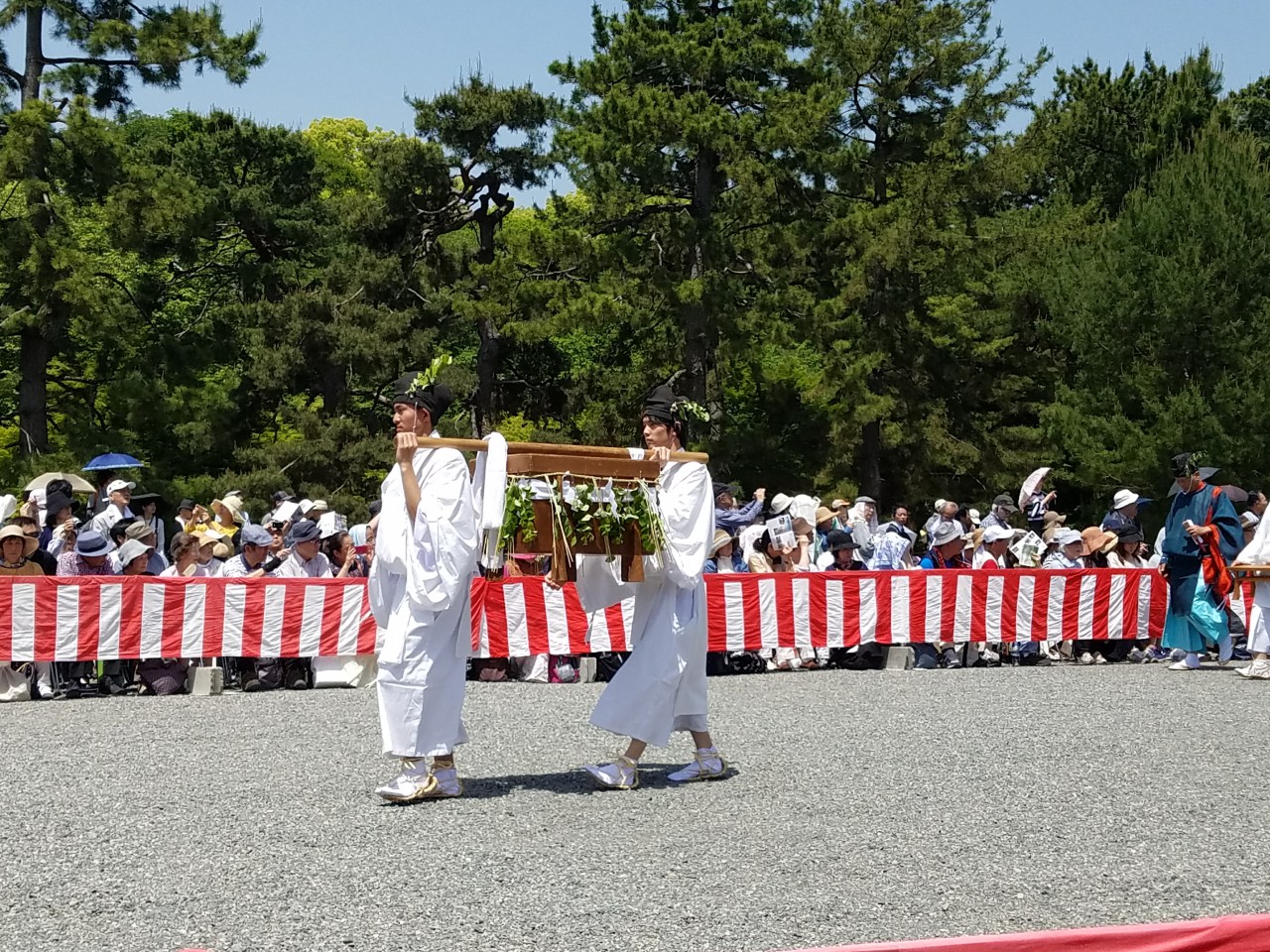
The equipment and costumes of the procession incorporate leaves and petals of the hollyhock flower (shown atop this basket), for which the festival is named.

Hollyhock petals are also featured in the emblem of the Tokugawa clan (shown in the middle of this drum), the shoguns who ruled Japan during the Edo period.

Not all of the flowers featured during the procession were hollyhocks, but they still coordinated well with the many colours of the marchers' robes, from yellow...


...to white.

The weather that day was clear, sunny, and unusually warm, with temperatures in Kyoto reaching highs of over 30°C (86°F).  I'm sure this young lady appreciated the shade.  On the other hand, we in the paid seats were instructed to take down our own umbrellas when the parade started, so as not to block other peoples' views.  Good thing we had hats!

The centrepiece of the procession is a maiden known as the Saio (斎王, saiō).  In early traditions, the Saio was a young female member of the Imperial family who pulled double-duty as the priestess of the two Kamo shrines.  Nowadays, since 1956, the Saio selected for this function can be any unmarried woman from Kyoto.  The kimono worn by the Saio for this event is called a Junihitoe (十二単), named after the twelve pieces it is (nominally) comprised of.

Now that the role of Saio is open to the public, any one of these young girls could earn this prestigious honour.  I'd bet that's something to look forward to...!

Finally, on our way out, we met this charming fellow who, although not taking part in the parade itself, was dressed for the occasion and let us take his picture.  I have no idea whom he was, but I do hope he enjoyed himself that day!

Well, that's it for me for Kyoto.  Find out where we set up camp next, and how we got there, next time on Sekai Ichi!


Hours: The festival parade takes place on the 15th of May, at the times listed earlier in this article.  In the event of inclement weather, the event will be held on the following 16th, and if that date gets rained out too, it will be cancelled for that year.

Cost: Paid seating is available at the Imperial Palace and Shimogamo Shrine for ¥2,700, and at Kamigamo Shrine for ¥1,000.  Tickets for the Imperial Palace and Shimogamo Shrine can be purchased through convenience stores and certain websites.  Tickets for Kamigamo Shrine must be purchased at the shrine itself, at noon on the festival day.  Seating with an English audio guide included is available only for the Imperial Palace, for ¥4,300.  These tickets can be purchased at the tourist information centres at Kyoto Station and Kyoto Tower.

When I attended the festival in 2018, I bought my tickets online from Voyagin (English).  For 2019, they cost US$31 for regular seating at the Imperial Palace and US$50 for seating with audio guides.  Tickets for Kamigamo Shrine go on sale at noon on the day of the festival, at the shrine itself.

Kyoto Imperial Palace

Address: 3 Kyōto-gyoen, Kamigyō-ku, Kyōto-shi, Kyōto-fu 〒602-0881

Access: The front gate of the Kyoto Imperial Palace park is 3 minutes on foot from Marutamachi Station, exit 1.  From Kyoto Station, take the Karasuma (K) subway line to Marutamachi (K07, 7 minutes, ¥260).

Shimogamo Shrine

Address: 59 Shimogamo Izumigawachō, Sakyō-ku, Kyōto-shi, Kyōto-fu 〒606-0807

Access: From Kyoto Station (stand A2), take bus #4 or #205 (anti-clockwise) to Shimogamo Jinja-mae (下鴨神社前, 30 minutes, ¥230).  Upon exiting the bus, the entrance to the shrine grounds will be on the left-hand side.

You can also walk to Shimogamo Shrine in 10-15 minutes from Demachi-Yanagi Station.  From Kyoto Station take the JR Nara (D) line to Tofukuji (D02, 2 minutes, ¥150, JR Pass OK), followed by the Keihan Main Line to Demachi-Yanagi (KH42, 11 minutes, ¥270).

Kamigamo Shrine

Address: 339 Kamigamo Motoyama, Kita-ku, Kyōto-shi, Kyōto-fu 〒603-8047

Access: From Kyoto Station, take bus #4 (stand A2) or #9 (stand B1) to Kamigamo Misonohashi (上賀茂御薗橋, 40-50 minutes, ¥230).  The shrine entrance is directly in front of the bus stop.

You can also walk to Kamigamo Station in 25 minutes from Kitayama Station.  From Kyoto Station, take the Karasuma subway line to Kitayama (K03, 15 minutes, ¥290).

Tuesday, September 25, 2018

Gion Corner

This article is based on a visit made on Monday, 14 May 2018.

Previously on Sekai Ichi, I spent a day in Kyoto.  After visiting the Arashiyama district, the Toei Kyoto Studio Park, and the Kyoto Railway Museum, I wrapped it up by heading to the Gion district.  I had been there before on a previous trip, but there was one major gap I sought to fill this time around: a cultural performance held twice-nightly at a theatre called the Gion Corner (弥栄会館 ギオンコーナー, Yasaka Kaikan Gion Kōnā).

The show starts with a tea ceremony on the sidelines, running concurrently with the next couple of acts below.  The consumption of green tea in Japan was documented as far back as the early 9th century AD, having been brought over from China.  Later on, a man named Sen no Rikyu (千利休, 1522-1591) codified the process of the tea ceremony (茶道, chadō, lit. 'way of tea').  Here, the hostess wisks around matcha (抹茶), green tea powder, to mix it in with hot water.

The first act on the main stage, accompanying the tea ceremony, is a pair of koto players.  The koto (箏) is a 13-stringed instrument based on the Chinese guzheng, introduced to Japan in the 7th-8th centuries AD.  Next to them, a man conducts ikebana (生け花, lit. 'living flowers'), or flower arrangement.  The flowers he set up were then placed in the alcove, or tokonoma (床の間) to our left, a common feature in Japanese-style rooms.

The next act is a performance of court music, or gagaku (雅楽, lit. 'elegant music').  Evolved in the late 6th century from Chinese yayue music, gagaku is most commonly performed for Shinto rituals, and for the Imperial household.  The orchestra on the left is led by this orange-clad, masked conductor, who directs the players as part of a dance known as bugaku (舞楽, lit. 'dance music').  The koto, described above, does sometimes feature into gagaku, but was not present in this particular performance.

Next is kyogen (狂言), a short comedic play.  Kyogen was developed as interludes to be performed in between noh plays, to lighten the mood.  In the story performed here, two thieves are caught trying to steal sake from a lord (centre).  He has one of the thieves (right) bound with his arms behind his back, and the other's (left) tied to either side of a pole rested across his shoulders.  Hilarity ensues when they try to come up with ways to drink the sake.

After that are a couple rounds of kyomai (京舞, lit. 'Kyoto dance'), the dance performed by geisha (芸者, lit. 'art person') -- in Kyoto, the term geiko (芸子, lit. 'art girl') is more common), and apprentice maiko (舞妓, lit. 'dance woman') for private teahouse functions.  Gion, the district where this very theatre is located, was one of Kyoto's five old entertainment districts with geisha in widespread employment, so it makes sense for them to be featured here.  As for the kyomai, there is limited footwork beyond the occasional turning around, but a heavier emphasis on intricate hand and arm movements.

Finally, the repertoire ends with a bunraku (文楽) performance.  Also known as ningyō jōruri (人形浄瑠璃), bunraku can be thought of as kabuki theatre in puppet form.  In this story, a young woman, the only character on stage, is so desperate to see her firefighter lover again that she rings a fire-alarm bell.  The tower in the background is designed so that the puppet's handlers can get behind it and create the illusion of her climbing it.  The use of handlers clad in black robes and masks, to appear invisible against the stage's backdrop, may have contributed to the image of ninjas wearing the same, as I have suggested before.

In all, the show lasts about 50 minutes, held twice daily at 6:00 and 7:00 PM.  Tickets must be purchased at the box office, but there is enough seating that selling out should not be an issue.  In addition to the show, you may also wish to visit the on-site Maiko gallery, a small museum of hairstyle samples, clothing, accessories, videos, and other memorabilia relating to geiko and maiko.  But, as for me, this performance wrapped up another day in Japan.  Check back for a report on one of Kyoto's biggest festivals, the top-ten museums about anime and manga, and more Know Your Trains, next time on Sekai Ichi!


Hours: Performances start at 6:00 PM and 7:00 PM every day.  From December to mid-March, they are held only on weekends and holidays.

Cost: ¥3,150.

Address: Yasaka Hall, 570-2 Gion-machi Minami-gawa, Higashiyama-ku, Kyoto 〒605-0862

Access: From Kyoto Station, take bus #100, 106, 110 (stand D1), or 206 (stand D2) to the Gion bus stop (20 minutes, ¥230).  The area is also served by Gion-Shijo station on the Keihan Main Line (KH), and Kawaramachi Station on the Hankyu Kyoto (HK) line.  It takes about 7 minutes to walk to Gion Corner from either the Gion bus stop or Gion-Shijo Station, or 10 minutes from Kawaramachi Station.

Directions: From the Gion bus stop, head down Shijo-dori, away from Yasaka Shrine.  Turn left at the next traffic light, onto Hanamikoji-dori.  The theatre entrance will be on the left, before the Kennin-ji temple grounds.

Friday, September 7, 2018

Kyoto Railway Museum

This article is based on a visit made on Monday, 14 May 2018.

Edit 10 October 2019: Updated with information on the new train station opened near the museum.

Previously on Sekai Ichi, I visited the Arashiyama district and the Toei Kyoto Studio Park as part of a day-trip around Kyoto.  This eclectic tour continued afterwards with a visit to the Kyoto Railway Museum (京都鉄道博物館, Kyōto Tetsudō Hakubutsukan).  This museum is owned by JR West and was newly opened in 2016, replacing the Umekoji Steam Locomotive Museum on the same spot.

After going through the entrance hall, visitors walk out onto a covered promenade, lined by preserved train cars.  From left to right, this shot shows a C62-class steam train, an 80-series electric train, and a 0-series Shinkansen train.  In particular, the C62 is popular among railfans. Another model, preserved at the SCMaglev and Railway Park in Nagoya, broke the the speed record for steam trains in 1954, and in Leiji Matsumoto's manga and anime series Galaxy Express 999, the space trains were designed after the C62.

The main hall is designed around three more showcase trains.  From left to right, they are a 500-series Shinkansen, an 81-series diesel train, and a 489-series "Raicho" electric train.  The 500-series Shinkansen, introduced in 1997, was the first of Japan's bullet trains to run at 300 kilometres per hour (185 miles per hour) in regular service.

There is a stronger emphasis on steam engines in this museum, since it was the focus of its predecessor.  Japan built its first steam locomotive in 1872, almost a half-century after the first ones made in Britain (1825).  It's not this one, however; the 230-class engine shown above, dating back to 1903, is not even the oldest train on display at this museum

Another car preserved in this museum is the front locomotive for the "Sakura" sleeper train.  Nicknamed "Blue Trains" for their livery, the first sleeper services in Japan emerged in the mid-1950s.  The "Sakura" connected Tokyo and Nagasaki, for example.  However, with other emerging modes of transportation -- the Shinkansen, highway buses, and low-cost airlines -- being faster and/or cheaper, JR phased out sleeper services in the 21st century.  The Blue Trains are all retired, and the only active sleeper services as of this article are the Sunrise Izumo (Tokyo-Izumo) and Sunrise Seto (Tokyo-Takamatsu).  The name "Sakura", meanwhile, was re-used for services on the Sanyo and Kyushu Shinkansen.

There are lots of other exhibits which show the evolution of train travel in Japan over its century-plus history.  For example, here are two kinds of ticket gates.  The older gates, on the left, required station attendants to stand and check passengers' tickets manually, whereas the newer gates, on the right, can read tickets and IC cards automatically.  I imagine that added convenience has helped the increasing passenger traffic over the years flow in and out of stations much more smoothly.

These are conductor uniforms from before and after the dissolution of JNR (Japan National Railways).  JNR was a state-owned railway company that formed in the post-war years, and covered the whole of Japan.  However, amidst massive debt and declining ridership, in 1987 JNR was split into multiple privately-owned companies, forming the JR (Japan Railways) group of today.  This very museum is owned by JR West, which operates in western Honshu.

The collection of memorabilia includes plastic models of meals served on the old trains.

As with any train museum worth its salt, the Kyoto Railway Museum has a big model railway diorama.  I must say, however, that it wasn't quite as impressive as the diorama at Nagoya's train museum, because that one was larger and had more details from more cities.

I must also say, however, that I liked other little details such as the simulated cotton smoke coming out of the steam trains at this wheelhouse.  ...Which shouldn't even be there if the trains are standing still, but never mind; I think it's cute.

Other model trains, such as the Evangelion Shinkansen, are displayed in separate cases.  The real Type-500 Eva had been retired just before my visit, on 7 May 2018.  However, on 30 June, it was replaced with a new Hello Kitty-themed Shinkansen.

The Kyoto Railway Museum has quite a few interactive exhibits.  Here is one where you can drive model trains around a track by controlling the throttle (right) and brake (left) levers.  I don't know how many of you have played the Densha de Go! video games, but it's like that -- only without any time limits to stress over.

Another one lets visitors print their own sample train tickets.  There are many options involved in this process, from the starting and ending stations, to the time of departure, to the seat to be reserved.  But, all you have to do (and all you can do to move on) is touch the blue-highlighted options as they come up.  At the end, the machine will print out a sample ticket for you to take home!

At this station, you can control the display on a departure board.  Different combinations of buttons on the console are used to set the name, time, and destination of each of the three listings.

In addition to the simulators and activities I've shown you, there are also train conductor simulators (not pictured).  Admission to this simulator is free, but entry is controlled by a lottery system.

The top floor has an observation deck looking out across the railyards of Kyoto Station.  I saw a couple of Shinkansen trains passing by, but failed to capture any in photos or videos.  I did, however, spot landmarks such as Kyoto Tower (left) and the pagoda of To-ji temple (right).

By Toshinori baba [CC BY-SA 4.0 ], from Wikimedia Commons
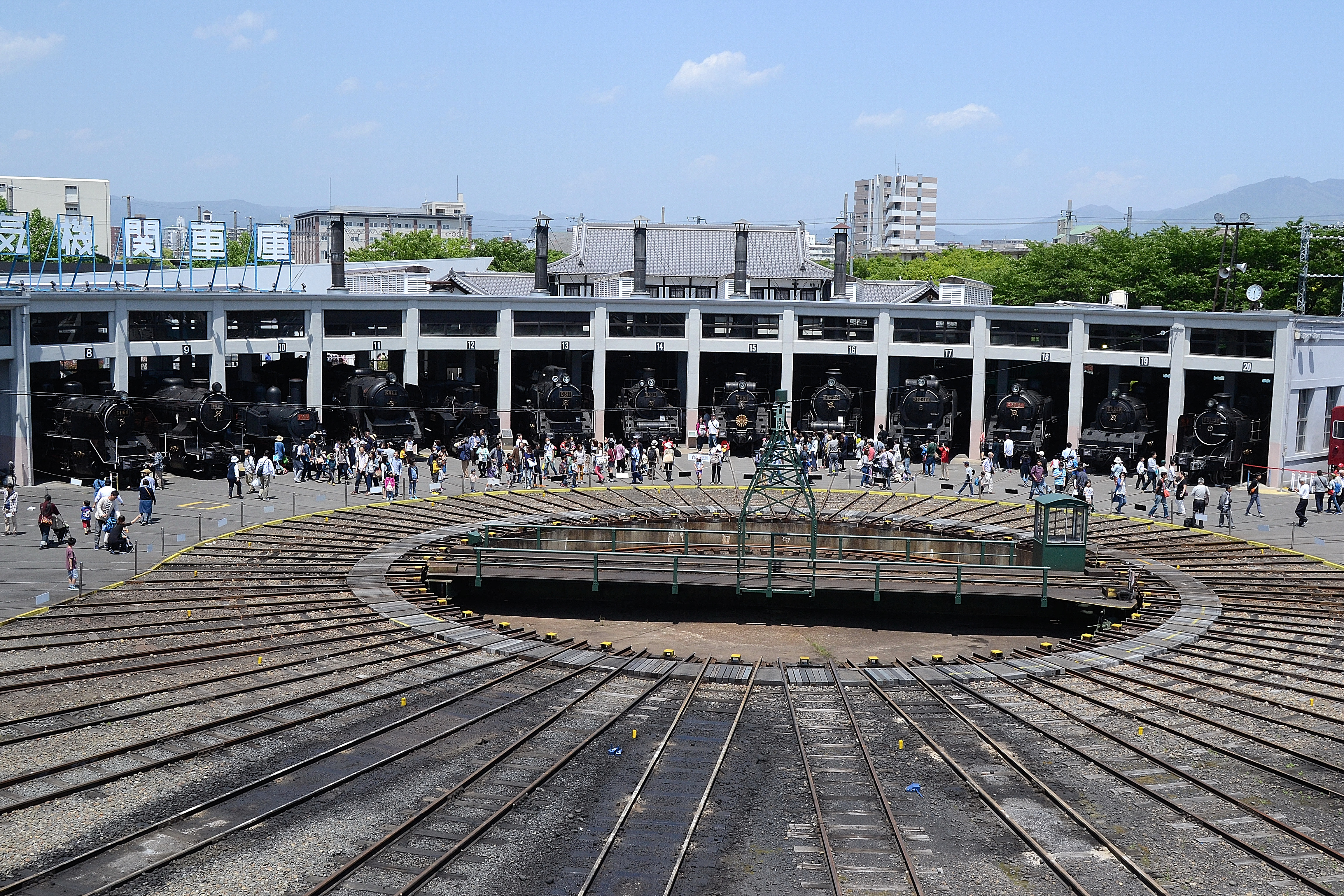
It was close to closing time when I visited, so I didn't have time to explore more of the museum grounds.  But, I can tell you this museum also has a full-sized roundhouse, first built in 1914 and later used as part of the Umekoji Steam Locomotive Museum, with more retired trains on display.  It happens to be the oldest concrete-built train shed in Japan.  There's even a short track where steam trains make regular runs, every 15-30 minutes.  Museum visitors can ride them for a small fee.

This building used to be part of Nijo Station, a couple of stops north on the Sagano line.  In 1996 it was dismantled as part of the station's remodeling and moved here, where it served as the entrance to the Umekoji Steam Locomotive Museum.  Now it serves as the Kyoto Railway Museum's exit and gift shop.  I did barely miss the bus I had intended to make, but waiting for the next one (only 15 minutes) gave me time to buy some nice souvenirs.  Most of them were related to the Evangelion Shinkansen, of course.  Find out where we would eventually head off to, next time on Sekai Ichi!


Hours: Open from 10:00 AM to 5:30 PM.  Admission ends 30 minutes before closing time.  Closed on Wednesdays (besides national and school holidays), and from 30 December to 1 January.

Costs: ¥1,200.  Rides on the steam train cost an extra ¥300.  Audio guides, available in Japanese, English, Chinese, and Korean, cost an extra ¥500 to rent.

Address: Kankiji-chō, Shimogyō-ku, Kyōto-shi, Kyōto-fu 〒600-8835

Access: From Kyoto Station, take the JR Sagano (E) line to Umekoji-Kyotonishi station (E02, 3 minutes, 150, JR Pass OK).  This station was newly built and opened in 2019.

There is also a bus stop, Kyoto Railway Museum-mae, right in front of the museum, and another, Umekoji Park, two minutes away on foot.  Buses serve the former stop more frequently on weekends and holidays than weekdays.  From Kyoto Station, take bus #86, 88, 103, 104, or 110 to Kyoto Railway Museum (7 minutes, ¥230), or take bus #86, 88, 205, or 208 to Umekoji Park (9 minutes, ¥230).  All of the above buses depart from stand B3.

Website(English) (Japanese)

Thursday, September 6, 2018

Toei Kyoto Studio Park

This article is based on a visit made on Monday, 14 May 2018.

Edit 10 October 2019: Updated prices to reflect the increase in Japan's national sales tax.

Toei is one of Japan's major film and TV production companies.  They own studios in Tokyo and Kyoto, with the latter also serving as a theme park known as Toei Kyoto Studio Park (東映太秦映画村, Tōei Uzumasa Eigamura).

Toei's animation division is one of the most prolific production companies in the anime scene.  Starting life as Japan Animated Films in 1948, and purchased by Toei in 1956, they've been responsible for many of the world's most popular anime shows.  These range from early yet highly influential giant-robot (Mazinger Z) and magical-girl (Cutie Honey) shows, to the anime versions of Dragon Ball, Sailor Moon, and One Piece.   Pictured here are the lead heroines of Pretty Cure / PreCure, a magical-girl franchise which has been on-going for over 15 years.

One of the first things you'll see in the Studio Park's entrance hall is a small yet densely-packed exhibit showcasing their works through posters and figurine cases.  I even recognised a figure or two which I had copies of myself at home!

Toei is also famous for its tokusatsu, or live-action special-effects, hero shows.  The first of their two big ones is Kamen Rider (仮面ライダー, Kamen Raidā, lit. 'Masked Rider'), whose first season aired in 1971.  Created by manga author Shotaro Ishinomori, each of Kamen Rider's thirty seasons (so far) have their own stories and aesthetics, but they all share common elements, namely a protagonist who fights evil by transforming into a masked hero with an insect aesthetic and a motorcycle.  In the Hero Land permanent exhibit, there are mannequins of all the different Kamen Riders, starting with (pictured) the two heroes of the first season.

The other big tokusatsu show in Toei's repertoire, also represented in Hero Land, is Super Sentai (スーパー戦隊, Sūpā Sentai, lit. 'Super Fighting Force'), which began with the series Himitsu Sentai Goranger in 1975.  In contrast to Kamen Rider's solo heroics, Super Sentai stars teams of heroes who fight on the ground and pilot giant combining robots.  One common element about Super Sentai is that the red ranger serves as the team's leader, so the exhibit here includes mannequins of all the red rangers thus far in the franchise's history.

I'm not as familiar with Kamen Rider as Super Sentai, but these costumes lit up, which is always cool.

If you can manage to tear yourself away from the entry hall's exhibits, you'll get to explore the rest of the park, which consists of many mock-historical townscapes.  These places serve as sets for the filming of jidai-geki (時代劇, lit. 'era drama') movies, which refer to any story set in Japan's history, usually the Edo period.  Visitors are allowed to watch the filming of these scenes as they pop up.

I didn't catch any filming during my time there (that I was aware of), but I did get to watch some kids join in on a samurai sword fighting lesson.

You can also rent jidai-geki costumes of your own.  Plans start at ¥4,500 for simpler costumes, and go up to ¥12,000 for ones with full wig and makeup.

If you prefer your entertainment to be more regularly-scheduled, there's a theater where free stint shows are held.  Compared to the demonstration we saw the day before at the Iga-Ryu Ninja Museum, this one is more about showing off a narrative tale.  It's all in Japanese, but the action, character designs, and effects all help the play speak for itself.

This lake is inhabited by a mechanical monster which bobs its head above the surface every so often.  It's not Godzilla -- those rights are owned by another studio, Toho -- but Toei has made their share of kaiju monster movies themselves.

Facsimilies of specific locations have also been created.  This was taken atop a copy of the old Nihonbashi bridge in Edo.  Last mentioned in the Edo-Tokyo Museum article, the Nihonbashi (日本橋, lit. 'Japan bridge') was a bridge that served as the starting point for all roads leading from Edo.  I don't know what the original was really like, but this version was quite steeply-humped.

And this is Yoshiwara (吉原), based on the former pleasure quarter of Edo.  Courtesan women would sell themselves by sitting pretty behind the grated windows along the... storefronts, shall we say.  Geisha also worked in the teahouses there, but not -- let me make this perfectly clear -- not as prostitutes.  Of course, this park's depiction of Yoshiwara, and the history of what would've went on here, are sanitised for general audiences.

 Even among the generic townscapes, the detail is impressive.

There are even a few interior sets kept for good measure.  Not as many details as in the Fukagawa Edo Museum, but all the better to keep things uncluttered for filming.

Some buildings in the park reflect more recent periods.  This turn-of-the-century-style building is a museum of Japan's filmmaking history.

The park also has its own trick art museum.  Many of the pieces were the same as what I saw last time in Odaiba, but this time I got the size-illusion room to work.  This museum is one of several paid attractions within the park.  I also tried out the "Escape the Castle" obstacle course (I beefed it at the laser maze) and the shuriken-throwing range (which I also beefed -- it takes a lot of power just to get them to stick in the back wall, let alone hit the target).

Which brings me to my sign-off selfie, taken next to the red ranger from Kyoryu Sentai Zyuranger, the Super Sentai season from 1992.  Why this one?  It was the first show adapted by Power Rangers, the American version of Super Sentai.  Power Rangers was absolutely huge when I was young, and while I'm not quite the fan I once was, I've come back to this fandom every once in a while, so there was still a thrill to be had posing next to its star hero!  My next destination that day would also have given me a thrill as a kid, but more so as an adult.  Find out where, next time on Sekai Ichi!


Hours: Varies; typically open from 9:00 AM to 5:00 PM.  Entry ends 60 minutes before closing time.  No regular closing days.

Costs: ¥2,400.  Paid attractions cost an additional ¥500-1,000 each.

Address: 10 Uzumasa, Higashi Hachioka-chō, Ukyō-ku, Kyōto-shi, Kyōto-fu 〒616-8161

Access: Toei Kyoto Studio Park is 5 minutes on foot from Uzumasa-Koryuji Station (Keifuku Arashiyama (A) tram), or 15 minutes from Hanazono Station (JR Sagano (E) line).  The park also has a rear exit which is 2 minutes from Satsueisho-mae Station (Keifuku Kitano (B) tram), or 5 minutes from Uzumasa Station (JR Sagano line).

From Kyoto Station, take the JR Sagano line to Hanazono (E06, 10 minutes, ¥200, JR Pass OK), and walk 15 minutes to the park's front entrance.  Alternately, take Kyoto Bus 73 or 75 (Stand C6) to Uzumasa Higashi-guchi (30 minutes, ¥230), and walk 3 minutes to reach the park.

Directions: From Uzumasa-Koryuji Station, turn right at the traffic light, continue up the hill, then turn left at the next traffic light.  The park entrance will be on your left, before the train overpass.

From Hanazono Station, turn left onto Marutamachi-dori.  At the third traffic light, turn left, then right at the dead-end immediately after.  Continue until the next traffic light, then turn left.  The park entrance will be on your right, after the train overpass.

Website(English) (Japanese)