COVID-19 Coronavirus Notice

COVID-19 Coronavirus Notice

Updated 2 July 2020

If you are reading this message, please be aware of travel restrictions in place as part of measures to contain the spread of the COVID-19 "Coronavirus" and its symptoms. Japanese authorities are refusing entry to individuals from, or who have been to, a list of over 100 countries (More information). All other visitors must apply for a visa, and undergo a quarantine upon entering the country. Within the Japan, there are no longer any travel restrictions, and most public attractions have re-opened with precautions for sanitation and social distancing. In short, travel to Japan is not recommended at this time, until the situation normalises. I will not be editing my individual articles to reflect this, but again, please keep this in mind when reading them.
Showing posts with label shopping. Show all posts

Friday, August 10, 2018

Hotel Gracery Kyoto Sanjo

This article is based on a visit made on Saturday, 12 May 2018.

Previously on Sekai Ichi, I wrapped up a long day in Hakone and moved on to Kyoto for a few nights.  The place we stayed at was the Hotel Gracery Kyoto Sanjo (ホテルグレイスリー京都三条, Hoteru Gureisurī Kyōto Sanjo), located in Kyoto's centre-city area.

Hotel Gracery Kyoto Sanjo consists of the North and South towers, the South annex having been opened only in May 2017.  The entrance hallway to the South lobby has a Kabuki theme, and I will explain why in a minute.

I've seen these helper robots elsewhere in Japan; this one was stationed in front of the breakfast restaurant.  When you check in, be sure of which annex, North or South, you'll be staying at, and check in at the appropriate one.  The staff will point you to the correct one if you try to check in at the other, but knowing ahead saves time, if nothing else.  As a hint, the South tower has most of the twin rooms.

So, what attracted me to Hotel Gracery in the first place?  That would be their concept rooms: the two vivid Kabuki Rooms and the subtly refined Kyoto Room.  I checked into the twin Kabuki room, also known as the Matsu-no-Ma (松の間, lit. 'pine room'). They also have a double Kabuki room called the Sakura-no-Ma (桜の間, lit. 'cherry blossom room').  The twin Kabuki room was inspired by the play Kanadehon Chūshingura (仮名手本忠臣蔵, lit. 'Treasury of Loyal Retainers').  This story, adapted into bunraku and kabuki productions, was in turn inspired by the Akō incident of 1703, where a band of forty-seven rōnin tracked down and murdered the man who made their old master commit suicide.  This room sticks to the more pleasant details, with a major inspiration being the (real-life) Kyoto teahouse from act 7, and patterns on the ceiling and bedsheets are based on costumes from the play.

The fun starts as soon as you insert your keycard into the holder by the front door.  The lights turn on, as expected, but then a sound cue plays: a series of woodblock-drum hits, and an announcer calling out some name or command which eludes my memory.  The curtain in front of the mirror has the same black-red-green striped pattern as is used in kabuki theatres nationwide.  When you start to pull it aside, a hidden motor triggers to pull it the rest of the way automatically, and another sound cue plays.

The beds lie on a raised, tatami-laden section of the room, so do be careful not to stub your foot on the ledge, or to leave your shoes on the mats.  The bedside console has the usual array of unmarked light switches, plus a pair of unmarked buttons, one on each side.  Press it, and another sound cue plays.  Quite the surprise if you press it at night, and you'll be tempted to because these buttons are lit, and there's no way to turn them off.  If even small lights are enough to keep you awake, I suggest bringing a mask or something else to cover your eyes with.

The bathroom arrangement is similar to that of most modern Japanese homes, except that the door and shower walls are decorated with examples of Kabuki actors' face-paint patterns.  In addition to the toilet being in a separate room, the bath room itself has two separate faucets, one for filling the tub, and one outside for washing yourself, similar to an onsen.  I tried to take a bath once, but the faucet didn't fill the tub very quickly, perhaps due to it being on the upper floor, so I was fine with just using the shower.

The hotel's surroundings are densely urban, but since the Kabuki rooms are on the hotel's top (9th) floor, there are a nice selection of roofs to look down upon.

Hotel Gracery stands along a covered shopping arcade named Teramachi-dori (寺町通, lit. 'temple-town street').  You could call this place a mini-Akihabara, since it has branches of the dojinshi comic stores Toranoana, Melonbooks, and Lashinbang, plus a movie theatre and a game centre.  There are also restaurants serving everything from churros to crepes.

There's even a branch of the crab restaurant Kani Doraku, with a scaled-down version of the famous crab sign from its Osaka store.

Staying in the Kabuki Twin room cost us an average of US$250 a night, over par for twin rooms in Japan, but not by too much.  For some reason, this and the other concept rooms at the Hotel Gracery cannot be booked through their own website, but are instead available from third-party booking sites like Orbitz, Priceline, or Booking.com.  For all its quirks, or despite some of them, staying at the Kabuki room was an enjoyable, whimsical experience.  I can think of more convenient locations if you'll be going in and out of Kyoto Station a lot, but the neighbourhood is a nice one to get lost in.  Find out where I'll be using this place as a base to travel to, next time on Sekai Ichi!


Hotel Gracery Kyoto Sanjo South

Address: 420 Rokkaku-dōri, Sakuranochō, Nagakyō-ku, Kyōto-shi, Kyōto-fu 〒604-8035

Access: From Kyoto Station, take bus #4, 5, 17, or 205 to Kawaramachi Sanjo (15 minutes, ¥230).  Bus 104 is faster (12 minutes), but runs more frequently on weekends & holidays (4 per hour) than weekdays (1 per hour).  Alternately, take the Karasuma (K) subway line to Karasuma Oike (K08, 5 minutes), then the Tozai (T) line to Kyoto Shiyakusho-mae (T12, 2 minutes, ¥260).

Directions: From the Kawaramachi Sanjo bus stop, head south down Kawaramachi-dori, and turn right at the traffic light, onto Rokkaku-dori.  The hotel is 2 minutes ahead, just before the end of the road, with the North tower on the right and the South tower on the left.

From Kyoto Shiyakusho-mae station, take exit 1 and turn around.  Cross the street, turn right at Kawaramachi-dori, and continue to the second traffic light in 4 minutes.  Turn right onto Rokkaku-dori as above.

Alternately, when you emerge from the station, stay on Oike-dori, find the entrance to the Teramachi covered shopping arcade (it has signs in Japanese and English), and head down it.  Walk down for two blocks, bear right at the fork in the road, and turn left at the next block after that.  It is next-door to the Tully's Coffee on the corner.

Website: (English) (Japanese)

Friday, August 3, 2018

Eva-ya and Hakone Yuryo

This article is based on a visit made on Saturday, 12 May 2018.

Edit 10 October 2019: Updated prices to reflect the increase in Japan's national sales tax.

When one visits Hakone, one should never miss the chance to try bathing in one of its hot springs.  Nearly every hotel in Hakone has an onsen attached, with some of them allowing non-guests to use them for a fee.  There are also dedicated public bath facilities, one of which I visited in between my bouts of museum-hopping.

But first, there was something I just had to do.  Right beneath Hakone-Yumoto station, there is a gift shop called Eva-ya (えゔぁ屋), which sells merchandise from the anime franchise Evangelion.  You can't miss it; it's the one with a statue of Rei Ayanami out front (to the right in this shot).  Why would there be a place like this here, you may ask?  It's only because the show is set in Hakone, or rather its near-future counterpart, "Tokyo-3".  So, you may see natural landmarks like Lake Ashi along with the local towns, before they get all stomped up amid the giant robot fights.

You can preview of most of Eva-ya's goods by visiting their (Japanese-only) website; I have it linked at the end of this article.  This being Hakone, there are plenty of items relating to onsen bathing.  This means you'll see a lot of stuff with pictures of the five main characters in yukatas, or more hilariously, the Unit-01 robot with a towel on its head.  The full-size bath towels were quite expensive (¥4,500), so instead I got a smaller tenugui (手拭い) for only ¥800, with a picture of Asuka Langley Soryu on it.  I tried using it with me when I went into the bath right afterwards (see below), but it was really thin and not much use for drying off with.  Apparently, tenugui are traditionally made that way, but they are used for many other purposes, so I'm sure I shall think of something else to use it for.  I actually prefer the selection at Evangelion World better, but then again, you don't need to pay to get into Eva-ya.

Now, where was I?  That's right; a trip to the spa.  The one I wound up going to was Hakone Yuryo (箱根湯寮), accessible by a short, free shuttle bus hop from Hakone-Yumoto.

There was a bit of a line to check in, but it moved quickly enough.  It did give me a chance to take in the rustic accouterments they decorated the place with.  Despite their presence, Hakone Yuryo is a newer place, having opened only in 2013.

Once inside, you follow a path around this garden, passing the restaurant and relaxation rooms along the way, until you reach the building with the baths themselves.  I don't have pictures of the bath area, for obvious reasons, but I'll give you an idea.  The tub in the indoor section had a wooden-grated floor for the water to flow up from beneath, and floor-to-ceiling windows to look out over the forested valley below.  The outside section was a pavilion with multiple pools, allowing even closer views of the valley.  Up in the back, there were a couple of deep single-person tubs.  They were cooler than the other baths in the place, and while it felt a bit silly to lie in them with my arms and legs hanging out, it was even more relaxing to do so.

Today's sign-off selfie comes from Eva-ya, accompanied by Rei-chan.  My shirt, featuring her opposite number Asuka, was one I purchased when I was at Evangelion World on my last trip.  Of course this was intentional.  But for now, I've got one more stop before leaving Hakone.  Find out where, next time on Sekai Ichi!


Hakone Eva-ya

Hours: Open from 9:00 AM to 6:00 PM.  No regular closing days.

Costs: Free to enter.

Address: 707-1 Yumoto, Hakone-machi, Ashigara Shimo-gun, Kanagawa-ken 〒250-0311

Access: Eva-ya is located directly beneath Hakone-Yumoto Station at street level.

Website: (Japanese)

Hakone Yuryo

Hours: Open from 10:00 AM to 9:00 PM; closes at 10:00 PM on weekends.  Admission ends one hour before closing.  No regular closing days.

Costs: ¥1,500, or ¥1,300 with an active Hakone Free Pass.  Bath towels cost ¥450; face towels cost ¥250.  Private rooms cost ¥4,300-6,300 to rent for 60 minutes, and can be reserved in advance by calling +81 046-085-8411 (Weekdays 10:00 AM - 9:00 PM JST, weekends 10:00 AM - 10:00 PM JST).

Address: 4 Tonosawa, Hakone-machi, Ashigara Shimo-gun, Kanagawa-ken 〒250-0315

Access: From Hakone-Yumoto, a free shuttle bus runs to Hakone Yuryo every 10-15 minutes, taking 3 minutes.  The bus stop is in front of the station's west exit.  This bus also stops at Hakone Forest Adventure along the way.

Website: (English) (Japanese)

Monday, July 9, 2018

Peace Kawaguchiko

This article is based on a visit made on Friday, 11 May 2018.

Edit 9 October 2019: Updated prices to reflect the increase in Japan's national sales tax.

Previously on Sekai Ichi, I had begun my latest holiday of Japan with a few day trips in and around Tokyo.  Our third full day was dedicated to the Fuji Five Lakes, but with a twist.  Rather than plan our adventure around public transportation, we opted to take a private tour from someone recommended by my grandmother and travel partner.

We took a highway bus from Tokyo Station, as I had done on my last excursion to the area.  This time around, I had the good sense to reserve my departing bus tickets ahead of time.  (Coming back was a different story, but we'll cross that bridge when we get to it.)  To buy our tickets, I used the website Japan Bus Online, which is available in English.  All you have to do is print out the e-mail receipt, and show it to the driver.  This particular bus had livery and decor advertising Thomas Land, part of the Fuji-Q Highland theme park.

In the past, I have written how Mt. Fuji is notoriously shy, in terms of how often it gets obscured by cloud cover.  But for once, this was not the case!  The weather was so clear and pleasant that Fuji-san was visible for practically the whole day!  It popped up off-and-on during our bus ride in, with this shot taken from the parking lot of Fuji-Q Highland.

The next stop after that, before our eventual disembarkation at Kawaguchi-ko, was Fuji-san Station.  Until 2011, it used to be named Fuji-Yoshida Station, named after the city itself.  Along with the new name, the station got a redesign by industrial designer Eiji Mitooka (水戸岡 鋭治, Mito'oka Eiji, b. 1947), whose work record includes many trains and stations, including the 800-series trains for the Kyushu Shinkansen.  The station's new design includes a torii at the front entrance, which I imagine echoes the traditions of the past.  Just as the devoted would begin their ascent of Mount Fuji from one of the nearby shrines, the hikers of today are more likely to take a bus from here or Kawaguchi-ko to one of the 5th stations halfway up the mountain, and climb up from there.

When we finally disembarked at Kawaguchi-ko, we stood around wondering where to meet our guide, only for him to show up holding a sign with our names on it.  His own name is Chris, and he runs Hidden Japan Tours (English).  Originally a Pennsylvania native, he moved to and settled in the Fuji Five Lakes within the past couple of decades.  His father still lives at the same retirement home as my grandmother, which is how he was recommended to me.

Among their business ventures, Chris and his wife Yumi purchased, and are restoring, this disowned building, re-opening it as Peace Kawaguchiko.  Still in the process of refurbishment at the time of our visit, it nonetheless serves as an artisan craft store, a cafe, and rents out bicycles.

Souvenir stores are a dime a dozen around these parts, with many of the goods having been cheaply made overseas.  At Peace, however, everything on sale is hand-crafted by local artisans, one of which happens to be Chris's aforementioned wife.  A lot of these items were designed with inspiration from the five classical Japanese elements: fire (stones), water (indigo-dyed textiles), wood (self-explanatory), metal (jewelry), and earth (earthenware).

The painting in the back is an image of Konohana Sakuya-hime (木花咲耶姫), or "Sakuya-hime" for short.  In Shinto, she is the goddess of Mount Fuji, and many shrines around the area venerate her as their patron kami.  One legend had her jealously tearing up the Yatsugatake mountains, located northwest in Nagano Prefecture, for being taller than Mt. Fuji.  Right now, they are 2,899 metres (9,511 feet) tall, almost nine hundred metres shorter than Fuji-san.

I myself was charmed into buying this pair of Mount Fuji-shaped candles, as a gift to my mom for the then-upcoming Mother's Day.  They reminded me of a pair of lights I had seen set up in Shinjuku on my last holiday.

The second floor holds a tea bar and restaurant.  It was not open yet during our visit, but I found its rustic and eclectic decor also interesting.  One of the chefs on staff is from Peru, and has some of his local dishes on the menu, in addition to more standard Japanese fare.  Ingredients used throughout this menu include locally-raised pork and fruits, two of Yamanashi Prefecture's most famous agricultural products.

There is also a small stage for musical acts to perform on.

And from the cafe space, we can look out at Kawaguchi-ko, and the long bridge which spans its eastern half.  However, Chris instead drove us around the lake's coast en route to Kawaguchi Asama Shrine, next time on Sekai Ichi!


Hours: The shop is open from 10:00 AM to 7:00 PM, and the cafe is open from 11:00 AM to Midnight.

Address: 4042-1 Funatsu, Fujikawaguchiko-machi, Minamitsuru-gun, Yamanashi-ken 〒401-0301

Costs: Entry is free.  Bicycle rentals cost ¥500 per hour, or ¥1,000 per day.

Access: From Kawaguchiko Station, take the Red Line (R) bus to Funatsu-hama Onsen Town (#10 / "船津浜温泉街", 9 minutes, ¥160), and walk for 2 minutes down the road.  It will be across from the Lawson's convenience store.  It is also 10 minutes away on foot.

Website: (English) (Japanese)

Saturday, April 29, 2017

Ikebukuro and Sunshine 60

This article is based on a visit made on Tuesday, 15 November 2016.

Edit 3 October 2019: Updated prices to reflect the increase in Japan's national sales tax.

After a day spent exploring some of Kamakura's shrines and temples, I made my way back to Tokyo for a night on the town.  My evening's activities were centred around Ikebukuro (池袋, lit. 'pond bag'), a district on the northwestern corner of the Yamanote loop line.

This is the eastern plaza in front of Ikebukuro Station, taken at night when I returned from the evening's activities.  Ikebukuro is the second-busiest railway station in the world, behind the nearby Shinjuku, and four companies operate lines here: JR East, Tokyo Metro, Tobu, and Seibu.  A little Fun Fact for you: the names "Tobu" (東武) and "Seibu" (西武) stand for east and west Musashi (武蔵), the old province that used to cover modern-day Tokyo.  Ironically, however, Tobu's terminal and department store stand on the western side of the station, and vice-versa for Seibu.

This owl statue inside the station, near the east exit, is a popular landmark for meeting friends,  similar to the Hachiko statue outside Shibuya Station.  Its name is "Ikefukuro-zo" (いけふくろう像, Ikefukurō-zō, lit. 'pond owl statue'), which is similar to "Ikebukuro", but ending with a long "o".

I got lost a couple of times along the way, but I eventually found the right roads to lead me to where I was headed.  Sunshine 60 Street, which leads to the complex of the same name, was even blocked off as a pedestrian zone when I arrived.

A Sega arcade was all lit up when I was making my way back out.  Ikebukuro is kind of like Shinjuku on a smaller scale; it has a similar array of shopping, dining, and entertainment options.  Just off to the north of Sunshine City, there is also an otaku-centric shopping area.  It's not as big as, say, Akihabara, but it does focus on a female clientele, hence its name: Otome Road (乙女ロード, Otome Rōdo), "otome" meaning "maiden".  This means there is a greater emphasis on stuff like cosplay parts, "print club" photo booths, dojinshi fan-comics with popular bishonen characters in... ahem, guy-on-guy situations, and "butler cafes", which are like maid cafes but with male waiters.

But, as for me, I had my dinner at a good old-fashioned maid cafe.  Maidreamin', one of the more popular cosplay-cafe chains, has a branch on Sunshine 60 Street.  My waitress called me a fuzzy bear (chicks dig the beard, lol) and even gave me a pair of furry ears to match.  While you are not allowed to take your own pictures of the staff in these kinds of establishments, you can pay a nominal fee to have them take a picture with you, and give you a copy of your own.  Which I did.

The Sunshine 60 building.
By Morio [GFDL or CC-BY-SA-3.0], from Wikimedia Commons
After that bit of nosh, my next destination was Sunshine City.  Sunshine City is a shopping mall at the base of the Sunshine 60 skyscraper (pictured above).  The tower was completed in 1978 and stands just shy of 240 metres (786 feet).  At the time, it was the tallest building in Asia, a record lost seven years later to the 63 Building in Seoul.  There is an observation deck on the top floor, which was recently re-opened after renovations and now includes some VR-style attractions.  There is also an aquarium and a planetarium at Sunshine City, along with other attractions which I will describe below.

I found a Pokémon Store in Sunshine City. with a huge assortment of merchandise from the Nintendo game franchise.  The shop is watched over by wicked-awesome statues of some of the more advanced-form Pokémon, such as Mega Lucario and Mega Mewtwo Y.

ALL PIKACHU EVERYTHING.  It's a small Pokéworld after all.

Pika-daruma.  And the shrink-wrapped things on the left are kadomatsu (門松, lit. 'gate pine'), a traditional New Year's decoration.  But with Pokémon.

Plushies of Pokémon taken over by Ditto.  Ditto, called "Metamon" (メタモン) in Japanese, is a blobby Pokémon that takes the form of other Pokémon to use their abilities.  In the anime show, Ditto's "victims" have their face replaced with tiny beady eyes and a long, thin mouth.  The Ditto-fied Pokémon for sale here are Raichu (the evolved form of Pikachu), Vulpix, Espeon, and Umbreon.

And then there's this thing.  I don't know what it is, but it's a play on the Japanese box-art of Super Mario Bros.... but with Pokémon!

Moving on, Namja Town (ナンジャタウン, Nanja Taun) is an indoor theme park on the second floor of Sunshine City.  It has a few rides and games, and two unique food areas: one specialising in gyoza, Chinese-style dumplings, and another for desserts.  I did not actually go to Namja Town, but instead headed one floor up to its sister park...

...J-World Tokyo, devoted to the manga and anime characters made famous from Shonen Jump magazine!  But, that story will have to wait for another day.  See you next time on Sekai Ichi!


Access: 10 minutes on foot from the East exit of Ikebukuro Station (JR Yamanote (JY), Saikyo (JA), Shonan-Shinjuku (JS), Tokyo Metro Marunouchi (M), Yurakucho (Y), Fukutoshin (F), Tobu Tojo (TJ), and Seibu Ikebukuro (SI) lines), or 3 minutes on foot from Higashi-Ikebukuro Station (Tokyo Metro Yurakucho line).

From Shinjuku Station, take the Saikyo line to Ikebukuro (5 minutes, ¥160).  The Yamanote line is slower (9 minutes) but more frequent.  From Tokyo Station, take the Marunouchi subway line (16 minutes, ¥200).

Maidreamin Ikebukuro

Hours: Open from 1:00 PM (11:00 AM on weekends) to 11:00 PM (5:00 AM on Friday, 5:00 PM on Saturday).

Address: Asahi Kaikan Building 4F/5F, 1-12-11 Higashi-Ikebukuro, Toshima-ku, Tōkyō-to 〒170-0013

Directions: From the East exit of Ikebukuro Station, make your way across the plaza and onto the wide boulevard.  At the next traffic light, bear right onto "Sunshine 60 Street".  Go up the stairs or elevator in the building just before the KFC, on first block on the right.  The entrance is on the 5th floor.

Website: (English) (Japanese)

Sunshine City

Hours: Open 9:00 AM - 8:00 PM, individual store hours may vary.

Address: 3-1 Higashi-Ikebukuro, Toshima-ku, Tōkyō-to 〒170-0013

Directions: From the East exit of Ikebukuro Station, make your way across the plaza and onto the wide boulevard.  At the next traffic light, bear right onto "Sunshine 60 Street".  Continue until you reach the Tokyu Hands store on your right; an underground passage to Sunshine City starts here.

From Higashi-Ikebukuro Station, there is a direct underground passage connecting the station and Sunshine City.

Website: (English) (Japanese)

Pokémon Center Mega Tokyo

Hours: Open from 10:00 AM to 8:00 PM.  No regular closing days.

Address: Sunshine City 2F, 3-1 Higashi-Ikebukuro, Toshima-ku, Tōkyō-to 〒170-0013

Directions: Facing Namja Town (see below), turn right and right again.  The store will be on your right side.

Website: (Japanese)

Namco Namjatown

Hours: Open from 10:00 AM to 10:00 PM.  Admission ends 1 hour before closing time.  No regular closing days.

Costs: ¥500; attractions cost an additional ¥600-800 each. A Passport allowing use of unlimited attractions for the day costs ¥3,500 (¥1,800 after 5:00 PM).

Address: Sunshine City 2F, 3-1 Higashi-Ikebukuro, Toshima-ku, Tōkyō-to 〒170-0013

Directions: From the underground entrance in front of Tokyu Hands (see the previous article for more info), continue down the main walkway.  After you pass the Fountain Plaza, go up the escalators until you reach the second floor.  Namja Town will be in front of you.

Website: (English) (Japanese)

Monday, April 3, 2017

Nakano Broadway

This article is based on a visit made on 14 November 2016.

As a shopping destination, Akihabara is famous among fans of anime and manga, myself included, but it only really gained that distinction during the 2000s.  Before that, there was Nakano, in the western suburbs of Tokyo, and in particular the Nakano Broadway (中野ブロードウェイ, Nakano Brōdowei) shopping complex.
The road to Nakano Broadway begins right out of Nakano Station, and takes us through the Sunmall covered shopping arcade.

The Sunmall goes on for 250 metres (740 feet) and takes about 3 minutes to walk across... that is, unless you get distracted by its variety of shops and restaurants.  Also, is it just me, or does that floor tile pattern make for a good optical illusion?

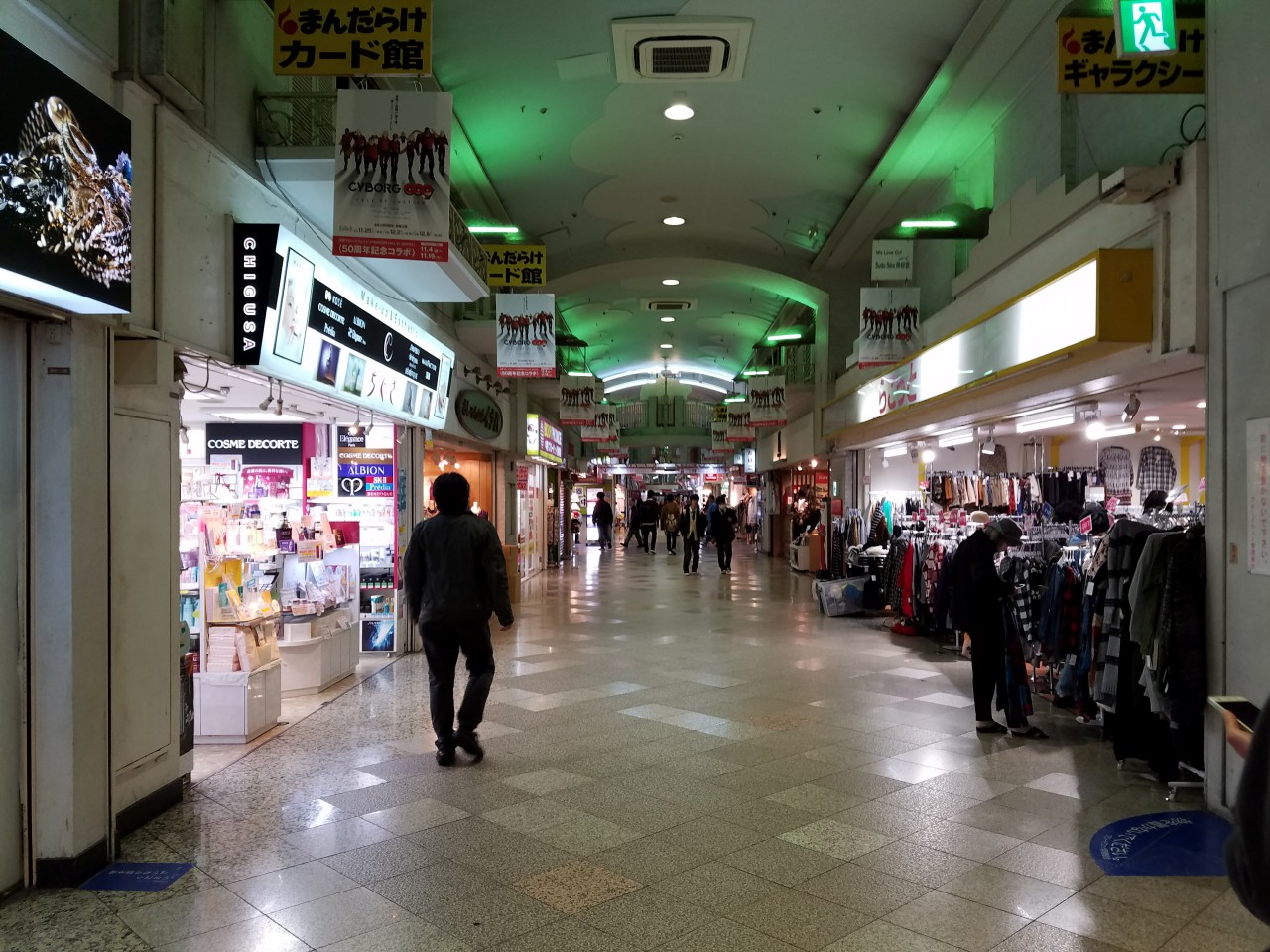
The entrance to Nakano Broadway itself stands at the end of the Sunmall.  At the time of my visit, there was an ad campaign for a new movie trilogy based on Cyborg 009, an old but popular manga series written by the prolific Shotaro Ishinomori.  It's pronounced "zero-zero-nine", but I can't help but to say it "double-oh-nine", because I'm such a James Bond fan.

Nakano Broadway's shopping area consists of four floors plus a basement.  While each floor has a mixture of store types, most of the otaku-focused places are on the 2nd and 3rd floor.  The 1st floor has more places to buy clothes and accessories, many of them second-hand, where the basement has the most grocery shops, frequented by locals.

One brand with a very strong presence in Nakano Broadway is Mandarake, a store for pre-owned anime goods.  I've mentioned Mandarake before, specifically their store in Akihabara, and indeed they have branches all across Japan, but Nakano is, by far, their densest focus.  Within Nakano Broadway alone, Mandarake has a whopping 30 stores!  Mind you, some of them are smaller than others, but among them, there are stores which focus on specific interests.  Many of them (such as Mandarake Headquarters on 3F, shown) just sell manga books, either professionally-published works or fan-made dojinshi.  If you have something you'd like to sell and share with others, they have a "buying desk" location on the 3rd floor, just a couple of doors down from the shop shown here.

I'm a little surprised that all those book sets appear to be standing out in the open, not behind any sort of protective glass.  Maybe the Japanese can be trusted not to shoplift, or maybe they're scared to make such a move under the watchful eyes of Tetsujin-28 over there.  (Or maybe there are just some security cameras I can't see in this shot.  Yeah, it's probably that.)

One unique service offered by some stores in Nakano Broadway, and elsewhere in Japan, is the "rental case".  Clients can pay a flat rate for one of the cases (which varies depending on the location; cases at eye-level are more expensive) and use them to store items they no longer need.  Then, other shoppers can purchase either specific items or the entire contents of that case.  These here aren't examples of rental cases; they're just sample displays outside a Mandarake store (Mandarake Katsudou Shashin (Movie), 2F), but you get the idea.

You can even buy cosplay outfits, too (Mandarake Cosplay, 2F)!  Magical girls (from Sailor Moon, Madoka Magica, etc.) and Disney princess (from Snow White, Frozen, etc.) seemed to be perennial favourites when I was there.  Of course, with prices for pre-made costumes reaching as much as ¥20,000 (US$200), not counting wigs or accessories, most cosplayers I know prefer to make their costumes themselves.  At least, that's how I know it to be in countries like the US; I wonder if that's also the prevailing wisdom in Japan's cosplay scene?

Of course, it's more than just anime and manga fandoms that draw people to Nakano Broadway.  Some people like to collect model cars, so there's a Mandarake for that.  This one (Mandarake Daisharin (Car), 2F) had a bunch of James Bond cars and toys on display in the window, so of course I had to take a picture of that.  Strangely, even though I'm a huge fan of 007, I didn't buy anything from there.  That's probably for the best; some of this stuff was also going for tens of thousands of yen (hundreds of US dollars)!

From model cars, we go to model trains.  Yes, this hobby has spread to Japan as well, and the wide array of limited-express trains that have operated over the years makes for an interesting variety.  This store (Train Models Bigyard, 2F), which surprisingly is not a branch of Mandarake, sells many kinds of model trains, including those (seen here on the front shelves) based on the "Azusa" and Odakyu "Romancecar" limited expresses.  Hm, perhaps I should write up some Know Your Trains articles on them...

Need a break from shopping?  There are a few eateries and cafes in Nakano Broadway, mainly on the 1st, 2nd, and basement floors, complementing the restaurants along the Sunmall outside.  The Fujiya bakery on the 1st floor has a small statue of its famous Peko-chan mascot up front, dressed in a seasonal kimono.

If you head back outside and off onto one of the side streets crossing the Sunmall, you'll find an even greater variety of restaurants, primarily noodle joints and izakaya pubs.  It's quite a densely-packed neighbourhood back here.  And that's to say nothing of Nakano Broadway itself, where I got lost a couple of times.  But I managed to find my way out in time for my next excursion: a tour to the one and only Studio Ghibli Museum, next time on Sekai Ichi!


Hours: Varies by store.  Most stores open between 10:00 AM and 12:00 PM, and close around 8:00 PM.  Closing days also vary by store, but are usually Wednesdays.

Access: Nakano Broadway is 3 minutes on foot from the north exit of Nakano Station.  From Shinjuku Station, take the JR Chuo (Rapid) (JC) line to Nakano (JC06, 5 minutes, ¥160, JR Pass OK); Chuo-Sobu (Local) (JB) trains only take a couple of minutes longer.  From Tokyo Station, take the Chuo line (20 minutes, ¥220, JR Pass OK), or walk to the nearby Otemachi Station and take the Tozai (T) subway line (T01, 20 minutes, ¥200).

Website: (English) (Japanese)