COVID-19 Coronavirus Notice

COVID-19 Coronavirus Notice

Updated 2 July 2020

If you are reading this message, please be aware of travel restrictions in place as part of measures to contain the spread of the COVID-19 "Coronavirus" and its symptoms. Japanese authorities are refusing entry to individuals from, or who have been to, a list of over 100 countries (More information). All other visitors must apply for a visa, and undergo a quarantine upon entering the country. Within the Japan, there are no longer any travel restrictions, and most public attractions have re-opened with precautions for sanitation and social distancing. In short, travel to Japan is not recommended at this time, until the situation normalises. I will not be editing my individual articles to reflect this, but again, please keep this in mind when reading them.
Showing posts with label architecture. Show all posts

Monday, September 30, 2019

Hida Folk Village

This article is based on a visit made on Friday, 18 May 2018.

Previously on Sekai Ichi, I introduced the city of Takayama, which is where I went on the tenth full day of my vacation.  To get there from Toyama, I took the Wide View Hida express, which I have written about before in a Know Your Trains article, for a 90-minute ride south into the heart of Honshu.

As I described in the above article, the Wide View trains live up to their name not only with extra-large windows along the sides, but also with a wrap-around front window on the end car.  It is ordered at the front of the train when heading from Nagoya/to Toyama, and at the back in the other direction.  We got seats in that car both ways, and since it is designated as a Green Car, we had it almost all to ourselves.

The Wide View Hida is officially my favourite train journey ever, in terms of scenery.  Despite the cloudy weather, the hues of the brilliant green forests and clear blue streams shone through.  Some of the best scenery can be found in the section between Inotani and Hida-Furukawa, which the Hida covers in over half an hour without any stops.

Occasionally a cloud of mist would hover over the swiftly-flowing streams, which I also found pleasantly atmospheric.  Yet, all good things must come to an end, and we did have to leave the train eventually, but the best was yet to come.

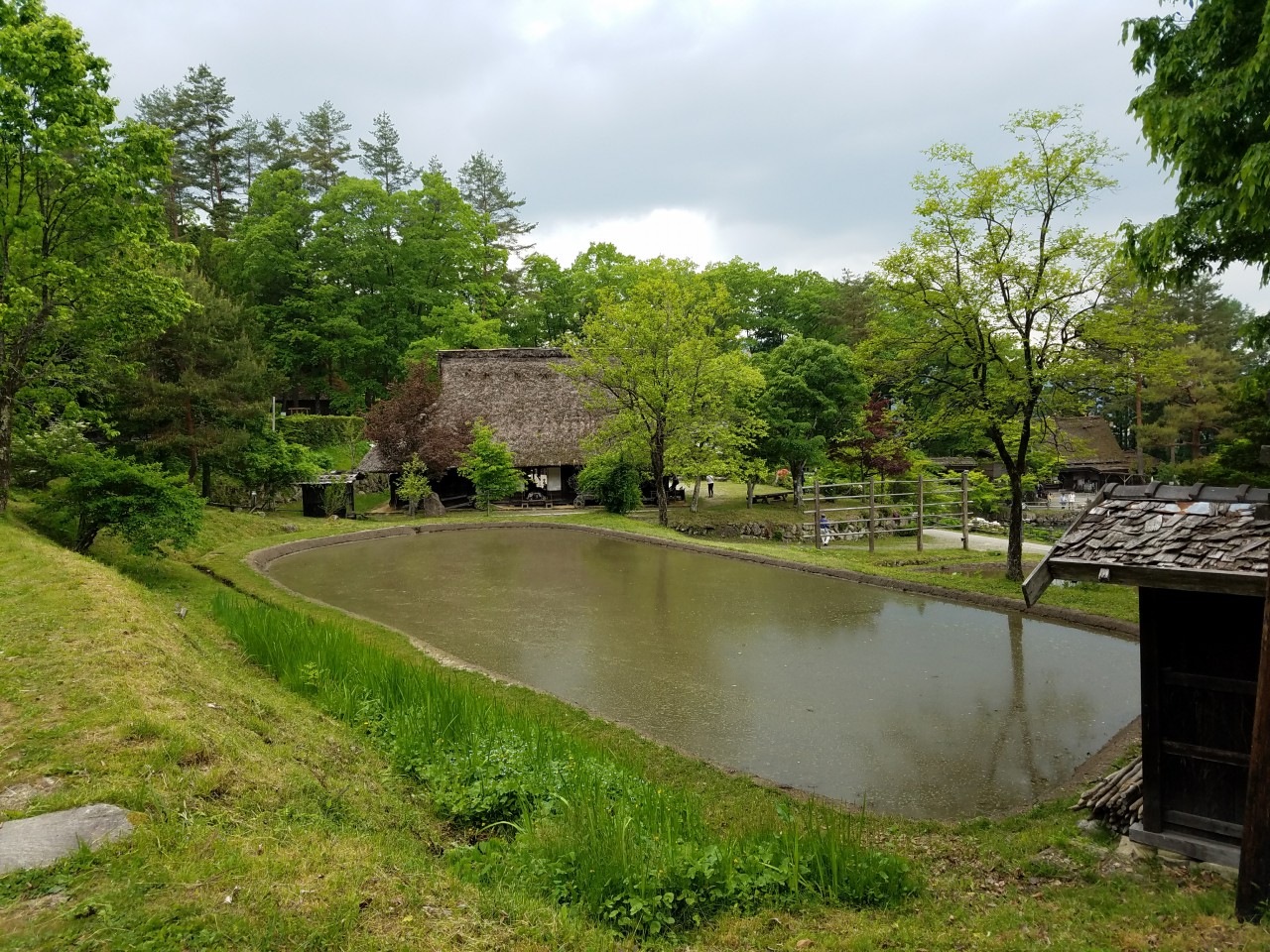
From Takayama Station, we took a bus to Hida Folk Village (飛騨の里, Hida no Sato), an open-air museum which has collected and preserved houses from farming towns across the region.  As soon as you enter the park, you are greeted with a splendid viewpoint of some of those houses from across a lake.  Many come from Shirakawa-go, which has become popular in its own right after becoming a UNESCO World Heritage Site.  Indeed, I had also planned a day trip there, since there are also direct buses that go there from Toyama, where I was staying, but ultimately I decided that it would be more convenient just to get the same experience here.

There are a few free small activities put out around here for visitors to try out.  You can put on the coat, hat, and back-mounted basket of a farmer, or even try out an Edo-period water gun.  It's one of those straight rod-like things where you push a plunger in and it shoots the water by pressure alone.  It was surprisingly hard to hit the targets posted above the lake.

There are multiple styles of houses, all grouped under the term minka (民家, lit. "house of the people"), on display at Hida-no-Sato.  They date from the Edo or Meiji periods, and most of them are open for visitors to walk in.  As you explore the houses, you'll be taking your shoes on and off a lot, and there are quite a few staircases, both inside and out.  Visitors with mobility needs should be aware of that ahead of time.

Hida no Sato holds seasonal events throughout the year.  They celebrate festivals like Girls' Day (3 March) and Boys' Day (5 May), and also some agricultural activities.  In these fields, rice is planted in the late Spring, and harvested in the following Autumn.

There were so many houses present that I didn't manage to visit nearly all of them, but the ones I did each presented different aspects of life in old rural Japan.  Inside, you will find elements like irori (囲炉裏), which are sunken fire pits used for cooking, located in the middle of the main room.  Pots are hung above the fire pit by hooked steel rods called jizaikagi (自在鉤).

When you climb up to the top levels, you will get a better look at how these homes are constructed. They are typically made without using any nails; instead, wooden beams are lashed together with rope.  The roofs are thatched with straw; the thickness (up to a metre/3 feet) and the steeply-sloped shape (up to 60 degrees) of the roofs makes them strong enough to withstand the heavy snowfalls this region is infamous for, as well as slough off rain that would cause it to rot.

The families who used to own these homes were involved in various trades, and the methods of their labour are represented here.  Exhibits within the houses show how products like silk, paper, or tofu were made back in the day, and include artifacts involved in those processes.  You may also see volunteer artisans making these crafts first-hand.

While you're there, don't forget to check out the Hida-Takayama Crafts Experience Centre, just across the road from the main entrance.  They hold paid courses, with instructions available in English, for making things like sarubobo cloth dolls and senbei rice crackers.  These courses cost ¥600 to ¥1600, and you can get discount if you present a paid ticket for Hida no Sato itself.

We went for the senbei baking experience, not only because it was the cheapest and quickest, but because I had developed a serious taste for the things in trips before.  How it works is you hold the raw crackers by a pair of tongs and hold them in the kiln-like oven in front of you.  The goal is to rotate them at regular intervals so that, as they bake and expand, they grow as flat and evenly as possible.  You get to bake ten crackers in total, alternating between lighter ones flavoured with salt, and darker ones flavoured with soy sauce.  Although it took us some time to get the routine down pat, they all came out delicious!  So for my sign-off selfie, allow me to demonstrate the fruits of my labour.  No time to bask, though, since I still have much more to cover from Takayama, including the Yatai Kaikan festival museum, next time on Sekai Ichi!


Hours: Open from 8:30 AM to 5:00 PM.  No regular closing days.  The Crafts Experience Centre is open from 10:00 AM to 4:00 PM, and is closed on Thursdays.

Cost: ¥700.

Address: 1-1-590 Kamioka Motomachi, Takayama-shi, Gifu-ken 〒506-0031

Access: From the Takayama Bus Centre, take the Sarubobo loop bus to Hida no Sato (9 minutes, ¥210).  The return trip takes about 15 minutes, but be aware that every third bus takes a detour out to the Festival Forest museum, adding 20 minutes onto the trip back to downtown Takayama.

Website: (English) (Japanese)


Friday, November 17, 2017

Shinjuku Night Walk

This article is based on a visit made on Wednesday, 23 November 2016.

Previously on Sekai Ichi, I visited the Tokyo Metropolitan Government Building in Shinjuku (新宿, lit. 'new lodge'), one of Tokyo's 23 wards.  I had never been to Shinjuku before, so once I got my fill of the nighttime views from that tower, I walked over there to finally kick it off my bucket list.

Shinjuku Station is registered in the Guinness Book of World Records as the world's busiest railway station.  In 2007, for example, it handled an average of 3.64 million people per day.  The central cluster consists of the JR East, Odakyu, and Keio stations.  Nearby, Tokyo Metro, Toei Subway, and Seibu also have stations using the Shinjuku name.

The walk from the Tocho building to Shinjuku station is about 600 metres (2,000 feet).  There were a few light installations set up along the way, including these trees which had animated lights "falling" from their branches.  Coincidentally, the weather started getting misty off-and-on at this point.

My path then went through an underground passage, emerging on the west side of the station.  On the way, I encountered a branch of Megane Drug (メガネドラッグ, Megane Doraggu), an eyeglass pharmacy chain.  Many of their stores are identified by two things: 1) a statue of their mascot, a bespectacled samurai-looking person of indistinguishable gender, and 2) a free station for people to clean their glasses at.  I used it, and it helped a bit.

After re-emerging in front of the station, and briefly getting lost amidst the Odakyu and Keio stations/department stores, I had to get something to eat.  To that, I turned to Omoide Yokocho (思い出横丁, lit. 'memory lane'), a short and narrow alley, due west of Shinjuku Station.  Omoide Yokocho is packed with tiny restaurants serving quick Japanese bites, like yakitori chicken, ramen and soba noodles, and sushi.  Most of these places are so small, you could count the number of seats on your hands.  I can't remember which of those places I ended up eating at, but the yakitori I got there was delicious!

After leaving Omoide Yokocho and crossing under the train lines, I wound up here.  On the east side of the station, the plaza in front of Studio Alta is a popular meeting place.  Studio Alta is an advertising agency whose office is identifiable by its giant video monitor.  (This picture was taken during a revisit on Wednesday, 9 May 2018.)

The other side of the plaza also had a pair of Mount Fuji light displays, one in blue and one in red.

Pass Studio Alta and cross Yasukuni-dori, and you will wind up in Kabuki-cho (歌舞伎町, Kabuki-chō).  The name comes from a Kabuki theatre that was supposed to be built here in the 1940s, but never came to be.  Nonetheless, Kabuki-cho guarantees a wild time.  It has many restaurants and nightclubs including, Robot Restaurant, the now-world-famous dinner theatre.

It is also Japan's biggest "red-light district", owing to its concentration of massage parlours, love hotels, hostess clubs... pretty much everything short of actual prostitution (which is technically illegal in Japanese law).  If you do choose to venture out into that sort of thing, take extra-special care of your wallet, and your drink.  The cover charges on these places can be exorbitant, but that's nothing if someone spikes your drink, and you get charged for way more than you bargained for!  But if you stay on the more populated streets, and don't give the touts so much as a glance, you should be fine.  Really, the worst thing that happened to me is that I lost track of time at a game centre, time that I could have spent at other winter light places.

This avenue ends in front of the Toho Building.  Its tenants include a movie theatre and a hotel, the Hotel Gracery Shinjuku.  It's a nice mid-range hotel, from what I've looked up.  I have never stayed there, but have considered it on several occasions.

And up on the corner of that building is a statue of, you guessed it, Godzilla.  The most famous of Japan's movie monsters, Godzilla (ゴジラ, Gojira) first showed up on the scene in its self-titled 1954 film.  Since then, Toho Studios have made 30 official entries in the series.  This includes the latest movie, Godzilla: Planet of the Monsters, which should be in Japanese theatres and on Netflix by the time you read this.  In fact, not too long ago, Godzilla was appointed as the cultural ambassador of Shinjuku, [1] where we are now.

By 江戸村のとくぞう [CC BY-SA 4.0], from Wikimedia Commons
Once you're done with Kabuki-cho, another nightlife area you might like is just next door, to the east.  Golden Gai (ゴールデン街, Gōden Gai) is something of a cross between Kabuki-cho and Omoide Yokocho, in that it is a densely-packed collection of small bars.  Each of these watering holes has a unique character brought on by their distinctive decor.  Some cater to a few regular customers, accepting new patrons by recommendation only, but others welcome foreigners and locals alike, and are even run by ex-pats themselves.  While somewhat less seedy in nature than the rest of Kabuki-cho, the cover charges for these places can add up as well.

Back to places I actually did go to, this is what it looks like when you turn around from the Toho Building above.  There's a luxury goods store here whose front was decorated like an old-style warehouse, which I felt was kind of neat.

Not as neat as this building over here, though.  It is called the Yasuyo Hall (安与ホール, Yasuyo Hōru), and it contains public event space in addition to a bank, a hair salon, and an art gallery.

After much aimless navigating, I finally wound back up at Shinjuku Station.  Across from the main exit, "Busta Shinjuku" (バスタ新宿, Basuta Shinjuku) is a new bus terminal that opened earlier in 2016, replacing and improving upon the pre-existing one.  If you are taking a long-distance bus from Tokyo, especially to places such as Mount Fuji and Lake Kawaguchi, chances are good that you will depart from here.

As for me, I had to head back down to the subways, as I was on my way to Roppongi for even more holiday lights.  Find out how that went, next time on Sekai Ichi!


Access: Shinjuku Station is served by the JR Yamanote (JY), Chuo (JC), Chuo-Sobu (JB), Saikyo (JA), Shonan-Shinjuku (JS), Odakyu Odawara (OH), Keio (KO), Tokyo Metro Marunouchi (M), Toei Shinjuku (S) and Oedo (E) lines.  From Tokyo Station, take the JR Chuo (Rapid) line to Shinjuku (JC05, 15 minutes, ¥200).

Note: If you are using the Toei Oedo line, be aware that there are actually two stations serving different parts of the line.  Shinjuku (新宿, E27) is on the south side of the loop, and is closer to Roppongi, Daimon, etc.  This station is shared by the Shinjuku subway line and the Keio New Line.  Shinjuku Nishi-guchi (新宿西口, E01) is on the north side of the loop, and is closer to Iidabashi, Ryogoku, etc.  Both stations are connected with the JR station by underground passages, and both are one stop away from Tocho-mae, so if you mess up and walk into the wrong station, you could go there and transfer to the other half of the line.  It is still best to be aware of this ahead of time, lest your commute take longer than expected!

Omoide Yokocho

Hours: Varies between restaurants.  Most are open from 5:00 PM to midnight; some are open for lunch.  Last orders are usually 30 minutes before closing time.

Website(Japanese)


[1] https://www.theguardian.com/world/2015/apr/09/godzilla-recruited-as-tourism-ambassador-for-tokyo

Wednesday, November 15, 2017

Tokyo Metropolitan Government Building

This article is based on a visit made on Wednesday, 23 November 2016.

The Tokyo Metropolitan Government Building (東京都庁舎, Tōkyō-to Chōsha), or "Tocho" (都庁, Tōchō) for short, is a complex of buildings that serve as the main office for the government of the city and prefecture of Tokyo.  Opening in 1991, it replaced the previous city hall, located across town in Yurakucho (its space is now occupied by the Tokyo International Forum).  The architect Kenzo Tange, whose works also include the Yoyogi National Stadium and Hiroshima Peace Memorial Museum, designed the new building.  Its appearance was designed as a cross between a computer chip and a Gothic cathedral.

Tokyo Metropolitan Government Building No. 1, with its two towers extending up from the mid-point, is of interest to tourists for its public observation decks.  There is one in each tower, and they have different open times.  Both decks stand 202 metres (663 feet) above ground, and best of all, they are completely free to visit.  Since this is a working government office, expect to go through a bag check before boarding the elevator up to the deck.

The wide patch of darkness in this picture is Yoyogi Park.  When I visited Meiji Shrine, which is located in the middle of that park, I commented how "the cityscape surrounding the shrine grounds seems to disappear as you walk further in and the sylvanian tranquility engulfs you".  Looking at it from above, especially at night when its surroundings are all lit up, adds a new layer of depth to that argument.

This observatory is one of the places in Tokyo from where it is possible to spot Mount Fuji, off to the west.  Obviously, in the darkness of this early autumn evening, that's not happening.  More visible, however, is the Park Hyatt Hotel, the triple-towered building off to the left.  It is one of the more expensive hotels in Tokyo, which in this town is saying something, quite frankly.  It is famous as a setting for Lost In Translation, a 2003 "romantic dramedy" movie starring Bill Murray and Scarlett Johanssen.  I had seen it for the first time before setting off for this holiday, and I quite liked it.

I had two cameras on me that night: the one in my cell phone, and a separate digital camera.  I tried taking long-exposure night shots, such as these, with the latter.  It was tough keeping it still long enough to take the picture.  As such, most of those shots came out all jumpy and blurry, but this one, with Tokyo Tower glowing like a golden needle, was the best I got out of it.

The observatories also host a cafe and gift shop.  Every so often, there are also expositions where local products from different regions of the country are sold.  At the time of my visit, there was a "local specialties fair" with products from all 48 prefectures of Japan on sale.

Saitama is the prefecture to the immediate north of Tokyo.  Some of its highlights include the urban Saitama City, the historic Kawagoe, and the rural Chichibu.  Saitama's tourism board even produced an animated short feature to advertise the prefecture, called "Sightseeing War in Saitama ~Battle of Sakuya~".  Its lead character, Sakuya, is portrayed front and centre on this poster.

But Saitama would have to wait, as my next travel aspirations were considerably more local.  Join me for a nighttime walk through Shinjuku, next time on Sekai Ichi!


Hours: The North Observatory is open from 9:30 AM to 11:00 PM.  The South Observatory is open from 9:30 AM to 5:30 PM, or until 11:00 PM when the North Observatory is closed.  Entry ends 30 minutes before closing time.

The North Observatory is closed on 2nd and 4th Mondays of every month, and the South Observatory is closed on the 1st and 3rd Mondays of the month.  Both observatories are closed on 29-31 December and 2-3 January.

Costs: Free.

Address: 2-8-1 Nishi-Shinjuku, Shinjuku-ku, Tōkyō-to 〒163-8001

Access: Right next to Tocho-mae Station (Toei Oedo (E) line), or 10 minutes on foot from Shinjuku Station (JR Yamanote (JY), Chuo (JC), Chuo-Sobu (JB), Saikyo (JA), Shonan-Shinjuku (JS), Odakyu Odawara (OH), Keio (KO), Tokyo Metro Marunouchi (M), Toei Shinjuku (S) and Oedo (E) lines).

From Tokyo Station, take the JR Chuo (Rapid) line to Shinjuku (JC05, 15 minutes, ¥200).

Directions: From Shinjuku Station (JR New South Exit), turn right out of the gate.  Cross the street at the next intersection, turn right, then take the second left.  Keep going straight, and the Metropolitan Government Building will be ahead on your right side.

Website(English) (Japanese)

Tuesday, October 31, 2017

Hiroshima Peace Memorial Park

This article is based on a visit made on Monday, 21 November 2016.

Edit 8 October 2019: Updated prices to reflect the increase in Japan's national sales tax.

Previously on Sekai Ichi, I visited the Hiroshima Peace Memorial Museum, devoted to the history and memory of the atomic bombing of Hiroshima on 6 August 1945.  When the bomb detonated, a good chunk of land in the city's centre was left completely razed.  In the years that followed, it was decided to leave that space as a public park, the Peace Memorial Park (平和記念公園, Heiwa Kinen Kōen), adorned with monuments and the aforementioned museum erected to evoke wishes of peace and a world free of nuclear weapons and nuclear warfare.

Many statues and monuments dot the park, depicting and offering tribute to various groups of people who had been victimised by the bomb and by World War II in general.  I saw some of these right after I got off the bus from Hiroshima Castle, on the south side of the park.  This one, known as the Statue of Peace or "New Leaves", was sculpted by Katsuzo Entsuba.  The base contains an inscription by Dr. Hideki Yukawa (湯川 秀樹, Yukawa Hideki, 1907-1981), a Nobel Prize laureate who campaigned for nuclear disarmament.

This one seems a bit more dramatic in its depiction of someone who had been critically wounded, or possibly killed, from the explosion, and someone else carrying them in agony.  It is called the Monument to the A-Bombed Teachers and Students of National Elementary Schools.

A close-up of the garlands of origami cranes hung behind the statue.  The paper crane is a major motif of peace relating to the bombing, as I would soon learn in the museum afterwards.


After passing under, or visiting, the museum, we will reach this cenotaph, an archlike structure engraved with the names of all victims of the Hiroshima bombing.  Underneath this cenotaph, a plaque is inscribed with a message.  Translated to English, it reads:
"Let all the souls here rest in peace, for we shall not repeat the evil."
Translations to several other languages are inscribed on floor plaques nearby.

Behind the cenotaph stands a reflecting pool and this monument, atop which an eternal flame burns.  It was first lit in 1964, and is meant to remain lit until the last nuclear weapon in the world has been destroyed.  Good luck with that, world.

Nearby the cenotaph and eternal flame is another statue, the Peace Prayer Monument, which appears to depict a goddess figure standing atop a crescent moon.

Continuing the arch motif of the cenotaph, farther back we see the Children's Peace Monument.  It is topped by a statue of Sadako Sasaki, whom you may have read from my last article was a child who suffered from leukemia after surviving the bomb, and folded a series of origami cranes in her final months.  Fittingly, her statue here depicts her holding a wireframe crane, and there is also a crane-shaped bell ringer beneath the arch.

Behind the Children's Monument are several displays with messages to peace and many more paper cranes.  This one depicts a face whom I thought to be Barack Obama, but could just as likely be a Japanese politician whom they were either praising or trying to send a message to.


Nearing the north end of the park, we finally get to one of its most enduring symbols, both literally and figuratively.  The "A-Bomb Dome", as it has become known, was the closest building to the bomb's epicentre that survived partially standing.  It was originally built as the Hiroshima Prefectural Product Exhibition Hall, designed by the Czech architect Jan Letzel in 1915.  Again, as discussed in my previous article, concrete structures like this were able to withstand the blast more than the wooden buildings that were more common in the area.  The A-Bomb Dome has remained much as it has since then, with only minor structural renovations to keep it that way.  It was also inscribed as a UNESCO World Heritage Site in 1996.

Finally, the Peace Clock Tower.  It was built after the bombing, as far as I can tell, but it does look like the kind of twisted wreckage the bomb would have left in its wake.

Taisyo [GFDL or CC BY 3.0], from Wikimedia Commons
I missed it, but a new attraction had opened nearby right before my visit, earlier in 2016.  The Orizuru Tower (おりづるタワー, Orizuru Tawā) is a multi-purpose building with a visitor's centre, interactive exhibition space, and an observation deck.  The word "orizuru" means "paper crane", and it is indeed a major motif of the place.  This is of course related to the story of A-bomb survivor Sadako Sasaki, whom I mentioned in my last article.  The entry fee is a little steep, but if you thought the view from Hiroshima Castle wasn't close enough for your liking, the view from Orizuru Tower's rooftop deck is supposed to be even better.  It looks down over the Peace Park, and on a clear day, you can even see Miyajima Island!  For an added fee, you can fold a crane of your own and drop it into the Orizuru Wall, which can then be seen from street level.

Finally, this is the tram stop I took to get back to my hotel.  It stands right nearby the Peace Park and the A-Bomb Dome, and is fittingly named after the latter.  Even though you can see the Orizuru Tower in the background of this and other pictures above, I sadly was unaware of it at the time.  Either that, or I just felt shagged out and wanted to head back home, as it were.  Fortunately, I would go to see Miyajima in person.  But before that, a tour through the Mazda car factory, next time on Sekai Ichi!


Hiroshima Peace Park

Hours: Open 24 hours.  No closing days.

Costs: Free.

Address: 1-1 Nakajima-chō, Naka-ku, Hiroshima-shi, Hiroshima-ken 〒730-0811

Access: From Hiroshima Station, take tram line 2 or 6 to Genbaku Dome-mae / Atomic Bomb Dome (M10, 15 minutes, ¥190).  The north end of the park is right across the river to the south.  Alternatively, take tram line 1 to Fukuro-machi (U2, 15 minutes, ¥190), and walk west for 5 minutes, on Heiwa-dori, to reach the park from the south.

The Peace Memorial Museum is also a stop on the Maple-oop bus.  From Hiroshima Station, take any of the three lines to Peace Memorial Park (16 minutes, ¥200, JR Pass OK).

Website(Japanese)

Orizuru Tower

Hours: Open from 10:00 AM to 7:00 PM.

Costs: ¥1,700.  Adding a crane to the Orizuru Wall costs an additional ¥100.

Address: 1-1 Nakajima-cho, Naka-ku, Hiroshima-shi, Hiroshima-ken 〒730-0811

Access: Orizuru Tower is next to the Genbaku Dome-mae tram station.

Website(English) (Japanese)

Saturday, October 21, 2017

Shinsekai and Tsutenkaku

This article is based on a visit made on Sunday, 20 November 2016.

Edit 7 October 2019: Updated prices to reflect the increase in Japan's national sales tax.

Shinsekai (新世界, lit. 'new world') is a neighbourhood in south-central Osaka.  It came into form in the early 20th century, and was then inspired by the cityscapes of Paris and New York.  The highlights of Shinsekai back then were the tower Tsutenkaku, modelled after the Eiffel Tower, and Luna Park, an amusement parked named after another one from New York's Coney Island.  Shinsekai's glory days may be behind it -- Luna Park is long gone, and Tsutenkaku exists in a different form -- but still today it maintains its own unique attractions and cuisine.

DVMG [CC BY 3.0], via Wikimedia Commons
The first thing I did when I arrived at Shinsekai was visit Spa World, a public onsen with many themed baths.  Of the two floors used by the baths, there is the European Zone (like Greece, Ancient Rome, Finland, etc.), and the Asian Zone (like Arabia, Persia, Japan, etc.).  The two floors alternate between male and female-only every month, so I wound up in the Asian Zone.  I don't have any pictures of these baths, for obvious reasons, but the photos on their website, listed below, should spark your imagination.  They even have a separate water park and pool area on the top fooor, which is mixed-gender and requires swimsuits -- again, for obvious reasons.

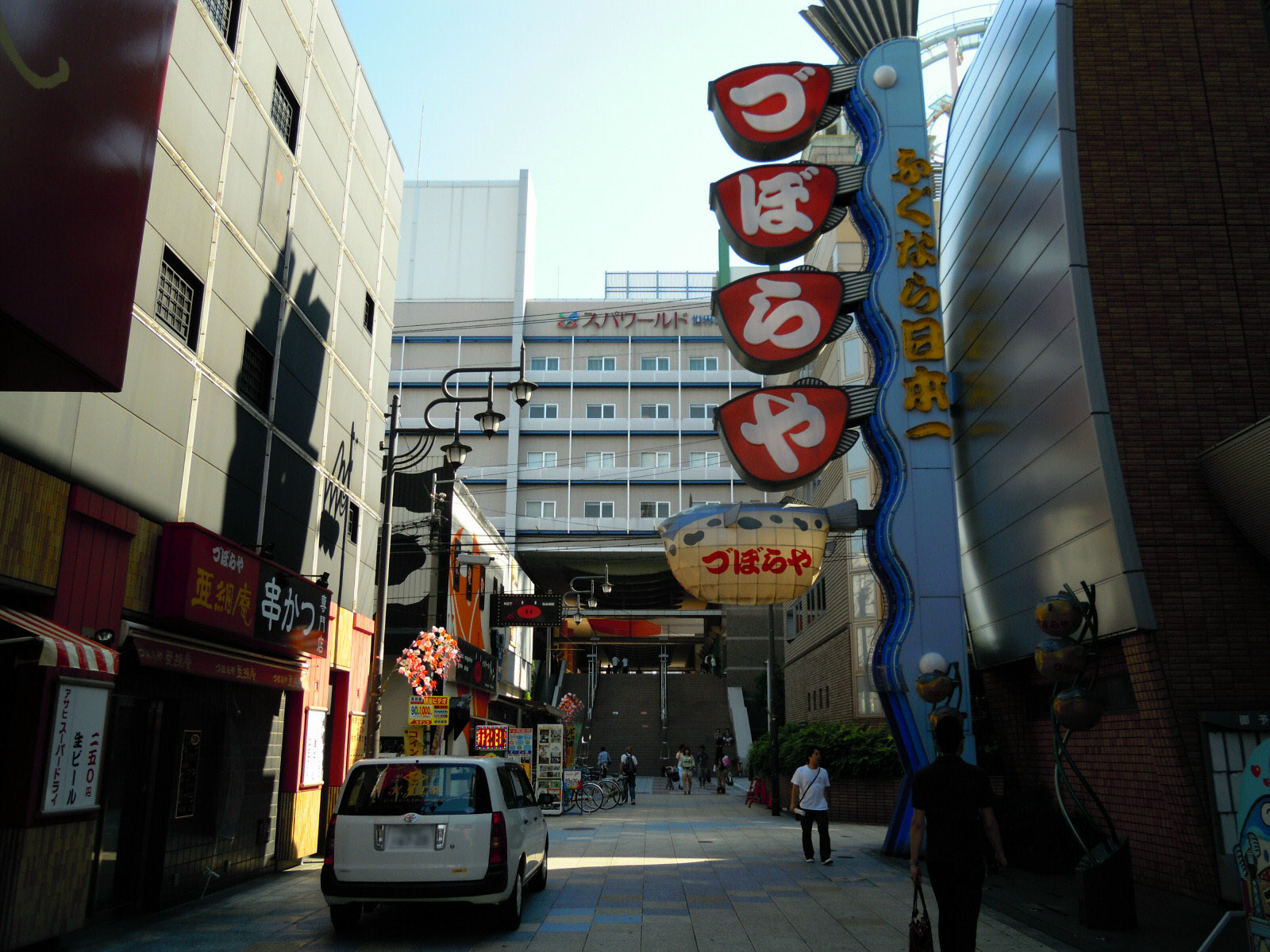
Upon leaving Spa World, I was mere steps away from Shinsekai itself.  This place is home to a dense concentration of eateries, which compete with one another by erecting elaborate, extravagant advertisements.  One of the most iconic signs, I would say, is that giant blowfish hanging from a pole.  This restaurant, called Zubora-ya, specialises in fugu (フグ), raw sliced blowfish.  If you've heard of the dish, you may know how there are certain poisonous organs in the blowfish, which can paralyse and kill a person if eaten.  Fugu chefs are trained for years upon years to avoid this, so dining at any reputable fugu restaurant should be safe, if expensive.  Fun fact: the Emperor of Japan is banned from ever eating fugu, for obvious reasons.

There are a vast array of restaurants beyond the fugu place I described above.  One of the most common things you'll find on the menu here is kushikatsu (串カツ) an assortment of many fried and skewered dishes.  Kushikatsu can be meats (beef, chicken, squid), vegetables (tomatos, asparagus, lotus roots), and even dessert-y stuff (bananas, cheese, cheesecake).  They're cheap, with each stick costing about ¥100 to ¥200.  There are also small tubs of dipping sauce available for free, but since they're shared among diners, there is one rule you must be aware of: no double-dipping!  #seinfeld

This little fellow is known as Billiken (ビリケン, Biriken).  Known as "The God of Things As They Ought to Be", this charm doll character was originally created in America, after the turn of the 20th century.  It faded from popularity after a few years, unless you go to St. Louis University, where he is still their athletics mascot.  Anyway, Billikens also started catching on in Japan at that time, to the point that a Billiken statue was enshrined in the original Tsutenkaku in 1912.  Another such statue exists in the modern tower, which you will see later on.

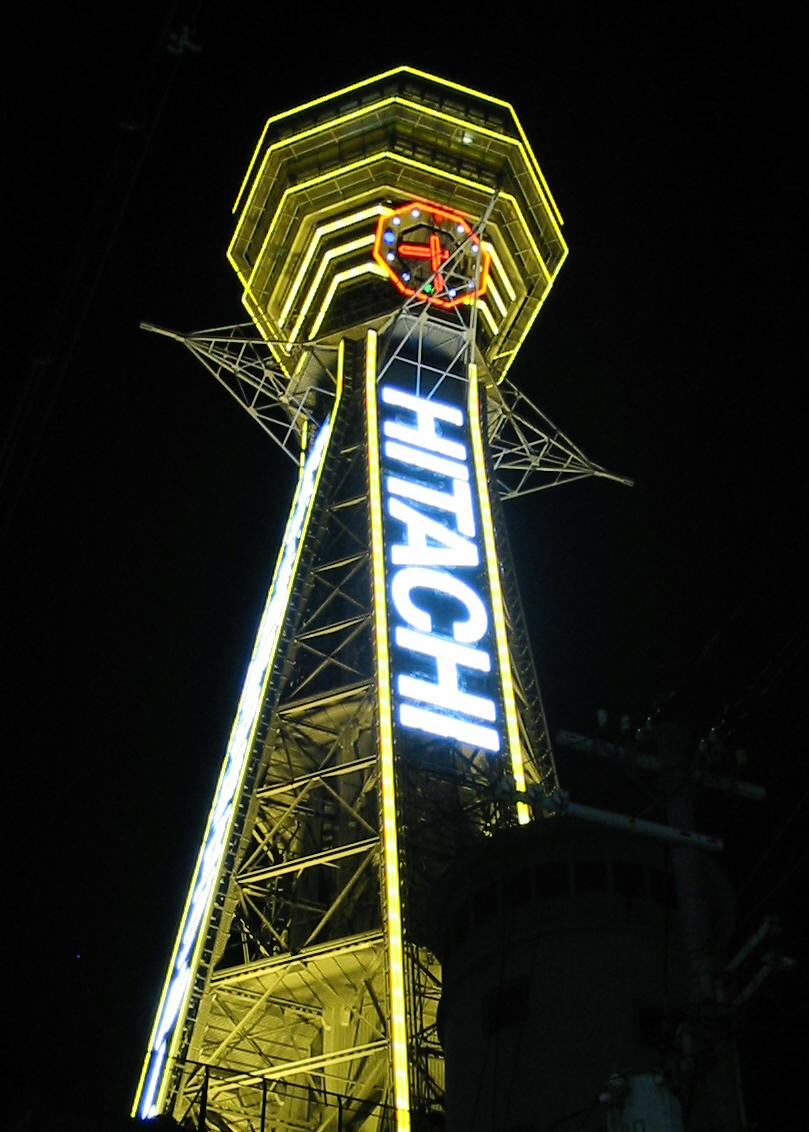
After getting my nosh on, I set my sights skyward towards Tsutenkaku (通天閣, Tsūtenkaku, lit. 'Heaven-reaching tower'), an observation tower right in the centre of Shinsekai.  As mentioned above, there was an earlier version of Tsutenkaku, built in 1912, but it was torn down for scrap metal during World War II.  Its current incarnation dates back to 1956, stands 103 meters /338 feet tall, and was funded largely by the Hitachi corporation, hence the prominent placement of their name along the side.  Here it is during the day (taken that morning from Tennoji Station)...

By Momopy (Momopy) [GFDL or CC-BY-SA-3.0], via Wikimedia Commons
...and here it is at night.  Formerly lit up by neon, Tsutenkaku recently switched to LED lighting, which is more energy-efficient, and also changes to different colours every month.  The tower is functional, too.  Not only does it hold the largest clock in Japan, but the lights on the top-most ring (not visible from this angle) change colours based on the next day's weather.  White stands for clear weather, orange is cloudy, blue is rainy, and combinations of two colours indicate a mid-day change in weather.

The main deck of Tsutenkaku stands 84 metres (275 feet) above ground, and has a full 360° vantage of southern Osaka.  On top of that (in more ways than one), if you pay an extra ¥500, you can climb up to an open-air deck, which also offers 360 degrees of views.  They even lend you a pair of binoculars for taking a closer look, but hold on to them tight!  To the southeast, you can look over Tennoji Park and Abeno Harukas, the new skyscraper.

Here is a close-up of Abeno Harukas.  Its observation deck (300m / 984ft.) may be taller than Tsutenkaku's, but is more expensive to get into (¥1,500).  And besides, being closer to the ground lets us take in more details of our surroundings!

Once we're done looking out from the top of Tsutenkaku, we can take the elevator down to a small museum of sorts... and back in time, as well.  This display illustrates what Tsutenkaku's early-century predecessor looked like, as well as the amusement park that used to stand at its base.  The original Tsutenkaku stood only 64 metres (210 feet), but was the second-tallest structure in Asia at the time (Source: (English)).

This is followed by a museum, cafe, and shop dedicated to Glico, a confectionary company based in Osaka.  Their most famous product is Pocky (ポッキー, Pokkī), a cookie stick dipped in fudge.  You may have seen these if you've been to any anime convention ever.  There are many flavours of Pocky, with the main standbys being chocolate and strawberry.  Here, we see the Tsutenkaku re-created using boxes of Pocky.

With my feet back on terra firma, I tried another new beverage from a vending machine: a sports drink called Pocari Sweat.  I couldn't quite put my finger on the taste; it was very watered-down, but with a certain sour tang to it.  My research tells me it has a mild grapefruit flavour, and since I'm not so familiar with that fruit, that explains my puzzlement.  Suffice it to say, I didn't like it quite as much as the Oronamin C, which I had tried that morning.

For my sort-of selfie sign-off, I had my picture taken with the Billiken statue in Tsutenkaku's main deck.  The big draw with this thing is that you donate a coin and rub its feet, and it is supposed to grant your wishes.  We'll see how well that turned out when we go up to Dotonbori, next time on Sekai Ichi!


Access: The closest stations are Shin-Imamiya (JR Osaka Loop (O) line), Dobutsuen-mae (Osaka Metro Midosuji (M) line), and Ebisu-cho (Osaka Metro Sakaisuji (K) subway and Hankai (HN) tram lines).

From Osaka/Umeda Station, take the JR Osaka Loop line to Shin-Imamiya (O19, 17 minutes, ¥180, JR Pass OK), or the Midosuji subway line to Dobutsuen-mae (M22, 13 minutes, ¥230).
From Namba, take the Midosuji subway line to Dobutsuen-mae (4 minutes, ¥180), or the Nankai Main or Koya lines to Shin-Imamiya (NK03, 2 minutes, ¥150). You could also walk to Shinsekai in 15 minutes from Nankai Namba Station.

Directions: From Shin-Imamiya Station, turn left from the exit.  You should be facing the Maruhan/Don Quijote store.  Cross the road, turn right, and take the next left (past Spa World).

From Dobutsuen-mae Station, take exit 5.  You should emerge in front of the Maruhan/Don Quijote store.  Continue as described above.

Spa World Osaka

Hours: Open from 10:00 AM to 8:45 AM the following morning.  Infrequent, irregular closing days.

Costs: An all-day pass costs ¥1,200 on weekdays, or ¥1,500 on weekends and holidays.  Staying overnight, between midnight and 5:00 AM, costs an extra ¥1,300.  Water rides in the pool area cost  ¥500 each.

Address: 3-4-24 Ebisu Higashi, Naniwa-ku, Ōsaka-shi, Ōsaka-fu 〒556-0002

Website(English) (Japanese)

Tsutenkaku

Hours: Open from 9:00 AM to 9:00 PM.  Admission ends 30 minutes before closing time.  No regular closing days.

Costs: ¥800.  The upper open-air deck costs an additional ¥500, payable on the main observation deck.

Address: 1-18-6 Ebisu Higashi, Naniwa-ku, Ōsaka-shi, Ōsaka-fu 〒556-0002

Website(English) (Japanese)