COVID-19 Coronavirus Notice

COVID-19 Coronavirus Notice

Updated 2 July 2020

If you are reading this message, please be aware of travel restrictions in place as part of measures to contain the spread of the COVID-19 "Coronavirus" and its symptoms. Japanese authorities are refusing entry to individuals from, or who have been to, a list of over 100 countries (More information). All other visitors must apply for a visa, and undergo a quarantine upon entering the country. Within the Japan, there are no longer any travel restrictions, and most public attractions have re-opened with precautions for sanitation and social distancing. In short, travel to Japan is not recommended at this time, until the situation normalises. I will not be editing my individual articles to reflect this, but again, please keep this in mind when reading them.
Showing posts with label observation decks. Show all posts

Thursday, April 9, 2020

Tokyo Skytree Daytime

This article is based on a visit made on Sunday, 20 May 2018.

Previously on Sekai Ichi, in 2014, I visited Tokyo Skytree, the world's tallest broadcast tower, at night.  At the end of that article, I commented about wanting also to go up it in the daytime.  Well, in my last full day in Japan to date, I finally made it happen.

Actually, I had been here on the first day of this trip, but the cloud cover was so thick, the tower disappeared into it halfway up.  In such occasions, the Skytree may still be open, but the staff will advise you against visiting, since the views would not live up to their full potential.  So, we turned around and gave it a pass, taking a gamble on the weather clearing up for our final day in Tokyo.  It paid off.

A cultural fair promoting Taiwan was being held in the Skytree Town's courtyard, at the base of the tower itself.  These dragon dancers knew how to attract a crowd!

Being late morning on a weekend, and with exceedingly pleasant weather, Skytree was even more crowded than I remember it from last time.  For once, it started to feel like a tourist trap, I must admit.  To save time, we took advantage of the Fast Skytree Ticket line, a new service added after my last visit.  It is open exclusively to foreigners and costs an extra ¥1,000, but for dealing with a much shorter line, I'd say it was worthwhile.

The upside to our choice of time was, once we finally found a place at one of the windows, the views were the farthest and clearest I've ever experienced.  This shot looks down and to the west, with Asakusa's Senso-ji temple complex in the centre.

For the first time from one of Tokyo's observation decks, I even managed to spot Mount Fuji!  From here, it is visible to the left, with Shinjuku's skyscrapers on the right.  Can you spot some of the more famous ones, like the NTT Docomo building and the Tokyo Metropolitan Government building?

No visit to an observation tower would be complete without looking down one of its glass floors.  Well, all but the more acrophobic of us.

At the time, Skytree was hosting a promotion for the movie Avengers: Infinity War, so decorations and merchandise of the movie's many Marvel superheroes lined the halls of the tower, including the base and the Tembo Galleria.

Speaking of that upper deck, the 451-metre (1,480-foot) Sorakara Point, its highest point, was taken up by standees of the film's main characters.  So much for taking my obligatory selfie up there...

...but I tried.

Here's an even better sign-off selfie, of me posing with Black Panther.  (Which is one of my favourite MCU movies, alongside Iron Man, Captain America: The First Avenger, Thor: Ragnarok, The Avengers, and Avengers: Endgame.)  But getting back on topic, even though I think I've had my fill of Tokyo Skytree for one lifetime, I'm glad I was able to experience it in all its glory, and share in it with my grandmother.  But before I officially sign off on this holiday, I have one more special treat to give you patient readers.  Find out what, next time on Sekai Ichi!


Hours: Open 8:00 AM to 10:00 PM. No regular closing days.

Costs: ¥2,100 for the Tembo Deck, plus an additional ¥1,000 for the Tembo Galleria.  On weekends and holidays, the ticket prices are ¥2,300 and ¥1,100 respectively. Major credit cards including MasterCard, Visa, JCB, and Discover are accepted.

It is possible to reserve tickets ahead of time through their website; however, this requires a credit card issued in Japan. However, foreign guests can take advantage of the new Fast Skytree Tickets, which are sold at a separate counter and allow the user to skip the regular lines. These tickets cost ¥3,200 (Tembo Deck only) or ¥4,200 (Tembo Deck & Galleria).

Address: 1-1-2 Oshiage, Sumida-ku, Tōkyō-to 〒130-0045

Access: Right next to Oshiage Station on the Tokyo Metro Hanzomon (Z) and Toei Asakusa (A) lines, and Tokyo Skytree Station on the Tobu Skytree (TS) line.  From Tokyo Station, walk to nearby Otemachi Station and take the Hanzomon subway line to Oshiage (Z14, 15 minutes, ¥200).

Directions: The ticket counter is on the 4th floor, directly underneath the tower.  The Oshiage subway stations are on the east side of the Skytree complex (roughly underneath the East Tower), and Tobu's Tokyo Skytree station is on the opposite west side.

Website: (English) (Japanese)

Wednesday, November 15, 2017

Tokyo Metropolitan Government Building

This article is based on a visit made on Wednesday, 23 November 2016.

The Tokyo Metropolitan Government Building (東京都庁舎, Tōkyō-to Chōsha), or "Tocho" (都庁, Tōchō) for short, is a complex of buildings that serve as the main office for the government of the city and prefecture of Tokyo.  Opening in 1991, it replaced the previous city hall, located across town in Yurakucho (its space is now occupied by the Tokyo International Forum).  The architect Kenzo Tange, whose works also include the Yoyogi National Stadium and Hiroshima Peace Memorial Museum, designed the new building.  Its appearance was designed as a cross between a computer chip and a Gothic cathedral.

Tokyo Metropolitan Government Building No. 1, with its two towers extending up from the mid-point, is of interest to tourists for its public observation decks.  There is one in each tower, and they have different open times.  Both decks stand 202 metres (663 feet) above ground, and best of all, they are completely free to visit.  Since this is a working government office, expect to go through a bag check before boarding the elevator up to the deck.

The wide patch of darkness in this picture is Yoyogi Park.  When I visited Meiji Shrine, which is located in the middle of that park, I commented how "the cityscape surrounding the shrine grounds seems to disappear as you walk further in and the sylvanian tranquility engulfs you".  Looking at it from above, especially at night when its surroundings are all lit up, adds a new layer of depth to that argument.

This observatory is one of the places in Tokyo from where it is possible to spot Mount Fuji, off to the west.  Obviously, in the darkness of this early autumn evening, that's not happening.  More visible, however, is the Park Hyatt Hotel, the triple-towered building off to the left.  It is one of the more expensive hotels in Tokyo, which in this town is saying something, quite frankly.  It is famous as a setting for Lost In Translation, a 2003 "romantic dramedy" movie starring Bill Murray and Scarlett Johanssen.  I had seen it for the first time before setting off for this holiday, and I quite liked it.

I had two cameras on me that night: the one in my cell phone, and a separate digital camera.  I tried taking long-exposure night shots, such as these, with the latter.  It was tough keeping it still long enough to take the picture.  As such, most of those shots came out all jumpy and blurry, but this one, with Tokyo Tower glowing like a golden needle, was the best I got out of it.

The observatories also host a cafe and gift shop.  Every so often, there are also expositions where local products from different regions of the country are sold.  At the time of my visit, there was a "local specialties fair" with products from all 48 prefectures of Japan on sale.

Saitama is the prefecture to the immediate north of Tokyo.  Some of its highlights include the urban Saitama City, the historic Kawagoe, and the rural Chichibu.  Saitama's tourism board even produced an animated short feature to advertise the prefecture, called "Sightseeing War in Saitama ~Battle of Sakuya~".  Its lead character, Sakuya, is portrayed front and centre on this poster.

But Saitama would have to wait, as my next travel aspirations were considerably more local.  Join me for a nighttime walk through Shinjuku, next time on Sekai Ichi!


Hours: The North Observatory is open from 9:30 AM to 11:00 PM.  The South Observatory is open from 9:30 AM to 5:30 PM, or until 11:00 PM when the North Observatory is closed.  Entry ends 30 minutes before closing time.

The North Observatory is closed on 2nd and 4th Mondays of every month, and the South Observatory is closed on the 1st and 3rd Mondays of the month.  Both observatories are closed on 29-31 December and 2-3 January.

Costs: Free.

Address: 2-8-1 Nishi-Shinjuku, Shinjuku-ku, Tōkyō-to 〒163-8001

Access: Right next to Tocho-mae Station (Toei Oedo (E) line), or 10 minutes on foot from Shinjuku Station (JR Yamanote (JY), Chuo (JC), Chuo-Sobu (JB), Saikyo (JA), Shonan-Shinjuku (JS), Odakyu Odawara (OH), Keio (KO), Tokyo Metro Marunouchi (M), Toei Shinjuku (S) and Oedo (E) lines).

From Tokyo Station, take the JR Chuo (Rapid) line to Shinjuku (JC05, 15 minutes, ¥200).

Directions: From Shinjuku Station (JR New South Exit), turn right out of the gate.  Cross the street at the next intersection, turn right, then take the second left.  Keep going straight, and the Metropolitan Government Building will be ahead on your right side.

Website: (English) (Japanese)

Friday, November 10, 2017

Mount Misen

This article is based on a visit made on Tuesday, 22 November 2016.

Previously on Sekai Ichi, I took a walk through Momijidani Park.  On the opposite end of the park stands the base station of the Miyajima Ropeway (宮島ロープウエー, Miyajima Rōpuwē), which leads up the island's mountains, including its highest peak of Mount Misen (弥山, Mi-sen), at 535 metres (1,755 feet) above sea level.

A display in the ropeway's queue shows the multiple varieties of cables used by the system.  I shall admit my fear of heights would act up slightly in the multiple gondolas I would ride, but these cables were suitably sturdy enough to hold me and everybody else up safely.

The Miyajima Ropeway is made up of two segments.  In the first part, a "gondola lift" system, the a series of gondolas runs in a continuous loop up and down the mountain.  The cars here are smaller, carrying up to 8 people each.  This leg takes up to 10 minutes to ride, but new cars arrive at both stations frequently.

After alighting at the mid-way Kayatani Station, we board the second leg of the ropeway.  This second part is an "aerial tramway" style lift, which uses only two gondolas that go back and forth opposite each other.  The cars here are larger, and the ride itself only takes 4 minutes, but departures are less frequent.  Expect them to come by every 15 minutes, although if there are a lot of people in queue, the waiting time between cars may be shortened to as little as 5 minutes.

The ropeway takes us up to the Shishi-iwa (獅子岩, lit. 'lion rock') Observatory, which is 430 metres (1,410 feet) above sea level.  It's not the tallest place on the island, but the views it offers over the Seto Inland Sea are no less amazing.

The large island in the middle of this panorama is Etajima (江田島), and hosts one of Japan's naval academies.  Somewhere behind that island is the city of Kure (呉).  It was the site of one of the Imperial Japanese Navy's shipyards.  The Kure Naval Arsenal produced some of the most famous warships of the Japanese fleet, such as the Miyako (1898-1904), Yamato (1940-1945), and Nagato (1919-1945).  Kure was bombed by the Allies near the end of World War II, after which the shipyard was picked up by a private company, Japan Marine United.

From the vantage point on Shishi-iwa, this island, Onasabi-shima (大奈左美島, Ōnasabi-shima), appears to take a stylised human shape.  But that is merely a trick of perspective; the actual island is shaped like a shallow crescent, and is longer than it appears.

This little dot of an island is called Kogurokamijima (小黒神島).  Again, it is longer in the back than it appears here.

This panorama is one of my favourite pictures I took out of my entire trip.  I love the way it glows blue on one side and gold on the other.  Sure, it's not the best view of the scenery (the panorama I showed you earlier in this article is better in that regard), but it's a lovely effect that came out completely by accident.  Sometimes the best things in life come from serendipity, and I guess that's what makes this one so special.  Click this link to view it in full resolution.

Once you're done with the Shishi-iwa Observatory, you may wish to continue hiking up Misen.  There is a trail you can take that winds up to the summit, passing several temple buildings along the way.  One of them, the Reikan-do, shelters an eternal flame which has been kept alight since the 9th century AD, so they say.  It was even used to light the eternal flame in Hiroshima's Peace Park.  The round-trip hike takes about an hour to complete, but with the evening looming, I did not have enough time to attempt it.

Apart from the ropeway, there are three hiking trails you could take to get up to Misen.  The shortest but steepest starts from Momijidani Park, and two others start from Daisho Temple and Omoto Shrine.  They all take over an hour to climb uphill, and a bit less going downhill.  As I waited for my return voyage on the ropeway, I feared I would miss the last trip and be forced to make that hike down (which they don't want you doing at night, anyway).  But, I got on safe and sound.

As an added bonus, here are some pictures I took after I got back down to sea level.  With the autumn sun having set so early, Itsukushima Shrine and its torii gate were lit up for the evening.

The shrine was closed for the night by that point, but its owners light it up every evening until 11:00 PM.  Staying overnight in one of the ryokans on the island is one way to enjoy this better, especially in the summer months when the night falls later.  But that was not in my plans; I already had a perfectly good hotel back in Hiroshima to return to.

And with this sign-off selfie, I must say good-bye to Miyajima, Hiroshima, and the Chugoku region.  The next morning, I would spend most of the day riding across the country back to Tokyo, including an eagerly-awaited journey on the Evangelion Shinkansen.  When I finally got into Tokyo, there enough time left in the afternoon for me to explore some winter light displays across the city.  See them for yourself, along with some budget alternatives to the Japan Rail Pass, next time on Sekai Ichi!


Miyajima Ropeway

Hours: Open from 9:00 AM to 5:00 PM from March to October; varies seasonally.  The last downhill ride is 30 minutes after initial closing time.  No regular closing days.  Ropeway service may be suspended by inclement weather or regular maintenance (in February and July).

Costs: ¥1,000 one-way, ¥1,800 round-trip.

Address: Momiji-dani, Miyajima-chō, Hatsukaichi-shi, Hiroshima-ken 〒739-0552

Access: The base ropeway station is 25 minutes on foot from Miyajima Pier, or 15 minutes from the exit of Itsukushima Shrine.

Directions: Follow the directions to Momijidani Park from my last article.  The base ropeway station, also called Momiji-dani, is an additional 10-minute walk through the park.

Website: (English) (Japanese)

Friday, October 20, 2017

Umeda Sky Building

This article is based on a visit made on Sunday, 20 November 2016.

Edit 7 October 2019: Updated prices to reflect the increase in Japan's national sales tax.

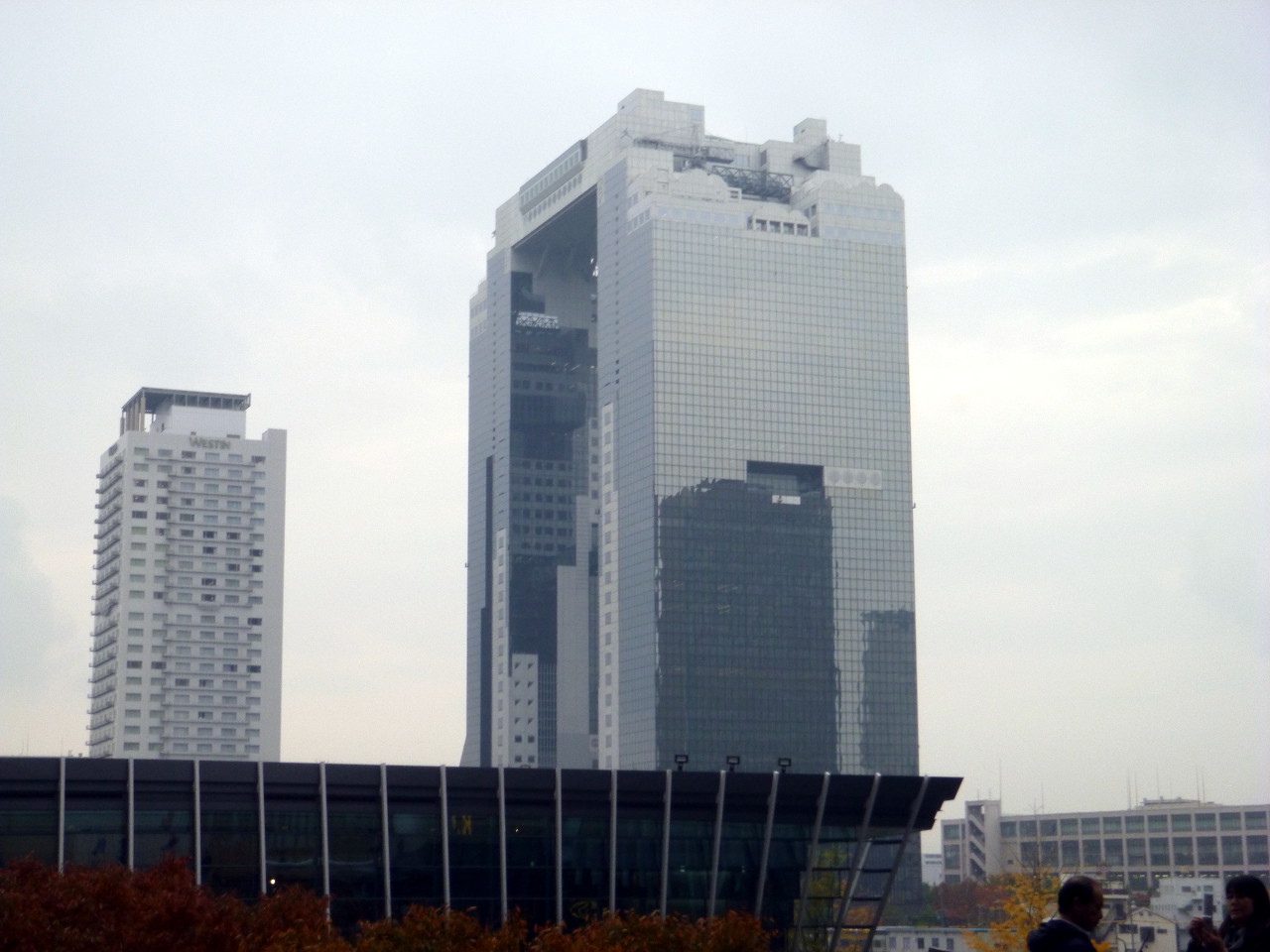
Previously on Sekai Ichi, I visited the Osaka Museum of History.  Once I had my fill, I crossed town to the Umeda Sky Building (田スカイビル, Umeda Sukai Biru), a skyscraper in the Kita (north) district of Osaka.  It stands 173 metres (568 feet) tall, opened in 1993, and was designed by Hiroshi Hara (原 広司, Hara Hiroshi, b. 1936), also famous as the architect of Kyoto Station.

Getting to the Umeda Sky Building from Osaka Station involves walking westward, through a pedestrian tunnel that runs underneath a freight railyard.  As I emerged from this tunnel and walked up to the foot of the building, I was greeted by the sight of a German-style Christmas market.

The Umeda Sky Building is actually made up of two towers, with a piece on top connecting them.  This spot is known as the Floating Garden Observatory (空中庭園, Kūchū Teien, lit. 'sky garden'), and it is where we'll be going.

Here's a clearer look at what the towers look like, in Lego form.  This scale model was on display in an exhibition room at the top.

In the same room, they had a special exhibition on landmark souvenirs from around the world.  Here are a few from right here in Osaka.  The subjects in this display represent Tsutenkaku, in the south-centre of the city, and the Tower of the Sun, built for the 1970 World Expo site in the north of the city.

On the more bizarre side, there was also a Barbie doll with a dress modelled after the Sydney Opera House!

Step up and outside, and you will find yourself on an open-air observatory, offering a 360-degree view of Osaka's surrounding cityscape.  First up is the south view, where the bulk of Osaka has been built up.

One of the more curious features I saw from this vantage point is a highway that cuts through the middle of a building.

The west view looks across the Yodo River and towards Osaka Bay.  If the weather were nicer, it would be possible to see all the way to the Akashi-Kaikyo Bridge outside of Kobe, but obviously that was not the case.

The north view again looks out over the Yodogawa.  Shin-Osaka Station, and subsequently my hotel, should be around here somewhere...

And finally, the east view shows a bit more of Osaka's urban concentration.  In between the two glass towers in the centre, you can see a red Ferris wheel -- the same one I saw from ground-level the night before.

There is a large hole in the centre of the observatory floor, partially ringed by reflective glass walls.  If the sky were clearer, I bet they'd look really nice.  Rising up into this hole are the escalator tunnels used to funnel people into and out of the observatory.

This place is a romantic hotspot for couples, too.  By sitting in these two chairs and holding hands, you can make spots on the floor light up.  You can also buy padlocks, get your names engraved on them, and clip them on to the wire fence behind.

Whilst I do love a good wide view, at the same time I am also afraid of heights, so it is with a degree of relief that I took the elevator back down and into the Christmas market I had mentioned earlier.  And I see they really put some effort into this setup, with one giant Christmas tree set up in the courtyard.  Not sure how it compares to the one they have at the Rockefeller Centre in New York, but it's definitely something.

Finally, I chanced upon this juggler who had set up shop in that same plaza, and stayed for two of his acts.  In one, he rolled these reflective glass balls around his hands and arms.  Back home, I've seen those things sold as "Fushigi Balls".  Coincidentally, "fushigi" (ふしぎ) is a Japanese word, meaning "mystery", and indeed seeing them in practise makes them look more mysterious than they are.  And for his next act, shown above, he spun these rings around so that one in each pair appeared to stay in place.  It was actually really cool seeing them in motion, and I would have stayed longer, but my flighty attention span was beckoning me to my next destination.  That would take me across town to Shinsekai, next time on Sekai Ichi!


Hours: Open from 9:30 AM to 10:30 PM.  Admission ends 30 minutes before closing time.  No regular closing days.

Costs: ¥1,500.

Address: 1-8-7 Ōyodonaka, Kita-ku, Ōsaka-shi, Ōsaka-fu  〒531-6023

Access: The Umeda Sky Building is 10 minutes on foot from Osaka (JR Kyoto/Kobe (A) and Osaka Loop (O) lines) and Umeda (Osaka Metro Midosuji (M) and Hankyu (HK) lines) stations.

Directions: From the North exit of Osaka Station, walk along the bridge between the two buildings, and turn right when you reach the road.  At the next traffic light, cross the road to your left, and head along the underground passage.  Once you emerge, the building will be across the next street.

From the Umeda subway station, climb up from exit 5; you will emerge in front of the Yodobashi Camera department store.  Facing the road, turn left, and left again at the next traffic light.  Continue down the road until you reach the end, and the underground passage described above.

From Hankyu's Umeda station, head down the street from the Hankyu Sanban-gai exit.  The underground passage will be at the end of the road.

Website: (English) (Japanese)

Monday, March 20, 2017

Fuji TV Building

This article is based on a visit made on Sunday, 13 November 2016.

Edit 2 October 2019: Updated prices to reflect the increase in Japan's national sales tax.

Fuji TV (フジテレビ, Fuji Terebi) is one of the six major television networks in Japan.  Their current headquarters is on the island of Odaiba in Tokyo Bay, and has various facilities for visitors.  This building, the third headquarters occupied by Fuji TV, was built in 1996 and designed by the architect Kenzo Tange (丹下 健三, Tange Kenzō, 1913-2005), whose works also include the Yoyogi National Gymnasium (1964) and the Tokyo Metropolitan Government Building (1991).  The orb on the top of the building is the "Hachitama" observatory, which we will be visiting shortly.

But before we get there, check out what I saw on the way there: a group of Mario Kart-cosplay go-kart drivers.  No, seriously, there are travel companies who plan actual go-karting excursions like these around Tokyo, like this one for example.

This fountain stands in the plaza in front of the building.  The mascot of Fuji TV is a blue dog named Laugh, and more information on him may be found here: (English)

From ground level, we will go up this tubular escalator to a plaza on the 7th floor, the somewhat misleadingly-named "Rooftop Garden".  It's true that it is on the roof of something, but there's still so much more building left to go from there!

It is from here where we will board the direct elevator for the observatory on the 25th floor.  Tickets for this part are sold at ground level, before the escalator, and here on the 7th-floor plaza, right beside the elevator.

Or, you could just stay on the Rooftop Garden.  There are many opportunities for striking architectural photos to be found here.

The elevator goes up from the Rooftop Garden on the 7th floor to the 25th floor.  There is a brief hallway before we get into the main observation room, but there are a few windows for us to look out from here.  This is a view of the Palette Town complex, home to the Venus Fort shopping mall, Toyota Megaweb car exhibition centre, and the Daikanransha ("Giant Sky Wheel") ferris wheel.  You may remember that I went there last time I was in town.

I also looked down to see this pedestrian overpass, which crosses over the Bayshore Expressway (湾岸線, Wangan-sen).  This highway has several long, straight stretches, and as such, was a popular scene for illegal high-speed street races in the late 1980s and '90s.  In fact, a manga and anime series about that scene, Wangan Midnight, takes its name from that road.  So it's a good thing we have this bridge for pedestrians to walk over!

The elevator leads us almost directly to the Hachitama Spherical Observation Room.  This space is also used to promote new programmes airing on Fuji TV.  For example, when I visited, they were promoting the show Monster Hunter Stories, an anime spin-off of the video game franchise.

In the back of the room are wide windows looking out upon Tokyo Bay, back towards the mainland.  A 270° viewing range is possible from this room.  Rainbow Bridge is front and centre from this angle.  It is even possible to see as far as Mount Fuji if weather conditions cooperate which, of course, they did not that day.

If we leave the observatory room and head down a floor, we'll also come across the colourful set of Mezamashi TV (めざましテレビ, Mezamashi Terebi), a morning talk show.

Autographs from many Japanese and international celebrities line the back wall.  Some of the ones I recognised are the director James Cameron, the actress Charlize Theron, and the South Korean boy band Big Bang.

Back down on the "Rooftop Garden", your eye may be captured by a few statues of anime characters.  These are strategically placed near gift shops dedicated to some of the many anime shows Fuji TV has broadcast, including One Piece, Dragonball, and more.

The Dragonball store is watched over by a model of the celestial dragon Shen-long (or "Shenron" in Japanese rendering).  Fearsome as it may appear, don't be scared!  In the world of Dragonball, Shen-long grants one wish to anyone who manages to collect all seven Dragon Balls.  If this were real, what would you wish for...?

Right next to the gift shops, there was a small exhibition on the recent manga & anime series Assassination Classroom.  The yellow octopus-looking fellow standing to my right, in standee form, is Kuro-sensei.  He is the junior-high homeroom teacher of the main characters, who continually plot to kill him.  If you're interested, Assassination Classroom is available for streaming on Funimation's website.

There are still other attractions of interest in the Fuji TV building, from yet more shops and restaurants to "Wonder Street", a free series of exhibits based on Fuji TV's various shows.  I was unaware of it at the time, however.  Of course, when you're in Odaiba, there's so much to do that some stuff will inevitably fall through the cracks.  But, that's why you can always come again!


Hours: Open 10:00 AM to 6:00 PM.  Admission ends 30 minutes before closing time.  Closed from 29 December to 1 January.

Costs: ¥700.

Address: 2-4-4 Daiba, Minato-ku, Tōkyō-to 〒137-8088

Access: The Fuji TV building is 5 minutes from Daiba Station (Yurikamome line, (U07)), or 5-10 minutes from Odaiba Kaihin-Koen (Yurikamome line, (U06)) and Tokyo Teleport (Rinkai line, (R04)) stations.

Directions: From Daiba Station, leave from the South exit and turn right.  Continue for 150 metres (500 feet), crossing the next two roads, and the Fuji TV building will be on your right.

From Odaiba Kaihin-koen Station, leave from the South exit and turn left.  Continue for 550 metres (1,800 feet), crossing the next road, and the Fuji TV building will be on your left.

From Tokyo Teleport Station, leave from Exit B and head straight.  At the pedestrian overpass, cross the road and turn right.  At the next intersection, turn left.  The Fuji TV building will be on your left.

Website: (English) (Japanese)