COVID-19 Coronavirus Notice

COVID-19 Coronavirus Notice

Updated 2 July 2020

If you are reading this message, please be aware of travel restrictions in place as part of measures to contain the spread of the COVID-19 "Coronavirus" and its symptoms. Japanese authorities are refusing entry to individuals from, or who have been to, a list of over 100 countries (More information). All other visitors must apply for a visa, and undergo a quarantine upon entering the country. Within the Japan, there are no longer any travel restrictions, and most public attractions have re-opened with precautions for sanitation and social distancing. In short, travel to Japan is not recommended at this time, until the situation normalises. I will not be editing my individual articles to reflect this, but again, please keep this in mind when reading them.
Showing posts with label Osaka prefecture. Show all posts

Monday, October 23, 2017

Dotonbori Walk

This article is based on a visit made on Sunday, 20 November 2016.

Dotonbori (道頓堀, Dōtonbori, lit. 'Dōton canal'), also spelled Dotombori, is an entertainment district in Osaka's southern Namba region, built along a canal of the same name.  The MO of Dotonbori is gastronomic overload -- if you can think of any Japanese food item, odds are there's a joint here that serves it.  With delicacies like takoyaki, okonomi-yaki, ramen, sushi, and more to be found on the many menus, there is something for everyone to enjoy.  (Not me, though; I just ate.)

Named after Yasui Doton (安井道頓, Yasui Dōton, 1533-1615), the man who started expanding this river, Dotonbori saw its first developments under the Tokugawa Shogunate in the 17th century, when multiple kabuki and bunraku theatres were set up in the area.  Restaurants sprang up alongside them to serve the influx of patrons.  Most of these theatres have been lost to time, and more specifically the bombings of World War II, but the relatively newer Shochiku-za, built in the 1920s, survived and is active to this day.

The most iconic advert in all of Dotonbori could very well be Glico's "running man", seen here on the left.  The original Running Man was erected in 1935 and used neon lights.  The sixth-generation sign, seen here, switched to LEDs and may occasionally change its background.  The Running Man and its neighbours are best seen from the Ebisubashi (戎橋, lit. 'Ebisu bridge') pedestrian bridge, although it is very, very crowded.  Ebisubashi is named after the god Ebisu, since there is a shrine named after and dedicated to him 1.5km (4,900 ft.) to the south.

There's not as much to see on the eastern side of Dotonbori, but there are a few interesting sights here and there.  For example, the Don Quijote store on the north (left) side of the canal has an oblong Ferris wheel, called the Ebisu Tower (えびすタワー, Ebisu Tawā), running up and down the front of the building!  (11:00 AM - 11:00 PM, ¥600, Website: (Japanese))  Another good way to take it in would be one of many river cruises that flow up and down the canals.

Even more restaurants, signboards, and not to mention foot traffic, can be found on the street running parallel to Dotonbori canal.  Just off of Ebisu-bashi, turn around and you will see one of the area's other iconic adverts.  The mechanical crab on the left is the mascot for Kani Doraku (かに道楽, Kani Dōraku, lit. 'crab indulgence'), a crab restaurant, naturally.  There are multiple Kani Doraku locations around Osaka, with three along Dotonbori alone!

This is a billboard for Meiji, a snack food and pharmaceutical company, and a rival company of Glico, mentioned above.  Some of their most popular products are Hello Panda, small creme-filled cookies decorated with pictures of panda bears, and Yan Yan, cookie sticks with separate fudge for dipping (sort of like a do-it-yourself Pocky).  The farmer guy on this sign is holding a bag of Karl, a milk-cheese snack.  Also they put Osaka Castle in the background, for local recognition, I guess.

Here, an Indian/Thai restaurant finds itself next-door to a gyoza (ギョーザ, gyōza) restaurant.  Gyoza are pan-fried dumplings filled with ground meat (usually pork) and vegetables (cabbage, green onions, ginger, garlic, et al.).  They originated from China, where they are known as jiaozi (饺子, Mandarin Chinese: jiǎozi).  After being adopted by the Japanese, they took on a few changes, such as a thinner dough and a stronger garlic flavour.

Zubora-ya, the fugu restaurant in the middle of Shinsekai, also has a branch here on Dotonbori, it seems.

Speaking of Shinsekai, there's also a kushikatsu place here.  Although this chef doesn't seem too happy to see me...

This little drummer boy is known as Kuidaore Taro (くいだおれ太郎, Kuidaore Tarō), or Kuidaore Ningyo (くいだおれ人形, Kuidaore Ningyō).  The "Kuidaore" in his name is an expression known around Osaka, which means to eat oneself to ruin... yeah, that's pretty much a distinct possibility here.  He was first installed in 1950, but the restaurant that had originally placed him, also called "Cui-daore", closed not too long ago, so he was moved a few doors east.

Less ominous (and less creepy, IMO), is this motorised toy of Doraemon that someone had set up to bike around and around this pole.  Doraemon (どらえもん), created by Fujiko F. Fujio, is a robot cat sent from the future to a boy named Nobita.  It's kind of like a childrens' anime version of Doctor Who.  In America it's mildly popular at best, but is insanely so in Asia.  The original Doraemon anime ran for a staggering 1,787 episodes between 1979 and 2005, with another series picking up from there right after!

This fish may not have its own anime series like Doraemon, but I thought it looked cool nonetheless.  It stands in front of a conveyor-belt sushi restaurant called Daikisuisan (大起水産), so the fish motif makes sense.

Some of the side-streets offer a decidedly more quaint atmosphere.  Some of them, like Hozenji-yokocho (not pictured, but close), even remind me of places like Kyoto's Gion district.  I missed out on Hozenji itself, but nestled in between even more pubs, it has a small Buddhist temple of the same name.

When I re-emerged onto the main boulevard of Mido-suji, I found myself next to yet another restaurant with a distinctive mascot.  This is a branch of Kinryu Ramen (金龍ラーメン, Kinryū Rāmen). The name "Kinryu" means "gold dragon", hence the dragon decorating the side of the building.  Kinryu Ramen sets itself apart by staying open 24 hours a day, and by offering seating on tatami mats.  Their other branch, on Dotonbori, even has some of its tables set up outside, at street level!

And finally, I wrapped up the night with a look at a few Christmas lights along Midosuji (御堂筋Midōsuji).  Midosuji runs north-to-south between Umeda and Namba, and lends its name to the subway line underneath it.  You know, I've noticed that road names in Osaka tend to end in "-suji" (筋), rather than the more common "-dori" (通り).  The word "suji" alone means muscle sinew, but is also a synonym for line, string, stripe, or plot.  That may seem strange, but then the Kansai region, and especially Osaka, is famous for its distinct dialect of the Japanese language.  Maybe it's just a case of that, who knows...?

For my sign-off selfie, I'm taking it back to Ebisu-bashi and the Glico Running Man!  Although, it was hard taking a selfie in this place due to the difference in lighting.  Either I came out too dark, or the signs behind me were too bright.  In the end, I went for the latter.  Even harder is posing like the running man when you're holding your camera with one end, but I guess I gave it a fair shot.

Well, that's it for the Kansai region, for now.  For my next day in Japan, I would venture westward to the Chugoku region, or more specifically, Hiroshima.  That, and a new Know Your Trains article, next time on Sekai Ichi!


Access: As with the Osaka/Umeda station area, Namba has four distinct stations in close proximity to each other.  The closest stations to Dotonbori are Osaka Metro's Namba subway station (Midosuji (M), Sennichimae (S), and Yotsubashi (Y) lines) and Osaka-Namba Station (Kintetsu Nara (A) and Hanshin Namba (HS) lines).  Nankai's Namba station (Nankai (NK) Main and Koya (NK) lines) lies to the south, and JR-Namba station (Yamatoji (Q) line) lies to the west.

From Osaka/Umeda Station, take the Osaka Metro Midosuji line to Namba (M20, 7 minutes, ¥230).

Directions: From Namba Station (subway), take exit 14; you will emerge near Kinryu Ramen on Mido-suji.  Turn around and turn right at the next traffic light to get on to Dotonbori street.  Take the next left for Ebisu-bashi.  Alternately, take the second right (next right after Ebisu-bashi), and the second left afterward to get to Hozenji Yokocho.

Friday, October 20, 2017

Umeda Sky Building

This article is based on a visit made on Sunday, 20 November 2016.

Edit 7 October 2019: Updated prices to reflect the increase in Japan's national sales tax.

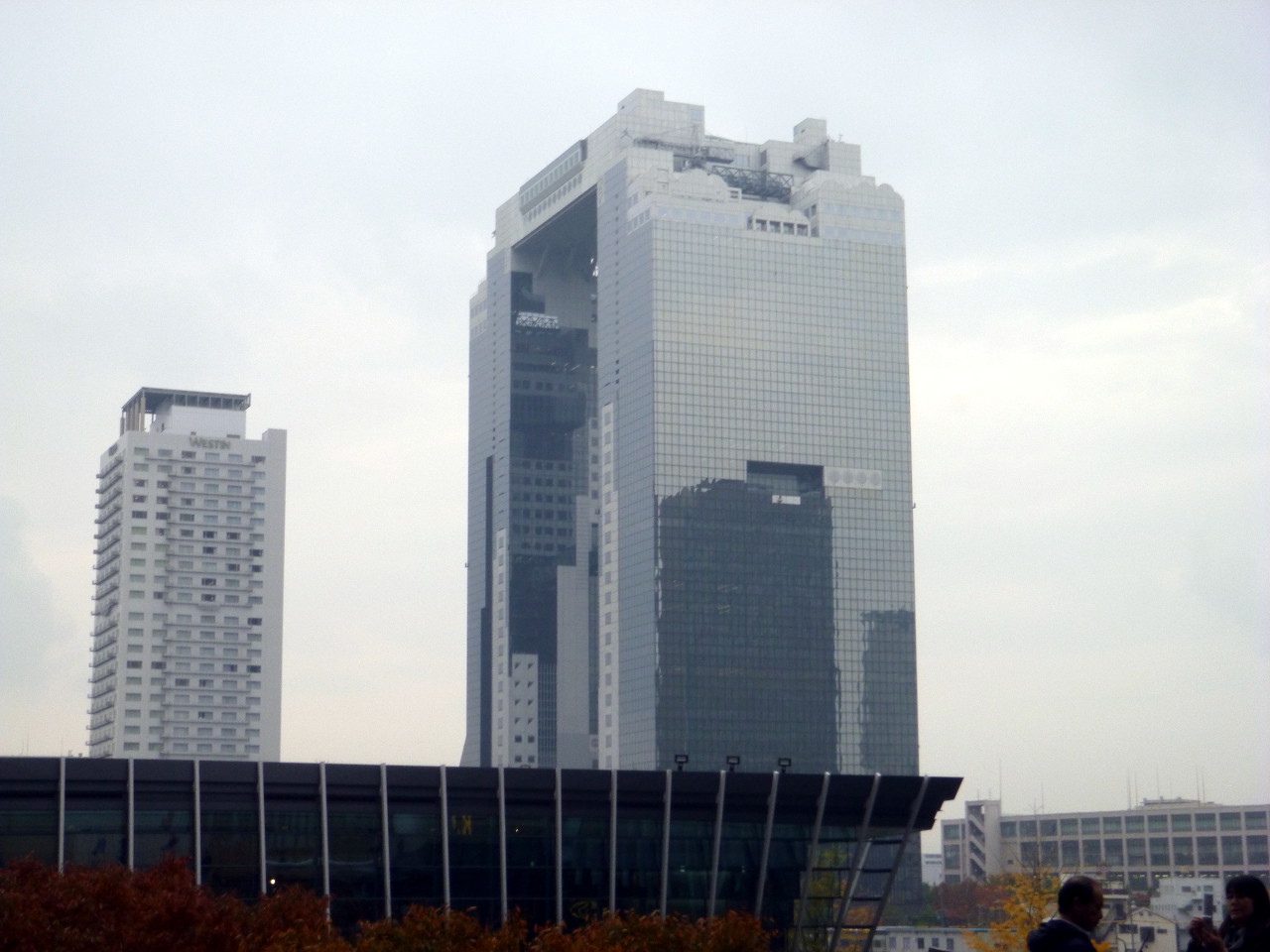
Previously on Sekai Ichi, I visited the Osaka Museum of History.  Once I had my fill, I crossed town to the Umeda Sky Building (田スカイビル, Umeda Sukai Biru), a skyscraper in the Kita (north) district of Osaka.  It stands 173 metres (568 feet) tall, opened in 1993, and was designed by Hiroshi Hara (原 広司, Hara Hiroshi, b. 1936), also famous as the architect of Kyoto Station.

Getting to the Umeda Sky Building from Osaka Station involves walking westward, through a pedestrian tunnel that runs underneath a freight railyard.  As I emerged from this tunnel and walked up to the foot of the building, I was greeted by the sight of a German-style Christmas market.

The Umeda Sky Building is actually made up of two towers, with a piece on top connecting them.  This spot is known as the Floating Garden Observatory (空中庭園, Kūchū Teien, lit. 'sky garden'), and it is where we'll be going.

Here's a clearer look at what the towers look like, in Lego form.  This scale model was on display in an exhibition room at the top.

In the same room, they had a special exhibition on landmark souvenirs from around the world.  Here are a few from right here in Osaka.  The subjects in this display represent Tsutenkaku, in the south-centre of the city, and the Tower of the Sun, built for the 1970 World Expo site in the north of the city.

On the more bizarre side, there was also a Barbie doll with a dress modelled after the Sydney Opera House!

Step up and outside, and you will find yourself on an open-air observatory, offering a 360-degree view of Osaka's surrounding cityscape.  First up is the south view, where the bulk of Osaka has been built up.

One of the more curious features I saw from this vantage point is a highway that cuts through the middle of a building.

The west view looks across the Yodo River and towards Osaka Bay.  If the weather were nicer, it would be possible to see all the way to the Akashi-Kaikyo Bridge outside of Kobe, but obviously that was not the case.

The north view again looks out over the Yodogawa.  Shin-Osaka Station, and subsequently my hotel, should be around here somewhere...

And finally, the east view shows a bit more of Osaka's urban concentration.  In between the two glass towers in the centre, you can see a red Ferris wheel -- the same one I saw from ground-level the night before.

There is a large hole in the centre of the observatory floor, partially ringed by reflective glass walls.  If the sky were clearer, I bet they'd look really nice.  Rising up into this hole are the escalator tunnels used to funnel people into and out of the observatory.

This place is a romantic hotspot for couples, too.  By sitting in these two chairs and holding hands, you can make spots on the floor light up.  You can also buy padlocks, get your names engraved on them, and clip them on to the wire fence behind.

Whilst I do love a good wide view, at the same time I am also afraid of heights, so it is with a degree of relief that I took the elevator back down and into the Christmas market I had mentioned earlier.  And I see they really put some effort into this setup, with one giant Christmas tree set up in the courtyard.  Not sure how it compares to the one they have at the Rockefeller Centre in New York, but it's definitely something.

Finally, I chanced upon this juggler who had set up shop in that same plaza, and stayed for two of his acts.  In one, he rolled these reflective glass balls around his hands and arms.  Back home, I've seen those things sold as "Fushigi Balls".  Coincidentally, "fushigi" (ふしぎ) is a Japanese word, meaning "mystery", and indeed seeing them in practise makes them look more mysterious than they are.  And for his next act, shown above, he spun these rings around so that one in each pair appeared to stay in place.  It was actually really cool seeing them in motion, and I would have stayed longer, but my flighty attention span was beckoning me to my next destination.  That would take me across town to Shinsekai, next time on Sekai Ichi!


Hours: Open from 9:30 AM to 10:30 PM.  Admission ends 30 minutes before closing time.  No regular closing days.

Costs: ¥1,500.

Address: 1-8-7 Ōyodonaka, Kita-ku, Ōsaka-shi, Ōsaka-fu  〒531-6023

Access: The Umeda Sky Building is 10 minutes on foot from Osaka (JR Kyoto/Kobe (A) and Osaka Loop (O) lines) and Umeda (Osaka Metro Midosuji (M) and Hankyu (HK) lines) stations.

Directions: From the North exit of Osaka Station, walk along the bridge between the two buildings, and turn right when you reach the road.  At the next traffic light, cross the road to your left, and head along the underground passage.  Once you emerge, the building will be across the next street.

From the Umeda subway station, climb up from exit 5; you will emerge in front of the Yodobashi Camera department store.  Facing the road, turn left, and left again at the next traffic light.  Continue down the road until you reach the end, and the underground passage described above.

From Hankyu's Umeda station, head down the street from the Hankyu Sanban-gai exit.  The underground passage will be at the end of the road.

Website(English) (Japanese)

Thursday, October 19, 2017

Osaka Museum of History

This article is based on a visit made on Sunday, 20 November 2016.

Previously on Sekai Ichi, I made a morning visit to Sumiyoshi Shrine in the south of Osaka.  From there, I turned around and headed north to the Osaka Museum of History (大阪歴史博物館, Ōsaka Rekishi Hakubutsukan).  If you've ever been to the Edo-Tokyo Museum in Tokyo -- and I have -- this place covers similar ground, albeit with a more specific focus on Osaka and the surrounding regions.

The museum stands across the corner from Osaka Castle Park.  In the shot above, it occupies the left-hand tower.  The one on the right, connected by a glass-domed, ground-level plaza, belongs to NHK, the public television network.  Once in the museum, audio guides in Japanese, English, Mandarin Chinese, and Korean may be rented for ¥200 each.  This gives you a remote-like handset, and a laminated sheet which tells you what to play and where.

The path through the museum starts at the 10th floor.  Compared to the Edo-Tokyo Museum, which mostly starts its teachings at the 17th-century Edo period, the Osaka Museum of History starts way back further.  This pavilion is designed to evoke the old Naniwa Palace that stood nearby, over 1,300 years ago.  Occasionally the window shades will be lowered to darken the room and make the video, looping on the screens above, better visible.

Life-sized statues about the pavilion depict the Emperor and the servants of their court.

From the window on this floor, you can see out to the former site of the Naniwa Palace, which stood from AD 652 to 686.  Nowadays, its excavated foundation sits across the road from Osaka Castle park.  Speaking of...


Osaka Castle (大阪城, Ōsaka-jō) can also be seen from the museum.  Better views of the castle can be seen from the stairwell, as above, but good luck taking a decent picture from all the window glare.  I only got the colours on this one as good as I did with some post-prod editing.

Naniwa Palace may be long gone, but archaeological investigations of its former site have been documented in this museum.  There are scale-model re-creations of what it may have looked like, based on the foundations that researchers were able to find of the building.  With the museum's own smartphone app (available for iOS and Android), you can look out at the palace foundations with your phone's viewfinder, and see an augmented-reality re-creation of the palace that way, as well!

The 9th floor sends the clock forward a millenium, with a focus on Osakan society during the Edo period.  In the hallway above, you will walk under a couple of fake bridges, and there's a very good reason for that.  Osaka is criss-crossed by a dense network of rivers and canals, and so the people built many bridges to cross them.  There was even a phrase coined in their honour, the "808 bridges of Naniwa", referring to a seemingly-uncountable amount.  Today, the Kanji for bridge, "hashi" (橋), appends many place names in Osaka, even if the bridges they were named after no longer exist.

As with the Edo-Tokyo Museum, there are many miniature re-creations of scenes past.

Another scale model, this one depicting a kabuki play in progress.  As with Edo, Osaka was also a major centre of the kabuki theatre.  For a full-sized Kabuki experience, you could visit the Osaka Shochiku-za (大阪松竹座, Ōsaka Shōchiku-za) theatre, in the downtown Namba district.

A very boat-like festival float, or maybe an actual boat.  The festival it was built for escapes me, although it could have been the Tenjin Matsuri (天神祭).  Held annually on 24-25 of July, and dating back to the 10th century AD, the festival is marked by processions on land and on river, with a fireworks display to boot.  On the second day, the land procession starts and ends at Osaka Tenman-gu shrine, due southeast of Osaka/Umeda Station, and is promptly followed by the river procession, cruising out and back along the nearby O River.

The 8th floor is a little different, in that it has a general focus on archaeology.  There are several hands-on activities you can spend your time on, such as this puzzle where you try to re-create a vase by sticking pieces together onto a magnetic base.  As you can see from this picture, I managed it. :-)

Finally, we come down to the 7th floor, which shifts the focus to 20th-century history.  By this point, Japan had opened itself up to influences and technologies from around the world, but never lost its own cultural identity.

Another model of one of Osaka's old train stations.  Among the descriptions, you may learn about the Midosuji subway line.  It was the second underground line built in Japan, after the Ginza line in Tokyo.  It opened in 1933 between Umeda and Shinsaibashi stations, and expanded to its present length over the next 50+ years.  And like the Ginza, I got the most use from the Midosuji out of all the subway lines in Osaka.

The far end of the room illustrates the lively theatre scene in Osaka, which I also mentioned earlier.  One thing I find distinctive about this scene is the family of mannequin patrons off to the right.  The parents are dressed in Japanese formalwear, while their child is wearing fashions of a more Western design.  This alone gives you an idea of the changes that were going on in the middle of the 20th century.

I found a guest for my sign-off selfie -- one of the mannequins on this floor.  Afterwards, I briefly recharged myself at the hotel, before resuming my Osakan adventure at the Umeda Sky Building.  Find out what that was like, next time on Sekai Ichi!


Hours: Open from 9:30 AM to 5:00 PM.  Admission ends 30 minutes before closing time.  Closed on Tuesdays, and from 28 December to 4 January.

Costs: ¥600.

Address: 4-1-32 Ōtemae, Chūō-ku, Ōsaka-shi, Ōsaka  〒540-0008

Access: The closest subway station is Tanimachi Yonchome (Osaka Metro Chuo (C) and Tanimachi (T) lines).  The museum is also 15-20 minutes away on foot from Morinomiya Station (JR Osaka Loop (O), Osaka Metro Chuo, and Nagahori Tsurumi-ryokuchi (N) lines).

From Osaka Station, walk to the nearby Higashi-Umeda Station and take the Osaka Metro Tanimachi line to Tanimachi Yonchome (T23, 6 minutes, ¥230).

Directions: From the Tanimachi line, take exit 2 to street level and bear right, along the road.  The museum will be on your right side in 300m (1,000 ft.), just before the next traffic light.

From the Chuo line, take exit 9 to street level.  The museum will be immediately on your left.

Website: (English) (Japanese)

Thursday, October 12, 2017

Sumiyoshi Taisha

This article is based on a visit made on Sunday, 20 November 2016.

Sumiyoshi Grand Shrine (住吉大社, Sumiyoshi Taisha) is a Shinto shrine situated on the southern edge of Osaka.  It was founded way back in AD 211, centuries before Buddhism was introduced in Japan from India and China, and the Chinese architectural customs that came along with it.  Thus, it maintains features found on precious few religious structures in Japan, and is all the more unique for it.

To get there from my hotel above Shin-Osaka Station, I took the subway down to the central Namba station complex, and transferred to the Nankai line, which stops right in front of the shrine grounds.  No, this wasn't the train I took there; it was another one that was standing on the platform as I left.  This is one of Nankai's "Rapi:t" express services to Kansai International Airport.  I wrote more about it, along with JR West's competing "Haruka", previously.

On the way, I hit up a vending machine and bought a bottle of "Oronamin C" (オロナミンC), a vitamin drink.  I couldn't quite pin down the taste, but it was a little sweet and syrupy.  I quite liked it, in fact, and sought it out every day for the rest of my trip.

The Nankai railway also appears to have sponsored Sumiyoshi Shrine as well.  In the rear grounds of the shrine, I walked about this forest of banners, some showing a cross-promotion for Nankai and Hello Kitty (ハローキティ, Harō Kiti).  Doubtless you've come across Hello Kitty at some point in your life, but what's her story; where did she come from?  Hello Kitty was created in 1974 by the Sanrio company, who licences the character for use in many products and media.  She has had many, many friends introduced over the years, like My Melody the rabbit, Keroppi the frog, Pochacco the dog, Badtz-Maru the penguin... I could go on.

But I'm getting ahead of myself.  As you enter the shrine, you will pass over a canal on one of three bridges.  The two raised ones on the sides, such as this one, are particularly photogenic, especially when you can get a reflection in the water.

The walkways surrounding the shrine are lined by mossy stone lanterns.  The green of this scene ought to serve as the right antidote for those overwhelmed of all the vermilion colours within the shrine itself.  I also chanced upon what looked like a wedding or funeral procession while walking about, but thought better of taking a picture.

The four main halls of this shrine have features found in very few other shrines across Japan.  The roofs of these buldings are not curved, as is so common in east Asia, but are slanted straightly to either side, and hang over all sides of the building they rest upon.  There is also a rail at the top which is crossed by short horizontal bars called katsuogi (堅魚木, lit. 'hard fish wood'), and bookended at both sides by vertical cross-bars called chigi (千木, lit. one-thousand wood').  Furthermore, each of the four halls face to the west; most shrines face south in accordance with feng-shui, another influence derived from China.  Together, this architecture style is known as Sumiyoshi-zukuri (住吉造), named after this very shrine.

Despite the uniqueness of this "Sumiyoshi-zukuri" architecture, which is named after the shrine, prayer halls have been added in front of each of the four main halls.  These black-tinted buildings follow a more common, Chinese-based style.  Now, the reason there are four main halls is because four deities are enshrined here: the Sumiyoshi Sanjin (住吉三神), three gods related to seafaring, plus the Empress Jingu (神功天皇, Jingū-tennō), who ruled from AD 201 to 269.  Indeed, three of the halls are lined up together from west to east, with the fourth standing beside one of the others.

For Osaka's citizens, Sumiyoshi Taisha is a prime choice for Hatsumode (初詣, Hatsumōde), the first shrine visit on New Year's Day.  In 2010, for example, 2.6 million people attended this shrine, not all that far from the 3.2 million drawn in by Meiji Shrine in Tokyo.  Meanwhile, the festivities of Shichi-Go-San, which I had experienced in Kamakura earlier that week, were still going strong through the weekend.  I had my picture taken next to a portable shrine parked beside one of the buildings.

These two children, who (or their mother) let me take their picture, were also dressed up for the rituals of Shichi-Go-San, most likely.

Finally, I found this poster adorning the shrine's inner walls.  It is an advert for a bicycle museum, displaying some examples of their collection.  Some of their more clever examples are a bike with side-by-side seats, and a bike with a car-like body surrounding the driver.

I passed by the Tennoji station area on my way up to my next destination.  Since I didn't stay, I thought I'd at least introduce you to the Abeno Harukas (あべのハルカス, Abeno Harukasu) building.  Officially titled the Abenobashi Terminal Building, Abeno Harukas opened in 2014 and stands 300 meters (984 feet) tall, making it the tallest inhabitable building in Japan.  (Compare that to the Tokyo Skytree, which is over twice as tall but does not support long-term living quarters.)  The top three floors are occupied by an observation deck offering 360-degree views of the city.  The rest of the building is used as a hotel, office space, a department store, and in the basement, Kintetsu's Osaka-Abenobashi station, the terminal for their Minami-Osaka line.

Today's sign-off selfie was taken back at the shrine and features, again, Hello Kitty.  Next time on Sekai Ichi, we'll visit the Osaka Museum of History.  Until then, nyan~!


Hours: Open 24 hours.  No regular closing days.

Costs: Free.

Address: 2-9-89 Sumiyoshi, Sumiyoshi-ku, Ōsaka-shi, Ōsaka-fu 〒612-0822

Access: The entrance to Sumiyoshi Taisha is directly in front of the Sumiyoshi Torii-mae tram stop (Hankai (HN) and Uemachi (HN) lines), and across the street from Sumiyoshi Taisha Station (Nankai Main (NK) line).

From Namba Station, take the Nankai Main Line to Sumiyoshi Taisha (NK08, 10 minutes, ¥210).  Signs pointing to the shrine are posted above the station exits.  Note that only local trains stop at Sumiyoshi Taisha.

From Osaka/Umeda Stations, take the Osaka Metro Midosuji (M) line to Namba (M20, 10 minutes, ¥230), then transfer to the Nankai line as described above.

Website(Japanese)