COVID-19 Coronavirus Notice

COVID-19 Coronavirus Notice

Updated 2 July 2020

If you are reading this message, please be aware of travel restrictions in place as part of measures to contain the spread of the COVID-19 "Coronavirus" and its symptoms. Japanese authorities are refusing entry to individuals from, or who have been to, a list of over 100 countries (More information). All other visitors must apply for a visa, and undergo a quarantine upon entering the country. Within the Japan, there are no longer any travel restrictions, and most public attractions have re-opened with precautions for sanitation and social distancing. In short, travel to Japan is not recommended at this time, until the situation normalises. I will not be editing my individual articles to reflect this, but again, please keep this in mind when reading them.
Showing posts with label Mie prefecture. Show all posts

Monday, August 20, 2018

Danjiri Museum

This article is based on a visit made on Sunday, 13 May 2018.

Edit 10 October 2019: Updated prices to reflect the increase in Japan's national sales tax.

Previously on Sekai Ichi, I visited the ninja museum and castle in Iga City.  Afterwards, I wrapped up our excursion with a museum we passed on the way back to the train station.  That would be the Danjiri Museum (だんじり会館, Danjiri Kaikan), which is dedicated to the local Ueno Tenjin Festival.

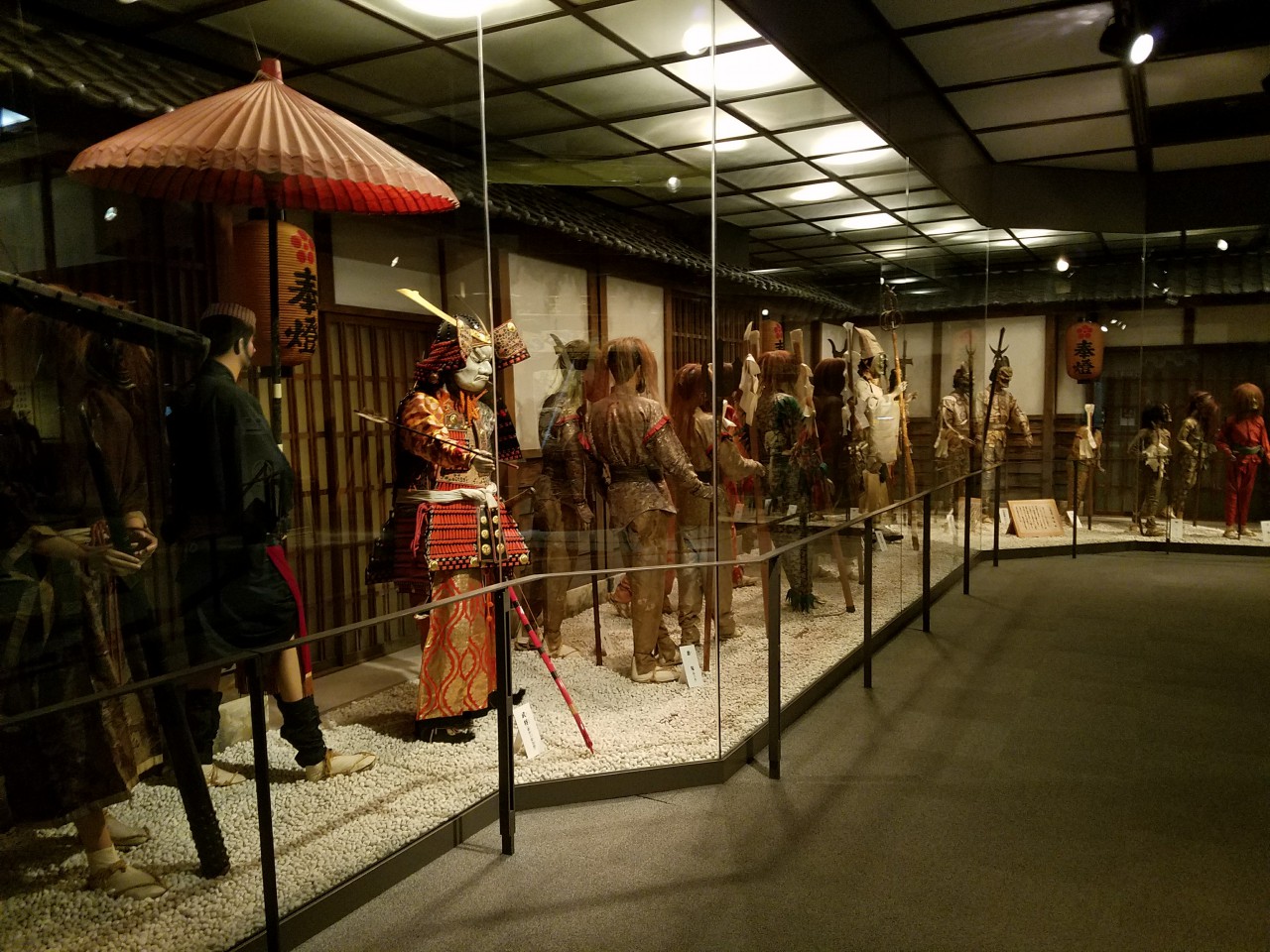
The Ueno Tenjin Festival (上野天神祭, Ueno Tenjin Matsuri) is held annually on 23-25 October, and dates back over 400 years.  The parade procession starts from and ends at the nearby Ueno Tenman Shrine (上野天満宮, Ueno Tenman-gu), on the east side of town.  This shrine is one of over 10,000 Tenman shrines in Japan, all of which are dedicated to the soul of the 9th-century scholar Sugawara no Michizane (菅原 道真, 845-903), posthumously deified as the god Tenjin (天神, lit. 'sky god').  In between festivals, its nine shrine floats are put on display at this museum.  A video depicting and explaining the festival plays on the screens in the back of the hall every half-hour.  It is narrated in Japanese without subtitles, but if you ask the staff, you can get a headset device to listen to it in English, and possibly other languages.

"Floats" used in Japanese festival parades are called mikoshi (神輿, lit. 'divine palanquin') or o-mikoshi (お神輿).  During festivals, the kami (for the uninitiated, a Shinto god) of a particular shrine is transferred into one of these mikoshi, effectively making them portable shrines.

Smaller mikoshi can be lifted and supported by the shoulders of carriers.

Larger mikoshi, on the other hand, need to be pulled by their supporters.

Lanterns are common decorations for mikoshi, and pretty much everywhere else, come festival time.

The Ueno Tenjin procession also includes a hundred paraders dressed in costumes with oni masks.  Oni (鬼) are demons in Japanese folklore.  They serve as the bad guys in many folktales, but for festivals, they instead protect the town from bad luck by scaring away evil spirits... and children, most likely.

Speaking of costumes, the Danjiri Kaikan is also the place where you can rent ninja costumes to dress up in for the day!  This service is available from 10:00 AM to 4:00 PM, and costs ¥1,080 per person.  The colours available include black, blue, red, and pink, so historical accuracy is not as important here as is the simple fun of dressing up, which has its merit I'll admit.  It's popular with the kids, although I'm sure there are adult sizes available as well.

I would have been willing to try on a ninja costume, but it was late, it was rainy, and I had a bus to catch.  So, in contrast to the complicated train journey we took on the way up, the bus was a one-shot, ninety-minute (actually two hours with highway traffic) hop back to Kyoto Station.  With barely anybody else on board, it was just what I needed to dry off and relax as we drove through the other ninja town, Koka, and on the Meishin Expressway back to Kyoto.  Indeed I would have taken a bus into Iga-Ueno also, but A) its only viable departure time wouldn't have worked out as well, and B) I had a Japan Rail Pass and wanted to use it.  Bit of a short day, but I've got lots more coming on Kyoto itself.  All this and a new Know Your Trains, next time on Sekai Ichi!


Hours: Open 9:00 AM to 5:00 PM.  Admission ends 30 minutes before closing time.  Closed on one day in the 2nd or 3rd weekend in April, 23-25 October, and 29 December-1 January.

Costs: ¥600.

Address: 122-4 Ueno Marunouchi, Iga-shi, Mie-ken 〒518-0873

Access: Danjiri Kaikan is five minutes on foot from Ueno-shi Station.

Directions: From the exit of Ueno-shi Station, head across the parking lot, turn left, and cross the tracks.  The museum is at the corner of the second traffic light, on the right side.

Website: (Japanese)

Friday, August 17, 2018

Ueno Castle

This article is based on a visit made on Sunday, 13 May 2018.

Edit 10 October 2019: Updated prices to reflect the increase in Japan's national sales tax.

Previously on Sekai Ichi, I visited the Iga-Ryu Ninja Museum in Iga City.  Nestled in the northern end of Ueno Park, the museum is a virtual stone's throw away from Iga-Ueno Castle (伊賀上野城, Iga Ueno-jō).  Also known as Ueno Castle for short, or as the "White Phoenix Castle" (白鳳城, Hakuhō-jō), this white-clad keep is practically a scaled-down version of the great Himeji Castle.

Ueno Castle was constructed in 1585 under the command of Sadatsugu Tsutsui (筒井 定次, 1562-1615), who occupied it until he was overthrown by the Tokugawa shogunate in 1608.  It was then picked up by Todo Takatora (藤堂高虎, Tōdō Takatora, 1556-1630), whose likeness is shown above on the left.  Todo's renovations included building 30-meter (99-foot) foundation walls, the tallest of their kind in Japan, at the base of the castle.  On the right is the castle's mascot, Tiger-kun (た伊賀ーくん, Taigā-kun).  He is a tiger because the kanji for "tiger" (虎) is present in lord Todo's name. The "iga" sound in Tiger-kun's name is also spelled with the kanji for its hometown of Iga (伊賀).

After peace broke out, the Tokugawa shogunate placed restrictions on building new castles.  When Ueno Castle's keep was felled by a typhoon in 1612, no one bothered to have it rebuilt.  And so it was for centuries until 1935, when Katsu Kawasaki (川崎 克, Kawasaki Katsu, 1880-1949), a Iga-born Diet representative, raised funds to have the castle finally rebuilt.  Mr. Kawasaki also funded construction of the Haisenden, the nearby monument hall to the poet Bashō, in 1942.

Pretty much all descriptive signs throughout the museum are written in Japanese only.  The artifacts on display throughout the castle museum includes this set of helmets.  Japanese helmets, which come in multiple styles collectively known as kabuto (兜 / 冑), were frequently adorned with distinctive, often hornlike crests on the front, top, or sides; these are called tatemono (立物).

Also on display was an example of a norimono (乗り物, lit. 'vehicle'), or palanquin.  These sorts of vehicles became widespread among nobility and royalty of the Edo period, because A) the growing population in Japan meant that less space was available for raising horses, and B) there was a new law, called "Sankin-kōtai" (参勤交代, lit. 'alternate attendance'), which forced regional lords to travel to and from Edo and spend half the year there.

One can look at a few quirky artistic interpretations of the castle.  These images, of the castle on the left and Haisenden on the right, are made out of postage stamps.  Personally, I also got a kick out of looking at photos of most of Japan's other castles, lining the upper walls of the second floor, and seeing how many I recognised.

In its current form, Ueno Castle was rebuilt exclusively in wood, as opposed to other 20th-century reconstructions which favoured concrete and other materials.  Considering the decision to rebuild castles in their traditional style is becoming a more common decision in recent days -- Nagoya Castle is currently undergoing such a process -- Kawasaki-san was ahead of his time.

The keep's interior has three floors, and from the top, there are windows to look out in all four directions.  The ceiling on the third floor is lined with paintings and calligraphy from various 20th-century Japanese artists.  Note that the stairs from the second to third floors are very steep.

Honestly, there aren't that many landmarks to look out upon, especially in this weather.  If I have recalled (and researched) this correctly, this is the view looking to the south.  Ueno-shi Station should be somewhere off to the left.

Of course, it wouldn't be Iga if there weren't ninjas involved somehow.  To that end, it should be pretty easy to spot a couple of ninja mannequins hiding in the rafters of Ueno Castle.  At least, I think they were mannequins.  There are actually places in town where one can rent ninja costumes, so I can't be sure...  Find out where that could be... I mean, where I could be going to after this, next time on Sekai Ichi!


Hours: Open 9:00 AM to 4:45 PM.  Closed on 29-31 December.

Costs: ¥600.

Address: 106 Ueno Marunouchi, Iga-shi, Mie-ken 〒518-0873

Access: Ueno Castle is a 10-15 minutes' walk from Ueno-shi station.

Directions: From the exit of Ueno-shi Station, head across the parking lot, turn left, and cross the tracks.  Turn left at the second traffic light, then the next right, and you will be at the entrance of Ueno Park.  In the park, head straight uphill for 150m (500 ft.), until you reach a clearing.  Following signs for the tenshukaku (天守閣), turn left.  At the top of the hill, turn left, head down the stairs, then turn right.  Continue across the clearing to reach the castle entrance.

Website: (English) (Japanese)

Wednesday, August 15, 2018

Iga-Ryu Ninja Museum

This article is based on a visit made on Sunday, 13 May 2018.

Edit 10 October 2019: Updated prices to reflect the increase in Japan's national sales tax.

Previously on Sekai Ichi, I introduced Iga City, and on day 5 of my voyage, I took my grandmother and myself there.  The journey was complicated; as described in that last article, getting there from Kyoto required multiple train transfers.  But I stuck it out in order to reach my destination, because Iga is one of the best places to learn the true story behind one of the most famous things ever associated with Japan -- the ninja.

But it was worth it to catch the special "ninja train" on the last leg, the Iga Railway.  They have three of these trains making multiple trips each day, in liveries of blue, pink, or (shown above) green.  The interiors of these ninja trains have retro, faux-wooden decor, wood-carving decorations above the doors, and a couple of ninja mannequins perched on the storage shelves.

So, what were the ninja, really?  Ninjas were spies employed on a mercenary basis by shogun lords and their rivals, primarily during the feudal era, for missions involving infiltration, gathering information, sabotage, and assassination.  Their collected knowledge of stealth, survival, and combat techniques is known today as ninjutsu (忍術, lit. 'secret arts').  During their prime in the Warring States period (15th-16th centuries AD), the two biggest schools of ninjutsu were based in Iga, where we are now, and in Koka, not that far away in modern-day Shiga Prefecture.  Today, there are ninja-related museums in both Iga and Koka where their knowledge is preserved and shared.

The Iga-Ryu Ninja Museum is located in the back of Ueno Park in Iga City (not to be confused with the Ueno Park in Tokyo).  Due to the rain, I managed to get a taxi from Ueno-shi Station, but it only went as far as the entrance to the park, leaving my grandmother and me to walk the rest of the way, only about five minutes.  There were several of these signs with this pink ninja girl, or Kunoichi (くノ一).  They had instructions in Japanese, English, French, German, and Italian, all languages of the G7 member nations.  Their summit in 2016 was held 80 kilometres (50 miles) away, in Ise-Shima.

The museum visit starts with a guided tour around a ninja's house.  The guide narrates in Japanese, but he also rolls down English descriptions for the rest of us to follow along with.  Besides, most of his demonstrations, like using a drop-down ladder in a hall alcove to reach a hidden compartment above, speak for themselves.

Other secret compartments were designed for holding smaller objects like weapons or scrolls.  The boards covering them were designed in a way that they could not even be removed until the door alongside them was slid back far enough.

If worst cane to worst, the ninja would have to escape the house without detection.  To that end, another hidden door led outside, and could only be opened by slipping something thin underneath its latches.  Something like... a pair of leaves, for instance.  But you wouldn't have figured that out on your own, right?

After the tour, which lasts maybe ten minutes, you get to explore the rest of the museum at your own pace.  It goes into detail about the equipment and techniques employed by ninja, with equal descriptions in Japanese and English.

What is your mental image of a ninja?  Do you imagine them wearing black clothes, to blend into the shadows of the night?  In reality, the shinobi shozoku (忍び装束, lit. 'ninja dress') was a dark blue or grey.  In the ages before light pollution was a thing, the night sky had a lot more colour to it, so pure black would have contrasted more so than other lighter, neutral shades.  The idea of black ninja clothes may have been spread from kabuki-theatre stage hands, who wore black and worked in front of solid-black backgrounds to stay hidden from the audience.  That, or simplicity just catches on.

In daytime, a ninja was more likely to hide in plain sight, collecting information while posing as someone unimportant.  The seven disguises employed by ninjas include commoners, merchants, street performers, and Buddhist priests.

It was not often in a ninja's best interest to fight, but when they had to, they had many ways to stun, surprise, and otherwise misdirect opponents.  One of the most famous ninja weapons is the throwing star, or shuriken (手裏剣, lit. 'hidden hand blade').  As seen above, shuriken come in many shapes, and there are seven ways to throw them.  On their own, shuriken are not all that lethal, but their edges could be coated in poison for extra damage.  Another famous, and famously-misunderstood ninja tool is the kunai.  Although commonly depicted as a throwing knife, this flat blade (seen a few pictures up) was more often used as a handhold for climbing walls, poking holes into other walls to create a listening spot, or simply for digging into the ground to collect rainwater.  Once you learn how many uses a kunai has, the translation of its name (苦無) as "no worry" makes sense.

Ninjas also employed the use of explosives and firearms, having been made available in Japan after introduction by Portuguese and Chinese merchants.  Weapons like firecrackers and smoke bombs were great tools for disorienting opponents.  Perhaps its is these unconventional weapons and tactics, and the mystery building from centuries of ninjas no longer being an active thing, which gave ninjas and ninjutsu such a magical reputation.  After all, as Clarke's Third Law goes, "any sufficiently advanced technology is indistinguishable from magic".

Ninjas had many more skills and techniques not related to combat.  For example, they learned how to tell the time of day by looking at the dilated pupils of a cat's eyes.  They developed a secret system of communication called goshikimai (五色米, lit. 'five-coloured rice'), where they used combinations of multi-coloured grains of dried rice to spell out messages in the Japanese syllable-alphabet.

For my sign-off selfie, here I am trying out a pair of mizugumo (水蜘蛛, lit. 'water spider').  This buoyant pair of footwear could allegedly be used to walk on water.  Although that particular function may not be true -- it was busted on MythBusters, no less -- they would be more effective for skating across something a bit denser, like mud.

To be honest, I knew quite a lot about ninjas going in.  To that, I would like to thank Gaijin Goomba, a YouTuber who does videos analysing the hidden culture behind today's video games and anime.  He's done so many videos relating to ninjas and ninjutsu in particular, that he has a separate series, "Which Ninja", dedicated to breaking down various ninja characters and how their abilities reflect real ninja techniques... or not.  It helps that the guy behind it actually spent a couple of years teaching English in Japan, and in Mie Prefecture no less, so he was able to come to this very museum and get primary-source knowledge for himself.  I very much recommend going over to check out his channel.

If you find yourself in the real Iga-Ryu Ninja Museum, don't forget to watch the Ninja Show, a demonstration of ninja weaponry and fighting techniques held every one to two hours.  It costs an extra ¥500 to get in, and photography is forbidden, but it's a brilliant extension of what you can learn at this museum.  Or, for a separate fee, you could try your hand at throwing shuriken at the museum's own target range.  While you're here, you may also wish to explore other historic attractions around the park, like the Ueno Castle.  I did just that, in fact, so find out more next time on Sekai Ichi!


Hours: Open from 9:00 AM to 5:00 PM.  Admission ends 30 minutes before closing time.  Closed from 29 December to 1 January.

Costs: ¥800.  The ninja show costs an extra ¥500, and the shuriken-throwing experience costs ¥300 for five throws.

Address: 117 Ueno Marunouchi, Iga-shi, Mie-ken 〒518-0873

Access: Iga-Ryu Ninja Museum is ten minutes on foot from Ueno-shi Station.

Directions: From the exit of Ueno-shi Station, head across the parking lot, turn left, and cross the tracks.  Turn left at the second traffic light, then the next right, and you will be at the entrance of Ueno Park.  In the park, head straight uphill for 250m / 800 ft., until you reach the museum's ticket office on your left.

Website: (English) (Japanese)

Saturday, August 11, 2018

Introduction To: Iga-Ueno

Edit 10 October 2019: Updated prices to reflect the increase in Japan's national sales tax.

Iga City (伊賀市, Iga-shi), formerly known as Iga-Ueno (伊賀上野), is a small city located in the eastern Kansai region.  Its claim to fame is being one of the home bases of the ninja, the spies employed by the shoguns and their rivals in the feudal eras.  Today, their traditions are preserved and demonstrated at the excellent Iga-ryu Ninja Museum.  Iga City is also the home of the Ueno Castle, and multiple monuments to the haiku poet Basho (松尾 芭蕉, Matsuo Bashō, 1644-1694), who was born in this city.

Main Attractions

1) Iga-ryu Ninja Museum: A comprehensive museum of the Iga ninja, with live demonstration shows.

No machine-readable author provided. Outside147~commonswiki assumed (based on copyright claims). [GFDL, CC-BY-SA-3.0 or CC BY-SA 2.5], via Wikimedia Commons
2) Haiseiden: A hat-shaped monument to Bashō, where a haiku festival is held every October.

3) Ueno Castle: A feudal castle, traditionally rebuilt in the 1930s.

4) Basho Memorial Museum: A small museum devoted to Bashō's poems and travels.

5) Danjiri Kaikan: A museum about the local Ueno Tenjin Festival (23-25 October), housing some of its floats.

By Yanajin33 [CC BY-SA 3.0], from Wikimedia Commons
6) Basho Birth House: The home which Bashō grew up in, preserved and opened to the public.

By Opqr [CC BY-SA 4.0], from Wikimedia Commons
7) Sukodo Former School: A rebuilt and preserved Edo-period school for samurai children.

Orientation

Most of the city's attractions are within 15 minutes' walking distance of Ueno-shi Station, on the Iga Railway line.  The Ninja Museum, Ueno Castle, Danjiri Festival Museum, and Basho Museum all lie in or around Ueno Park, the entrance of which is 250m (850ft.) north of the station.

Access

Iga can be accessed in about two hours from Osaka, Kyoto, or Nagoya, by either the JR or Kintetsu railway networks, followed by a shorter ride on the Iga Railway.  Multiple transfers are required when going by train; for example, part of JR's Kansai Main Line has not been electrified, so you will need to switch between electric and diesel trains for different sections.  Direct highway buses are also available between the above cities, although their service can be infrequent depending on where you are departing from.

From Osaka, take the JR Yamatoji (Q) line from Osaka or JR-Namba to Kamo Station (Q39, 65 minutes), continue on the Kansai Main Line (V) to Iga-Ueno Station (35 minutes, total ¥1,520), then take the Iga Railway to Ueno-shi (7 minutes, ¥260).  The Japan Rail Pass is valid on all but the Iga Railway section.  Alternately, take the Kintetsu Osaka (D) line from Osaka-Uehommachi to Iga-Kambe (D52, 90 minutes, ¥1,160), then take the Iga Railway to Ueno-shi (25 minutes, ¥370).  Limited-express trains can shave up to half an hour off the time, but cost ¥920 extra, and most trains require transferring to a local train at Nabari Station (D49).  Additionally, on weekends and holidays only, there are four buses per day between Ueno-shi and Osaka (80 minutes, ¥1,800) or Shin-Osaka (100 minutes, ¥1,800) stations.  More information: (Japanese).

From Kyoto, take the JR Nara (D) line from Kyoto to Kizu Station (D19, Local: 40-60 minutes), transfer on the Yamatoji line to Kamo (5 minutes), and continue on the Kansai Main Line to Iga-Ueno Station (35 minutes, total ¥1,170), then take the Iga Railway to Ueno-shi.  Alternately, take the JR Biwako (A) line from Kyoto to Kusatsu Station (A24, 20-25 minutes), the Kusatsu (C) line to Tsuge (45 minutes), and the Kansai Main Line to Iga-Ueno (15 minutes, total ¥1,170), then take the Iga Railway to Ueno-shi.  Again, the Japan Rail Pass is valid on all but the Iga Railway.  As of 2019, there are no longer any direct buses between Iga and Kyoto.

From Nagoya, take the JR Kansai Rapid (CJ) line from Nagoya to Kameyama Station (CJ17, 60 minutes), continue on the Kansai Main Line to Iga-Ueno Station (45 minutes, total ¥1,690), then take the Iga Railway to Ueno-shi (7 minutes, ¥260).  Again, the Japan Rail Pass is valid on all but the Iga Railway.  Alternately, take the Kintetsu Nagoya (E) line from Kintetsu-Nagoya to Ise-Nakagawa (E61, 80 minutes), then the Kintetsu Osaka line to Iga-Kambe (35 minutes, ¥1,590), and then take the Iga Railway to Ueno-shi.  Limited-express trains can shave up to half an hour off the time, but cost an extra ¥920 (to Ise-Nakagawa) to ¥1,340 (full trip).  Additionally, there are eight buses per day between Ueno-shi and the Meitetsu Bus Centre at Nagoya Station (100 minutes, ¥2,000).  More information: (Japanese).

A discount ticket introduced in 2019, the Iga Ninja Liner Ticket, includes bus fare from Nagoya to Iga-Ueno, and admission to the Iga-ryu Ninja Museum and Danjiri Museum.  The one-way version costs ¥3,000, and the round-trip version costs ¥4,600.  It may be purchased from the Meitetsu Bus Centre at Nagoya Station, or at Chubu Centrair Airport.  More information: (Japanese)