COVID-19 Coronavirus Notice

COVID-19 Coronavirus Notice

Updated 2 July 2020

If you are reading this message, please be aware of travel restrictions in place as part of measures to contain the spread of the COVID-19 "Coronavirus" and its symptoms. Japanese authorities are refusing entry to individuals from, or who have been to, a list of over 100 countries (More information). All other visitors must apply for a visa, and undergo a quarantine upon entering the country. Within the Japan, there are no longer any travel restrictions, and most public attractions have re-opened with precautions for sanitation and social distancing. In short, travel to Japan is not recommended at this time, until the situation normalises. I will not be editing my individual articles to reflect this, but again, please keep this in mind when reading them.

Friday, July 13, 2018

Haha-no-Shirataki

This article is based on a visit made on Friday, 11 May 2018.

Edit 9 October 2019: Updated prices to reflect the increase in Japan's national sales tax.

Previously on Sekai Ichi, I embarked on a private day-tour of the Fuji Five Lakes, where our guide took us to see some of the lesser-known, more out-of-the-way places in the area.  From our last spot, Kawaguchi Asama Shrine, he drove us uphill to a waterfall, the Haha-no-Shirataki (母の白滝, lit. 'mother white waterfall').

But first, we stopped at the parking lot for this.  It is one of Chris's favourite views of Mount Fuji, also overlooking Lake Kawaguchi (to the right, barely visible in this shot).  Wish I could say the same about the bugs...  I tried recording footage of this outlook for possible video projects, and many of my takes were thwarted by a stray bug flying across the shot.

It was a short walk from the parking lot down to the waterfall itself.  On the way we spotted some wisteria, which was growing a tad more healthy than in Ashikaga the day before.


The name "Haha-no-Shirataki" means "Mother's white waterfall".  If you were walk further upstream, you would eventually run into the "Chichi-no-Shirataki" (父の白滝, lit. 'father white waterfall'), where "chichi" here means "father".  I'm not that good at estimating distances, but I would guess these falls to be in the neighbourhood of 10 metres (30 feet) tall.  I wonder if anyone's tried meditating under that waterfall...

Speaking of meditation, Haha-no-Shirataki is something the Japanese like to call a "power spot", a place of solitude where one can soak up the natural and spiritual energy.  In terms of Shinto, most power spots are places where kami are believed to have landed on and departed from Earth.  Whether or not Haha-no-Shirataki is one such place, I did feel some sort of sylvan blessing.  Having a small shrine (barely visible on the left) helped, as well as there being only one other person around at the time.  He was a photographer who took our picture for us, although I don't have that photo on me at the moment.

For lunch, we stopped at Lake Bake, a bakery-cafe on the northern shore of Kawaguchi-ko.

The outdoor seating area looks over the lake.  Mt. Fuji may be seen as well, but from my seat it was obscured by this one tree and a few passing clouds.  What I did see consistently was the Oishi Flower Park, just next door to the right (west, not pictured).  It is a small place, and Chris usually includes it on his tours, but we agreed to skip it in favour of the Shibazakura festival, which we got to later in the day.

There are wooden animal sculptures scattered all around the grounds.

Many of them were bears.  I would have expected this trio to mimic the Three Wise Monkeys from Nikko (you know, "hear no evil, speak no evil, see no evil" -- yeah, that's where that's from), but then how would they hold on to the fence?

I appreciate your welcoming spirit, mister bear.  I had a lovely time at your restaurant and shall recommend it to others.  But for now, I must be off.  Our party went on our way around the rest of the Fuji Five Lakes, starting with Sai-ko, next time on Sekai Ichi!


Haha-no-Shirataki

Hours: Open 24 hours.

Costs: Free.

Address: Fujikawaguchiko-machi, Minamitsuru-gun, Yamanashi-ken 〒401-0304

Access: There is no public transportation available to Haha-no-Shirataki.  From Kawaguchi Asama Shrine (read my previous article for info on how to get there), its parking lot is a 10-minute drive or a 40-minute walk.  The waterfall itself is a 5-minute walk beyond the parking lot.

Website: (English) (Japanese)

Lake Bake Cafe

Hours: Open from 10:00 AM to 4:00 PM.  Closed on Wednesdays, and the 2nd and 4th Thursdays of each month.

Address: 2585-85 Oishi, Fujikawaguchiko-machi, Minamitsuru-gun, Yamanashi-ken 〒401-0305

Access: From Kawaguchi-ko Station, take the Red Line (R) bus to Kita-Hamaso (#21 / 北浜荘前, 25 minutes, every 15 minutes, ¥490), and walk down the road for 2 minutes.  The restaurant is 180m (600ft) on the left.

Website: (Japanese)

Thursday, July 12, 2018

Kawaguchi Asama Shrine

This article is based on a visit made on Friday, 11 May 2018.

Edit 9 October 2019: Updated prices to reflect the increase in Japan's national sales tax.

Previously on Sekai Ichi, I embarked on a private day-tour of the Fuji Five Lakes.  After stopping at a pleasant little craft shop restored by our tour guide, he took us to our first destination, Kawaguchi Asama Shrine (河口浅間神社, Kawaguchi Asama-jinja).

Asama Shrines are a sub-set of Shinto shrines devoted to the god of volcanoes, Sakuya-hime, whom I mentioned before.  Their purpose is to placate her spirit, with the intent to keep Mt. Fuji from erupting.  They are all built within sight of Fuji-san, or failing that, feature a model of the mountain within their grounds.  In 2013, a selection of Asama Shrines, including this one, were added to the UNESCO World Heritage Site listing for Mount Fuji.  More information: (English)

Some of the more famous Asama Shrines include the Fujisan Sengen Shrine (富士山本宮浅間大社, Fujisan Hongū Sengen Taisha), to the southwest of the mountain in Fujinomiya, and the Fujiyoshida Sengen Shrine (北口本宮冨士浅間神社, Kitaguchi Hongū Fuji Sengen Jinja), just south of our location in Kawaguchi-ko.  The more famous ones were also used as starting points for climbing the mountain, although most people nowadays get a ride up to one of the 5th stations and climb from there.  Like its bigger brother, the approach to Kawaguchi Asama Shrine is lined with tall cedar trees.

Approaching the main hall.  This shrine may not be the biggest or most lavishly-decorated of the Asama Shrines, but there were few other visitors, letting us explore and appreciate the grounds in peace.

But whilst there weren't many people to disturb me, the mosquitoes and other bugs were another story...

A few sake barrels are lined up to one side of the main hall.  Kawaguchi Asama Shrine holds two festivals throughout the year: the Magomi Matsuri (孫見祭り) on 25 April, and Daidai O-kagurasai (太々御神楽祭) on 28 July.  On both occasions, a ritual dance called the Chigo-no-Mai (稚児の舞) is performed, meant to placate Sakuya-hime and, hopefully, stave off eruptions and earthquakes.

The shrine grounds are dotted with many tall cedar trees, but seven of them, the Hichi-hon Sugi (七本杉, lit. 'seven cedars'), were deified -- note the shimenawa around them -- and designated as official monuments of the shrine.

Two of the cedars are tied together with a shimenawa.  Together, these trees are called a futahashira (父母, lit. 'father and mother').

I have never seen a shimenawa knotted like this before, but am nonetheless intrigued by this fashion.  It seems to symbolise marriage, from what I've read.

This tree is not one of the seven cedars, but its bark was imbued with a swirling pattern which I also found fascinating.

No sign-off selfie this time, but Chris volunteered to pose for a picture, in front of the last of the seven cedars.  And with that, he drove us up to one of his secret spots for one of the best views of Mt. Fuji, next time on Sekai Ichi!


Hours: Open 24 hours.  No regular closing days.

Costs: Free.

Address: 1 Kawaguchi, Fujikawaguchiko-machi, Minamitsuru-gun, Yamanashi-ken 〒401-0304

Access: From platform 5 at Kawaguchiko Station, take a bus bound for Kofu Station (K) or Oishi Petit Pension (P), and get off at Kawaguchiko Post Office (#210 / 河口局前, 10 minutes, 1-2 per hour, ¥440), then walk for 4 minutes down the road.  The shrine will be on your right side.

Website: (English) (Japanese)

Monday, July 9, 2018

Peace Kawaguchiko

This article is based on a visit made on Friday, 11 May 2018.

Edit 9 October 2019: Updated prices to reflect the increase in Japan's national sales tax.

Previously on Sekai Ichi, I had begun my latest holiday of Japan with a few day trips in and around Tokyo.  Our third full day was dedicated to the Fuji Five Lakes, but with a twist.  Rather than plan our adventure around public transportation, we opted to take a private tour from someone recommended by my grandmother and travel partner.

We took a highway bus from Tokyo Station, as I had done on my last excursion to the area.  This time around, I had the good sense to reserve my departing bus tickets ahead of time.  (Coming back was a different story, but we'll cross that bridge when we get to it.)  To buy our tickets, I used the website Japan Bus Online, which is available in English.  All you have to do is print out the e-mail receipt, and show it to the driver.  This particular bus had livery and decor advertising Thomas Land, part of the Fuji-Q Highland theme park.

In the past, I have written how Mt. Fuji is notoriously shy, in terms of how often it gets obscured by cloud cover.  But for once, this was not the case!  The weather was so clear and pleasant that Fuji-san was visible for practically the whole day!  It popped up off-and-on during our bus ride in, with this shot taken from the parking lot of Fuji-Q Highland.

The next stop after that, before our eventual disembarkation at Kawaguchi-ko, was Fuji-san Station.  Until 2011, it used to be named Fuji-Yoshida Station, named after the city itself.  Along with the new name, the station got a redesign by industrial designer Eiji Mitooka (水戸岡 鋭治, Mito'oka Eiji, b. 1947), whose work record includes many trains and stations, including the 800-series trains for the Kyushu Shinkansen.  The station's new design includes a torii at the front entrance, which I imagine echoes the traditions of the past.  Just as the devoted would begin their ascent of Mount Fuji from one of the nearby shrines, the hikers of today are more likely to take a bus from here or Kawaguchi-ko to one of the 5th stations halfway up the mountain, and climb up from there.

When we finally disembarked at Kawaguchi-ko, we stood around wondering where to meet our guide, only for him to show up holding a sign with our names on it.  His own name is Chris, and he runs Hidden Japan Tours (English).  Originally a Pennsylvania native, he moved to and settled in the Fuji Five Lakes within the past couple of decades.  His father still lives at the same retirement home as my grandmother, which is how he was recommended to me.

Among their business ventures, Chris and his wife Yumi purchased, and are restoring, this disowned building, re-opening it as Peace Kawaguchiko.  Still in the process of refurbishment at the time of our visit, it nonetheless serves as an artisan craft store, a cafe, and rents out bicycles.

Souvenir stores are a dime a dozen around these parts, with many of the goods having been cheaply made overseas.  At Peace, however, everything on sale is hand-crafted by local artisans, one of which happens to be Chris's aforementioned wife.  A lot of these items were designed with inspiration from the five classical Japanese elements: fire (stones), water (indigo-dyed textiles), wood (self-explanatory), metal (jewelry), and earth (earthenware).

The painting in the back is an image of Konohana Sakuya-hime (木花咲耶姫), or "Sakuya-hime" for short.  In Shinto, she is the goddess of Mount Fuji, and many shrines around the area venerate her as their patron kami.  One legend had her jealously tearing up the Yatsugatake mountains, located northwest in Nagano Prefecture, for being taller than Mt. Fuji.  Right now, they are 2,899 metres (9,511 feet) tall, almost nine hundred metres shorter than Fuji-san.

I myself was charmed into buying this pair of Mount Fuji-shaped candles, as a gift to my mom for the then-upcoming Mother's Day.  They reminded me of a pair of lights I had seen set up in Shinjuku on my last holiday.

The second floor holds a tea bar and restaurant.  It was not open yet during our visit, but I found its rustic and eclectic decor also interesting.  One of the chefs on staff is from Peru, and has some of his local dishes on the menu, in addition to more standard Japanese fare.  Ingredients used throughout this menu include locally-raised pork and fruits, two of Yamanashi Prefecture's most famous agricultural products.

There is also a small stage for musical acts to perform on.

And from the cafe space, we can look out at Kawaguchi-ko, and the long bridge which spans its eastern half.  However, Chris instead drove us around the lake's coast en route to Kawaguchi Asama Shrine, next time on Sekai Ichi!


Hours: The shop is open from 10:00 AM to 7:00 PM, and the cafe is open from 11:00 AM to Midnight.

Address: 4042-1 Funatsu, Fujikawaguchiko-machi, Minamitsuru-gun, Yamanashi-ken 〒401-0301

Costs: Entry is free.  Bicycle rentals cost ¥500 per hour, or ¥1,000 per day.

Access: From Kawaguchiko Station, take the Red Line (R) bus to Funatsu-hama Onsen Town (#10 / "船津浜温泉街", 9 minutes, ¥160), and walk for 2 minutes down the road.  It will be across from the Lawson's convenience store.  It is also 10 minutes away on foot.

Website: (English) (Japanese)

Saturday, July 7, 2018

Top Ten Autumn Foliage Spots

Previously on Sekai Ichi, I talked about the top ten sites in Japan for viewing cherry blossoms, or sakura.  Whilst the tradition of viewing them is an identifiably Japanese practise, another popular pasttime occurs on the opposite side of the year.  Viewing autumn foliage, known as koyo (紅葉, kōyō, lit. 'red leaf / maple') in Japanese, is almost-equally popular throughout the country.

The "koyo front" is pretty much the reverse of the "sakura front" during the Spring.  It starts with Hokkaido in mid-to-late September, northern and high-altitude regions of Honshu in October, and the Pacific coast, including major cities like Tokyo, Kyoto, and Hiroshima, in November.  A few warmer places hold out until as late as mid-December.  All in all, however, the koyo season tends to be more forgiving than the sakura season, since more varieties of trees turn, and for longer periods of time.

With all that established, it is time to run down my top ten picks for autumn foliage locations in Japan.  I admit I have not yet personally visited many of these places... yet, so this list is subsequently based on remote research.  I have based the entries of this list on criteria such as the number and varieties of trees in bloom, uniqueness of their surroundings, ease of access, and relative lack of exposure.  And in the interest of fairness, I've ordered this list not by quality, but by geographic location, moving from northeast to southwest along the country.

1) Daisetsuzan National Park, Hokkaido
Average peak: Mid-September to mid-October
Takimi Pond (滝見沼), part of the trails around Daisetsu Kogen.
By pakku [CC BY 3.0], via Wikimedia Commons
Daisetsuzan (大雪山) is a massive national park in the middle of Hokkaido which experiences some of the earliest autumn foliage in all of Japan.  It is criss-crossed by a dense network of trails, ranging from simple half-hour walks to epic multi-day hikes.  The hot-spring towns of Asahidake Onsen (旭岳温泉) and Sounkyo Onsen (層雲峡, Sōunkyō Onsen) are some of its most accessible bases; both happen to have ropeway lifts which lead directly into the park.  Some of the best colours, meanwhile, can be found deeper in the park, in Daisetsu Kogen.  It is trickier to access, especially by public transportation (buses from Sounkyo only operate for a couple of weeks in September), but it's worth it to walk the trail around the highland's many ponds.

2) Onuma Quasi-National Park, Hokkaido
Average peak: Mid to late October
The Komagatake volcano, serving as the backdrop of Onuma Park.
pakku [CC BY 3.0], via Wikimedia Commons
Only 25km (15mi.) and under an hour by train from Hakodate, the Onuma Quasi-National Park (大沼公園, Ōnuma Kōen) is arranged around two vast lakes at the foot of the volcanic Mt. Komagatake (北海道駒ヶ岳, Hokkaidō Komagatake).  There are walking paths of many different lengths, starting from as little as 15 minutes, which cross over several of the miniature islands dotting the lake.  If you happen to visit during warmer, greener seasons, you can try out one of the sightseeing cruises across the lakes.

3) Lake Towada and Oirase Stream, Aomori Prefecture
Average peak: Late October
Chushi-otaki, a waterfall along the Oirase Stream.
By 玄史生 [CC BY-SA 3.0 ], from Wikimedia Commons
Stepping down onto the main island of Honshu, Lake Towada (十和田湖, Towada-ko) is the largest caldera lake in Japan.  The forests surrounding the lake offer no shortage of colours, which can be enjoyed from sightseeing cruises across the lake.  The absolute highlight of the region has to be the Oirase Stream (奥入瀬渓流, Oirase Keiryū), the lake's only outlet.  A trail follows a 9km (5.5mi.) stretch of the river.  Much of this trail is shared with a road and is subject to traffic, although cars have been banned on certain days to ease congestion.  For those who aren't up to hiking the full stretch, there are bus stops at regular intervals.

4) Hachimantai, Akita & Iwate Prefectures
Average peak: Early to late October
Akita Prefectural Route 23, also known as the Hachimantai Aspite Line.
By 掬茶 (Own work) [CC BY-SA 3.0], via Wikimedia Commons
Due south of Lake Towada is the Hachimantai (八幡平) region, straddling Akita and Iwate prefectures.  It starts in the south with Lake Tazawa (田沢湖, Tazawa-ko), the deepest lake in Japan.  Like with Towada-ko, regular sightseeing cruises offer a wide view of the shore's landscape.  The best colours are to be found up closer to the mountains, however.  Many trees line the roads between the region's many remote hot-spring towns, such as Nyuto Onsen (乳頭温泉), Goshogake Onsen (後生掛温泉, Goshōgake Onsen), and Tamagawa Onsen (玉川温泉).

5) Naruko Gorge, Miyagi Prefecture
Average peak: Late October to early November
One of the bridges crossing the Naruko Gorge.
くろふね [CC BY 3.0], via Wikimedia Commons
The meandering Naruko Gorge (鳴子峡, Naruko-kyō) is crossed by numerous road and rail bridges which appear to float in between dense clouds of leaves on either side.  Starting from the Naruko-kyo Resthouse, there are two hiking trails around the area.  The longer of the two has been cut short since 2008 due to earthquake damage, but the open section still leads down into the gorge. After your hike, reward yourself with a visit to the nearby kokeshi doll museum, and/or the milky bath-waters of Naruko Onsen.

6) Bandai-Azuma National Park, Fukushima Prefecture
Average peak: Early to late October
One of the ponds along the Goshiki-numa rail, with Mt. Bandai in the background.
By Σ64 [GFDL or CC BY 3.0], from Wikimedia Commons
Bandai-Azuma Park forms the base of the volcanic mountains of the same names.  An eruption by Mt. Bandai (磐梯山, Bandai-san) in 1888 formed much of the landscape in the Ura-Bandai (裏磐梯, lit. 'behind Bandai') region, where some of the park's best foliage may be found.  A popular trail within the park is the Goshiki-numa trail.  Approximately 4km (2.5mi.) in-between bus stops, it meanders along multiple ponds of vivid blues and green hues.  For those with their own car, even more colours can be seen by driving along free roads like the Bandai-Azuma Lake Line and Bandai-Azuma Skyline, assuming they haven't been closed due to the winter season or seismic activity from the nearby volcanoes (as has currently been the case since September 2018).

7) Nikko, Tochigi Prefecture
Average peak: Early October to mid-November
The Ryuzu waterfalls.
By Abasaa (Own work) [Public domain], via Wikimedia Commons
Nikko (日光, Nikkō) figures on many tourists' itineraries in Japan, due in large part to the town's density of historical religious sites, like Tosho-gu Shrine and Rinno-ji Temple.  Within the heritage area alone, the autumn leaves add a welcome burst of colour to those sites.  But it's worth branching out and heading up to the Oku-Nikko (奥日光, lit. 'inner Nikko') region as well.  Drive or ride a bus up the Irohazaka (いろは坂, lit. 'ABC slope') winding road, and you will find yourself at the foot of Lake Chuzenji (中禅寺湖, Chūzenji-ko).  Some of its best landscapes are found further still, like the twin Ryuzu waterfalls (竜頭ノ滝, Ryūzu no Taki), the Senjogahara (戦場ヶ原, Senjōgahara) marshland, and the hot-spring town of Yumoto (湯元).  Due to the wide range in elevation, there are plenty of chances to see something special during autumn in Nikko.

8) Fuji Five Lakes, Yamanashi Prefecture
Average peak: Late October to mid-November
The Maple Corridor of Kawaguchi-ko.
Taken on Wednesday, 16 November 2016.
Of the five lakes around Mount Fuji, Lake Kawaguchi (河口湖, Kawaguchi-ko) has some of the most and best options for viewing fall colours.  A good place to start would be the Maple Corridor, set up on the northeast shore of the lake.  I was lucky enough to view this in season; you may read my report here.  Further along the coast, the Momiji Tunnel, however it is situated along the road with no access by public transportation.  The Churei-to Pagoda, previously mentioned in my list of top ten cherry blossom spots, also has a good number of maple trees which turn in the season as well.

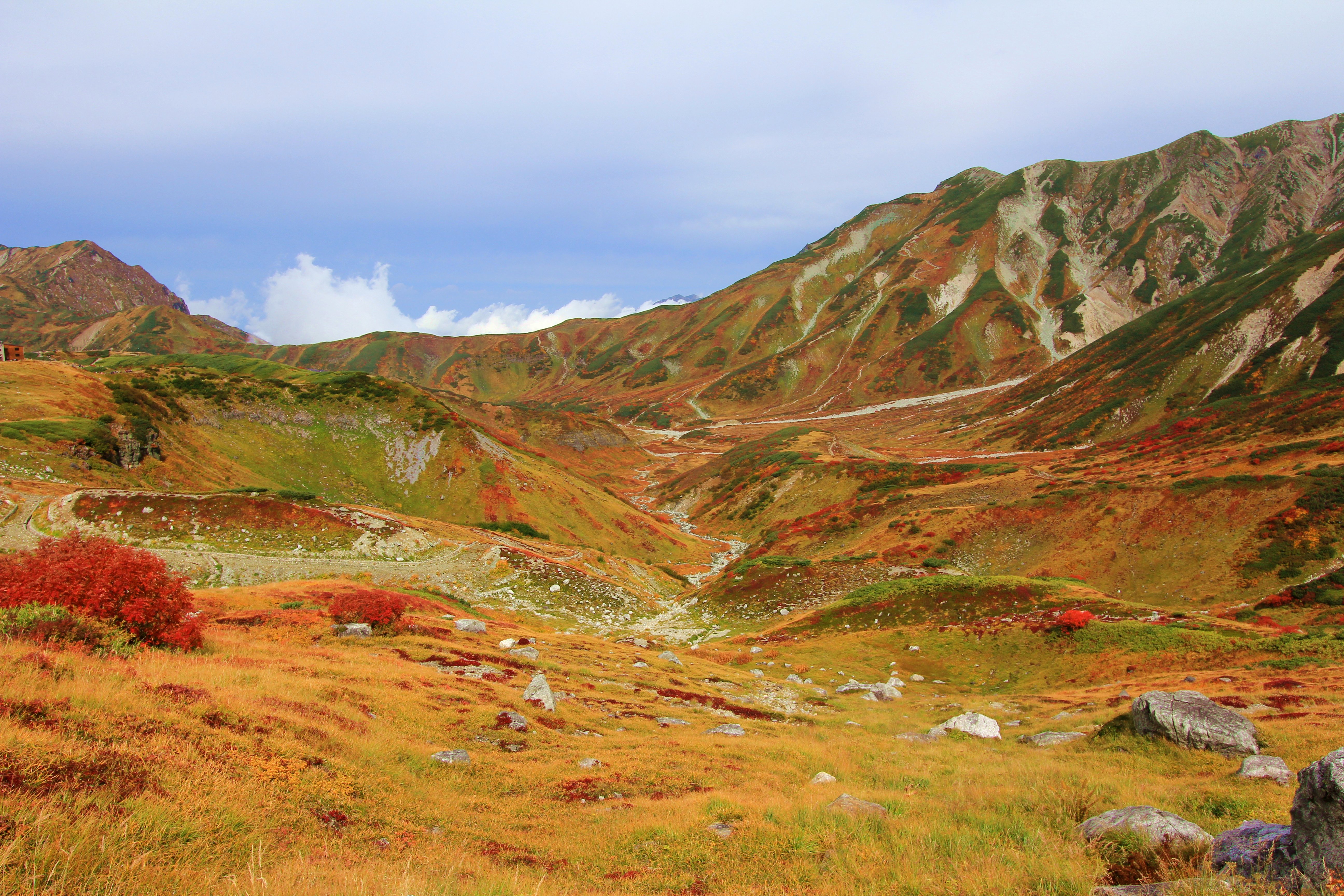
9) Tateyama-Kurobe Alpine Route, Toyama Prefecture
Average peak: Late September to early November
The Murodo Highlands, the first part of the Alpine Route to see autumn colours.
くろふね [CC BY 3.0], via Wikimedia Commons
The Tateyama-Kurobe Alpine Route (立山黒部アルペンルート, Tateyama Kurobe Arupen Rūto) is open only from April to November, but packs unique natural wonders into every season during that period, and the autumn months are no exception.  The season starts in late September with the Murodo (室堂, Murodō) highlands, the highest point of the route, where the most vibrant colours are provided by the grasses and bushes dotting the mountainous landscape.  Later on in October, the koyo front shifts downhill, and can be witnessed while riding the Tateyama Ropeway, and at hiking stopovers such as Midagahara and Bijodaira.  Last but not least are the sylvan valleys below the Kurobe Dam (黒部ダム, Kurobe Damu).

10) Tofuku-ji Temple, Kyoto
Average peak: Mid to late November
The Togetsukyo Bridge of Tofuku-ji.
By KimonBerlin (https://www.flickr.com/photos/kimon/4587863480/) [CC BY-SA 2.0], via Wikimedia Commons
Kyoto (京都, Kyōto) also has a bounty of autumn foliage locations -- my personal favourite so far is Kodai-ji temple -- but one outshines its peers by a wide margin.  Tofuku-ji (東福寺, Tōfuku-ji) is a Buddhist temple in southeastern Kyoto, not far from Fushimi Inari Shrine, in fact.  The temple's most famous view is of the Tsutenkyo (通天橋, Tsūtenkyō) bridge, which appears to float atop a sea of firey leafage at the peak of the season.  Unfortunately, its reputation and crowds have grown so much that its security personnel may enact certain measures to relieve congestion, such as rerouting visitors along different paths, or banning them from taking photographs from the bridge.  Other recommended spots include Kiyomizu-dera in the Higashiyama region (more so once renovations on the main hall are finished in 2020), Eikan-do on the Philosopher's Path, and the Arashiyama district to the west.

Honourable Mentions:
  • Meiji-jingu Gaien, Tokyo: The avenue leading into this sports park is lined on both sides with tall, golden ginkgo trees.
  • Engaku-ji, Kamakura: Some of Japan's latest-blooming colours (as late as mid-December) occur in Kamakura's shrines and temples, like Engaku-ji.
  • Kurobe Gorge: A scenic railway ride along a steep ravine, due north of the Tateyama-Kurobe Alpine Route.
  • Mino Park: A waterfall park located close to Osaka.
  • Momijidani Park, Miyajima: A park leading up to the start of the Miyajima Ropeway.  Fittingly, the name "Momiji-dani" means "maple valley".
Wildcard) Sakurayama Park, Fujioka, Gunma Prefecture
Average peak: Mid-November
https://www.odigo.jp/articles/8056-sakura-in-winter
Finally, for my Wildcard slot, did you know that there is a variety of cherry tree which blooms in the autumn and/or winter?  It's called the Jugatsu-zakura (十月桜), a name meaning "October cherry".  Even better, there exists a park where these trees bloom side-by-side with more traditional maples, and that is the Sakurayama Park (桜山公園, Sakurayama Kōen) in Fujioka, Gunma prefecture.  Sadly, it can be relatively challenging to get to.  The nearest train station (Gunma-Fujioka) is a 35 minutes' drive away, and there are no bus services in between, at least not that I could research.  But for those willing to take the initiative, it's bound to be a one-of-a-kind sight.

Friday, July 6, 2018

Know Your Trains: Hitachi and Tokiwa

Edit 9 October 2019: Updated prices to reflect the increase in Japan's national sales tax.

An E657-series train, on a test run at Kita-Senju Station.
By Rsa [GFDL or CC-BY-SA-3.0], from Wikimedia Commons
Previously on Sekai Ichi, I visited the Hitachi Seaside Park in Ibaraki Prefecture.  While I went as part of a guided tour, the park can also be visited by public transportation.  And the fastest way there is by the Hitachi limited express train which, along with its sister train, the Tokiwa, passes the park on its way up and down the JR Joban line.

Name Start Station End Station(s) Time Max. Frequency*
Hitachi Shinagawa Iwaki 150 minutes 1 per hour
Tokiwa Shinagawa Katsuta 100 minutes 1 per hour
Takahagi 130 minutes 4 per day
* Departure frequency is based on July 2018 schedules and are subject to change.

The Joban Line starts from centre-city Tokyo and goes northeast until it reaches the Pacific Ocean coast, near Mito and the Hitachi Seaside Park, and follows it northwards until terminating at Sendai. The Hitachi service skips most of the earlier stops ends at Iwaki, the largest city in Fukushima Prefecture, while the Tokiwa makes more stops and terminates earlier on. Traditionally, the Hitachi and Tokiwa both started from Ueno Station. But, on 14 March 2015, the Ueno-Tokyo line was opened, providing through-service between the Tokaido and northern main lines. The Hitachi and Tokiwa take advantage of this by making additional stops at Tokyo and Shinagawa stations, the latter serving as their new terminus.
Name (English) Name (Japanese) Line Hitachi Tokiwa
Shinagawa 品川 JR Tokaido (JT) O O
Tokyo 東京 O O
Ueno 上野 X X
JR Joban (JJ)
Kashiwa 柏 I X
Sanuki 佐貫 I O
Ushiku 牛久 I O
Tsuchiura 土浦 I X
Ishioka 石岡 I X
Tomobe 友部 I X
Akatsuka 赤塚 I O
Kairakuen* 偕楽園 O O
Mito 水戸 X X
Katsuta 勝田 X X
Tokai 東海 I O
Omika 大甕 O O
Hitachi-Taga 常陸多賀 O O
Hitachi 日立 X O
Takahagi 高萩 O O
Isohara 磯原 O O
Nakoso 勿来 O I
Izumi 泉 X I
Yumoto 湯本 X I
Iwaki いわき X I
Legend
X: All trains stop at this station.
O: Some trains stop at this station.
I: No trains stop at this station.
*Kairakuen is a temporary station open only during the plum-blossom season in February/March.

Notable Stops
  • Mito: The capital city of Ibaraki Prefecture, and site of Kairaku-en, one of Japan's three most famous landscape gardens, which is famous for plum-tree blossoms in February and March.
  • Katsuta: The closest station to Hitachi Seaside Park.
  • Hitachi: A seaside city with a sizable cherry blossom festival.
  • Izumi: The closest station to the Aquamarine Fukushima aquarium.
  • Yumoto: The closest station to the Spa Resort Hawaiians water park.
  • Iwaki: The largest city in Fukushima Prefecture.
An E653-series Super Hitachi train (retired in 2013), passing the plum trees of Kairaku-en.
Fumihiko Ueno [CC BY 3.0], via Wikimedia Commons
Both the Hitachi and Tokiwa use E657-series train sets, which were introduced in 2012.  In both the regular and Green cars, seats are arranged in a 2+2 layout, with 96cm (38 in.) of seat pitch in the regular sections, and 116cm (46 in.) in the Green Cars.  All seats have their own electrical outlets.

Service Total Cars Non-Reserved Cars Reserved Cars Green Cars
Hitachi 10 0 9 (Cars #1-4, 6-10) 1 (Car #5)
Tokiwa 100 9 (Cars #1-4, 6-10) 1 (Car #5)

Tips
  • All seats on the Hitachi and Tokiwa require reservations.  These are free to make with the Japan Rail Pass and JR East Tohoku Area Pass.
  • The JR East Nagano-Niigata Area Pass and Tokyo Wide Pass also cover the Hitachi and Tokiwa, but only up to Isohara, the last stop in Ibaraki prefecture. Users of these passes must pay for any fares beyond that out-of-pocket, up to ¥1,440 (to Iwaki).
  • During Kairaku-en's plum blossom festival in February/March, a temporary train station is set up at the park's entrance, between Akatsuka and Mito Stations.  At the moment, I have been unable to confirm if Hitachi and/or Tokiwa trains make an additional stop there, or if you will need to transfer to a local at the next closest stop.
Trivia
  • The name "Hitachi" (ひたち) is also the name of Hitachi Province, the former counterpart to present-day Ibaraki Prefecture.  As a train service, the name was first used in 1963 for express trains between Ueno and Iwaki*.
    • *Iwaki Station was known as Taira Station until 1994.
  • The name "Tokiwa" (ときわ) is an alternate reading of Joban (常磐, Jōban), a region encompassing the old Hitachi (常陸国, Hitachi no Kuni) and Iwaki (磐城国, Iwaki no Kuni) provinces, the latter forming the eastern portion of modern-day Fukushima Prefecture.  As a train service, the name was first used for another express service between Ueno and Iwaki.  It operated from 1958 to 1985.
  • The Hitachi was once supplemented by two new services: the Super Hitachi in 1989, and the Fresh Hitachi in 1997. In March 2015, they were renamed simply Hitachi and Tokiwa, respectively.

Thursday, July 5, 2018

Tobu Treasure Garden

This article is based on a visit made on Thursday, 10 May 2018.

Edit 9 October 2019: Updated prices to reflect the increase in Japan's national sales tax.

Previously on Sekai Ichi, I went on a tour to visit flower parks in the Kanto region.  We visited the Hitachi Seaside Park and the Ashikaga Flower Park.  Due to factors beyond our control, namely that some of their more famous flowers were beyond peak bloom faster than normal, our tour guide threw us a bone.  She replaced some of the time we would have spent elsewhere with an additional stop, at the Tobu Treasure Garden (東武トレジャーガーデン, Tōbu Torejā Gāden).  It is a smaller, more intimate park than the other two we visited.  It certainly seems smaller when you look down on the central, hedge-lined corridor, but cross over to the right...

...and the park opens up to a hilly clearing.  And... what could this be?

Now that's more like it!  The nemophila flowers we had missed at Hitachi Seaside Park were out in force here!  Granted, it was still past peak bloom, but closer to it -- and with weather I could actually admire them in.  Compared to Hitachi, this park is located more inland, in Gunma prefecture, so it's likely that higher elevations and cooler weather offset floral blooms a few days compared to the coastal regions.

There are many other colours on display in this garden besides blue.  Here is a mound of purple flowers whose species currently escapes me.

Another hill was topped with young snapdragon flowers.

They also have a hill here which they cover with pink phlox moss, but that was all gone by the time we arrived.  I was set to see more of that in the Fuji Five Lakes, so that cast some doubt as to how far along in their lifecycle they would be... but I'll leave that as a surprise for you readers...!

In the middle of the hilly garden, there is a raised platform topped by this copper tea-kettle.  It was donated by Morin-ji (茂林寺), a Buddhist temple nearby, to serve as a good-luck charm.

If you head all the way back, you will come across a secluded rose garden.

Closeup of a pink rose...

...and a bunch of orange roses.

The most distinguishing feature of this park is the chapel, the St. Peter and Paul Church, which sits in the front corner.  The staff says it was transported all the way from Paddington, England which, if I'm looking up the right place, is a district of London.

The chapel comes complete with a pipe organ and stained-glass windows depicting various saints, which didn't come out so clear in this photo.  The rose window up above is a traditionally English touch.  And yes, you can arrange to hold your wedding here.

As if to remind me of where I actually was, a small pond on the entrance plaza was populated with plenty of small carp (鯉, koi), whose red-on-white spots reminded me of the Japanese flag.

Finally, my sign-off selfie, taken when we all returned to our starting point in Shinjuku.  Here I am to the right, next to my grandmother, and a couple from Hawaii who joined us for the day.  We walked together on our way to Shinjuku Station before parting ways to find dinner in the station's department stores.  After Nana and I supped, we returned to our hotel to rest up before our next day's activities.  That would be a tour of the Fuji Five Lakes, next time on Sekai Ichi!


Hours: Open from 9:00 AM to 5:00 PM from April to June, or from 10:00 AM to 4:30 PM from October to mid-November.  Closed from July to September, and from mid-November to March.

Costs: Varies from ¥500 to 1,000 depending on the season and the condition of flowers within the park.

Address: 1050 Horiku-chō, Tatebayashi-shi, Gunma-ken 〒374-0066

Access: From Tobu's Asakusa Station in Tokyo, take the Ryomo limited express to Tatebayashi Station (TI10, 65 minutes, ¥1,960 reserved), followed by a 10-minute taxi drive (about ¥1,500).  There are one or two Ryomo trains per hour.

Or, take a local train on the Tobu Isesaki (TI) line to Morinji-mae (TI09, 110 minutes, ¥910), followed by a 15-minute walk.  Section Express trains in the mornings and evenings make the journey directly; otherwise, you will need to transfer at a station in-between, i.e. Tobu Dobutsu-koen (TS30).

Website: (Japanese)