COVID-19 Coronavirus Notice

COVID-19 Coronavirus Notice

Updated 2 July 2020

If you are reading this message, please be aware of travel restrictions in place as part of measures to contain the spread of the COVID-19 "Coronavirus" and its symptoms. Japanese authorities are refusing entry to individuals from, or who have been to, a list of over 100 countries (More information). All other visitors must apply for a visa, and undergo a quarantine upon entering the country. Within the Japan, there are no longer any travel restrictions, and most public attractions have re-opened with precautions for sanitation and social distancing. In short, travel to Japan is not recommended at this time, until the situation normalises. I will not be editing my individual articles to reflect this, but again, please keep this in mind when reading them.
Showing posts with label Nagano prefecture. Show all posts

Wednesday, March 25, 2020

Matsumoto Nakamachi District

This article is based on a visit made on Saturday, 19 May 2018.

Previously on Sekai Ichi, I visited Matsumoto Castle during a brief stopover on my way back to Tokyo.  But rather than leave it at that, I spent some time at Nakamachi (中町), the merchant district which grew in the Edo period, under the auspices of the castle's lords.

Nakamachi is famous for its style of storehouse, or kura (蔵), architecture.  Key aspects of the kura style are thick, white-washed, earthen walls, black tile roofs, and lattice grid patterns along the sides.  Kura are a common site in many of Japan's old towns, as their sturdy construction was an invaluable method of keeping rice and other stockpiles safe and secure.  Further examples, authentic or less so, can be seen scattered about the city, even at this convenience store across from the entrance to Matsumoto Castle.

On the way we passed an old bookstore designed after the black-and-white castle.  It looked all the more surreal squeezed in between two modern rectangular buildings.  To the right is a souvenir store where my grandmother found a temari handball for one of her friends, having fallen in love with the things at first sight in Kanazawa.


Heading down from Matsumoto Castle, our path took us to two parallel streets on either side of the Metoba River.  Just along the north side of the river is Nawate-dori (縄手通り).  This lane of shops was set up in the Meiji period, attracting visitors on their way to the nearby Yohashira Shrine (四柱神社).  This arrangement is similar to what sprang up around Senso-ji in Tokyo or Yasaka Shrine in Kyoto.

Nawate-dori is commonly known as "Frog Street", and the reason behind this association is a pun.  The Japanese word for frog, "kaeru" (蛙/かえる), sounds the same as a form of "to buy" (買える), which shop owners called out to potential customers passing by.

Moving on, Nakamachi-dori presents a completely different vibe at first.  The wider road, the bright white walls of the kura buildings, and the beautiful weather of this particular day all give it an open, airy feel in comparison to Nawate-dori.

Nakamachi-dori hosts a wide selection of restaurants.  The cuisines on offer include Japanese kaiseki, izakaya pubs, noodles, bakeries, and Korean barbecue.  Our choice for lunch was Hawaiian Dining Hula-la, a Hawaiian-themed burger joint, as the name implies.

I was intrigued to find sugidama, decorations on the front of sake breweries that were prevalent in Takayama's old town, here in Matsumoto as well.  As it turns out, this sugidama belongs to a community centre called the Nakamachi Kurassic-kan (中町 蔵シック館), a pun using the word for warehouse, "kura", as part of "kurasshiku", the Japanese spelling of "classic".


663highland / CC BY-SA
Nakamachi also has an eclectic assortment of museums, which we regrettably eschewed in favour of returning to Tokyo sooner.  In the middle of Nakamachi-dori is a Weights and Scales Museum, and just past the west exit, across the main road, is the Matsumoto Timepiece Museum (shown above).  With a giant grandfather clock built above the entrance, you can't miss it.

By 663highland [GFDL, CC-BY-SA-3.0 or CC BY 2.5], from Wikimedia Commons
A short walk from the far exit of Nakamachi will bring you to the Matsumoto City Art Museum (松本市美術館, Matsumoto-shi Bijutsukan), which I featured on my list of Japan's top ten contemporary art museums.  It hosts the works of local artists of the past and present, from sculptures to calligraphy to the festive pop art of Yayoi Kusama (草間彌生, b.1929).

TAKA@P.P.R.S / CC BY-SA

For one last pic to brighten your day, even the vending machines at Matsumoto City Art Museum are coated in Kusama's signature polka-dot pattern, as are the top-right row of cans.  Pity that they don't seem to be for sale, since that would make for one stylish can of Coke.  But whatever; I've got further business to wrap up back in Tokyo, next time on Sekai Ichi!


Directions: To go by bus, take the East Town Sneaker bus from Matsumoto Station's Oshiro-guchi exit to Kura-no-machi Namakachi (5 minutes, ¥200).

To go by foot, start from Matsumoto Station's Oshiro-guchi exit and head straight down the main road.  After 5 minutes, turn left at the fourth traffic light (Fukashi 2-chome / 深志二丁目), then continue straight for 4 minutes.  The entrance to Nakamachi-dori will be on the right.  Nawate-dori is the second right afterwards, just past the bridge.

Hawaiian Dining Hula-la

Hours: Open from 11:30 AM to 10:00 PM, or to 11:00 PM on Saturdays and holidays.  Last orders end 1 hour before closing time.  No regular closing days.

Address: 2-5-13 Chuo, Matsumoto, Nagano 〒390-0811

Directions: From the Kura-no-machi Nakamachi bus stop, turn around and start towards the main road.  About halfway down the block, the restaurant will be on the left side.

Website: (Japanese)

Matsumoto Timepiece Museum

Hours: Open from 9:00 AM to 5:00 PM.  Admission ends 30 minutes before closing time.  Closed on Mondays and from 29 December to 3 January.

Costs: ¥300.

Address: 1-21-15 Chuo, Matsumoto-shi, Nagano-ken 〒390-0811

Directions: From the Kura-no-machi Nakamachi bus stop, turn around and head towards the main road.  Cross it, turn right, then take the next left.  The museum will be on the left side, at the next corner.

Website: (Japanese)

Matsumoto City Art Museum

Hours: Open from 9:00 AM to 5:00 PM.  Closed Mondays and from 29 December to 2 January.

Cost: ¥410.

Address: 4-2-20 Chuo, Matsumoto-shi, Nagano-ken 〒390-0811

Access: From Matsumoto Station, take the East Town Sneaker bus to Matsumoto-shi Bijutsukan (16 minutes, ¥200).

Directions: To walk to the museum from the Kura-no-machi Nakamachi bus stop, head straight down the street (300m) until you reach the stoplight at the other end, and turn right.  Continue on (300m) to the next traffic light and turn left.  Continue on (300m), and the museum will be on your left, past the next traffic light.

Website: (English) (Japanese)

Friday, March 20, 2020

Matsumoto Castle

This article is based on a visit made on Saturday, 19 May 2018.

Previously on Sekai Ichi, I took a detour on my way back to Tokyo, courtesy of the Resort View Furusato train.  We disembarked at Matsumoto Station, and hopped a bus to the central focus of the city: the eponymous Matsumoto Castle (松本城, Matsumoto-jō), which is one of Japan's twelve remaining feudal-era castles.

Matsumoto Castle, in its current form, was completed in 1594, replacing a fort that stood on its spot for almost a century beforehand.  It was the headquarters of the Matsumoto Domain until the Meiji Restoration of 1868, when the land was put up for auction, but spared from redevelopment thanks to the citizens' efforts.  Since then, the castle was acquired by the city government and preserved as a museum.

The castle is surrounded by small but pleasant park area, and guarded over by its mascot character, Alp-chan (アルプちゃん, Arupu-chan).  True to its name, its helmet evokes the mountains of the nearby Japan Alps.

Something I highly recommend doing ahead of visiting is to sign up for a free volunteer guide to take you along through the castle.  The Alps Language Service Association offers these guides in English and other select languages.  To apply, visit their booth at the south entrance to the castle park (open from 10:00 AM to 3:00 PM), or apply on their website up to two weeks before your visit.  More information: (English)

Obviously, neither of these cosplayers were my guide, but the actual guide did help take my picture here.

Because it was never reconstructed, Matsumoto Castle has maintained the same authentic wooden interior since it was built centuries ago.  What is different nowadays is that the keep hosts a museum, which focuses on weaponry of feudal Japan.  One fact I learned here was that women played a role in maintaining the castle's defences, in particular by making gunpowder.

Where there are weapons, one needs armour.  Our guide told us an anecdote about George Lucas visiting a Japanese castle before developing the first Star Wars movie in the '70s, giving him design inspirations for the character Darth Vader.  I wasn't able to confirm this in my own research, but samurai armour was cited as a reference by other concept artists who worked on the film, especially the shape of the kabuto helmets.

The keep contains six storeys, despite the outside appearance of only five.  If you recall from my visit to Nagoya Castle, this is a common defence tactic of Japanese castle construction.  The stairs leading up to the fourth floor and beyond are dangerously steep, but your reward is witnessing these splendid views from the top floor!  These views would be even more splendid in mid-April, when the hundreds of cherry trees planted around the gardens bloom into pink petals.

From this angle, we can see a red-railed bridge, which makes for a photogenic shot when viewed from ground level, combined with the keep.  If it is normally possible to walk across this bridge, it was not so that day, having been closed off for some sort of repairs.

The top floor has a small shrine hidden up in the rafters.  It was here where my guide told me about the symbolism behind the shimenawa, how the ropes and paper tassels represent clouds and lightning.

On your way down, your path will lead you into one of the castle's secondary turrets.  Shown above, the 3-storey "moon-viewing turret" (月見の宴, tsukimi no yagura) was added in 1634, in anticipation of a visit from the national lord Tokugawa Iemitsu.  Ironically, the shogun's path was blocked by a rock slide and he never showed up.

With my sign-off selfie, I would once again like to extend a big thank you to Reiko (right), our volunteer guide.  With her insight, I am comfortable confirming Matsumoto Castle as one of Japan's finest castles to visit, rivaled only by the "white egret" itself, Himeji Castle.  But there's more to Matsumoto than just the castle, and if you'll stick around with me, I'd like to show you a bit more of the city, next time on Sekai Ichi!


Hours: Open from 8:30 AM to 5:00 PM, or from 8:00 AM to 6:00 PM during Golden Week and O-Bon.  Admission ends 30 minutes before closing time.  Closed on 29-31 December.

Costs: ¥610.

Address: 4-1 Marunouchi, Matsumoto-shi, Nagano-ken 〒390-0873

Access: Matsumoto Castle is 8 minutes by bus, or 15 minutes by foot, from Matsumoto station.

Directions: To go by bus, take the Town Sneaker North bus from Matsumoto Station's Oshiro-guchi exit to Matsumoto-jo/Shiyakusho-mae (8 minutes, ¥200).

To go by foot, start from Matsumoto Station's Oshiro-guchi exit and head straight down the main road.  After 5 minutes, turn left at the fourth traffic light (Fukashi 2-chome / 深志二丁目), then continue straight for 10 minutes, bearing right after crossing the river mid-way.

Website(English) (Japanese)

Wednesday, December 18, 2019

Introduction To: Matsumoto

Matsumoto (松本) is a city in Nagano Prefecture.  Before the Meiji restoration, it served as the capital city of Shinano Province.  Its chief attraction is the eponymous Matsumoto Castle, one of the twelve original castles to have survived intact since the feudal era.  Situated at the eastern base of the Japan Alps, Matsumoto is also an ideal base for excursions into outdoor treasures like Kamikochi Park and the Tateyama-Kurobe Alpine Route.

Main Attractions

The main keep of Matsumoto Castle, accessible from Matsumoto Station.
Taken on Saturday, 19 May 2018.
1) Matsumoto Castle: A black-walled castle that has survived since the late 16th century.

2) Nakamachi District: A neighbourhood of old white-walled merchant's houses and unique museums.

By 663highland [GFDL, CC-BY-SA-3.0 or CC BY 2.5], from Wikimedia Commons
3) Matsumoto City Museum of Art: A museum of modern art, with a particular focus on local-born artist Yayoi Kusama (草間 彌生, b. 1929).

By Saigen Jiro [CC0], from Wikimedia Commons
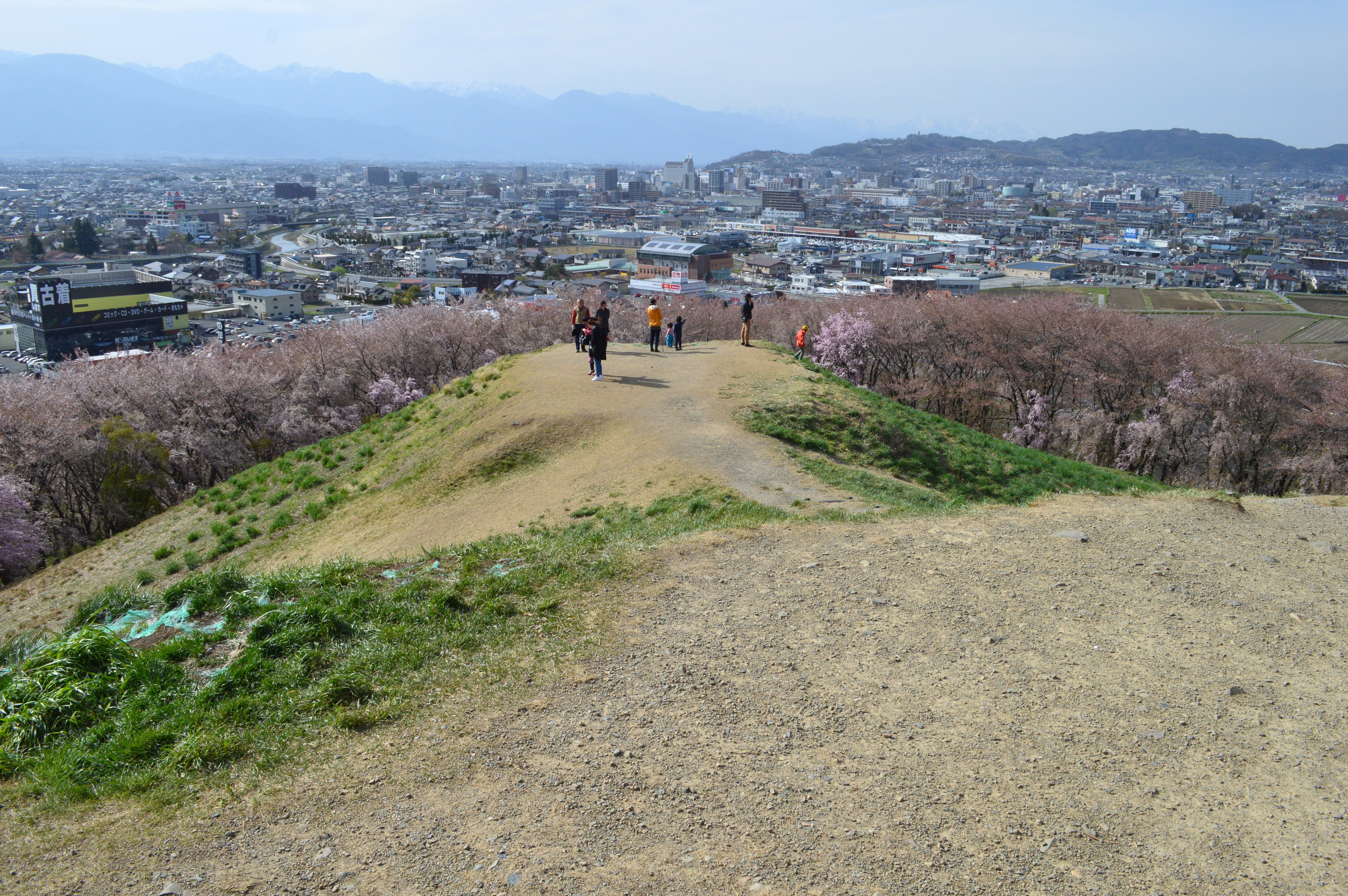
4) Koboyama Park: A park on the city's outskirts built on top of a former burial mound, adorned with thousands of cherry trees.

By photo: Qurren (talk)Taken with Canon IXY 10S [GFDL or CC BY-SA 3.0], from Wikimedia Commons
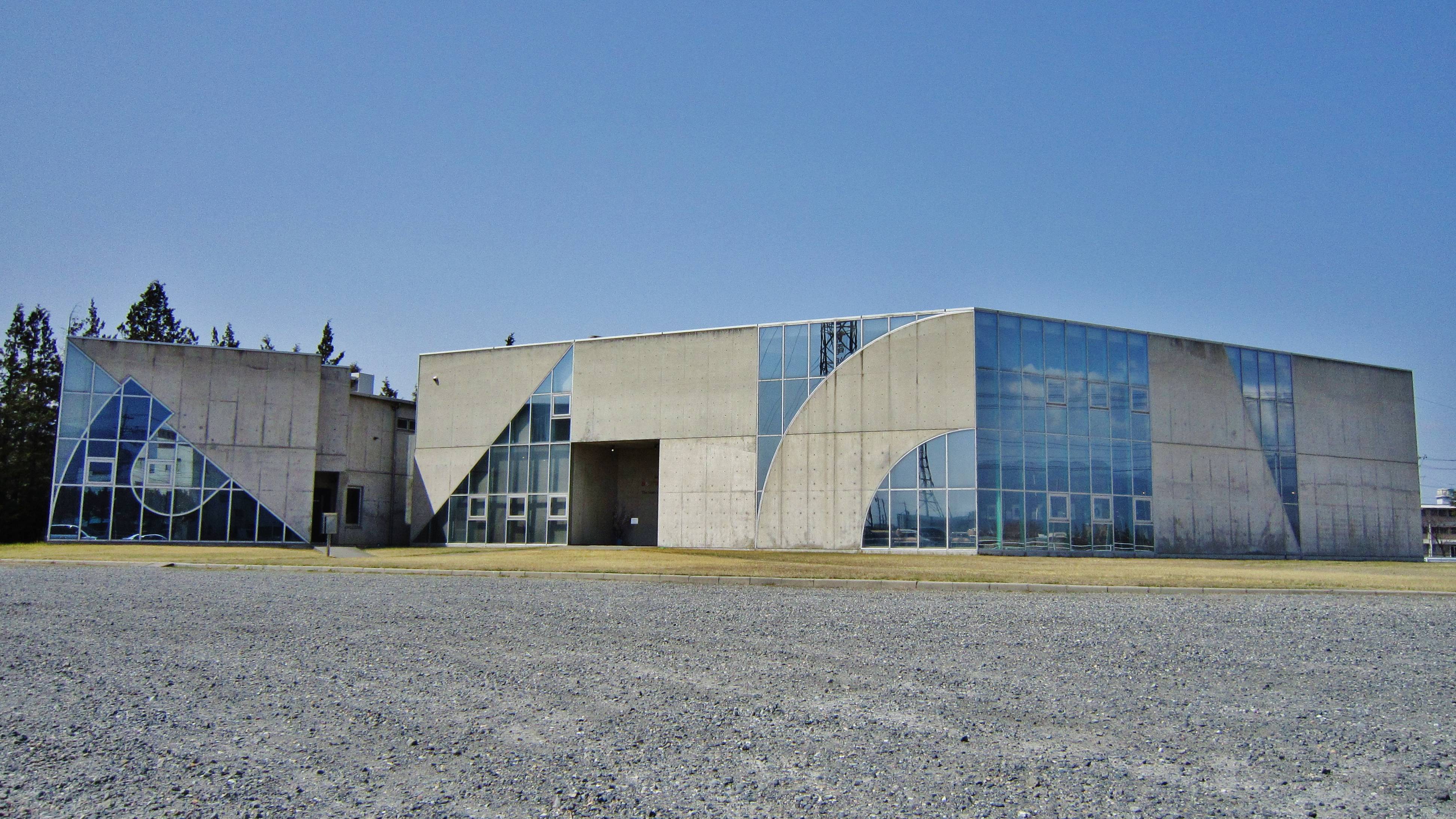
5) Japan Ukiyo-e Museum: An outlying museum about Japanese woodblock-print art.

By Wiiii [GFDL or CC BY-SA 3.0], from Wikimedia Commons
6) Kaichi School Museum: One of Japan's first school buildings, preserved from the Meiji Period (late 19th century).

mapplefan8 [CC BY-SA 3.0], via Wikimedia Commons
7) Asama Onsen: A hot-spring town within Matsumoto's city limits.

Orientation

Matsumoto Station stands to the east or southeast of most of the city's attractions.  For avid walkers, many destinations, including Matsumoto Castle, can be reached on foot within 15-20 minutes.  For everyone else, there is a network of tourist-oriented loop buses called the Town Sneaker buses.  There are four Town Sneaker routes: North, East, South, and West.  Of the greatest import to tourists are the north bus, which stops at the castle, and the east bus, which stops at Nakamachi and the Matsumoto City Museum.  They cost ¥200 per ride, or ¥500 for a one-day pass (which includes discounts at various spots), and buses arrive every 20-30 minutes.  More information: (Japanese)

Access

From Tokyo, the most direct way to get to Matsumoto is by the Azusa limited express train, along the Chuo Main Line.  The one-way journey from Shinjuku Station takes 2½ to 3 hours, and costs ¥6,620 for a reserved seat.  From Tokyo Station, it may be faster to take the Hokuriku Shinkansen to Nagano (80-100 minutes), then the Wide View Shinano limited express to Matsumoto (50 minutes).  In total, this costs at least ¥10,300 (reserved).  Both options are fully covered by the Japan Rail Pass and the JR East Nagano-Niigata Pass.  From western cities, take the Tokaido Shinkansen to Nagoya, then the Wide View Shinano limited express to Matsumoto (120 minutes, ¥6,410 reserved).

Highway buses, operated by Alpico Kotsu, are available to and from Tokyo's Shinjuku Station (3 hours, ¥3,800), Takayama (2½ hours, ¥3,250 one-way / ¥5,760 round-trip), and more.  If you have a JR East Nagano-Niigata pass, you can buy a round-trip bus ticket from Matsumoto to Takayama for a discounted ¥4,500.  More information: (English) (Japanese)

There is also a small airport, Shinshu-Matsumoto Airport (IATA code: MMJ), 8km (5 mi) south of the city.  It only serves a couple of domestic destinations: Fukuoka, Sapporo, and during the month of August, Osaka-Itami.  A shuttle bus between the airport and bus terminal is timed to meet all flights.  The ride takes 30 minutes and costs ¥600.  More information: (Japanese)

Excursions

1) Daio Wasabi Farm: A wasabi (spicy horseradish) farm open to visitors.
Access: JR Oito line from Matsumoto to Hotaka Station (30 minutes, ¥320, JR Pass OK), followed by a 10-minute taxi (~¥1,300) or shuttle bus ride (¥600 one-way / ¥1,000 round-trip) (Schedule).  Buses are only available on weekends and holidays, from mid-April to October.

2) Omachi: A starting point for crossing the Tateyama-Kurobe Alpine Route.
Access: JR Oito line from Matsumoto to Shinano-Omachi Station (60 minutes, ¥680, JR Pass OK).

3) Hakuba: A ski resort used during the 1998 Winter Olympics.
Access: JR Oito line from Matsumoto to Hakuba Station (105 minutes with 1 transfer, ¥1,170, JR Pass OK).

4) Nagano: The prefecture's capital city, and the host of the 1998 Winter Olympics.
Access: JR Shinano limited express from Matsumoto to Nagano Station (50 minutes, ¥2,900 reserved, JR Pass OK).

5) Kamikochi: A national park in the northern Japan Alps, centred around a river nestled between mountains.  Open only from April through November.
Access: Alpico line from Matsumoto to Shin-Shimashima Station (30 minutes), followed by a bus to Kamikochi (65 minutes, total ¥2,500 one-way / ¥4,650 round-trip) (Schedule).

6) Kiso Valley: A collection of preserved post towns along the old Nakasendo highway, which one may hike across.
Access: JR Shinano limited express from Nagoya to Nakatsugawa Station (75 minutes, ¥4,370 reserved, JR Pass OK), followed by a bus to Magome (25 minutes, ¥570) (Schedule).

Tuesday, December 17, 2019

Know Your Trains: Resort View Furusato

This article is based on a visit made on Saturday, 19 May 2018.

Previously on Sekai Ichi, I wrapped up a day trip to Takayama which, I would say, was one of the highlights of this trip.  After returning for our final night in Toyama, we were about to return to Tokyo.  But even though the Hokuriku Shinkansen provides a fast and direct link between the two cities, I felt like making a diversion along the way.  Our interim destination was the castle town of Matsumoto, and to get there, our route included a special train called the Resort View Furusato.

The Resort View Furusato (リゾートビューふるさと, Rizōto Byū Furusato) is one of JR East's lineup of "Joyful Trains".  These are specialised excursion trains which generally run on weekends and holiday periods, and have unique exterior and interior themes, often tying in with aspects of their particular regions.

The Resort View Furusato uses a 2-car HB-E300-series train, powered by a hybrid electric/diesel engine.  Inside, the Furusato may not appear as flashy as other Joyful Trains, but its essentials go above and beyond the call.  All seats have a generous pitch of 120 cm (47 inches), the most spacious regular seating in JR's entire fleet, and the windows are plenty wide, too.  At both ends of the train, there are small open areas where you can enjoy an even better view.  Traditional music performances are also held here, primarily on the western portion of the route which we skipped over.

Mid-way between Nagano and Matsumoto, the train makes an extended stop at Obasute Station.  Two things stand out about this station: first, there is a switchback here, where the train must change directions to climb up or down, not unlike certain points of the Hakone Tozan Railway.  And second, the platform has a commanding view of the Zenkoji Plain below, towards Nagano.

Attendants are also on hand throughout the whole journey.  You can buy certain snacks and gifts from them -- such as products made with apples, an agricultural specialty of Nagano Prefecture -- and they are happy to assist with taking your picture, such as I did at the above-mentioned stop.


We disembarked at Matsumoto, but the Resort View Furusato continues up the Oito line, which skirts up the eastern edge of the Japan Alps.  If you want to go to the Tateyama-Kurobe Alpine Route, you can take this train to Shinano-Omachi station, and transfer to a bus from there.  Kurobe Dam (pictured), one of the route's highlights, can be reached in only an hour from Shinano-Omachi.  Beware that if you do so, make sure you have enough time to catch the last connection at each stop, since crowds are liable to build up by the time you get there.  For more information, please read my introduction article on the Alpine Route here.

663highland [CC BY-SA 3.0], via Wikimedia Commons
On its outbound journey, the train also makes an extended half-hour stop at Hotaka.  This gives you enough time to visit Hotaka Shrine which, despite being situated right next to the station, is nestled within a pleasant wooded grove.  In that regard, it reminds me of Meiji Shrine in Tokyo.  Even Hotaka Station is modelled after the shrine's bare-wooden architecture!

Ski Mania [Public domain], via Wikimedia Commons
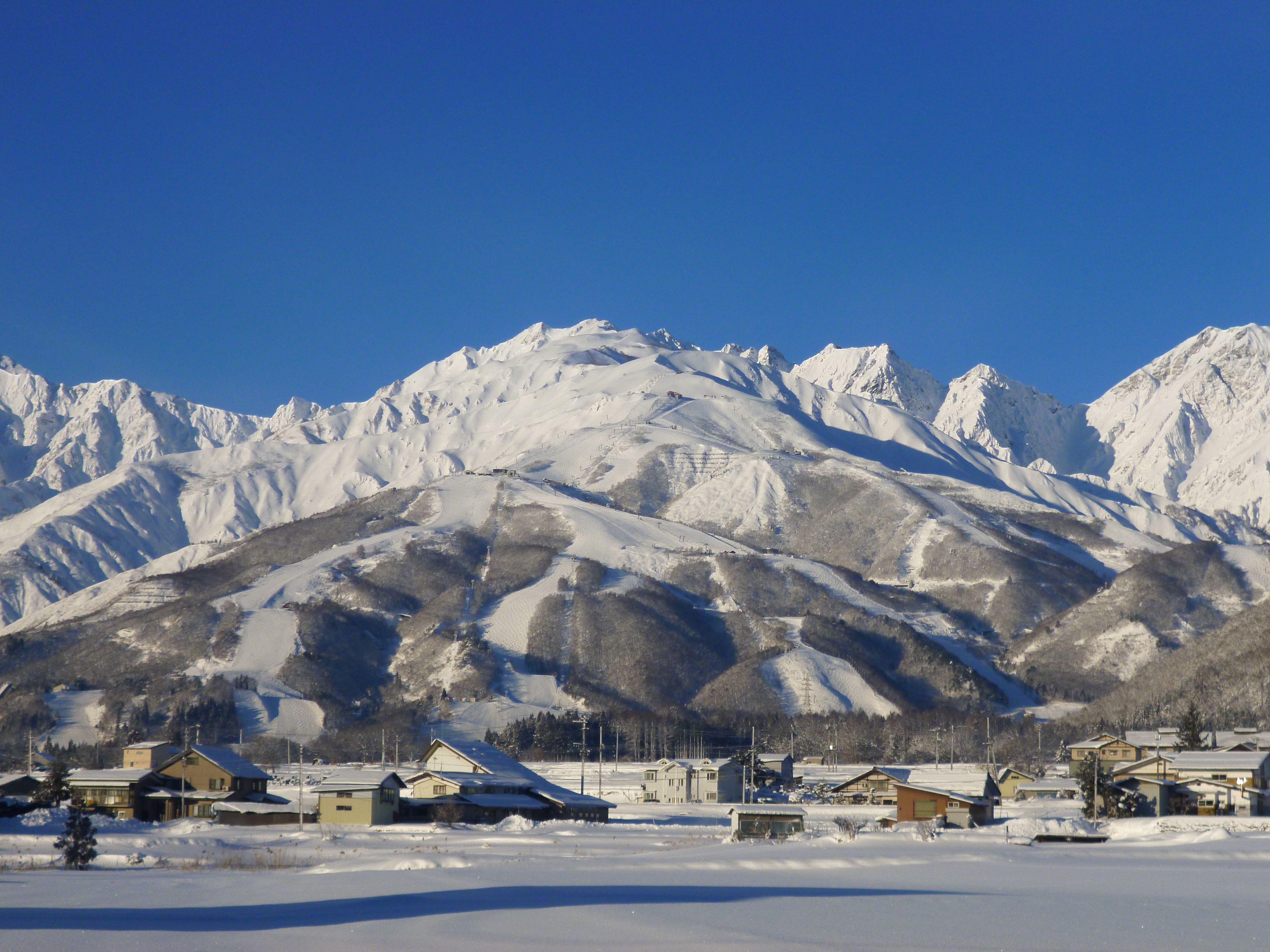
The far end of the line, from Hakuba to Minami-Otari, is home to a dense cluster of ski resorts, accessible by buses from either of the two stations as well as from Nagano.  The largest ski zone is Happo'one (pictured), which hosted Downhill and Super G skiing events during the 1998 Winter Olympics.


The Resort View Furusato runs on most Saturdays and Sundays, and some additional periods, including almost the entire month of August.  For up-to-date operating schedules, please visit the links at the bottom of this article.

StationResort View Furusato
for Minami-Otari
StationResort View Furusato
for Nagano
Nagano9:04 AMMinami-Otari3:18 PM
Shinonoi9:13 AMHakuba3:33 PM (Arr.)
3:39 PM (Dep.)
Obasute9:28 AM (Arr.)
9:45 AM (Dep.)
Shinano-Omachi4:20 PM (Arr.)
4:21 PM (Dep.)
Akashina10:11 AM (Arr.)
10:12 AM (Dep.)
Shinano-Matsukawa4:30 PM (Arr.)
4:31 PM (Dep.)
Matsumoto10:27 AM (Arr.)
10:41 AM (Dep.)
Hotaka4:42 PM (Arr.)
4:45 PM (Dep.)
Hotaka10:59 AM (Arr.)
11:31 AM (Dep.)
Matsumoto5:14 PM (Arr.)
5:23 PM (Dep.)
Shinano-Matsukawa11:41 AM (Arr.)
11:42 AM (Dep.)
Akashina5:40 PM
Shinano-Omachi11:52 AM (Arr.)
12:02 PM (Dep.)
Obasute6:06 PM (Arr.)
6:07 PM (Dep.)
Hakuba12:34 PM (Arr.)
12:42 PM (Dep.)
Shinonoi6:19 PM
Minami-Otari1:00 PMNagano6:29 PM

Tips
  • All seats on the Resort View Furusato are reserved.  The supplement fee is a flat ¥530 on top of regular fare.
  • The Resort View Furusato is classified as a rapid train, so you can ride it for free with the Japan Rail Pass, JR East Nagano-Niigata Pass, and even the Seishun 18 Ticket.
  • For the best views during the Nagano-Matsumoto section, including the Obasute overlook, sit on the right side of the train (for outbound services).  For the best views of the Japan alps beyond Matsumoto, sit on the left side (outbound).

More information: (English) (Japanese)

Tuesday, April 9, 2019

Introduction to: Tateyama-Kurobe Alpine Route

This article is based on a visit made on Wednesday, 16 May 2018.

Edit 11 October 2019: Updated prices to reflect the increase in Japan's national sales tax.
Edit 14 May 2020: Updated to add information on luggage forwarding services

The Tateyama-Kurobe Alpine Route (立山黒部アルペンルート, Tateyama Kurobe Arupen Rūto) is a sequence of transportation sections traversing the northern Japan Alps.  The concept of the Alpine Route came about after the construction of the Kurobe Dam, the largest hydroelectric dam in Japan.  Roads and tunnels built to aid in the dam's construction were re-tooled for tourism, creating the Alpine Route in 1971.  Visitors traversing the route will ride various trains, buses, and cable cars, all the while witnessing beautiful natural vistas, with multiple opportunities to stop and take hikes.  The entire route is opened only from mid-April to the end of November.

The route may be crossed in either direction, or you may also go to a certain point and turn back mid-way.  For the purposes of this blog, I will describe the route going from west to east, since that is how I took it.  Also, English reading order.

Transportation Sections

A) Toyama Chiho Railway: Not officially part of the Route, but the best method to access Tateyama Station, its westernmost point.
Time: 60 minutes
Departures: 1 per hour

B) Tateyama Cable Car: An inclined cable car at the western base of Mount Tateyama.
Time: 7 minutes
Departures: Every 20 minutes

663highland / CC BY-SA
C) Highland Bus: A regular bus service climbing most of the way up Tateyama, with occasional stops at the Midagahara plateau.
Time: 50 minutes
Departures: Every 40 minutes

D) Tateyama Trolleybus: A trolleybus, powered by overhead electricity, driven along a tunnel cut through the top of Tateyama.
Time: 10 minutes
Departures: Every 30 minutes

E) Tateyama Ropeway: The longest single-span (1.6km / 1 mi.) hanging cable-car in Japan.
Time: 7 minutes
Departures: Every 20 minutes

F) Kurobe Cable Car: An inclined cable car at the eastern base of Tateyama.
Time: 5 minutes
Departures: Every 20 minutes

G) Kanden Trolleybus: A trolleybus cutting through a tunnel within Mount Akasawa-dake, linking Kurobe Dam to the outside world.
Time: 16 minutes
Departures: Every 30 minutes

H) Alpico Kotsu Bus: A local transportation company offering regular buses to Omachi, and highway buses to Nagano.  Not officially part of the Route, but the best method to access Ogizawa, its easternmost point.
Time: 40 minutes (to Omachi), 105 minutes (to Nagano)
Departures: 1-3 per hour (to Omachi), 1 per hour (to Nagano)

Stops and Attractions

XF10 / CC BY-SA
1) Tateyama: The western end of the Alpine Route, boasting a few small museums.

Bijodaira04bs3200
663highland / CC BY-SA
2) Bijodaira: A virgin beech/cedar forest, with giant trees and folk legends.

Shomyo Falls (left) and Hannoki Falls (right).
I, Kahusi / CC BY-SA
3) Shomyo Falls: The tallest regular waterfall (350m / 1,148 ft.) in Japan.  In Spring, melting snow feeds the even taller (497m / 1,640 ft.) Hannoki Falls.

Alpsdake / CC BY-SA
4) Midagahara: One of the largest and highest alpine wetlands in Japan, with boardwalk-lined hiking trails.

5) Murodo: The highest point (2,450m / 8,038 ft.) of the Alpine Route, with many more hiking trails.  From April to June, a canyon is carved out of snow accumulated over the winter.

6) Daikanbo: The upper station of the Tateyama Ropeway.  Offers sweeping views looking down upon Kurobe Dam and the surrounding valley.

くろふね [CC BY 3.0], via Wikimedia Commons
7) Kurobedaira: The lower station of the Tateyama Ropeway.  Offers additional views looking down closer to Kurobe Dam, or up at Tateyama.

8) Kurobe Dam: The tallest dam in Japan, measuring 186 metres (610 ft) tall.  From June to October, it releases regular discharges of water, and cruise boats ply the reservoir above.

Shinano-Omachi Station.
663highland / CC BY-SA
9) Omachi: The eastern end of the Alpine Route, boasting numerous hot-spring resorts.

Costs

Tickets for the Alpine Route may be purchased from stations at either end.  Costs vary depending on the distance travelled, but one-way tickets for the whole length cost ¥11,050 per person.  For any given ticket, stopovers along the way are allowed, but backtracking is not.  A few money-saving value tickets are available, some of them exclusively for foreign visitors.
  • The Tateyama-Kurobe Option Ticket, ¥9,800, covers a one-way journey across the Alpine Route, including the express bus to/from Nagano.  It is good for five consecutive days, but must be purchased no later than the day before you intend to start using it.  It must be purchased inside Japan, and is available at Narita, Haneda, and Kansai airports, and major train stations in the JR East and JR West areas.  Train transportation to and from the Alpine Route itself is not included.  More information: (English)
  • The Alpine-Takayama-Matsumoto Area Pass, ¥17,830 (¥18,850 when purchased inside Japan), covers JR trains between Nagoya and Toyama (via Takayama), between Nagoya and Shinano-Omachi (via Matsumoto), and transportation along the Alpine Route itself.  It may be pre-purchased online for a discount, and exchanged or purchased directly at Chubu Centrair airport, and at major train stations in the JR Central area.  More information: (English)
  • JR Central also sells the "Tateyama Kurobe Alpine Kippu", a family of tickets which combine Alpine Route transportation with round-trip train fare from Nagoya, Kyoto, Osaka, or other cities, for eight consecutive days.  Unlike the above passes, these are sold to Japanese citizens as well as foreigners, although they may not be as good a value as the alternatives.  Costs for these tickets vary depending on the starting city, and which of several routes are taken.  More information: (Japanese)
  • Starting City Route Cost
    Nagoya "Hida Course" (via Takayama) ¥18,950
    "Shirasagi Course" (via Kanazawa) ¥22,250
    Kyoto "Hokuriku Round-trip" (via Itoigawa/Kanazawa) ¥23,660
    "Hokuriku/Chuo Course" (via Matsumoto/Nagoya) ¥26,220
    Osaka "Hokuriku Round-trip" (via Itoigawa/Kanazawa) ¥24,710
    "Hokuriku/Chuo Course" (via Matsumoto/Nagoya) ¥27,370
Access

With an early start, it is possible to traverse all or part of the Alpine Route as a day trip from Tokyo.  From Tokyo, take the Hokuriku Shinkansen to Nagano (80-100 minutes, ¥8,340 reserved, JR Pass OK), and an express bus to Ogizawa (105 minutes, ¥2,800).  These buses depart from the East Exit of Nagano Station, on the same side as the Shinkansen tracks.  On the other side, take the Hokuriku Shinkansen from Toyama back to Tokyo (130-160 minutes, ¥12,960 reserved, JR Pass OK).  This trip can also be done in the opposite direction.

A longer, but more scenic, approach from Tokyo is to take the Azusa or Super Azusa limited express from Shinjuku to Matsumoto (160 minutes), followed by the JR Oito line to Shinano-Omachi (55 minutes, total ¥7,390 reserved, JR Pass OK).  The bus between Shinano-Omachi and Ogizawa takes 40 minutes, and costs ¥1,390.  Unlike the express buses from Nagano, the Option Ticket is not valid on these buses.

Coming in from western cities takes even more time, and while it still may be possible to go and come back in a single day, it is less advisable.  From Nagoya, take the Shinano limited express either to Nagano, or via Matsumoto to Shinano-Omachi (3 hours, total ¥7,460 / 6,800 reserved, JR Pass OK).  On the way back, take the Hokuriku Shinkansen to Kanazawa (25 minutes), followed by the Shirasagi limited express to Nagoya (3 hours, total ¥9,210, JR Pass OK).  Alternately, there are a few direct Hida limited express trains that go straight to Nagoya, via Takayama (4 hours, ¥7,790 reserved, JR Pass OK).

From Kyoto, take the Tokaido Shinkansen to Nagoya (35-50 minutes), followed by the Shinano either to Nagano, or via Matsumoto to Shinano-Omachi (3 hours, total ¥11,130 / 10,800, JR Pass OK).  On the way back, take the Hokuriku Shinkansen to Kanazawa (25 minutes), followed by the Thunderbird limited express to Kyoto (130 minutes, total ¥9,040 reserved, JR Pass OK).  From Osaka (Shin-Osaka Station), add an extra 15 minutes and about ¥550 both ways.

Tips
  • While day trips along the route are possible from the above-mentioned cities, you will be very pressed for time if you attempt it.  A better idea would be to spend the night at one of the cities at either end of the route.  Some good choices are Nagano, Matsumoto, and Omachi on the east side, and Toyama or Kanazawa on the west.  There are even a couple of hotels along the route itself, including the Hotel Tateyama at Murodo, which just so happens to be the highest hotel in Japan by elevation.
  • Wait times can be a serious issue at certain points along the Alpine Route.  On weekends, and during the snow wall season from April to May, prepare for queues at transfer points to last an hour or more.  Bottlenecks to be particularly aware of include the trolleybuses and the Tateyama Ropeway, due to limited capacity and/or departure frequency.  The Apline Route's official website includes a calendar of projected wait times per day: (English) (Japanese)
  • Luggage forwarding services are available for part or all of the Alpine Route, ranging in cost from ¥1500 to ¥2500 per piece.  In order to have it arrive at the other end on the same day, make sure you drop it off early enough.  The same-day delivery times vary depending on where you're sending your luggage from.  More information: (English) (Japanese)
  • Private cars are not allowed on any section of the Alpine Route between Tateyama and Ogizawa.  There are free and/or paid parking lots at both ends.  For those who wish to have their car delivered from one end to the other, instead of backtracking, this will cost ¥26,000 for most cars.  More information: (English) (Japanese)
Trivia
  • Kurobe Dam was constructed between 1956 and 1963, to meet the growing electricity needs of the post-war Kansai region.  Of the 10 million people who were employed over the course of this period [citation needed], 171 workers lost their lives.  A monument made in their honour may be found along the reservoir.
  • Since "Omachi", the name of the town at the east end of the Alpine Route, is a common place name in Japanese, it is often referred to as Shinano-Omachi.  Shinano Province (信濃国, Shinano no Kuni) is the former name of Nagano Prefecture before 1871.