COVID-19 Coronavirus Notice

COVID-19 Coronavirus Notice

Updated 2 July 2020

If you are reading this message, please be aware of travel restrictions in place as part of measures to contain the spread of the COVID-19 "Coronavirus" and its symptoms. Japanese authorities are refusing entry to individuals from, or who have been to, a list of over 100 countries (More information). All other visitors must apply for a visa, and undergo a quarantine upon entering the country. Within the Japan, there are no longer any travel restrictions, and most public attractions have re-opened with precautions for sanitation and social distancing. In short, travel to Japan is not recommended at this time, until the situation normalises. I will not be editing my individual articles to reflect this, but again, please keep this in mind when reading them.

Wednesday, March 1, 2017

Regional Rail Passes and Which One to Buy

Edit 7 October 2019: Updated prices to reflect the increase in Japan's national sales tax.

A map of Japan, divided by the regions served by the six JR Group branches.
By Vladsinger [CC BY-SA 3.0 ], from Wikimedia Commons
Previously on Sekai Ichi, I wrote an article explaining the Japan Rail Pass.  While it is easily possible to save money by using it instead of paying for separate tickets, it's still a hefty investment at no less than ¥29,000 (over US$260 at the time of this article).  As such, the JR Pass is best suited for visiting multiple areas across the country.  But if your itinerary is more localised within a particular region, other options are available which might provide a better value.  The six companies of the Japan Railways group offer multiple regional rail passes, which I am going to break down for you now.

Please note that all the passes described below are for sale only to foreign visitors, unless otherwise specified.  They are also sold both outside and within Japan, but are more expensive when bought within the country, usually by a difference of ¥500 to ¥1,000.  Furthermore, some passes include free seat reservations where others do not.  You may still reserve seats using one of those passes, but it will only cover the base fare; you must then pay for the supplement fees out-of-pocket.  None of these passes cover Green Car or GranClass seating either, so again, additional fees must be paid for using them.

JR Hokkaido
A map of the islands of Hokkaido.
By T.Kambayashi [CC BY-SA 3.0 ], via Wikimedia Commons
Name Area(s) Period Price Reserved Seats Shinkansen
Hokkaido Rail Pass Hokkaido 3 days ¥17,400 Yes None
5 days ¥23,480
7 days ¥25,710
4/10 days ¥23,480
Hokkaido Free Pass Hokkaido 7 days ¥27,430 Yes (6 times) None

The Hokkaido Rail Pass covers all JR trains on the island of Hokkaido, including reserved seats on limited express trains, but does not cover the new Hokkaido Shinkansen.  It is sold in periods of 3, 5, or 7 consecutive days, or for any 4 days within a 10-day period.  Even in its cheapest option, however, it is still rather expensive, so it is best if you use it for travelling long distances on limited-express trains.

The Hokkaido Round Tour Pass covers the same area as the Hokkaido Rail Pass,  It is more expensive, and puts limits on the number of free seat reservations one can make, but is available for purchase by Japanese citizens in addition to foreign visitors.  However, it cannot be used during the New Year (28 December - 6 January), Golden Week (27 April - 6 May), or O-bon (11-20 August) holiday seasons.  If you are able to get a Hokkaido Rail Pass, I would recommend it instead, since even at its most expensive level it's cheaper than the Hokkaido Round Tour Pass.  Or, if you are coming into Hokkaido by train, you might as well just get a JR Pass, as it would save you plenty of money on taking the Tohoku/Hokkaido Shinkansen, in addition to providing the same coverage.

More information:
Hokkaido Rail Pass: (English)
Hokkaido Round Tour Pass: (Japanese)

JR East
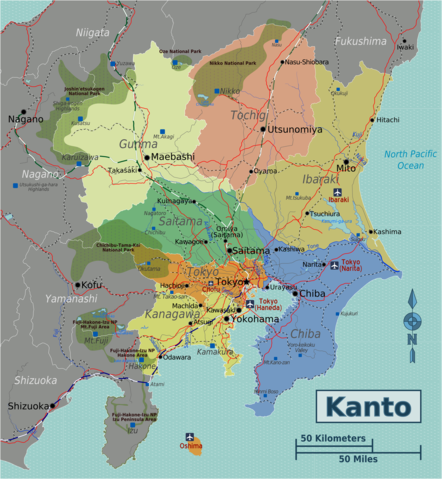
Maps of the Tohoku (left) and Kanto (right) regions, in eastern Honshu.
Tohoku map: By T.Kambayashi [CC BY-SA 3.0 ], via Wikimedia Commons
Kanto map: By T.Kambayashi [CC BY-SA 3.0 ], via Wikimedia Commons
Name Area(s) Period Price Reserved Seats Shinkansen
Tokyo Wide Pass Kanto 3 days ¥10,180 Yes Tohoku1, Joetsu2,
Hokuriku3
Tohoku Area Pass Kanto, Tohoku 5/14 days ¥19,350/
20,360*
Yes Tohoku, Yamagata,
Akita, Joetsu2, Hokuriku3
Nagano-Niigata Area Pass Kanto, Joetsu 5/14 days ¥17,310/
18,330*
Yes Tohoku1, Joetsu, Hokuriku4
East-South Hokkaido Pass Kanto, Tohoku,
Southern Hokkaido
6/14 days ¥26,900/
27,930*
Yes Tohoku, Yamagata, Akita,
Hokkaido, Joetsu2, Hokuriku3
Tohoku-South Hokkaido Pass Tohoku,
Southern Hokkaido
5/14 days ¥19,750/
20,790*
Yes Tohoku5, Yamagata,
Akita, Hokkaido
*Prices for pre-ordering the given pass outside of Japan vs. purchasing within Japan.
1Tohoku Shinkansen covered between Tokyo and Nasu-Shiobara stations.
2Joetsu Shinkansen covered between Tokyo and Echigo-Yuzawa stations (or Gala-Yuzawa during ski seasons).
3Hokuriku Shinkansen covered between Tokyo and Sakudaira stations.
4Hokuriku Shinkansen covered between Tokyo and Joetsu-Myoko stations.
5Tohoku Shinkansen covered between Shin-Shirakawa and Shin-Aomori stations.

The Tokyo Wide Pass is wider in scope than the name may imply.  In fact, it covers the entire Kanto Plain region, making it ideal for various day-trips from Tokyo.  (Fittingly, it was previously known as the Kanto Area Pass.)  It covers all JR lines in the region, including segments of the Tohoku, Joetsu, and Hokuriku Shinkansen lines.  It also covers a fair number of non-JR lines, including the Tokyo Monorail, Rinkai Line, Fujikyu Railway, Izukyu Railway, and JR/Tobu's limited express trains to Nikko and Kinugawa Onsen from Shinjuku (but not Tobu's station in Asakusa).  However, it is not valid on the Tokaido Shinkansen, which is owned by JR Central.  Furthermore, in order to use Hayabusa and Komachi services on the Tohoku Shinkansen, the limited express fees must be paid out-of-pocket.  (Not that it would do you much good anyway; those services only make the first three stops within the valid area.)  For its price, the Tokyo Wide Pass is not suitable just for transit in the immediate vicinity of Tokyo, but is a good value for various day-trips from Tokyo, especially those using one of the Shinkansen lines.

The Tohoku, and Nagano-Niigata area passes both cover the Kanto area in addition to other regions.  Unlike the Tokyo Wide Pass, they are valid for any 5 within a 14-day period, which starts when the pass is received by the user.  However, the Tohoku Area Pass is not valid on the Hokkaido Shinkansen, which is owned by JR Hokkaido.  Likewise, the Nagano-Niigata Area Pass is only valid on the Hokuriku Shinkansen up to Joetsu-Myoko; JR West owns the line from the west of that point.  These passes do not cover all of the non-JR lines as the Tokyo Wide Pass, but do cover a couple of non-JR lines in their respective regions, mainly those that connect to airports or isolated JR lines.  The Nagano-Niigata version pays off for a round-trip journey on the full covered length of the Joetsu or Hokuriku Shinkansen (normally ¥18,000-20,000 from Tokyo to Niigata or Joetsu-Myoko), and the Tohoku version is an even better for a round-trip journey on the Tohoku Shinkansen (¥35,000 from Tokyo to Shin-Aomori).

The South Hokkaido Pass covers the same areas as the Tohoku Area Pass in addition to the Hakodate and Sapporo areas on Hokkaido, including the Hokkaido Shinkansen.  It is also valid for an additional day within the same 14-day period.  Since a full round-trip ride on the Tohoku and Hokkaido Shinkansen from Tokyo costs over ¥44,000, this pass can be of terrific value for an excursion to Hokkaido.  While it is nearly as expensive as a 7-day Japan Rail Pass, the flexible 14-day period may be an advantage depending on your itinerary.

Edit 11 Sep 2018: On 5 January 2018, JR East and JR Hokkaido launched another pass together, the Tohoku-South Hokkaido Area Pass.  It is similar to the East-South Hokkaido pass, with the notable exception that it does not cover the Kanto region; its coverage starts northward from Fukushima prefecture.  As such, it is cheaper than the East-South Hokkaido pass, but includes one fewer day of flexible coverage (5 days out of 14, as opposed to 6).  If you're coming into the region by rail from Tokyo, it may not be the best bet, but if you're flying directly into the region via Sendai, Chitose, or other airports, this could save money over other passes.

More information:
Tokyo Wide Pass: (English)
JR East Pass (Tohoku Area): (English)
JR East Pass (Nagano/Niigata Area): (English)
East-South Hokkaido Pass: (English)
Tohoku-South Hokkaido Pass: (English)

JR Central
A map of the Chubu region, including the Hokuriku area in the northwest.
By Kambayashi [CC BY-SA 3.0 ], from Wikimedia Commons
Name Area(s) Period Price Reserved Seats Shinkansen
Mt. Fuji-Shizuoka Area
Tourist Pass Mini
Tokaido, Mt. Fuji 3 days ¥4,570/
5,080*
No None
Takayama-Hokuriku Area
Tourist Pass 
Chubu, Hokuriku 5 days ¥14,260/
15,280*
Yes (4 times)1 Hokuriku2
Alpine-Takayama-Matsumoto
Area Pass
Chubu 5 days ¥17,830/
18,850*
Yes (4 times) None
Ise-Kumano-Wakayama
Area Pass
Ise Peninsula 5 days ¥11,210/
12,220*
Yes (4 times)1 None
*Prices for pre-ordering the given pass outside of Japan vs. purchasing within Japan.
1Not valid for reserved seats on the Haruka limited express.
2Hokuriku Shinkansen covered between Toyama and Kanazawa stations.

The Mt. Fuji-Shizuoka Area Tourist Pass Mini covers regular trains and various buses around Mount Fuji, the Izu Peninsula, and Shizuoka Prefecture.  It does not cover the Tokaido Shinkansen, despite passing through the area.  It also does not cover transportation from any major cities, such as Tokyo or Nagoya.  So, you'll get the best value from it if you stay in the area for a few nights and visit two or all of the three areas mentioned above.

The Takayama-Hokuriku Area Tourist Pass covers trains from Nagoya to Toyama, Kanazawa to Osaka, and a brief section of the Hokuriku Shinkansen between Toyama and Kanazawa.  It also covers certain buses to Shirakawa-go, famous for its heritage farming villages.  However, it is not valid on the Tokaido Shinkansen.  It can make up its value with a full round-trip on the Wide View Hida (Nagoya-Toyama) and/or Thunderbird (Osaka-Kanazawa) limited express (each costing over ¥14,000 round-trip), so if used wisely, can be a good choice for an excursion into the region from Nagoya or Osaka

The Alpine-Takayama-Matsumoto Area Tourist Pass covers conventional trains in a loop between Nagoya, Matsumoto, Shinano-Omachi, Toyama, and Takayama.  This includes unlimited travel along the Tateyama Kurobe Alpine Route, a series of trams, buses, and cable-cars that cut through a section of the Japan Alps.  Famous sights along the Alpine Route include the Kurobe Dam and the Yuki-no-Otani, a canyon of snow which towers over part of the road from April to June.  The pass is very specific in the lines it is valid for, but it is still a great value for a round trip from Nagoya to the Alpine Route.

The Ise-Kumano-Wakayama Area Tourist Pass covers trains on a loop around the Kii Peninsula, including Nagoya and Osaka.  It also covers a few buses which can be used to reach inland areas.  However, it is not valid on the Tokaido Shinkansen (noticing a pattern here?).  Still, a round-trip ride to the southern end of the peninsula via the Wide View Nanki (from Nagoya) or Kuroshio (from Kyoto/Osaka) limited express can cost up to ¥15,000 or more, so this pass can be a great value if you go down far enough.

More information:
Mt. Fuji-Shizuoka Area Tourist Pass Mini: (English)
Takayama-Hokuriku Area Tourist Pass: (English)
Alpine-Takayama-Matsumoto Area Tourist Pass: (English)
Ise-Kumano-Wakayama Area Tourist Pass: (English)

JR West (Kansai/Hokuriku Regions)
A map of the Kansai region in central Honshu.
By T.Kambayashi (Image:Japan Kansai Map.svg) [CC BY-SA 3.0 ], via Wikimedia Commons
Name Area(s) Period Price Reserved Seats Shinkansen
Kansai Area Pass Kansai 1 day ¥2,300/
2,400*
No None
2 days ¥4,600/
4,800*
3 days ¥5,600/
5,800*
4 days ¥6,600/
6,800*
Kansai Wide Area Pass Kansai, Okayama 5 days ¥9,200/
10,200*
No Sanyo1
Hokuriku Area Pass Hokuriku 4 days ¥5,090/
5,600*
No Hokuriku2
Kansai Hokuriku Area Pass Kansai, Hokuriku 7 days ¥15,270/
16,290*
No Sanyo1, Hokuriku3
Hokuriku Arch Pass Tokyo, Hokuriku, Kansai 7 days ¥24,440/
25,460*
Yes4 Hokuriku
*Prices for pre-ordering the given pass outside of Japan vs. purchasing within Japan.
1Sanyo Shinkansen covered between Shin-Osaka and Okayama stations.
2Hokuriku Shinkansen covered between Kurobe-Unazuki-Onsen and Kanazawa stations.
3Hokuriku Shinkansen covered between Joetsu-Myoko and Kanazawa stations.
4Not valid for reserved seats on the Haruka limited express.

The Kansai Area Pass covers local and rapid JR trains in the Kansai area, covering Kyoto, Osaka, Nara, Kobe, et al., along with non-reserved seats on the Haruka limited express to/from Kansai International Airport.  However, it is not valid for the Shinkansen or any other limited express services.  It does not pay off just for transit within or between the main cities listed above, but is better for side trips to some of its more outlying areas, such as Himeji, Iga, or Hikone.  Starting from 1 October 2019, the Kansai Area Pass also includes 1-day passes for the Kyoto Subway lines and part of the Keihan network, hence the increased price.

The Kansai Wide Area Pass, on the other hand, not only covers a wider area than the Kansai Area Pass, but is valid on limited express trains and even the Sanyo Shinkansen (between Shin-Osaka and Okayama stations).  Unlike the JR Pass, it can be used on Nozomi and Mizuho express services.  However, it is not valid on the Tokaido Shinkansen to Kyoto, as it is owned by JR Central.  Additional areas covered include Okayama, Kinosaki Onsen, and the western Kii Peninsula.

The Hokuriku Area Pass covers the Hokuriku area along the Sea of Japan coast, including limited express trains and part of the Hokuriku Shinkansen.  However, since the Kayagaki express service does not have any non-reserved seating, it is not fully covered by the pass.  Similar to the Mt. Fuji-Shizuoka pass described above, the Hokuriku pass does not cover the urban Kansai area, so it's on your dime to get there.  If you are coming in from the Kansai area, you might be better off with the Kansai Hokuriku Area Pass, which is essentially a hybrid of the Kansai Wide and Hokuriku passes, and covers sections of the Sanyo and Hokuriku Shinkansen.

The Hokuriku Arch Pass combines coverage on the full length of the Hokuriku Shinkansen, limited-express trains between the Hokuriku and Kansai regions, access to Narita, Haneda, and Kansai airports, and more.  (The Tokaido and Sanyo Shinkansen are not covered.)  Going between Tokyo and Osaka this way takes 5-6 hours via the Hokuriku Shinkansen and Thunderbird limited express (and a normal round-trip fare of over ¥43,000!).  This is about twice as long as the Tokaido Shinkansen, but the Arch Pass is a few thousand yen cheaper than the JR Pass, and allows for stopovers at many interesting locations in the relatively-less-travelled Hokuriku area.

More information:
Kansai Area Pass: (English)
Kansai Wide Area Pass: (English)
Hokuriku Area Pass: (English)
Kansai-Hokuriku Area Pass: (English)
Hokuriku Arch Pass: (English)

JR West (Chugoku Region)
The Chugoku region, on the western end of Honshu.
By Marc Heiden [CC BY-SA 4.0 ], via Wikimedia Commons
Name Area(s) Period Price Reserved Seats Shinkansen
Kansai-Hiroshima Area Pass Kansai, Sanyo 5 days ¥13,700/
14,700*
No Sanyo1
Sanyo-San'in Area Pass Kansai, Sanyo,
San'in
7 days ¥19,400/
20,400*
Yes Sanyo
San'in-Okayama Area Pass Okayama, San'in 4 days ¥4,580/
5,390*
No None
Hiroshima-Yamaguchi Area Pass Western Sanyo 5 days ¥11,200/
12,200*
No Sanyo2
Okayama-Hiroshima-Yamaguchi Area Pass Central/Western Sanyo 5 days ¥13,700/
12,200*
No Sanyo3
Setouchi Area Pass Kansai, Sanyo,
Northern Shikoku
5 days ¥17,310/
18,330*
No Sanyo
Sanyo-San'in Northern Kyushu Pass Kansai, Sanyo,
San'in, Northern Kyushu
7 days ¥22,400/
23,420*
No Sanyo, Kyushu4
*Prices for pre-ordering the given pass outside of Japan vs. purchasing within Japan.
1Sanyo Shinkansen covered between Shin-Osaka and Hiroshima stations.
2Sanyo Shinkansen covered between Hiroshima and Hakata stations.
3Sanyo Shinkansen covered between Okayama and Hakata stations.
4Kyushu Shinkansen covered between Hakata and Kumamoto stations.

JR West also owns train lines in the Chugoku region, on the western end of Honshu.  Their passes for the area are self-explanatory, and most of them cover the Sanyo Shinkansen in part or in whole, including Nozomi and Mizuho services (but not the Tokaido Shinkansen to Kyoto).  In addition, the Sanyo-San'in and San'in-Okayama passes fully cover the Chizu Express, a third-sector line not covered by the Japan Rail Pass, that provides some of the fastest access to Tottori in the San'in region.  Some JR-run limited express services use this line, but the JR Pass would require a fee for the non-JR section.

The Setouchi Area Pass covers trains in the area surrounding the Seto Inland Sea, namely the Kansai, Sanyo, and northern Shikoku regions.  Coverage includes the entire length of the Sanyo Shinkansen, plus a few buses and ferries between the islands of Honshu and Shikoku.

Edit 3 July 2017: JR West has just launched a new area pass, the Sanyo-San'in Northern Kyushu Pass.  As per the name, this covers JR trains in the Kansai and Chugoku regions, plus the northern half of Kyushu, including the entire length of the Sanyo Shinkansen, and the Kyushu Shinkansen as far as Kumamoto.  It also covers the Chizu Express to Tottori, and local JR buses in Kyoto, Hiroshima, and Yamaguchi.

More information:
Kansai-Hiroshima Area Pass: (English)
Sanyo-San'in Area Pass: (English)
San'in-Okayama Area Pass: (English)
Hiroshima-Yamaguchi Area Pass: (English)
Okayama-Hiroshima-Yamaguchi Area Pass: (English)
Setouchi Area Pass: (English)
Sanyo-San'in Northern Kyushu Pass: (English)

JR Shikoku
A map of the islands of Shikoku.
By Marc Heiden [CC BY-SA 4.0 ], via Wikimedia Commons
Name Area(s) Period Price Reserved Seats Shinkansen
All Shikoku Rail Pass Kansai, Sanyo 3 days ¥9,000/
9,500*
Yes None
4 days ¥10,000/
10,500*
5 days ¥11,000/
11,500*
7 days ¥13,000/
13,500*
Shikoku Free Pass Shikoku 3 days ¥16,440 Yes None
*Prices for pre-ordering the given pass outside of Japan vs. purchasing within Japan.

Both the All Shikoku Rail Pass and the Shikoku Free Pass cover JR lines on the island of Shikoku.  The All Shikoku Rail Pass is sold in periods of 3, 4, 5, or 7 consecutive days.  It is also valid on multiple non-JR lines on Shikoku, including the Kotoden lines around Takamatsu, and the Iyotetsu lines around Matsuyama.

The Shikoku Free Pass is far more expensive, and is not valid on almost all non-JR lines, but is available for sale to Japanese citizens as well as foreign visitors.  Also, on the month of your birthday, you can buy the Birthday Kippu pass, which is the same as the Shikoku Free Pass, but costs only ¥10,280!  Still, if you're coming in from outside of the country, you're better off sticking to the All Shikoku Rail Pass.

More information:
All Shikoku Rail Pass: (English)
Shikoku Free Pass: (Japanese)

JR Kyushu
A map of the islands of Kyushu.
By T.kambayashi (Image:Japan Kyushu Map.svg) [CC BY-SA 3.0 ], via Wikimedia Commons
Name Area(s) Period Price Reserved Seats Shinkansen
All Kyushu Area Pass Kyushu 3 days ¥15,280 Yes (10 times) Kyushu
5 days ¥18,330 Yes (16 times)
Northern Kyushu Area Pass Northern Kyushu 3 days ¥8,660 Yes (10 times) Kyushu1
5 days ¥10,190 Yes (16 times)
Southern Kyushu Area Pass Southern Kyushu 3 days ¥7,500 Yes (10 times) Kyushu2
Fukuoka Wide Pass Fukuoka Prefecture 2 days ¥3,060 No None
1Kyushu Shinkansen covered between Hakata and Kumamoto stations.
2Kyushu Shinkansen covered between Kumamoto and Kagoshima-Chuo stations.

The All Kyushu Area Pass covers all JR lines on the island of Kyushu, including the Kyushu Shinkansen.  It is also valid on the Shinkansen's Mizuho express services, unlike the JR Pass.  Pass users can make free seat reservations up to 10 (for 3-day passes) or 16 (for 5-day passes) times.  The pass does not cover the Sanyo Shinkansen, which runs through the Fukuoka and Kitakyushu areas, as it is owned by JR West.

JR Kyushu also sells varieties of the pass specific to the northern and southern halves of the island, with the dividing line roughly drawn from Kumamoto in the west to Oita in the east.  If you wish to explore Kyushu using one of these passes, be sure to review your itinerary so you can buy the pass that's best for you.  Come to think of it, that's sound advice to heed for all of the other passes I've described in this article!

Edit 11 Sep 2018: on 1 September 2018, JR Kyushu introduced a Fukuoka Wide version of the Kyushu Rail Pass, which covers conventional JR lines in Fukuoka prefecture, including the cities of Fukuoka and Kitakyushu.  This also includes non-reserved seats on limited express trains within the covered area.  It does not cover seat reservations, any seats on the Sanyo or Kyushu Shinkansen, or other networks like Nishitetsu or the Fukuoka subway.

More information:
Kyushu Rail Pass: (English)
Fukuoka Wide Pass: (English)

Tuesday, February 28, 2017

Know Your Trains: Joetsu Shinkansen

Update 12 August 2018: Updated with new map.

A double-decker E4-series "MAX Tanigawa" train at Tokyo Station.
By Rebirth10 [CC BY-SA 4.0 ], from Wikimedia Commons
The Joetsu Shinkansen (上越新幹線, Jōetsu Shinkansen) is a high-speed rail line travelling from Tokyo to Niigata, on the coast of the Sea of Japan.  It runs through the mountainous north-central region of Japan, known as Joetsu (上越, Jōetsu), providing access to many ski and hot-springs resorts along the way.  It opened in 1982, several months after the debut of the Tohoku Shinkansen.  The maximum speed limit of trains on this line is 240 kilometres per hour, or 150 miles per hour.

A map of the Joetsu Shinkansen and its stops.

Times

Four services run on the Joetsu Shinkansen.  The "Toki" runs the full length of the line from Tokyo to Niigata, whereas the "Tanigawa" terminates mid-way at Echigo-Yuzawa.  Finally, the "MAX Toki" and "MAX Tanigawa" have identical stopping patterns as their regular counterparts, but use double-decker train cars.  (The name MAX stands for "Multi-Amenity Express".)  All Joetsu Shinkansen services are labelled in red on signboards.  Tanigawa and MAX Tanigawa mostly depart during the morning and evening commuter periods.

Name Start Station End Station(s) Time** Max. Frequency***
Toki Tokyo Niigata 2 hours 10 minutes 1 per 2 hours
MAX Toki 1-2 per hour
Tanigawa Tokyo Echigo-Yuzawa
Gala-Yuzawa*
90 minutes 1 per 2 hours
MAX Tanigawa 1-2 per hour
* Trains stop at Gala-Yuzawa during the winter ski season only.
** Approximate time between Tokyo and designated end station.
*** Departure frequency (per direction) is based on February 2017 schedules and are subject to change.

Stops

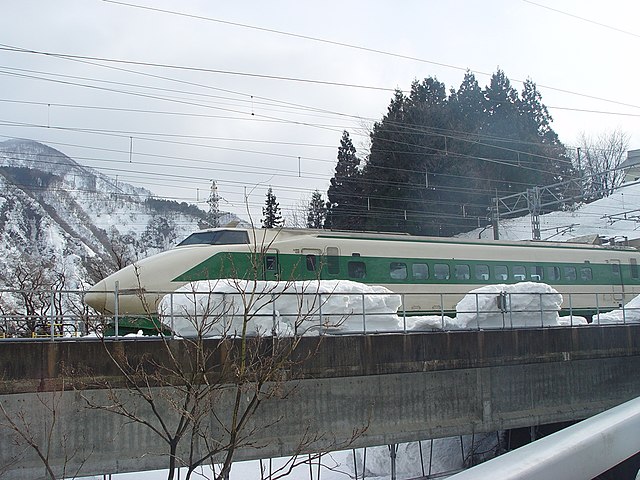
A 200-series train (taken out of service in 2013) on the Gala-Yuzawa branch line.
© DAJF / Wikimedia Commons
During the winter ski season, which usually falls between December and April, Tanigawa trains continue from Echigo-Yuzawa onto a short branch line to Gala-Yuzawa station, which is directly adjacent to the ski resort of the same name.  The Gala-Yuzawa Line, as this branch is called, is only 1.8 km (1.1 mi) long, only takes 3 minutes to traverse, and as such isn't nearly as fast as the main Joetsu line, but with tickets at only ¥240 (including limited express fees), it is one of the cheapest ways to experience the Shinkansen, however briefly.

Name (English) Name (Japanese) Prefecture Toki Tanigawa
Tokyo 東京 Tokyo X X
Ueno 上野 X X
Omiya 大宮 Saitama X X
Kumagaya 熊谷 O X
Honjo-Waseda 本庄早稲田 O X
Takasaki 高崎 Gunma X X
Jomo-Kogen 上毛高原 O X
Echigo-Yuzawa 越後湯沢 Niigata X X
Gala-Yuzawa ガーラ湯沢 I O
Urasa 浦佐 O I
Nagaoka 長岡 X I
Tsubame-Sanjo 燕三条 X I
Niigata 新潟 X I
Legend:
X: All trains stop at this station.
O: Some trains stop at this station.
I: No trains stop at this station.

Notable stops
  • Tokyo/Ueno: The largest city in Japan and the world.
  • Omiya: The capital city of Saitama Prefecture, and home to a popular railway museum.
  • Takasaki: Where the Hokuriku Shinkansen branches off.
  • Jomo-Kogen: Access to the hot springs of Minakami Onsen.
  • Echigo Yuzawa: Access to many ski resorts, including...
  • Gala-Yuzawa: Part of the eponymous ski resort.
  • Niigata: A port city on the Sea of Japan coast.
Seating
    On double-decker E4 trains, the upper floors of non-reserved cars may use non-reclining bench seats.
    © DAJF / Wikimedia Commons
    MAX Toki/Tanigawa services use sets of double-decker cars. The upper floors of non-reserved cars are made up of 3+3-layout bench seats. While they feature the same generous seat pitch of 97 cm (41 in), they are narrower due to the more packed layout, do not feature armrests between seats, and do not recline. Still, they're not much different from seating on regular trains. Between 2018 and 2021, E7-series trainsets from the Hokuriku Shinkansen will be introduced into service on the Joetsu line.  More information: (Japanese)

    Service Total Cars Non-Reserved Cars Reserved Cars Green Cars
    Toki 10 4-6 (Cars #1-6) 3-5 (Cars #4-8, 10) 1 (Car #9)
    MAX Toki 8x2 4x2 (Cars #1-4) 3x2
    (Cars #5-8)
    1x2
    (Cars #7-8)
    Tanigawa 10 9 (Cars #1-8, 10) 0 1 (Car #9)
    MAX Tanigawa 8x2 5x2 (Cars #1-5) 2x2
    (Cars #6-8)
    1x2
    (Cars #7-8)
    Tips
    • Unlike on the Tokaido, Sanyo, and Kyushu lines, the Japan Rail Pass is valid for ALL services on the Joetsu Shinkansen.  In addition, the JR East Nagano-Niigata Area Pass (English) covers the full line from Tokyo to Niigata, and the JR East Tokyo Wide Pass (English) covers the segment from Tokyo to Echigo-Yuzawa (plus Gala-Yuzawa Station when available).
    • If departing from, or arriving at, Tokyo, you may want to consider using Ueno Station instead of the eponymous Tokyo Station.  Ueno serves some of the same JR lines as Tokyo  (JR Yamanote (JY), Keihin-Tohoku (JK), Takasaki/Utsunomiya (JU), Joban (JO)), but also serves the Tokyo Metro Ginza (G) and Hibiya (H) lines, and is somewhat smaller and more manageable.  The adjacent Keisei-Ueno Station also provides faster access to Narita Airport, via the Skyliner limited express.
    Trivia
    • The Joetsu region (上越), which the Joetsu Shinkansen is named after, encompasses the old provinces of Kozuke (上野国, Kōzuke no kuni) and Echigo (越後国, Echigo no kuni), which correspond to the modern-day Gunma and Niigata prefectures.
    • The name "Toki" (とき) refers to the crested ibis, a endangered species of bird that is famous in Niigata Prefecture.  It was previously used for a limited express service, running between Ueno and Niigata.  It operated from 1962 to 1982, when the Joetsu Shinkansen opened.  As a Shinkansen service, the Toki name was abandoned when the Tanigawa was introduced in 1997, but subsequently restored when the Asahi (below) was cancelled.
    • The name "Tanigawa" (たにがわ) refers to Mount Tanigawa (谷川岳, Tanigawa-dake), a 1,977-metre (6,486-foot) volcano found along the line, near Minakami.  It was previously used for a limited express service, running between Ueno and Minakami in Gunma Prefecture.  It operated from 1982 to 1997, when it was replaced by the Shinkansen service of the same name.
    • There used to be another service on the Joetsu Shinkansen.  The "Asahi" (あさひ, lit. 'morning sun') and "MAX Asahi" were full-stop services from Tokyo to Niigata.  It began with the opening of the line in 1982, but were discontinued in 2002, effectively replaced by Tanigawa services.
    • The line was originally going to start from Tokyo at Shinjuku Station, but to save on construction costs, existing Tohoku Shinkansen tracks were used between Tokyo and Omiya stations.
    • On 23 October 2004, a Joetsu Shinkansen train bound for Niigata was derailed by the 2004 Chuetsu Earthquake.  This marked the first derailment in the Shinkansen's history.  Luckily, of the 155 passengers, nobody on board was injured or killed.

    The livery of the Genbi Shinkansen train is decorated in nature photographs by Mika Ninagawa.
    Fancy Free [CC BY-SA 2.5 ], via Wikimedia Commons
    But that's not all!  Since 29 April 2016, JR East has also been running a special train on the Joetsu Shinkansen line, called the Genbi Shinkansen (現美新幹線).  It boasts stylish interiors designed by contemporary artists and photographers, and as such has been described as "the world's fastest art exhibition".  One of the cars also includes a children's play area, and a cafe serving locally-made drinks and sweets.  The Genbi Shinkansen runs three times a day in each direction on weekends, making every stop between Echigo-Yuzawa and Niigata.  Unlike regular Toki or Tanigawa services, it does not directly depart from or terminate at Tokyo.

    Station Toki 451
    for Niigata
    Station Toki 452
    for Echigo-Yuzawa
    Echigo-Yuzawa 8:24 AM Niigata 11:26 AM
    Urasa 8:37 AM Tsubame-Sanjo 11:39 AM
    Nagaoka 8:49 AM (Arrive) Nagaoka 11:49 AM (Arrive)
    8:50 AM (Depart) 11:54 AM (Depart)
    Tsubame-Sanjo 9:01 AM Urasa 12:08 PM
    Niigata 9:14 AM Echigo-Yuzawa 12:20 PM
    Station Toki 453
    for Niigata
    Station Toki 454
    for Echigo-Yuzawa
    Echigo-Yuzawa 12:44 PM Niigata 2:02 PM
    Urasa 12:57 PM Tsubame-Sanjo 2:15 PM
    Nagaoka 1:09 PM (Arrive) Nagaoka 2:25 PM (Arrive)
    1:14 PM (Depart) 2:26 PM (Depart)
    Tsubame-Sanjo 1:25 PM Urasa 2:44 PM
    Niigata 1:38 PM Echigo-Yuzawa 2:56 PM
    Station Toki 455
    for Niigata
    Station Toki 456
    for Echigo-Yuzawa
    Echigo-Yuzawa 3:20 PM Niigata 4:42 PM
    Urasa 3:33 PM Tsubame-Sanjo 4:56 PM
    Nagaoka 3:45 PM (Arrive) Nagaoka 5:06 PM (Arrive)
    3:50 PM (Depart) 5:07 PM (Depart)
    Tsubame-Sanjo 4:01 PM Urasa 5:20 PM
    Niigata 4:14 PM Echigo-Yuzawa 5:32 PM

    Service Total Cars Non-Reserved Cars Reserved Cars Cafe
    Genbi Shinkansen 6 4 (Cars #12, 14-16) 1 (Car #11) 1 (Car #13)

    The interior of one of the Genbi Shinkansen's gallery cars.
    くるみ1211 (Kurumi 1211) [CC BY-SA 4.0], via Wikimedia Commons
    For more information on the Genbi Shinkansen, visit the following links: (English) (Japanese)

    Monday, February 27, 2017

    Ameya Yokocho Walk

    This article is based on visits made on Friday, 4 April 2014 and Sunday, 13 November 2016.

    Ameya Yokocho (アメヤ横丁, Ameya-yokochō, lit. 'Ameya alley'), or "Ameyoko" (アメ横) for short, is a market alley which runs beneath the train tracks in northeastern Tokyo.  Specifically, it spans roughly 400 metres (1,300 feet) between Ueno Station at the north end and Okachimachi Station at the south.

    So, how did this place get its name?  Well, there are two theories, and both have to do with the role it played in Tokyo's post-World War II economy.  The first is that it was named after the many candy shops, or ame-ya (飴屋), which flourished in a time when sugar was hard to come by.  The other claims it was named after America, spelled in Japanese as Amerika (アメリカ), since the sale of US Army surplus goods and other American products also rose back then.  Based on the banner signs (above), only the northern half of the street is called "Ameya Yokocho" and the southern half is "Ameyoko", so both stories could be plausible.

    A branch of the electronics department store Yodobashi Camera stands at the north end of Ameyoko.  Lined up along the other side of the building was a massive row of Gashapon machines.  For those who have no idea what "Gashapon" (ガシャポン) or "Gachapon" (ガチャポン) is, it's a kind of vending machine which dispenses small toys encased in plastic capsules.

    Due to its placement under the train tracks, Ameyoko is one of the few places in Tokyo which re-creates the hustle and bustle of other Asian cities.  But not when I visited, apparently...  The opening hours for the many businesses varies, but they tend to open between 10 and 11 AM, and close around 8 PM.

    ...That's more like it!  As this picture can attest to, however, pedestrians may share the road with (slow-moving) automotive traffic, so some alertness would not go amiss.

    The array of businesses set up in Ameyoko is vast, from grocery stores and other food markets like this fishmonger...

    ...to clothing and accessory shops, such as this luggage store where (on the upper-right corner) I spotted a few Beatles-themed suitcases!

    There's even a place that sells military-themed clothes and goods, based on uniforms from many different countries.  It's called Nakata Shoten, if you'd like to look it up (Japanese)

    Mid-way down, the path diverges into two.  Ameyoko proper continues to the left; to the right is a separate street called Ue-chu (上中, Uechū, lit. 'central Ueno'), which is a touch more upscale.  Don't worry if you end up taking it instead; it runs roughly parallel to Ameyoko, and they both end not far from each other.

    A close-up of the kappa statue at the centre of this junction.  The video monitor up above makes this place almost feel like a miniature Times Square (emphasis on miniature).

    And this is what you would find if you were to turn onto Ue-chu.

    Meanwhile, Ameyoko has many side-alleys intersect and branch off from it.

    This mural looms above the southern end of Ameyoko, depicting a surreal take on the area's usual market scene.  ...Say, is that Weird Al Yankovic in the middle there?

    And finally, we reach the southern end.  Not a bad walk for hopping between two stations on the Yamanote line!


    Access: To enter Ameya Yokocho via the northern end, the nearest station is Ueno (JR Yamanote (JY), Keihin-Tohoku (JK), Takasaki/Utsunomiya (JU), Joban (JJ), Tokyo Metro Ginza (G) and Hibiya (H) lines) station.  From Tokyo Station, take the Yamanote or Keihin-Tohoku line to Ueno (JY05/JK30, 8 minutes, ¥160, JR Pass OK).  The entrance to Ameya Yokocho is across the street from the Shinobazu exit.

    To enter via the southern end, use one of the following stations, all bunched close together.  Okachimachi (JR Yamanote and Keihin-Tohoku lines) is the closest, followed by the Ueno-Hirokoji (Tokyo Metro Ginza line), Ueno-Okachimachi (Toei Oedo (E) line), and Naka-Okachimachi (Tokyo Metro Hibiya line) subway stations.  From Tokyo Station, take the Yamanote or Keihin-Tohoku line to Ueno (JY04/JK29, 8 minutes, ¥160, JR Pass OK).  From JR's Okachimachi station, use the North exit.

    Thursday, February 23, 2017

    Know Your Trains: Yamagata and Akita Shinkansen

    Update 11 August 2018: Updated with new maps.

    A red E6-series train (front) coupled with a green E5-series (rear).
    By Sukhoi37 [CC BY-SA 3.0 ], from Wikimedia Commons
    As you know, the Tohoku Shinkansen is a high-speed line travelling north along the north-eastern half of Honshu, also known as Tohoku.  After it was completed, two branch lines were developed that connect to stations on the Tohoku Shinkansen.  These are colloquially called "Mini-Shinkansen", for instead of using newly-built lines, they consist of former narrow-gauge lines that were converted to the standard gauge used by Shinkansen trains.

    Mini-Shinkansen services consist of two trains coupled together.  Both trains are capable of running at full speeds along the Tohoku line, up to 320 km/h (200 mph).  At a certain point, one continues along the Tohoku line, whereas the other diverges onto the branch line.  The latter train is narrower, and as such all seating is arranged 2+2 across.  Unlike the purpose-built main lines, these branch lines are shared by conventional trains, and as such, Shinkansen services run more slowly along them, the maximum speed being 130 km/h (80 mph).

    The first of these lines is the Yamagata Shinkansen (山形新幹線).  It was opened in 1992 between the cities of Fukushima and Yamagata, and was later extended to Shinjo in 1999.  Trains serving the Yamagata Shinkansen are called "Tsubasa", and are coupled with a Yamabiko service between Tokyo and Fukushima.  Travel time is 3 hours and 40 minutes from Tokyo to Shinjo, or 2 hours from Fukushima to Shinjo.  Tsubasa trains depart once per hour, with every other service making the full trip to Shinjo, and the other half terminating at Yamagata.  Tsubasa services are labelled in gold on signboards.

    Name (English) Name (Japanese) Prefecture Yamabiko Tsubasa
    Tokyo 東京 Tokyo X X
    Ueno 上野 O O
    Omiya 大宮 Saitama X X
    Utsunomiya 宇都宮 Tochigi O O
    Koriyama 郡山 Fukushima O O
    Fukushima 福島 X X
    Yonezawa 米沢 Yamagata To Morioka X
    Takahata 高畠 O
    Akayu 赤湯 O
    Kaminoyama-Onsen かみのやま温泉 O
    Yamagata 山形 X
    Tendo 天童 O
    Sakurambo-Higashine さくらんぼ東根 O
    Murayama 村山 O
    Oishida 大石田 O
    Shinjo 新庄 O
    Legend
    X: All trains stop at this station.
    O: Some trains stop at this station.
    I: No trains stop at this station.

    Notable stops
    • Fukushima: The capital city of Fukushima Prefecture, and the point where the Tohoku Shinkansen branches off.
    • Kaminoyama-Onsen: Hot springs and fruit farms at the base of Mt. Zao.
    • Yamagata: The capital of the eponymous prefecture.
    • Oishida: The closest station to Ginzan Onsen.
    An E3-series "Tsubasa" train, approaching Kita-Yamagata Station.
    ttzshirasawa [CC BY 3.0], via Wikimedia Commons
    Seat class arrangements for Tsubasa services, and their corresponding Yamabiko trains, are as follows.

    Service Total Cars Non-Reserved Cars Reserved Cars Green Cars GranClass Cars
    Yamabiko 10 4-6
    (Cars #4-3/6)
    3-5
    (Cars #5/7-8, 10)
    1
    (Car #9)
    0
    Tsubasa 7 2
    (Cars #16-17)
    4
    (Cars #12-15)
    1
    (Car #11)
    0

    The Toreiyu Tsubasa, a special-edition E3-series train.
    By ttzshirasawa [CC BY 3.0 ], via Wikimedia Commons
    But that's not all!  Since July 2014, JR East has also been running a special service on the Yamagata Shinkansen line, called the Toreiyu (とれいゆ).  Named after the English word "train" and the French "soleil" (rendered in Japanese as "torein" and "soreiyu"), the Toreiyu features tatami-style seating, a lounge/bar area serving sake, wine, and other drinks made locally in Yamagata Prefecture, and even a footbath!  The Toreiyu runs between Fukushima and Shinjo stations, once in each direction on weekends.  Unlike regular Tsubasa services, it does not directly depart from or terminate at Tokyo.

    Station Toreiyu 1
    for Shinjo
    Station Toreiyu 2
    for Fukushima
    Fukushima 10:02 AM Shinjo 3:00 PM
    Yonezawa 10:36 AM Oishida 3:16 PM
    Takahata 10:44 AM Murayama 3:28 PM
    Akayu 10:50 AM Sakurambo-Higashine 3:34 PM
    Kaminoyama-Onsen 11:08 AM Tendo 3:40 PM
    Yamagata 11:26 AM Yamagata 4:13 PM
    Tendo 11:37 AM Kaminoyama-Onsen 4:23 PM
    Sakurambo-Higashine 11:45 AM Akayu 4:45 PM
    Murayama 11:50 AM Takahata 4:52 PM
    Oishida 12:00 PM Yonezawa 5:07 PM
    Shinjo 12:16 PM Fukushima 5:41 PM

    The footbaths in the last car of the Toreiyu Tsubasa.
    By Cheng-en Cheng (DSC_1711) [CC BY-SA 2.0 ], via Wikimedia Commons
    All seating on the Toreiyu is reserved.  The footbath is also reserved separately.  If you wish to use it, ask for a footbath ticket when reserving your seat, and if it's available, you will be assigned a 15-minute time period in which to use it.

    ServiceTotal CarsReserved Cars
    (Regular)
    Reserved Cars
    (Tatami)
    Lounge/BarFootbath
    Toreiyu
    Tsubasa
    61
    (Cars #11)
    3
    (Cars #12-14)
    1
    (Car #15)
    1
    (Car #16)

    For more information on the Toreiyu, visit its page on JR East's website (English) (Japanese).


    The second of the mini-Shinkansen lines is the Akita Shinkansen (秋田新幹線).  Opened in 1997, it diverges from Morioka to serve towns in Akita prefecture, terminating at the eponymous city.  Trains serving this line are called "Komachi", and are coupled with a Hayabusa service between Tokyo and Morioka.  Travel time is 4 hours and 45 minutes from Tokyo to Akita, or 90 minutes from Morioka to Akita, and trains depart in each direction once per hour.  Komachi services are labelled in pink on signboards.
    Name (English) Name (Japanese) Prefecture Hayabusa Komachi
    Tokyo 東京 Tokyo X X
    Ueno 上野 X X
    Omiya 大宮 Saitama X X
    Sendai 仙台 Miyagi X X
    Morioka 盛岡 Iwate X X
    Shizukuishi 雫石 To Shin-Aomori O
    Tazawako 田沢湖 Akita X
    Kakunodate 角館 X
    Omagari 大曲 X
    Akita 秋田 X
    Legend
    X: All trains stop at this station.
    O: Some trains stop at this station.
    I: No trains stop at this station.

    Notable stops
    • Morioka: The capital city of Iwate Prefecture, and the point where the Tohoku Shinkansen branches off.
    • Tazawako: A caldera lake with nearby onsen towns.
    • Kakunodate: A former samurai town with hundreds of weeping cherry blossom trees.
    • Akita: The capital of the prefecture, and host of the Akita festival in August.
    An E6-series train on the Akita Shinkansen line.
    By Cheng-en Cheng (DSC_3796) [CC BY-SA 2.0 ], via Wikimedia Commons
    As with the Hayabusa and Hayate, there is no non-reserved seating on Komachi services, so seat reservations are required with all tickets.  Seat class arrangements for Komachi services, and their corresponding Hayabusa trains, are as follows.

    Service Total Cars Non-Reserved Cars Reserved Cars Green Cars GranClass Cars
    Hayabusa 10 0 8 (Cars #1-8) 1
    (Car #9)
    1 (Car #10)
    Komachi 7 0 6
    (Cars #12-17)
    1
    (Car #11)
    0

    Trivia
    • In Japan, regular train lines are built to narrow-gauge standards (1,067 mm / 3 ft 6 in between rails), whereas the Shinkansen network uses standard gauge (1,435 mm / 4 ft 8½ in).  Regular trains on these lines were modified to use the standard instead of narrow gauge.
    • Both the Yamagata and Akita Shinkansen (between Omagari and Akita) share tracks with the Ou Main Line.  The rest of the Akita Shinkansen (between Morioka and Omagari) shares tracks with the Tazawako Line.
    • Komachi trains reverse direction at Omagari Station, due to the junction of the Ou Main Line and Tazawako Line at that station.
    • Mini-Shinkansen trains are narrower than regular Shinkansen trains due to the smaller loading gauge of regular trains on the same lines.  "Loading gauge" is the maximum height and width for train cars to fit in tunnels, under bridges, etc.
    • The slower speed limits on the mini-Shinkansen lines, at most 130 km/h (80 mph), are required due to the lines going through level crossings, which does not occur on main Shinkansen lines.
    • The name "Tsubasa" (つばさ) means "wing" in English.  It was previously used for a limited-express service between Ueno and Akita stations, from 1962 until 1992, when the Yamagata Shinkansen was opened.
    • The name "Komachi" (こまち) refers to Ono-no-Komachi (小野 小町), a 9th-century poet from modern-day Akita prefecture.  She was renowned as much for her poetry as for her beauty, and even today the name Komachi is a word used to describe a female beauty.

    Wednesday, February 22, 2017

    The Japan Rail Pass and How to Use It

    Edit 2 October 2019: Updated prices to reflect the increase in Japan's national sales tax.
    Edit 11 May 2020: Updated to reflect the updated Japan Rail Pass and the new online reservation website, both taking effect on 1 June 2020.

    A Green Car version of the Japan Rail Pass, issued in 2016.

    For overseas visitors looking to travel between multiple faraway destinations across Japan, the Japan Rail Pass is an ideal investment. It allows holders to ride local, express, and high-speed Shinkansen trains run by the Japan Railways (JR) Group without needing to buy tickets or use an IC debit card.

    Before reading any further, pay attention to the following requirement.  The Japan Rail Pass is only available for foreign residents coming to Japan on a "Temporary Visitor" visa.  Japanese nationals living outside of Japan, and/or married to a non-Japanese spouse, are also unable to purchase a JR Pass.

    The JR Pass is available for 7, 14, and 21 day periods.  These periods are measured in consecutive calendar days, measured from midnight to midnight.  It is also available in two versions: the regular pass allows free use of non-reserved and regular reserved seats, and the Green pass allows free use of upper-class Green Car seats on top of that. Official prices are quoted in Japanese yen, so actual prices in your local currency may vary among vendors.

    Length Price (Regular) Price (Green Car)
    7 days ¥29,650 ¥39,600
    14 days ¥47,250 ¥64,120
    21 days ¥60,450 ¥83,390

    As you can see, the JR Pass can be a hefty investment.  It is easily possible to save even more money by using it instead of paying for tickets directly, especially if you plan to use Shinkansen and/or limited express trains frequently, but you will need to do some research to determine whether or not the JR Pass is right for you.  If you're just staying within a certain city, the JR Pass would not be for you.  As a frame of reference, the 7-day pass costs roughly as much as a round-trip Shinkansen ride between Tokyo and Osaka, Kanazawa, or Morioka.

    The JR Pass is accepted on all Japan Railways (JR) Group lines, which accounts for about 70% of track mileage in Japan.  It does NOT cover trains run by non-JR companies, including city subway lines. There are a few exceptions which are covered by the JR Pass, however, generally to access isolated JR lines:
    • The Tokyo Monorail, for access to Haneda Airport.
    • The Aoimori Railway between Aomori, Noheji, and Hachinohe, for access to the JR Ominato line.
    • The Ishikawa Railway between Kanazawa and Tsubata, for access to the JR Nanao line.
    • The Echigo Tokimeki Railway between Toyama and Takaoka, for access to the JR Himi and Johana lines.
    Note: With the exception of the Tokyo Monorail, you cannot get off except at the stations listed above.

    The JR Pass is also not generally valid on non-train transportation, hence the name "Japan Rail Pass".  There are a few exceptions, however.
    • Buses: The JR Pass is valid on a few local buses run by the JR Group, such as the "Maple-oop" tourist loop bus in Hiroshima.  It is not valid on long-distance highway buses, even those run by the JR Group.
    • Ferries: The JR Pass is valid on the short ferry ride to Miyajima island near Hiroshima.  It is not valid on the ferry between Fukuoka and Busan, South Korea, despite also being run by the JR Group.
    A few notices about using the JR pass for limited express and Shinkansen trains:
    • Japan Rail Passes issued after 1 June 2020 will have a magnetic strip, allowing them to be used with automated gates like regular tickets.  Passes issued before than cannot be used with these gates.  However, nearly all gates have an attendant on either side. Simply show your pass (and reserved seat tickets as necessary) to them, and they will let you through.  They may ask for you to show your passport as well to confirm your identity.
    • Seat reservations may be made for free.  You may do this at reserved-ticket vending machines by scanning the QR code on your pass, entering your passport number, and searching for your train by start/end stations, date, and time.
      • You may also reserve tickets at "Midori no Madoguchi" ticket counters. These staff may speak English in addition to Japanese.  I found it handy to write down the information needed to reserve tickets beforehand (including train name/number, date, time, start/end stations, and seat type), and show it to the staff.
      • If you have made seat reservations on the new website, launching on 1 June 2020, you may pick up your seating tickets by using your pass at the appropriate ticket vending machine or service counter.  Insert both your pass and seat ticket into the ticket gates, as you would with regular tickets.
    • On the Tokaido, Sanyo, and Kyushu Shinansen, the JR pass is NOT valid for any seats on Nozomi and Mizuho express services. If you wish to use these trains when you have a pass, you must pay the full price out of pocket as normal. The fastest services available with the pass, the Hikari and Sakura respectively, only differ by half an hour at most.
    • A few JR trains, including limited express services, travel on both JR and non-JR lines. When using these trains, you will need to pay a supplement fee for the non-JR sections.  The fee varies between services, but works out to the cost of taking the non-JR segment alone.  Generally, it is still far less than paying for the whole trip out-of-pocket.
    So, let’s say you've worked out your itinerary and decided the JR Pass is right for you. How do you get it, then? It’s not as easy as simply buying one in Japan. Here’s what you need to do:
    1. Buy the JR Pass overseas, either directly or through a travel agency.  This can be done easily over the Internet, through many different websites.  Shop around to find the lowest price and most reliable vendor, but be aware that prices will not vary much from the official rates listed above.
    2. You will not receive the pass itself in the mail, but an exchange order. You will use this order to pick up the actual pass upon arrival in Japan.
    3. When you arrive in Japan, go to a JR Travel Centre, found in most major airports and train stations. A full list of offices may be found here: (English)
    4. Hand in your exchange order, along with the Temporary Visitor stamp in your passport, and receive your Japan Rail Pass.  This is necessary to confirm that you are an overseas visitor.  Note that the exchange order must be exchanged for the actual JR Pass within three months after the issue date marked on the exchange order.
    5. If you wish for your pass to take effect on a later date, you may do so at this time.  Even before the period takes effect, you may still reserve tickets for within that period.
    But that's not all!  From 1 June 2020, a new website will launch allowing users to not only purchase Japan Rail Passes, but also reserve train seats online.  The catch is that passes bought from this site are more expensive, and online reservations can only be made if you've bought the pass from this site.  More information: (English)  Furthermore, the Japan Rail Pass is also being sold directly within Japan on a trial basis.  The same eligibility requirements apply, so only temporary foreign visitors need apply.  However, the pass will be more expensive if purchased in this fashion, as opposed to the traditional method of buying an exchange order before arriving in Japan.  Prices for buying the JR Pass both within Japan and from the new website are as follows.  I have also included the differences between the direct purchase and pre-order prices for your reference.

    Length Price (Regular) Price (Green Car)
    7 days ¥33,610 (+¥3,960) ¥44,810 (+¥5,210)
    14 days ¥52,960 (+¥5,710) ¥72,310 (+¥8,190)
    21 days ¥66,200 (+¥5,750) ¥91,670 (+¥8,280)

    As with many things involved in travel planning, it pays -- almost literally in this case -- to get these sorts of things in order as soon as possible.  But it's nice to know there's another option available if you can't manage those preparations in time!

    More information on the Japan Rail Pass is available on the following website: (English)

    Tuesday, February 21, 2017

    Ryokan Kamogawa

    This article is based on a visit made on 1 April 2014.

    Goodness, I've gone all about what I did on my Spring 2014 holiday in Japan, and I never said anything about the hotels I stayed at?  Well, let me remedy that now.  You see, there are many types of accommodations to be found in Tokyo, covering a wide economic spectrum from basic capsule-hotel bunks to spacious luxury-hotel rooms that approach US$1,000 a night.  And in certain parts of the city, you can also find more traditional lodgings.  You know, tatami mats, futon beds, the whole nine yards.  I got my first taste of this on the later half of my trip, when I checked in to the Ryokan Kamogawa (旅館加茂川) in Asakusa.

    The Ryokan Kamogawa is nestled among the back-alleys of Asakusa, but is in fact not far from the major sights of the area, including Kaminari-mon, Senso-ji temple, and Tokyo Skytree.  In fact, on a clear day or night, you can see the Skytree if you step out and look to the right!

    This is what the hallways look like, specifically on the 4th-floor, where I stayed.  I find it odd that hotels in Japan may have rooms on the 4th floor.  For those unaware, in Japanese the numbers 4 ("shi") and 7 ("shichi") are considered unlucky, since they include the word for death (also "shi").  The same convention exists in Chinese, Korean, and other such languages, and indeed this whole concept is similar to the fear of 13 in Western countries.  But when you don't have all that many floors to work with, I suppose it can't be helped.  Besides, I stayed on the 4th floor and nothing bad happened to me!

    Each room has a tiny entrance hall.  Because the floor is made of tatami (straw mats), visitors should take off their shoes before entering.  The box on the right is a mini-refrigerator.

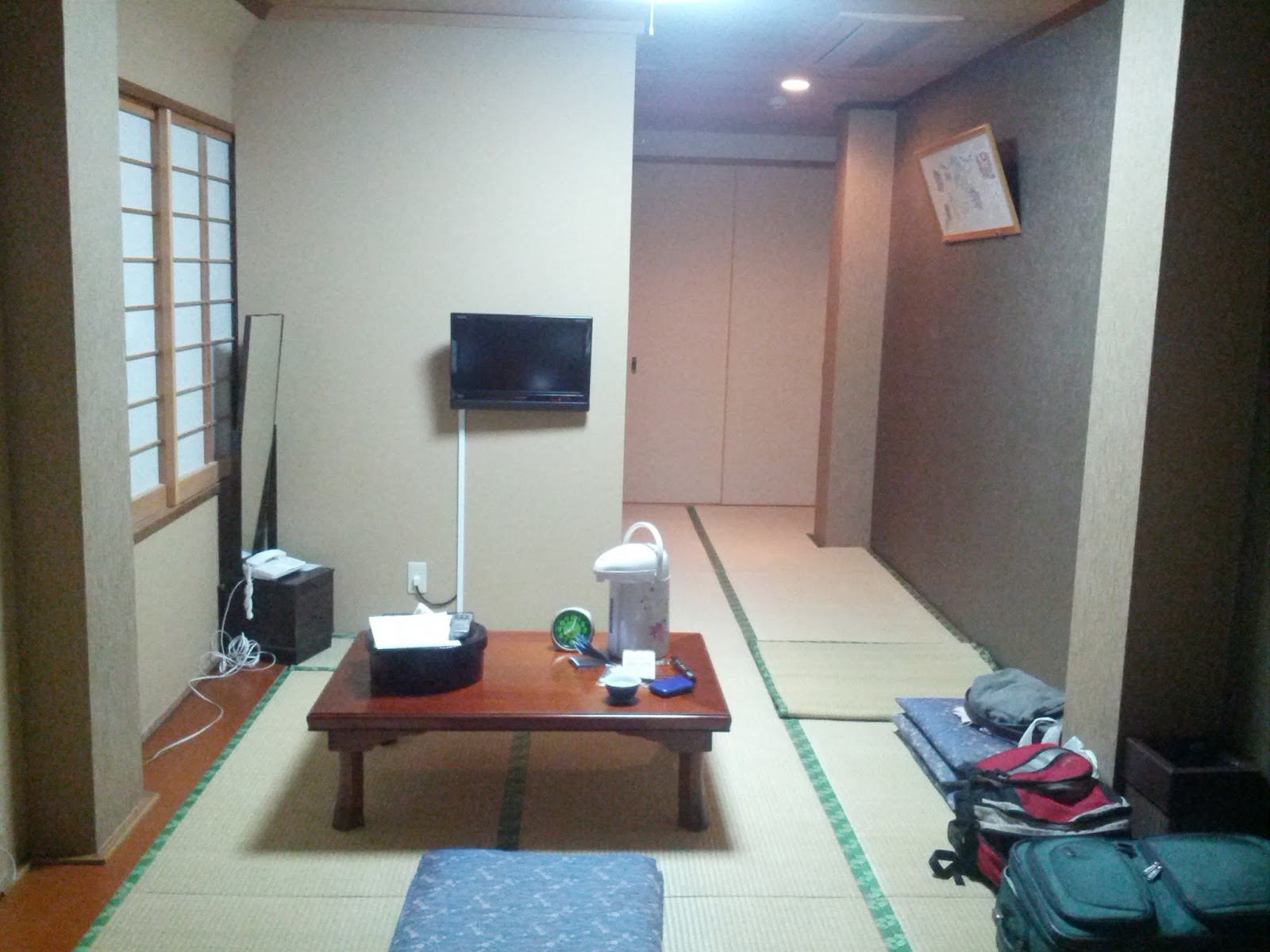
    My room was a standard-type room, which measures at about 17m² (183ft²).  Despite its size, the relative lack of furniture compared to other hotel rooms of similar size gives this a more open feel.  The closet in the back is used to store additional bedding and pillows.

    Being a solo traveller with limited luggage (what you see in the bottom-right corner is it), I did attempt to book a smaller (7.5m² / 80ft²) economy-type room, but there are apparently so few of them that they were booked out.  Of course, who am I to complain about that kind of upgrade?  I still only paid around US$120 a night for my stay, but this rate has changed since then.  Be sure to confirm the official rates from their website, linked at the bottom of this article.

    All rooms here have attached bathrooms, including a Washlet toilet and a shower-tub.  You may also notice another pair of slippers here; in Japan it is customary to use a separate set of slippers in the bathroom, so as not to track any floor-based germs out of it.

    My room had a bit of a view outside.  It isn't much, but you can see a tower ride from the Hanayashiki amusement park nearby.

    Traditional lodgings like these are often decorated with paintings, scrolls, and other objects d'art, and Ryokan Kamogawa was no exception.  Paintings of various old-time scenes are depicted here including, on the far right, the famous (and nearby) Kaminari-mon.

    Ryokans, and even other kinds of hotels in Japan, provide yukata robes for their guests to wear around their rooms and/or the hotel grounds.  I put one on and took a mirror-selfie with it.  Please pardon the sunburn; I had spent the day at Tokyo DisneySea and had under-estimated the intensity of the sunshine that day.  But sunburns aside, I had a nice stay at the Ryokan Kamogawa, and would recommend it for anyone's first try at these kinds of accommodations.  It provides authentically traditional and comfortable facilities, while not far from the modern conveniences of shopping and public transportation.  I also recommend you experience the hot-spring bath on the first floor, but remember to bring your own towel. Also, the water temperature can get very hot (over 40° Celsius / 104° Fahrenheit), but this is normal for onsen-style bathing.


    Address: 1-30-10 Asakusa, Taitō-ku, Tōkyō-to 〒111-0032

    Directions: Start from Asakusa Station (Tokyo Metro Ginza (G), Toei Asakusa (A), and Tobu Skytree (TS) lines) and take the exit closest to Kaminari-mon.  If you’re using the Ginza line, search for exits 1 or 3; for the Asakusa, find exit A4.   Upon reaching Kaminari-mon, turn right, go under the gate, and continue down the Nakamise shopping avenue.  Take the third left into the alley.  The hotel will be on the left side, before the next intersection.

    Other tips: The owner and most of the other family staff can speak in good English. They do accept certain foreign credit cards; for best results, use MasterCard or Visa. Free Wi-Fi is available for guests; login information is provided on check-in.  This hotel has a late-night curfew, but the owner will give you a keypad code to get in the back door with.

    Website: (English) (Japanese)