COVID-19 Coronavirus Notice

COVID-19 Coronavirus Notice

Updated 2 July 2020

If you are reading this message, please be aware of travel restrictions in place as part of measures to contain the spread of the COVID-19 "Coronavirus" and its symptoms. Japanese authorities are refusing entry to individuals from, or who have been to, a list of over 100 countries (More information). All other visitors must apply for a visa, and undergo a quarantine upon entering the country. Within the Japan, there are no longer any travel restrictions, and most public attractions have re-opened with precautions for sanitation and social distancing. In short, travel to Japan is not recommended at this time, until the situation normalises. I will not be editing my individual articles to reflect this, but again, please keep this in mind when reading them.

Tuesday, February 21, 2017

Ryokan Kamogawa

This article is based on a visit made on 1 April 2014.

Goodness, I've gone all about what I did on my Spring 2014 holiday in Japan, and I never said anything about the hotels I stayed at?  Well, let me remedy that now.  You see, there are many types of accommodations to be found in Tokyo, covering a wide economic spectrum from basic capsule-hotel bunks to spacious luxury-hotel rooms that approach US$1,000 a night.  And in certain parts of the city, you can also find more traditional lodgings.  You know, tatami mats, futon beds, the whole nine yards.  I got my first taste of this on the later half of my trip, when I checked in to the Ryokan Kamogawa (旅館加茂川) in Asakusa.

The Ryokan Kamogawa is nestled among the back-alleys of Asakusa, but is in fact not far from the major sights of the area, including Kaminari-mon, Senso-ji temple, and Tokyo Skytree.  In fact, on a clear day or night, you can see the Skytree if you step out and look to the right!

This is what the hallways look like, specifically on the 4th-floor, where I stayed.  I find it odd that hotels in Japan may have rooms on the 4th floor.  For those unaware, in Japanese the numbers 4 ("shi") and 7 ("shichi") are considered unlucky, since they include the word for death (also "shi").  The same convention exists in Chinese, Korean, and other such languages, and indeed this whole concept is similar to the fear of 13 in Western countries.  But when you don't have all that many floors to work with, I suppose it can't be helped.  Besides, I stayed on the 4th floor and nothing bad happened to me!

Each room has a tiny entrance hall.  Because the floor is made of tatami (straw mats), visitors should take off their shoes before entering.  The box on the right is a mini-refrigerator.

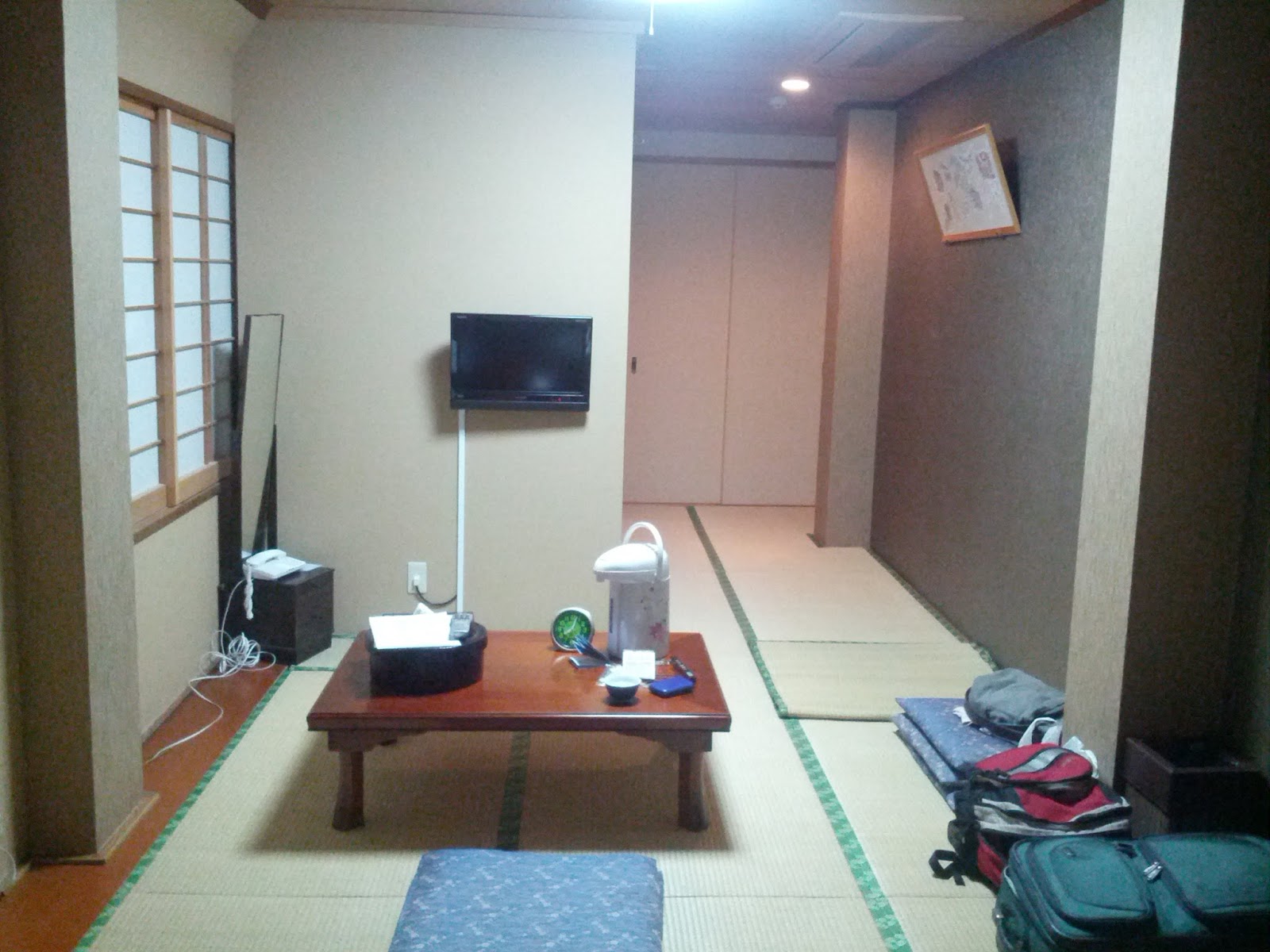
My room was a standard-type room, which measures at about 17m² (183ft²).  Despite its size, the relative lack of furniture compared to other hotel rooms of similar size gives this a more open feel.  The closet in the back is used to store additional bedding and pillows.

Being a solo traveller with limited luggage (what you see in the bottom-right corner is it), I did attempt to book a smaller (7.5m² / 80ft²) economy-type room, but there are apparently so few of them that they were booked out.  Of course, who am I to complain about that kind of upgrade?  I still only paid around US$120 a night for my stay, but this rate has changed since then.  Be sure to confirm the official rates from their website, linked at the bottom of this article.

All rooms here have attached bathrooms, including a Washlet toilet and a shower-tub.  You may also notice another pair of slippers here; in Japan it is customary to use a separate set of slippers in the bathroom, so as not to track any floor-based germs out of it.

My room had a bit of a view outside.  It isn't much, but you can see a tower ride from the Hanayashiki amusement park nearby.

Traditional lodgings like these are often decorated with paintings, scrolls, and other objects d'art, and Ryokan Kamogawa was no exception.  Paintings of various old-time scenes are depicted here including, on the far right, the famous (and nearby) Kaminari-mon.

Ryokans, and even other kinds of hotels in Japan, provide yukata robes for their guests to wear around their rooms and/or the hotel grounds.  I put one on and took a mirror-selfie with it.  Please pardon the sunburn; I had spent the day at Tokyo DisneySea and had under-estimated the intensity of the sunshine that day.  But sunburns aside, I had a nice stay at the Ryokan Kamogawa, and would recommend it for anyone's first try at these kinds of accommodations.  It provides authentically traditional and comfortable facilities, while not far from the modern conveniences of shopping and public transportation.  I also recommend you experience the hot-spring bath on the first floor, but remember to bring your own towel. Also, the water temperature can get very hot (over 40° Celsius / 104° Fahrenheit), but this is normal for onsen-style bathing.


Address: 1-30-10 Asakusa, Taitō-ku, Tōkyō-to 〒111-0032

Directions: Start from Asakusa Station (Tokyo Metro Ginza (G), Toei Asakusa (A), and Tobu Skytree (TS) lines) and take the exit closest to Kaminari-mon.  If you’re using the Ginza line, search for exits 1 or 3; for the Asakusa, find exit A4.   Upon reaching Kaminari-mon, turn right, go under the gate, and continue down the Nakamise shopping avenue.  Take the third left into the alley.  The hotel will be on the left side, before the next intersection.

Other tips: The owner and most of the other family staff can speak in good English. They do accept certain foreign credit cards; for best results, use MasterCard or Visa. Free Wi-Fi is available for guests; login information is provided on check-in.  This hotel has a late-night curfew, but the owner will give you a keypad code to get in the back door with.

Website: (English) (Japanese)

Tuesday, January 3, 2017

Know Your Trains: Tohoku Shinkansen

Edit 11 August 2018: Updated with new map.

An E5-series "Hayabusa" train on the Tohoku Shinkansen, coupled with an E6-series "Komachi" train behind.
By Nanashinodensyaku [CC BY-SA 4.0], from Wikimedia Commons
The Tohoku Shinkansen (東北新幹線, Tōhoku Shinkansen) is a high-speed rail line travelling from Tokyo to Aomori, the northernmost city on Honshu.  It runs through the mountainous and rural northeastern region of Japan, known as Tohoku (東北, Tōhoku, lit. 'northeast').  At a length of  674.9 km (419 miles), it is Japan's longest Shinkansen line.  It is also home to the fastest trains in all of Japan; the new E5 and H5-series trains run at a maximum speed of 320 km/h (200 mph) on certain sections.  It also serves as the trunk for two "Mini-Shinkansen" branch lines: the Yamagata and Akita Shinkansen (which are covered in a separate article).  The Hokkaido Shinkansen, opened in March 2016, is an extension of this line from Aomori to Hakodate, on the island of Hokkaido.

A map of the Tohoku Shinkansen and its stops.
Four types of services run on the Tohoku Shinkansen.  In order of slowest to fastest, they are called "Nasuno", "Yamabiko", "Hayate", and "Hayabusa".  All Tohoku Shinkansen services are labelled in green on signboards.

Name Start Station End Station(s) Time* Max. Frequency**
Nasuno Tokyo Nasu-Shiobara 1 hour 10 minutes 1 per hour
Koriyama 1 hour 40 minutes 5 per day
Yamabiko Tokyo Sendai 2 hours 2-3 per hour
Morioka 3 hours 20 minutes 2-3 per hour
Hayate Tokyo Morioka 3 hours 3 per day
Morioka Shin-Hakodate-Hokuto (Hokkaido) 2 hours 10 minutes 1 per day
Hayabusa Tokyo Shin-Aomori 3 hours 20 minutes 1 per hour
Shin-Hakodate-Hokuto (Hokkaido) 4 hours 30 minutes 1 per hour
* Approximate time between Tokyo and Shin-Aomori stations, unless an earlier terminal is listed.
** Departure frequency is based on December 2016 schedules and are subject to change.

A total of 23 stations lie on the Tohoku Shinkansen.  The main transit hubs are Tokyo, Omiya, Sendai, Morioka, and Shin-Aomori stations.  Below is a list of stations on the line, along with stopping patterns of all four services.

Name (English) Name (Japanese) Prefecture Nasuno Yamabiko Hayate Hayabusa
Tokyo 東京 Tokyo X X X X
Ueno 上野 X X X O
Omiya 大宮 Saitama X X X X
Oyama 小山 Tochigi X O I I
Utsunomiya 宇都宮 X X I I
Nasu-Shiobara 那須塩原 X O I I
Shin-Shirakawa 新白河 Fukushima X O I I
Koriyama 郡山 X X I I
Fukushima 福島 I X I I
Shiroishi-Zao 白石蔵王 Miyagi I O I I
Sendai 仙台 I X X X
Furukawa 古川 I X X I
Kurikoma-Kogen くりこま高原 I X X I
Ichinoseki 一ノ関 Iwate I X X I
Mizusawa-Esashi 水沢江刺 I X X I
Kitakami 北上 I X X I
Shin-Hanamaki 新花巻 I X X I
Morioka 盛岡 I X X X
Iwate-Numakunai いわて沼宮内 I I I O
Ninohe 二戸 I I I O
Hachinohe 八戸 Aomori I I I O
Shichinohe-Towada 七戸十和田 I I I O
Shin-Aomori 新青森 I I I X
Legend
X: All trains stop at this station.
O: Some trains stop at this station.
I: No trains stop at this station.

Notable stops
  • Tokyo/Ueno: The largest city in Japan and the world.
  • Omiya: The capital city of Saitama Prefecture, and home to a popular railway museum.
  • Utsunomiya: Access point for Nikko.
  • Nasu-Shiobara: Serves two hot-spring resort towns, Nasu Onsen and Shiobara Onsen.
  • Fukushima: The capital city of Fukushima Prefecture, and where the Yamagata Shinkansen branches off.
  • Sendai: The largest city in the Tohoku region, and access point for Matsushima bay.
  • Ichinoseki: Access point for the historical town of Hiraizumi.
  • Kitakami: One of Tohoku's most popular cherry-blossom sites.
  • Morioka: The capital city of Iwate Prefecture, and where the Akita Shinkansen branches off.
  • Shin-Aomori: The northernmost city on Honshu, a gateway to Hokkaido, and home of the Nebuta summer festival.
Interior of a GranClass car on an E5-series train.
By くるみ1211 (Kurumi 1211) [CC BY-SA 4.0], from Wikimedia Commons
In addition to non-reserved, reserved, and Green Car seating, some trains also carry a GranClass car, which is a level of luxury even beyond that of the Green Car.  These bucket seats are arranged in a 2+1 layout for extra space, and have a seat pitch of 130 cm (51 in).  Actual layouts may vary; the below chart refers to services using the newest train models (E5 and H5-series).

Service Total Cars Non-Reserved Cars Reserved Cars Green Cars GranClass Cars
Nasuno 16 10
(Cars #1-8, 12-16)
0 2
(Cars #9, 11)
1 (Car #10)
Yamabiko 10 3-6
(Cars #1-3/6)
2-5
(Cars #4/7-8)
1
(Car #9)
1 (Car #10)
17 9-12
(Cars #1-3/6, 12-17)
2-5
(Cars #4/7-8)
2
(Cars #9, 11)
1 (Car #10)
Hayate 100 9 (Cars #1-8, 9) 1 (Car #9) 0
Hayabusa 10 0 8 (Cars #1-8) 1 (Car #9) 1 (Car #10)

Tips
  • All seats on Hayate and Hayabusa services are reserved.  Seat reservations are free when using a Japan Rail Pass or JR East area pass.  In the event that all seats on a train are booked, it may be possible to buy a standing-room ticket.
  • Unlike on the Tokaido, Sanyo, and Kyushu lines, the Japan Rail Pass is valid for ALL services on the Tohoku Shinkansen.  In addition, the JR East Tohoku Area Pass (English) and the JR East South Hokkaido Area Pass (English) also cover the full line from Tokyo to Shin-Aomori.
  • The JR East Tokyo Wide Pass (English) also covers the segment from Tokyo to Nasu-Shiobara.  However, Hayabusa services are not fully covered by the Tokyo Wide Pass.  If you wish to use one of these trains, the pass will only cover the base fare; you must pay for the limited express and other fees out-of-pocket.  Not that it would do you much good anyway; within the pass's coverage area, the Hayabusa only makes the first three stops, the farthest being Omiya Station in Saitama.
  • The Japan Rail Pass does not cover the cost for upgrading to GranClass, nor do the JR East area passes.  If you wish to do so, they will only cover the base fare; you must pay for the limited express and GranClass upgrade fees out-of-pocket, even if using a Green Car JR Pass.
  • If departing from, or arriving at, Tokyo, you may want to consider using Ueno Station instead of the eponymous Tokyo Station.  Ueno serves some of the same JR lines as Tokyo  (JR Yamanote (JY), Keihin-Tohoku (JK), Takasaki/Utsunomiya (JU), Joban (JO)), but also serves the Tokyo Metro Ginza (G) and Hibiya (H) lines, and is somewhat smaller and more manageable.  The adjacent Keisei-Ueno Station also provides faster access to Narita Airport, via the Skyliner limited express.
  • Do not confuse Sendai Station on the Tohoku Shinkansen with the Sendai Station on the Kyushu Shinkansen.  The former (in Tohoku) is written as "仙台" in Japanese, the latter (in Kyushu) as "川内".
  • The Japan Rail Pass, does not cover any of the conventional lines that were transferred to other companies after the extension of the Tohoku Shinkansen (see below).  However, there are exceptions in which the pass may be used on these lines, but only to access other JR lines.  Pass holders may only get on or off at the specified stations.  They are as follows:
    • The Aoimori Line between Aomori, Noheji, and Hachinohe for transferring to the JR Ominato Line.
  • Holders of the JR East Tohoku Area Pass and JR East South Hokkaido Area Pass, however, may use the Iwate Galaxy and Aoimori lines freely.
Trivia
  • The name "Nasuno" (なすの) refers to the Nasu Highlands area in Tochigi Prefecture.  It was previously used for a limited express service, running between Ueno (later Shinjuku) and Kuroiso, also in the Nasu area.  It operated from 1959 to 2010.  When the name was used for the Shinkansen, starting in 1995, the old services were named "Oyaho Tochigi" and "Hometown Tochigi".
  • The name "Yamabiko" (やまびこ) refers to a type of mountain spirit in Japanese folklore.  It was previously used for a limited express service, running between Fukushima (later Ueno) and Morioka.  It operated from 1959 to 1982, the day before the Tohoku Shinkansen launched.
  • The name "Hayate" (はやて) means "strong wind" in English.  The service began on 1 December 2002, when the line was extended to Hachinohe.
  • The name "Hayabusa" (はやぶさ) means "falcon" in English. It was previously used for a limited-express sleeper service, running between Tokyo and Kagoshima.  It operated from 1958 to 2009.  The Shinkansen service began on 5 March 2011, a few months after the line was extended to Shin-Aomori.
  • There used to be another service on the Tohoku Shinkansen.  The "Aoba" (あおば) was a full-stop service from Tokyo to Sendai.  It began with the opening of the line in 1982, but was discontinued in 1997 and consolidated with the Nasuno service.  There was also a double-decker version of this service, called the "MAX Aoba".
  • The Hayabusa services that continue from Shin-Aomori on to the Hokkaido Shinkansen are H5-series trains.  They are distinguished from the E5-series, which stop no further than Shin-Aomori, by a purple stripe running along the hull, as opposed to a pink stripe for the E5, and boast a few minor mechanical upgrades to withstand the harsher Hokkaido winters.  Other than that, they are largely the same.
  • The first train models to run on the Tohoku Shinkansen in 1982 were the 200-series trains.  Despite the name, they predate the similar 100-series, which debuted on the Tokaido and Sanyo Shinkansen in 1985.  The reason for this quirk of numbering is that the JR Group, and JNR before it, have traditionally used odd numbers for train models used on lines headed west from Tokyo, and even numbers from east/north of Tokyo.
  • When the Tohoku Shinkansen was extended to Hachinohe, and later Shin-Aomori, sections of JR's conventional Tohoku Main Line that ran parallel to the Shinkansen were sold to different "third-sector" semi-public companies (co-owned by private companies and local prefecture governments).  The new railway lines that were formed in this manner are:
    • The Iwate Galaxy Railway Line, formed from the Tohoku Main Line from Morioka to Metoki, in Iwate Prefecture.
    • The Aoimori Railway Line (note the spelling), formed from the Tohoku Main Line from Metoki to Aomori, in Aomori Prefecture.

Friday, December 16, 2016

Ueno Park

This article is based on a visit made on Friday, 4 April 2014.

By the end of my Japan holiday in the Spring of 2014, the cherry-blossom season had come into full bloom.  Nowhere was this more apparent than in Ueno Park (上野公園, Ueno Kōen), one of the most popular sakura spots in Tokyo.

The central avenue of the park is lined with over 1,000 cherry trees across a 450-metre (1,500-foot) stretch.  Obviously it attracts a lot of hanami picnics, but the congestion of both those and the pedestrians is such that the hanami plots are roped off for separation, and should even be reserved as early in the morning as possible.

Garbage disposal is serious business in Japan.  Not only are recyclables sorted by glass, plastic, paper, etc., but non-recyclable rubbish is also sorted according to burnable (もえる, moeru) and non-burnable (もえない, moenai) trash.

Near the entrance stands this statue of the samurai Saigo Takamori (西郷 隆盛, Saigō Takamori, 1828-1877).  He served in the Imperial army during the Boshin War (1868-1869).  One of the decisive battles of the war took place in Ueno, hence the presence of this statue of him.  A few years afterwards, however, he led the Satsuma Rebellion (1877) against the Imperial army in Kyushu, only to get himself killed in inconsistently-reported circumstances.  Evidently, the people of Tokyo didn't hold that against him.

There are numerous shrines and temples waiting for you to find if you're willing to go not that far off the beaten path.  This short row of torii gates led to one... and another... and another!

Shinobazu Pond (不忍池) fills in the southern corner of Ueno Park.  Situated in the middle of the pond is a small island, atop which stands Benten-do (弁天堂, Bentendō), a temple hall honouring the Buddhist goddess Benzaiten (弁才天), or Benten for short, hence the name.  Benten, another of the Seven Lucky Gods, serves as a goddess of wisdom, and evolved from the Hindu goddess Saraswati.

Festival food stalls like to set up here during the sakura season, too.  The Japanese sure like to eat things on sticks, from rice dumplings to Turkish kebabs to whole fish, seen here.

Sakura season notwithstanding, Ueno Park is perhaps best known for its many museums, the centrepiece being the Tokyo National Museum.  Its collection of 110,000 pieces, of which 4,000 are on display at a time, consists of art and artifacts from Japan and other Asian cultures.

The park is also home to Ueno Zoo, the oldest zoo in Japan (opened 1882).  Today, the park houses 2,600 animals across 460 species.  In 1972, when Japan and the People's Republic of China re-established diplomatic relations, China gave the zoo its first panda bears as a present.  Thus, pandas have become not only the most famous animals housed at the zoo, but a symbol of the entire Ueno Park.

I wasn't kidding about the whole Panda theme.  Back in Ueno Station, I came across this adorable display of a panda underneath a cherry tree, holding a stick of dango (one of which I tried the day before).

Until next time, I'm signing off with a sakura selfie!


Ueno Park

Hours: The park itself is open 24 hours a day.  Operating hours for museums and other on-site attractions may vary.

Costs: The park itself is free to enter.  Entry costs for museums and other on-site attractions may vary.

Address: Ueno-kōen, Taitō-ku, Tōkyō-to 〒110-0007

Access: Directly adjacent to Ueno (JR Yamanote (JY), Keihin-Tohoku (JK), Takasaki/Utsunomiya (JU), Joban (JJ), Tokyo Metro Ginza (G) and Hibiya (H) lines) and Keisei-Ueno (Keisei Main (KS) and Airport (KS) lines) stations.

From Tokyo Station, take the Joban, Takasaki, or Utsunomiya lines from Tokyo to Ueno (JU02/JJ01, 5 minutes, ¥160, JR Pass OK).  Trains on the Yamanote and Keihin-Tohoku lines are more frequent and only take a couple of minutes longer.

Directions: From JR Ueno station, the closest exit is the Park Exit on the 4th floor.  The park entrance is across the pedestrian overpass.  From all other exits, turn right and continue along Chuo-dori.  The park entrance will be up the stairs straight ahead.

From Keisei-Ueno station, exit to street level and head left.  The park entrance will be up the stairs immediately to the left.

Website: (English) (Japanese)

Tokyo National Museum

Hours: Open from 9:30 AM to 5:00 PM.  Entry ends 30 minutes before closing time.  Closed Mondays (except holidays), and from 24 December to 1 January (except Mondays).

Costs: ¥620 for permanent exhibitions, ¥1,000-1,500 for special exhibitions.

Address: 13-9 Ueno-kōen, Taitō-ku, Tōkyō-to 〒110-8712

Directions: From the southern park entrance, walk north along the main path for about 10 minutes.  The museum will be straight ahead, at the far end of the path.

From the Park Exit of JR Ueno station, cross along the overpass, turn right, take the next left, and turn right again at the fountain crossing.  The museum will be straight ahead, at the far end of the path.

Website: (English) (Japanese)

Ueno Zoo

Hours: Open from 9:30 AM to 5:00 PM.  Entry ends 1 hour before closing time.  Closed Mondays (except holidays), and from 29 December to 1 January.

Costs: ¥600

Address: 8-93 Ueno-kōen, Taitō-ku, Tōkyō-to 〒110-0007

Directions: From the southern park entrance, walk north along the main path for about 5 minutes, then turn left at the crossing before the fountain.  The zoo entrance will be straight ahead.

From the Park Exit of JR Ueno station, cross along the overpass, turn right, then take the next left.  The zoo entrance will be straight ahead.

The western Ikenohata gate can also be accessed in 4 minutes from Nezu station (Tokyo Metro Chiyoda (C) line).

Website: (English) (Japanese)

Wednesday, December 14, 2016

Edo Wonderland

This article is based on a visit made on Thursday, 3 April 2014.


Edit 2 October 2019: Updated prices to reflect the increase in Japan's national sales tax.

Edo Wonderland, a.k.a. Nikko Edo-mura (日光江戸村, Nikkō Edo Mura, lit. 'Nikko Edo Village'), is a theme park built to re-create an Edo-period (AD 1600s to mid-1800s) townscape.  It is located in the town of Kinugawa Onsen (鬼怒川温泉), near Nikko, both of which are 120 kilometres (75 miles) north of Tokyo.

The nearest train station, Kinugawa Onsen station, is served by Tobu Railway.  The fastest method of access from Tokyo is to take their "Spacia" limited express train from Asakusa station.  The ride takes about two hours and makes only five stops.  For penny-pinchers, the next-slowest service, Rapid (not to be confused with the slower-still Section Rapid), makes a couple more stops and only takes 20 minutes longer, and costs almost half as much.  But the Spacia also has the regular trains beat in terms of comfort, so I'd say the upgrade was a wise investment.  English timetables are available on Tobu’s website: (English).  But be careful of which train you take!  On the above timetables, only the trains named “Kinu” go to Kinugawa Onsen; the “Kegon” trains branch off instead to Nikko!

Kinugawa Onsen is home to many hot-spring resorts, hence the name "onsen".  The gazebo structure in the centre-right is a free foot-bath.  I meant to try it on the way back, but I was wet enough already. >.<

Kinu-chan (キヌちゃん) and Kawa-chan (カワちゃん), the town mascots of Kinugawa Onsen.  One of the kanji in the town's name, "鬼", means "oni", an ogre-demon.  Thus, Kinu-chan and Kawa-chan are red- and blue-coloured oni, albeit rather cute oni.  Which is good; otherwise you'd scare off tourists!

The central area of Edo Wonderland.  The houses contain, in addition to the dining, shopping, and amusement facilities usual of theme parks, re-creations of old merchants' and artisans' homes.

This was a rather rainy day, as you can see by the reflection of the boards in this picture, and the multitude of umbrellas seen in other pictures.  That obviously didn't bother all these fish, though!

The crew members working about were dressed in historical, yet sensible, costume uniforms, and in some cases broke out old-style umbrellas like this.

This bell tower is similar to the one in Kawagoe.  If you've never been, Kawagoe is a town, 35km (22 mi.) northwest of Tokyo, known for its preserved warehouse disctrict.  The stage in front is used for various performances, but on a rainy day like this, that's obviously not happening.

Fortunately, that rained-out show is just one of several performances held regularly in Edo Wonderland, most of them in indoor theatres.  I got to see a ninja martial-arts stunt show and a water magic show.

There are other types of indoor activities, too.  Pictured here is an exhibit on neighbourhood firefighting brigades in Edo, including the samurai-led buke-bikeshi (武家火消) and volunteer-led machi-bikeshi (町火消).  They were formed in the 18th century due to the city's propensity to catch fire, with one, the Great Meireki Fire of 1657 (明暦の大火, Meireki no taika), claiming over 100,000 lives!

Another exhibit on ninja tools and techniques.  Nearly everything a ninja would use could be concealed, either from sight or as ordinary objects, and/or had multiple uses for combat, stealth, surveillance, and survival.

Continuing on the ninja theme, there is also a fun-house with all manner of sloping halls.  I don't get what was so "ninja" about this place, but it was fun to (try to) walk through.

Is this hallway crooked, or am I practising the 45-degree lean from Michael Jackson's "Smooth Criminal" video?  You make the call!

Beyond the funhouse is a Ninja Trick Maze.  I think the idea is that you're supposed to use these to navigate with...

...but I couldn't work it out myself.  Regretfully I had to employ the use of one of these exits. OTL

Dining options at Edo Wonderland run the gamut of everyday Japanese cuisine, with options including various noodle, rice bowl, and skewered meat dishes.

I also tried some dango, sticky rice dumplings on a stick.  It was tasteless and stuck to the inside of my mouth.

Now for something special.  You can rent period costumes and wear them around a bit!
The menu of available costumes is displayed on these panels outside.  There are multiple options for men, women, and children, with prices ranging from ¥4,000 for a basic townsperson to ¥10,000 for a nobleman/lady.  A full list of costumes and prices is available here: (Japanese)

Here I am posing in the samurai (侍) costume I rented.  That blue colour was an excellent fit for me!  The props it came with include a sword (which you're not supposed to unsheath, for obvious reasons), a coin bag (useful for modern accessories, too!), sandals (which were taxing for my toes to hold on to), and for the rainy weather, an umbrella.  If you're interested, this particular costume cost ¥5,500 to rent, and is available for men, women (as "swordswoman" / "女剣士"), and children.

Closing out this article with a shot of Nyanmage (ニャンまげ), the mascot of Edo Wonderland!  He is named after the chonmage (丁髷), the topknot hairstyle popularised by samurai in the Edo period and, to an extent, by sumo wrestlers to this day.  Of course, Nyanmage sports the hairstyle he was named after.

If you're in the area, you may want to check out the Grand Maze Palladium (in case the Ninja Trick Maze wasn't enough for you), or Tobu World Square, a park with miniatures of world landmarks.  Don't forget about Nikko, which is half an hour away by trains, and is home to some of Japan's most famous shrines, temples, and natural sights.  If all that seems too much to accomplish in a day trip (and it is), why not stay overnight in one of Kinugawa Onsen's hot spring hotels?  Tobu's train passes covering the area are good for two days or more!


Hours: Open from 9:00 AM to 5:00 PM from March to November, and from 9:30 AM to 4:30 PM from December to March.  Closed Wednesdays (except holidays), and from 8 to 21 December.

Price: ¥4,700, or ¥4,200 after 2:00 PM (1:00 PM in the winter).  If you have a Nikko Area Pass, described below, admission is discounted to ¥4,230.

Address: 470-2 Karakura, Nikkō-shi, Tochigi-ken 〒321-2524

Access: From Tobu Asakusa station, take the Tobu Kinugawa line to Kinugawa Onsen station.  Section Rapid trains take 2 hours and 50 minutes to get there; Rapid trains take 2 hours and 20 minutes (both cost ¥1,580).  The "Spacia" limited express makes the journey in only 2 hours, but requires a fee on top of the regular fare (total ¥2,940 on weekdays).

Tobu sells two passes which cover a round-trip train ride from Tokyo to the Nikko and Kinugawa Onsen area, Tobu-affiliated trains and buses within the area, and other discounts.  The Nikko World Heritage Area Pass (English) costs ¥2,040, lasts for two consecutive days, and covers trains and buses around downtown Nikko, but not the buses to Edo Wonderland.  The Nikko All Area Pass (English) costs ¥4,600 (¥4,230 between 1 December and 19 April), lasts for four consecutive days, and covers many more buses on top of the World Heritage Pass, including those to Edo Wonderland.  Both passes cover only the base train fare, but offer a 20% discount on limited-express fares, and discounted admission to Edo Wonderland as described above.  These passes are available only to non-Japanese citizens.

Alternately, from Shinjuku station, take the "Kinugawa" limited express to Kinugawa Onsen.  This takes 2 hours and 10 minutes, and costs ¥4,080 one-way.  All seats are reserved.  As the train is jointly run by JR East and Tobu, the Japan Rail Pass will cover part, roughly half, of the fare.  Pass holders only need to pay for the section using the Tobu lines.  Other JR East area passes, however, cover the entire trip.  More info on these area passes from JR East's website: (English)  However, the Tobu passes described above are not valid for trains to/from Shinjuku.

Directions: From Kinugawa Onsen station, take a bus from platform #3 to Nikko Edo-mura (20 min, ¥410, 3 per hour) to Edo Wonderland.  Schedule: (Japanese)

From JR Nikko station, take a free shuttle bus (30 min, 3-4 per day) to Edo Wonderland.  Schedule: (English)

Website: (English) (Japanese)

Monday, December 12, 2016

Tokyo Solamachi

This article is based on a visit made on Wednesday, 2 April 2014.

Previously on Sekai Ichi, I talked about Tokyo Skytree, the newest and tallest observation tower in Tokyo.  Among the tips I laid out in that post, I showed off the timed tickets they sometimes use, so visitors can wait outside a while and come back to get in line for entry tickets.  What is one to do in the intervening time?  Well, the Skytree itself is only the centrepiece of the Tokyo Skytree Town complex, which also includes office space, an aquarium, a planetarium, and a shopping mall called Tokyo Solamachi (東京ソラマチ, Tōkyō Soramachi).  Its name is also written as "sora-machi" in Japanese, which translates to "sky town".

Before going inside, I first stumbled upon the store "Donguri Kyōwakoku" (どんぐり共和国), or "Acorn Republic" (personally, I split the difference and call it "Donguri Republic"), a shop for official Studio Ghibli merchandise.  I discovered later on that this is actually a chain of stores with dozens of branches across Japan!

Posters for The Tale of the Princess Kaguya, Ghibli’s then-latest release in Japan.

Even if you're not looking to buy anything, it's worth popping into one of these stores just to see the displays based on Ghibli's movies, such as this one from My Neighbor Totoro.

A giant Jiji from Kiki's Delivery Service sitting in the window.  ♫ How much is that kitty in the window? ♫  It's probably not for sale.

Finally going inside.  The Solamachi Shotengai Shopping District (ソラマチ商店街, Soramachi Shotengai), on the eastern 1st floor,  is one of the main halls of Solamachi.  The wooden accents along the storefronts evoke an old-town Edo feel in a refined, modernist way, if that makes any sense.

A window display of a toy store.  The big poster on the left advertised figures from the TV anime Attack on Titan (進撃の巨人, Shingeki no Kyojin), which was really blowing up at the time of my visit.

Sets of Pokémon pins! The samples depict, from left to right, Oshawott cooking monjayaki, Meowth with Tokyo Tower, Pikachu with the Kaminari-mon lantern from Senso-ji, Eevee in a crepe from Harajuku, and another Pikachu with Skytree.   I would've picked these up instantly, if I actually collected pins...

Jump Shop is another anime character-goods store, this one focused on the manga comics seralised in Weekly Shonen Jump magazine, including the "big 3" of Dragon Ball, Naruto, and One Piece.  At the Jump Shop in Solamachi, there's a wall with the heights of different manga characters which you can measure yourself against. I'm almost as tall as Monkey D. Luffy, the main character of One Piece...

...However there are so many more characters taller than that!  See, that's the beauty of the manga art form: the licence to expand upon reality.

Solamachi boasts an eclectic sense of interior design all around, such as these painted plates adorning the wall of one of the food courts.  I kinda dig it.

Tokyo Skytree Town boasts other facilities of interest apart from shopping and the Skytree itself.  There's the Sumida Aquarium (open 9AM-9PM, entry ¥2,050) on the western 5th floor, and the Konica Minolta Planetarium (open 10AM-9PM, entry ¥1,500-3,800) on the eastern 7th floor.  So, even if your fear of heights were to inhibit you from visiting the actual Skytree, there's something for every interest in Tokyo Skytree Town!


Tokyo Solamachi

Hours: Open hours for individual stores may vary, but Solamachi itself is open from 10:00 AM to 9:00 PM.  Some restaurant floors are open from 11:00 AM to 11:00 PM.  No regular closing days.

Costs: Free entry.  Stores accept credit cards including MasterCard, Visa, Diner's Club, JCB, and China UnionPay.  Tax-free shopping is available at many stores for foreigners spending ¥5,000 or more at any one store.  A currency exchange machine (foreign-to-Yen only) is available in the middle of the 1st floor.

Address: 1-1-2 Oshiage, Sumida, Tokyo 〒130-0045

Access: Right next to Oshiage Station on the Tokyo Metro Hanzomon (Z) and Toei Asakusa (A) lines, and Tokyo Skytree Station on the Tobu Skytree (TS) line.  From Tokyo Station, walk to nearby Otemachi Station and take the Hanzomon subway line to Oshiage (Z14, 15 minutes, ¥200).

Website: (English) (Japanese)

Donguri Republic: Tokyo Skytree Town Shop

Hours: Open from 10:00 AM to 9:00 PM.  No regular closing days.

Address: Tokyo Solamachi 2F, 1-1-2 Oshiage, Sumida, Tokyo-to 〒131-0045

Directions: From Oshiage Station, climb up the outdoor stairs to the 2nd floor.  The store will be on the right.

From Tokyo Skytree Station, enter the mall on the 2nd floor, cross through the mall, and go through the far left-hand exit (next to the Plaza store).  The store will be on the left.

Website: (Japanese)

Jump Shop: Tokyo Skytree Town Shop

Hours: Open from 10:00 AM to 9:00 PM.  No regular closing days.

Address: Tokyo Solamachi 3F, 1-1-2 Oshiage, Sumida, Tokyo-to 〒131-0045

Directions: From Oshiage Station, enter the mall on the 3rd floor, and cross through the mall until you reach the "Solamachi Tabe-Terrace" food court.  The store will be on the left.

From Tokyo Skytree Station, enter the mall on the 3rd floor; this will put you into "Solamachi Tabe-Terrace".  The store will be on the right.

Website: (English) (Japanese)