COVID-19 Coronavirus Notice

COVID-19 Coronavirus Notice

Updated 2 July 2020

If you are reading this message, please be aware of travel restrictions in place as part of measures to contain the spread of the COVID-19 "Coronavirus" and its symptoms. Japanese authorities are refusing entry to individuals from, or who have been to, a list of over 100 countries (More information). All other visitors must apply for a visa, and undergo a quarantine upon entering the country. Within the Japan, there are no longer any travel restrictions, and most public attractions have re-opened with precautions for sanitation and social distancing. In short, travel to Japan is not recommended at this time, until the situation normalises. I will not be editing my individual articles to reflect this, but again, please keep this in mind when reading them.

Sunday, December 4, 2016

Know Your Trains: Sanyo Shinkansen

Edit 28 May 2018: Updated with new map.

An N700-Series (left) and a 500-Series (right) Shinkansen at Nishi-Akashi Station.
Takeshi Kuboki from Amagasaki, Japan / CC BY
The Sanyo Shinkansen (山陽新幹線, San'yō Shinkansen) is a high-speed rail line travelling from Shin-Osaka Station to Hakata Station in Fukuoka, on the island of Kyushu.  It was the second line in the Shinkansen network, opening in 1975.  It connects cities including Osaka, Kobe, Himeji, Hiroshima, Kitakyushu, and Fukuoka, in a minimum of two and a half hours end-to-end.  Its maximum speed limit is 300 kilometres per hour, or about 185 miles per hour.

Times

Five types of services run on the Sanyo Shinkansen.  The full-stop Kodama runs the full length of the line from Shin-Osaka to Hakata, separate from its counterpart on the Tokaido Shinkansen. The full-stop Hikari and limited-stop Nozomi continue on from the Tokaido line.  Finally the limited-stop Sakura and Mizuho continue on the Kyushu Shinkansen.

Name Colour* Start Station End Station(s) Time** Frequency***
Kodama Blue Shin-Osaka Hakata 4½ hours 1 per hour
Hikari Red Tokyo (Tokaido)
Shin-Osaka
Okayama 75 minutes 1 per hour
Nozomi Yellow Tokyo (Tokaido)
Shin-Osaka
Hakata 2½ hours 3-4 per hour
Sakura Pink Shin-Osaka Hakata
Kagoshima-Chuo (Kyushu)
3 hours 1-2 per hour
Mizuho Orange Shin-Osaka Hakata
Kagoshima-Chuo (Kyushu)
2½ hours 6 per day
* The colour associated with each particular service on signboards, etc.
** Approximate time between Shin-Osaka and Hakata stations, unless otherwise noted.
*** Departure frequency is based on November 2016 schedules and are subject to change.

Stops
A map of the Sanyo Shinkansen and its stops.
Each of the five services on the Sanyo Shinkansen have different stopping patterns.  Below is a list of stations on the line, along with the stopping patterns of all five services.

Name (English) Name (Japanese) Prefecture Kodama Hikari Nozomi Sakura Mizuho
Shin-Osaka 新大阪 Osaka X X X X X
Shin-Kobe 新神戸 Hyogo X X X X X
Nishi-Akashi 西明石 X X I I I
Himeji 姫路 X X O O O
Aioi 相生 X O I I I
Okayama 岡山 Okayama X X X X X
Shin-Kurashiki 新倉敷 X O I I I
Fukuyama 福山 Hiroshima X O O X I
Shin-Onomichi 新尾道 X O I I I
Mihara 三原 X O I I I
Higashi-Hiroshima 東広島 X O I I I
Hiroshima 広島 X O X X X
Shin-Iwakuni 新岩国 Yamaguchi X I I I I
Tokuyama 徳山 X I O O I
Shin-Yamaguchi 新山口 X I O O I
Asa 厚狭 X I I I I
Shin-Shimonoseki 新下関 X I I I I
Kokura 小倉 Fukuoka X I X X X
Hakata 博多 X I X X X
Legend
X: All trains stop at this station.
O: Some trains stop at this station.
I: No trains stop at this station.

Notable stops
  • Shin-Osaka: The economic and culinary centre of the Kansai region.
  • Shin-Kobe: A port city with one of Japan's three major Chinatowns.
  • Himeji: Home of Japan's most famous original castle.
  • Okayama: Gateway to the island of Shikoku, and home to a famous landscape garden.
  • Hiroshima: The first city in the world struck with an atomic bomb, now a monument to world peace.
  • Shin-Iwakuni: A town with a famous multi-arched bridge.
  • Kokura: The main station in Kitakyushu.
  • Hakata: The main station in Fukuoka, the largest city on Kyushu.
Seating
    Sakura and Mizuho trains make up for fewer Green Car seats with regular reserved seats (pictured)
    that are arranged 4 to a row and are almost as comfortable as Green seats.
    衛兵隊衛士 / CC BY-SA
    Apart from stopping patterns, the five services also differ in their seating layout.  On the Sanyo Shinkansen, Kodama, Sakura, and Mizuho trains run with 8 cars instead of 16.  Reserved seats on these trains are laid out in a 2+2 pattern, similar to Green Cars, and are almost as comfortable, although their seat pitch is the same as non-reserved seating, at (an admittedly still spacious) 104 cm (41 in).  Only half of one car is designated as Green on Sakura and Mizuho trains, and Kodama have no Green Cars altogether.

    Service Total Cars Non-Reserved Cars Reserved Cars Green Cars
    Kodama 8 5
    (Cars #1-3, 7-8)
    3
    (Cars #4-6)
    0
    Hikari 16 5
    (Cars #1-5)
    8
    (Cars #6-7, 11-16)
    3
    (Cars #8-10)
    Nozomi 16 3
    (Cars #1-3)
    10
    (Cars #4-7, 11-16)
    3
    (Cars #8-10)
    Sakura 8 3
    (Cars #1-3)
    4½
    (Cars #4-8)
    ½
    (Car #6)
    Mizuho 8 3
    (Cars #1-3)
    4½
    (Cars #4-8)
    ½
    (Car #6)

    Tips
    • Nozomi and Mizuho services are NOT covered by the Japan Rail Pass. Even if you have a JR Pass active, if you take one of these trains, you must pay the full fare out of pocket. On the Sanyo line, services are marked by different colours on signboards. If you're using a JR Pass, beware of yellow or orange text/backgrounds -- these denote Nozomi and Mizuho trains!
    • In addition to the Japan Rail Pass, the JR Kansai Wide Area Pass, JR Sanyo Sanin Area Pass, JR Kansai Hiroshima Area Pass, and JR Hiroshima Yamaguchi Area Pass cover part or all of the San'yo Shinkansen.  Notably, they also cover Nozomi and Mizuho services, where the nationwide JR Pass does not.  However, as a rule, they do not cover seat reservation or Green Car fees.  More information: (English).
    • Do not confuse Shin-Osaka Station with Osaka (a.k.a. Umeda) Station.  The latter is closer to the city centre, but is not served by the Shinkansen.  The two are still close together and are linked by the JR Kyoto (A) line (4 minutes, ¥160) and the OsakaMetro Midosuji (M) line (6 minutes, ¥230).
    Trivia
    • The name Sanyo (山陽, San'yō) means "southern mountain region" in English.  It refers to the area south of the mountain range in western Honshu, bordering the Seto Inland Sea.  The name is also used for the parallel Sanyo Expressway and Sanyo Main Line.
    • The name Sakura (さくら) means "cherry blossom" in English.  It was previously used for an overnight limited express service Tokyo and Nagasaki, which operated from 1959 to 2005.  It was reintroduced as a Shinkansen service in 2011, when the Kyushu Shinkansen was finished and connected to the Sanyo line.
    • The name Mizuho (みずほ) means "harvest", or literally, "abundant rice" in English.  It was previously used for an overnight limited express service between Tokyo and Kumamoto, which operated from 1961 to 1994.  It was reintroduced as a Shinkansen service in 2011, along with the Sakura.
    • A special Kodama service decorated in the theme of the TV anime Neon Genesis Evangelion had run on the Sanyo Shinkansen from November 2015 through May 2018.  Known as the "Type-500 Eva", it ran once daily from Hakata to Shin-Osaka in the morning, and back in the afternoon.  I had a chance to ride this train myself, and have posted more information in a separate article.
    • After the Evangelion Shinkansen was retired, a new Hello Kitty-themed service was introduced to replace it.  It made its debut on 30 June 2018.

    Friday, December 2, 2016

    Know Your Trains: Tokaido Shinkansen

    Edit 26 May 2018: Updated with a new map.

    An N700-Series Shinkansen train running in front of Mount Fuji.
    tansaisuketti / CC BY-SA
    The Tokaido Shinkansen (東海道新幹線, Tōkaidō Shinkansen) is a high-speed rail line travelling from Tokyo Station to Shin-Osaka Station. Opened in October 1964 to coincide with the Summer Olympics in Tokyo, this was the world's first high-speed rail line.  Even today, it remains the most used high-speed rail line in the world, transporting a cumulative total of 5.6 billion passengers over its 50-year-plus history [1].  It connects cities including Tokyo, Yokohama, Nagoya, Kyoto, and Osaka, in a minimum of two and a half hours end-to-end.  Its maximum speed limit is 285 kilometres per hour, or about 175 miles per hour.

    Times

    Three types of services run on the Tokaido Shinkansen: the full-stop Kodama, and the limited-stop Hikari and Nozomi.  Some Kodama services end early at Nagoya.  Most Hikari and Nozomi services, on the other hand, continue on to the Sanyo Shinkansen, ending as far as Hakata Station in Fukuoka.

    Name Colour* Start Station End Station(s) Time Frequency**
    Kodama Blue Tokyo Nagoya 3 hours 1 per hour
    Shin-Osaka 4 hours 1 per hour
    Hikari Red Tokyo Shin-Osaka
    Okayama/Hiroshima (Sanyo)
    3 hours 2 per hour
    Nozomi Yellow Tokyo Shin-Osaka
    Hakata (Sanyo)
    2½ hours 6 per hour
    * The colour associated with each particular service on signboards, etc.
    ** Departure frequency is based on April 2018 schedules and is subject to change.


    Stops

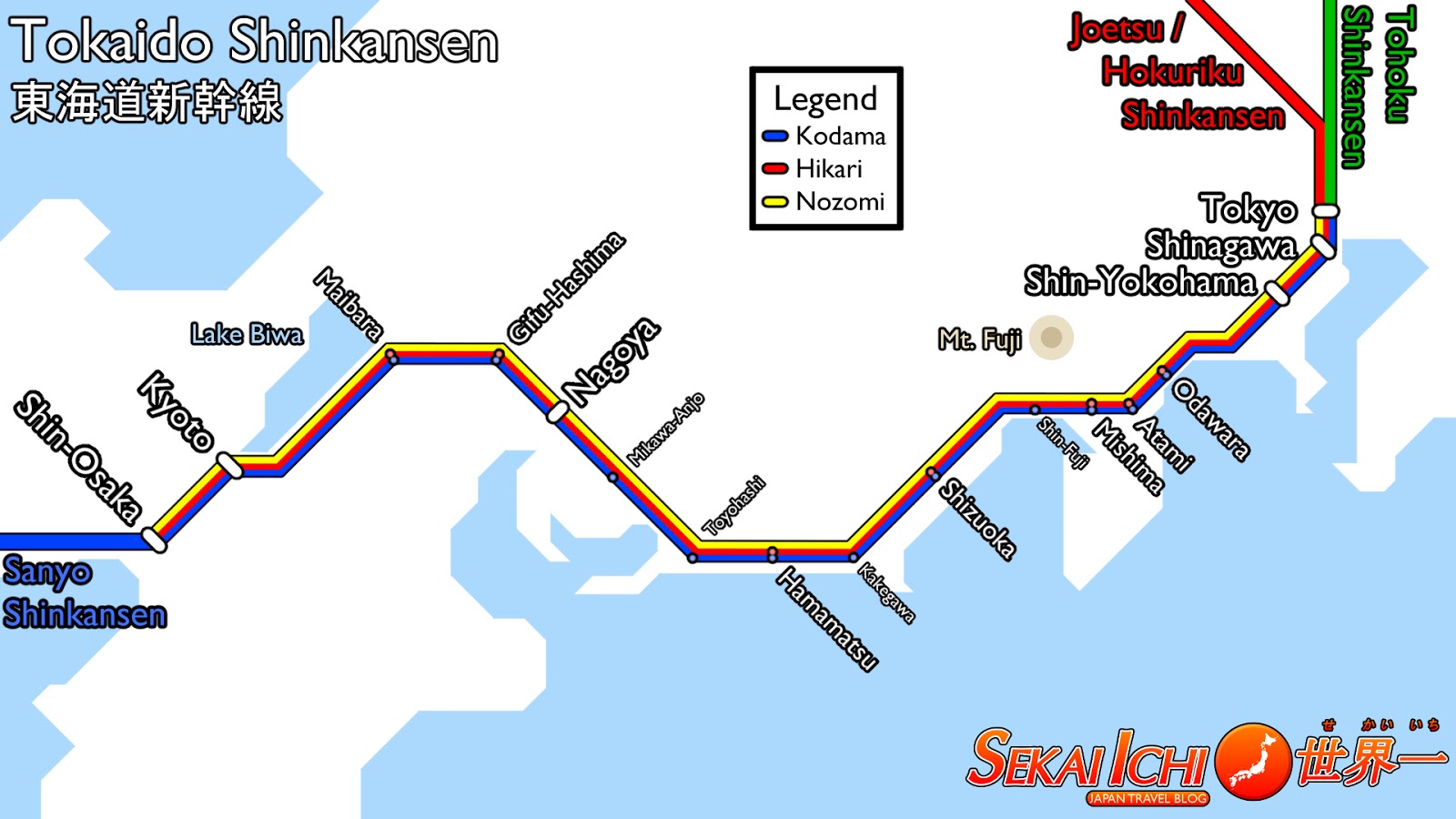
    A map of the Tokaido Shinkansen and its stops.
    Each of the three services on the Tokaido Shinkansen have different stopping patterns.  Below is a list of stations on the line, along with the stopping patterns of all three services.

    Name (English) Name (Japanese) Prefecture Kodama Hikari Nozomi
    Tokyo 東京 Tokyo X X X
    Shinagawa 品川 X X X
    Shin-Yokohama 新横浜 Yokohama X X X
    Odawara 小田原 Kanagawa X O I
    Atami 熱海 Shizuoka X O I
    Mishima 三島 X O I
    Shin-Fuji 新富士 X I I
    Shizuoka 静岡 X O I
    Kakegawa 掛川 X I I
    Hamamatsu 浜松 X O I
    Toyohashi 豊橋 Aichi X O I
    Mikawa-Anjo 三河安城 X I I
    Nagoya 名古屋 X X X
    Gifu-Hashima 岐阜羽島 Gifu X O I
    Maibara 米原 Shiga X O I
    Kyoto 京都 Kyoto X X X
    Shin-Osaka 新大阪 Osaka X X X
    Legend
    X: All trains stop at this station.
    O: Some trains stop at this station.
    I: No trains stop at this station.

    Notable stops
    • Tokyo / Shinagawa: The largest city in Japan and the world.
    • Shin-Yokohama: Japan's second-largest city, with one of the country's most famous Chinatowns.
    • Odawara: Gateway to the Hakone hot springs resort area.
    • Mishima / Shin-Fuji: Gateways to Mt. Fuji from western cities.
    • Nagoya: An economic centre with industrial and historical sites.
    • Kyoto: Japan's history-laden former capital city.
    • Shin-Osaka: The economic and culinary centre of the Kansai region.
    Seating

    Apart from stopping patterns, the three services also differ in their seating layout.  Nozomi trains dedicate more of their cars for reserved seating, whereas Hikari and Kodama trains have more non-reserved seats.

    Service Total Cars Non-Reserved Cars Reserved Cars Green Cars
    Kodama 16 10
    (Cars #1-7, 13-15)
    3
    (Cars #11-12, 16)
    3
    (Cars #8-10)
    Hikari 16 5
    (Cars #1-5)
    8
    (Cars #6-7, 11-16)
    3
    (Cars #8-10)
    Nozomi 16 3
    (Cars #1-3)
    10
    (Cars #4-7, 11-16)
    3
    (Cars #8-10)

    Tips
    • Nozomi services are NOT covered by the Japan Rail Pass.  Even if you have a JR Pass active, if you take one of these trains, you must pay the full fare out of pocket.  On the Tokaido line, services are marked by different colours on signboards.  If you're using a JR Pass, beware of yellow text/backgrounds -- this denotes a Nozomi train!
    • The "Platt Kodama" travel plan, offered by JR Tokai Tours, is a package which includes a ticket for a one-way ride on any Kodama train, and a voucher one free soft drink or beer.  This package can save users ¥2,000 to ¥4,000 over regular fares.
    • Multiple regional passes sold by JR East and JR West cover some regular trains in the areas crossed by the Tokaido Shinkansen, but do not cover the Tokaido Shinkansen itself, which is instead owned by JR Central.
    • If departing from, or arriving at, Tokyo, you may want to consider using Shinagawa Station instead of the eponymous Tokyo Station.  Shinagawa serves some of the same JR lines as Tokyo (Yamanote (JY), Keihin-Tohoku (JK), Tokaido (JT), and Yokosuka (JO)), but is somewhat smaller and more manageable.  It also serves the Keikyu Main Line, which goes to Haneda Airport on one end, and through the Asakusa Subway (A) line on the other.
    • Some Kodama trains terminate at Nagoya.  If you wish to use a Kodama train to get to Kyoto or Osaka, please be mindful of your train's terminal station before boarding.
    • Most trains continue beyond Shin-Osaka station on to the San'yo Shinkansen.  Most Nozomi trains terminate at Hakata Station in Fukuoka, and Hikari trains terminate at Okayama or Hiroshima stations.
    • Do not confuse Shin-Osaka Station with Osaka (a.k.a. Umeda) Station. The latter is closer to the city centre, but is not served by the Shinkansen.  The two are still close together and are linked by the JR Kyoto (A) line (4 minutes, ¥160) and the OsakaMetro Midosuji (M) subway (6 minutes, ¥230).
    • On the older 700-Series trains, cars #10, 15, and 16 are smoking.  All cars are non-smoking on the newer and more common N700-Series trains; smoking rooms are available at the ends of certain cars.
    • It is possible to see Mount Fuji from the Tokaido Shinkansen, between Mishima and Shin-Fuji stations.  Look to the right when heading for Osaka, or to the left when bound for Tokyo.  If you wish to reserve a seat where you can see Mt. Fuji, get a seat in row E for regular cars, or row D for Green Cars; this is true whether the train is going to or from Tokyo.

    Signboards on the outside of a Nozomi train.  If you have a Japan Rail Pass, beware of the yellow background!!
    JKT-c / CC BY
    Trivia
    • The name Tokaido (東海道, Tōkaidō) means "eastern sea road" in English.  It originally referred to a road linking Edo (Tokyo) and Kyoto during the Edo period.  The old road roughly paralleled the modern-day Tokaido Main Line and Tokaido Shinkansen.
    • The name Kodama (こだま) means "echo" in English.  It was previously used for a limited express service, running between Tokyo and Osaka in under 7 hours one-way.  At the time, this was the first train service with which it was possible to travel from Tokyo to Osaka and back in one day, hence the name "echo".  It operated from 1958 to 1964, ending the day before the Tokaido Shinkansen launched.
    • The name Hikari (ひかり) means "light" in English.  It was previously used for a limited express service, running between Fukuoka and Beppu.  Like the old Kodama, it operated from 1958 to 1964, ending the day before the Tokaido Shinkansen launched.
    • The name Nozomi (のぞみ) means "hope" or "wish" in English.  The Nozomi service was added in 1992, and used faster trains to cut the time between Tokyo and Shin-Osaka from 3 hours to 2½ hours.  Hikari used to have a similar limited-stop pattern as the Nozomi; additional stops were added to the Hikari's schedules to let Nozomi trains pass.
    [1] "About the Shinkansen: Outline".  Central Japan Railway Company.  Retrieved 1 December 2016. http://english.jr-central.co.jp/about/outline.html

    Thursday, December 1, 2016

    Know Your Trains: The Shinkansen

    All information is current as of the date this article was last updated.

    Edit 6 April 2018: Added information about using IC cards to board the Shinkansen.

    Trains are such an invaluable method of transportation in Japan, both for domestic citizens and foreign visitors, that I've decided to start a new series of articles called "Know Your Trains".  Each of these articles will be dedicated to either a certain train line or a specific service.  And in the world of Japanese rail travel, what more notable place to start is there than the Shinkansen network?
    A 700-Series Shinkansen train near Hamamatsu station.
    The Shinkansen (新幹線, lit. 'new trunk line'), also commonly known as the "bullet train", is the network of high-speed trains in Japan, run by the Japan Railways (JR) group.  Debuting in 1964 to coincide with the Olympic Games in Tokyo, the Shinkansen was the world’s first high-speed rail service. Today, there are eight different Shinkansen lines traversing the country.  They are famous for their speed, punctuality, comfort, and safety.

    A map of the Shinkansen network. (Current as of March 2017, when the planned Hokuriku Shinkansen route between Tsurugi and Shin-Osaka was announced.)
    Hisagi [CC BY-SA 4.0], from Wikimedia Commons
    As of 2016, there are 9 different Shinkansen lines connecting cities across the main islands of Honshu, Kyushu, and Hokkaido.  A quick overview of these lines, in order of debut, is below:

    Name Operator Debut Service Top Speed
    Tokaido Shinkansen JR Central 1964 Tokyo - Shin-Osaka 285 km/h (175 mph)
    Sanyo Shinkansen JR West 1972 - 1975* Shin-Osaka - Hakata 300 km/h (185 mph)
    Tohoku Shinkansen JR East 1982 - 2010* Tokyo - Shin-Aomori 320 km/h (200 mph)
    Joetsu Shinkansen JR East 1982 Tokyo - Niigata 240 km/h (150 mph)
    Yamagata Shinkansen** JR East 1992 Fukushima - Shinjo 130 km/h (80 mph)
    Akita Shinkansen** JR East 1997 Morioka - Akita 130 km/h (80 mph)
    Hokuriku Shinkansen JR East /
    JR West***
    1997 - 2015* Tokyo - Kanazawa 260 km/h (160 mph)
    Kyushu Shinkansen JR Kyushu 2004 - 2011* Hakata - Kagoshima-Chuo 260 km/h (160 mph)
    Hokkaido Shinkansen JR Hokkaido 2016 Shin-Aomori - Shin-Hakodate-Hokuto 260 km/h (160 mph)
    * The first year refers to the initial debut of the line, and the second year refers to the debut of the (currently) complete line.
    ** Marked lines are known as "Mini-Shinkansen", meaning they share their tracks with regular trains, and thus have a lower speed limit. Trains on both the Yamagata and Akita Shinkansen are coupled with other services on the Tohoku Shinkansen, then diverge on to their branch lines at certain points.

    *** The Hokuriku Shinkansen is jointly owned by JR East between Tokyo and Itoigawa stations, and by JR West between Itoigawa and Kanazawa.

    There are plenty of future plans for the Shinkansen network, both extensions of existing lines and entirely new lines.  (Please note that all plans are subject to change.)
    • The Hokuriku Shinkansen will be extended from Kanazawa to Tsurugi in 2022-23.  Later on, sometime in the 2040s, it will be extended further to Obama, Kyoto, and Shin-Osaka.
    • A branch line of the Kyushu Shinkansen, to Nagasaki, will partially debut in 2023-24.  At the moment, it is planned to stay separated from the main Kyushu Shinkansen.
    • The Hokkaido Shinkansen will be extended from Shin-Hakodate-Hokuto to Sapporo in 2030-31.
    • The Chuo Shinkansen, a new line using maglev technology, will open between Tokyo and Nagoya in 2027, and will be extended to Osaka by as early as 2037.  Trains on the Chuo line will travel at up to 505 km/h (315 mph), reaching Nagoya in only 40 minutes, and Osaka in 65 minutes.
    Seating in the regular (left) and Green Car (right) sections of a W7-series train on the Hokuriku Shinkansen.
    Taken on Thursday, 17 May 2018.
    Seating on the Shinkansen is very comfortable.  Virtually all seats can recline and offer no less than 100 centimetres / 40 inches of seat pitch, more so than economy seats on most airlines. They are divided into the following categories:
    • Non-Reserved: Non-reserved seats are laid out in a 3+2 pattern, or in other words, 3 seats on one side of the aisle, and 2 on the other side.  They have a seat pitch of 104cm (41 inches), and a width of 44cm (17 in.). Electricity outlets are available for window seats, or all seats on some newer trains, such as the E7/W7 trains on the Hokuriku Shinkansen. When using a non-reserved ticket, just use any available seat in the car. If using a Japan Rail Pass, there is no need to get a ticket beforehand; simply show your pass when going through the ticket gates.
    • Reserved: Reserved seats are generally the same as non-reserved seats (except for trains on the San’yo and Kyushu lines, which are closer to Green Car seats in terms of layout). The difference is that when purchasing your ticket, you are assigned a specific seat. Reserved tickets cost a few hundred yen on top of the ticket price. If using a JR Pass, you can book seats for free.
    • Green Car: Similar to business class on airplanes, Green Car seats are the next level up in comfort. Seats are laid out in a 2+2 pattern, offering greater seat width. Seat pitch is around 116cm (46 in.), seat width is 48cm (19 in.), and seats may have leg rests in addition to footrests. Electricity outlets are available for all seats. All Green Car seating is reserved.  Green Car tickets cost up to one-and-a-half times as much as regular tickets.  If using a JR Pass with a Green Car option, you can book these seats for free. If you have a regular JR Pass and wish to book a Green Car seat nonetheless, you will have to pay a supplement fee, including Green Car surcharges.
    • GranClass: Offered on some services on the Tohoku, Hokkaido, and Hokuriku lines, GranClass is even more luxurious than the Green Car. Seating is arranged in a 2+1 layout.  GranClass tickets cost up to twice as much as regular tickets.  If using a JR Pass, even the Green Car version, you will need to pay a supplement fee for GranClass seats. 
    Amenities aboard Shinkansen trains are comparable to, if not above, those of commercial airplanes.  Western-style toilets are available at the ends of some cars, in addition to trash receptacles, separate smoking rooms (virtually all Shinkansen cars today are non-smoking), and even drink vending machines.  Refreshment carts also travel down the aisles periodically, selling various drinks and snacks.  As for luggage storage, there are overhead shelves and some extra space behind the last row of seats in each car, but those travelling with larger suitcases may have trouble storing them.

    The "Midori no Madoguchi" logo used for JR's ticket counters, seen at Hiroshima Station.
    So, how do you use the Shinaksen?
    1. Purchase your ticket. This may be done at ticket windows marked either as “Shinkansen Tickets” or with the “Midori no Madoguchi ('green window')” logo (pictured above). You will receive two tickets: one is for the base fare (the equivalent of taking regular trains to your destination), and the other is for the Shinkansen supplement fare (including reservation, Green Car, and other applicable fees).
    2. Enter the regular ticket gates. Insert your base-fare ticket into the gates, or show it to the attendant. If using a Japan Rail Pass, you cannot use the automatic gates; simply show your pass to the attendant.
    3. Within the ticket zone, enter the separate Shinkansen ticket gates. Insert both the base-fare and Shinaksen supplement tickets into the machine simultaneously -- DO NOT STAPLE THEM TOGETHER -- or show them to the attendant. Again, if using a JR Pass, show it to the attendant. Note: In some stations, you may be able to enter the Shinkansen fare zone directly, without needing to go through the base fare zone first.
    4. Locate your train and platform. The display boards (example pictured below) listing upcoming trains alternate between Japanese and English.
    5. Once you have identified your train and its track, locate and board the appropriate platform. Line up behind the floor marker for your desired car.
    6. Board your train when it arrives. Shinkansen trains wait for a minute or two at each station before departing, longer than regular trains.
    7. The PA system will make an announcement, in Japanese followed by English, a few minutes before stopping at a station. If the car has a display board, the station’s name will be displayed as well. When the train is about to arrive at your destination, prepare to disembark.
    8. Upon disembarking, exit through the Shinkansen and/or regular ticket gates as needed. Make sure you have your tickets and/or JR Pass available.
    As a rule, IC cards (Suica, Pasmo, Icoca, etc.) can not be used to get on the Shinkansen.  However, a few exceptions have recently been implemented:
    1. As of September 2017, it is possible to use IC cards to board the Tokaido and Sanyo Shinkansen.  How it works is: you register an IC card and credit card together online, via smartex.jp.  When you book tickets in this fashion, the cost is not deducted from your IC card, but instead billed to your credit card.  When you enter your departing station, you can then simply tap in at the gates with your IC card.  There is an English-language mobile app, called "smartEX", from which you can do so; however, it is only available for citizens of the USA, Australia, Malaysia, Singapore, and Hong Kong.  It is not possible to use this service with a Japan Rail Pass.  More information: (English) (Japanese)
    2. As of April 2018, it is possible to use IC cards to take non-reserved seats on certain Shinkansen lines within the Kanto region.  This includes the Tohoku Shinkansen between Tokyo and Nasu-Shiobara, the Joetsu Shinkansen between Tokyo and Jomo-Kogen, and the Hokuriku Shinkansen between Tokyo and Annaka-Haruna.  Before doing so, you must register your IC card at a ticket machine; this service is called "Touch de Go!" (タッチでGo!).  The cost is deducted from your IC card's balance.  More information: (Japanese)
    A signboard at Shin-Osaka Station listing upcoming Sanyo Shinkansen services.
    Please be aware that different Shinkansen services have different stopping patterns. Do research ahead of time to be certain that your train will stop at your desired destination. I will write separate articles for each of the Shinkansen lines to provide more detailed information on their stopping patterns and more.

    Friday, November 11, 2016

    Suginami Animation Museum

    This article is based on a visit made on Wednesday, 2 April 2016.

    Suginami, a ward in the western suburbs of Tokyo, is home to a number of anime production companies. Thus, it is only fitting that a museum dedicated to animation can also be found in the area. The Suginami Animation Museum (杉並アニメーションミュージアム, Suginami Animēshon Myūjiamu) is small and somewhat out of the way, but is free to enter.

    If you're taking the bus, you'll want to get off at this police station, only 5 minutes from Ogikubo Station.

    The bottom of this banner features Piipo-kun (on the right), the mascot of the Tokyo Metropolitan Police Department.

    The museum is only a short walk away from the police station.  The outer walls of the museum building are decorated with reliefs of various anime characters. Can you name them all...?

    Upon entering the building, take an elevator to the 3rd floor to enter the museum. It is laid out across three tiers. Visitors may take pictures of the lower and upper tiers, but not the middle (where I am actually looking from).

    The reception desk stands in front of this column, where all manner of anime and manga creators have left their marks, in signature and sketch forms.

    A curved wall off to the left displays a chronological list of anime shows. TVs from across the decades loop anime clips of their respective eras.

    Giant robots have been a staple of anime since the mid-20th century. Mecha from the Mobile Suit Gundam (機動戦士ガンダム, Kidō Senshi Gandamu, lit. 'Mobile Fighter Gundam') franchise, which debuted in 1979, are standing beside the TV on the right. Behind them are figures of the time-travelling cat Doraemon (ドラえもん), another famous mascot character.

    "You wa Shock!" This immortal, semi-English line comes to us from the opening theme song of Fist of the North Star (北斗の拳, Hokuto no Ken).

    Near the back of this floor, one can learn about what work goes into the animation process. Back to the right of this shot, you can even try your hand at recording a voice track, but it's probably best if you know how to read and speak Japanese.

    Why, hello there, beautiful! These statues are characters from the 2007 film Brave Story, based on a light novel of the same name. The movie was dubbed to English, but was never released in North America.

    Re-creations of different animators' desks are displayed to describe various steps of the animation process. You can see how technology has evolved the process over time, with today's productions marrying hand-drawn lines with computer colouring. Even I learned a few insights from all this.

    Visitors can try their hand at drawing at one of the lightboxes or computers in this mock studio. Fun fact: When I attended AnimeNEXT 2016 (an anime convention in Atlantic City, NJ), I got almost the exact same Kill la Kill poster as the one in back, and I even got it autographed by some people who worked on the show!

    At one of the lightboxes, I traced this picture of Pinoko and Black Jack, from the anime of the same name. Created by Osamu Tezuka (Astro Boy, Kimba the White Lion), Black Jack is about the adventures of a mysterious, unconventional, and miraculous surgeon of the same name.

    The upper tier of the museum is home to rotating exhibits, such as this short film about ghostly yokai. Its name eludes me at the moment, however.


    Hours: Open from 10:00 AM to 6:00 PM. Admission ends 30 minutes before closing time. Closed on Mondays, and from 28 December to 4 January. Open on national holidays, but closed the day after.

    Costs: Free.

    Address: 3-29-5 Kamiogi, Suginami-ku, Tōkyō-to 〒112-8555

    Access: The nearest train station is Ogikubo Station (JR Chuo (JC), Chuo-Sobu (JB), and Tokyo Metro Marunouchi (M) lines).  From Shinjuku Station, take the Chuo (Rapid) line to Ogikubo (JC09, 10 minutes, ¥170, JR Pass OK).  From Tokyo Station, the same trip takes 25 minutes and costs ¥310.

    From Ogikubo Station, take a JR Kanto bus from stop #0 or #1. Get off at the Ogikubo Police Station (荻窪警察署前, Ogikubo Keisatsusho-mae) intersection (5 minutes, ¥220). The museum is on a side road across from the police station. It may also be reached on foot in about 20 minutes.

    Website: (English) (Japanese)

    Thursday, November 10, 2016

    Bunkyo Civic Centre & Tokyo Dome City

    This article is based on a visit made on Wednesday, 2 April 2014.

    Edit 2 October 2019: Updated prices to reflect the increase in Japan's national sales tax.

    There are many places in Tokyo where one can climb up to view the city skyline.  Tokyo Tower, Tokyo Skytree, and the Mori Tower at Roppongi Hills are some of the more famous.  But they are somewhat expensive; the examples I just listed cost ¥1,500 (US$15) or more for entry, with the upper decks costing a little extra on top of that.  But Tokyo has its share of free observatories as well.  The Tokyo Metropolitan Government Building in Shinjuku is one, and the Bunkyo Civic Centre (文京シビックセンター, Bunkyō Shibikku Centā) is another.

    Wiiii [GFDL or CC BY-SA 3.0], from Wikimedia Commons
    The building was completed in 1994, reaches 146 metres (479 feet) tall, and has been described as a "colossal Pez dispenser" in the press. [1]  Much of the building is used by offices for the Bunkyo ward government, and the base of the building also houses a pair of concert halls.  The 25th floor is taken up by an observation deck, standing 100 meters above ground and boasting a 330-degree view of Tokyo.

    The windows are tilted inward.  This is supposed to cut down on reflections from the lights inside the building.  This, obviously, doesn't apply to the windows looking inside the building.

    The Tokyo Skytree is clearly visible among the low-rise buildings to the east.  Perhaps hitching a ride on that blimp up there would afford an even better view, given the haze that morning.

    The 330-degree viewing angle excludes views to the direct south, which unfortunately account for some of Tokyo's more interesting cityscapes, like Tokyo Tower, Roppongi, and the Imperial Palace.  But it is enough to afford a view of the Tokyo Dome City amusement park, which I will cover later on below.

    To the northwest is Ikebukuro, one of Tokyo's many urban centres.  The train station is the second-busiest in the world, behind nearby Shinjuku Station.  The tallest building in this shot is Sunshine 60, part of the Sunshine City complex.  It opened in 1978 and, at 240 metres (787 feet) tall, was the tallest building in Asia at the time.

    And this is Shinjuku, to the west.  Of the buildings in the back, the one with two side-by-side columns is the Tokyo Metropolitan Government Building, and the curved one is the Mode Gakuen Cocoon Tower.  Mount Fuji is about 95 kilometres (60 miles) behind Shinjuku, and would make for a terribly interesting composition, but alas I was unable to see it in the morning haze.  And I apologise for my camera's poor picture quality when zoomed in like this.

    One view not obstructed by the haze is of these gardens below.  This is Rekisen Park (礫川公園, Rekisen Kōen, lit. 'stone river park'), a small park directly to the west of the civic centre.  The Marunouchi metro line can be seen poking above ground to the left.

    Afterwards, I made my way to Suidobashi Station by cutting through the Tokyo Dome City, the area surrounding the Tokyo Dome baseball stadium.

    Tokyo Dome is the home stadium of the Yomiuri Giants, one of the most famous baseball teams in Japan.  They are owned by and named after the Yomiuri Group (major-league sports teams in Japan are named after their parent company instead of their location), which also owns the Yomiuri Shimbun (Japanese) and Japan News (English) newspapers and the Nippon Television (日本テレビ, Nippon Terebi) network.  The Japan Baseball Hall of Fame is also found on the premises.

    Plenty of Giants merchandise for sale, including some cute plush mascots.  Much of it is in the team colours of black and orange.  In fact, those colours, and their "YG" logo, were inspired by the San Francisco Giants of America's MLB.  If you're not a fan, you may want to cheer for their rivals, the Hanshin Tigers of Kansai.  But with merch this cute, why would you want to?

    In addition to the stadium itself, attractions in the Tokyo Dome City include a hotel, the spa complex LaQua, and an amusement park.

    The Thunder Dolphin roller coaster is one of the park's flagship rides.  Despite lacking any inversions, it runs at a maximum speed of 130 km/h (81 mph), and a G-force of 4.4.  It passes through a hole in the LaQua building, and even through the middle of the Big O, the world's largest centreless Ferris wheel at 60m (200 ft.) in diameter.

    Tokyo Dome City also hosts Hero Action stage stunt shows starring the latest cast of Super Sentai, the TV series which forms the basis for Power Rangers in the US.  The one from 2014, Ressha Sentai ToQger, was based around trains.  (As of this post, it will not be adapted for Power Rangers.)  Knowing how much trains form a part of everyday life for the Japanese, I'm surprised it took Super Sentai almost 40 years to get to it.


    Bunkyo Civic Centre

    Hours: Open from 9:00 AM to 8:30 PM.  Closed on the 3rd Sunday in May, and from 29 December to 3 January.

    Costs: Free.

    Address: 1-16-22 Kasuga, Bunkyo-ku, Tokyo 〒112-8555

    Access: Directly adjacent to Korakuen (Tokyo Metro Marunouchi (M) and Namboku (N) lines) and Kasuga (Toei Mita (I) and Oedo (E) lines) stations.  From Tokyo Station, take the Marunouchi subway line to Korakuen (M22, 8 minutes, ¥170).  From Shinjuku, walk to the nearby Shinjuku Nishi-guchi station, and take the Oedo subway line to Kasuga (E07, 13 minutes, ¥220).

    Website: (Japanese)

    Tokyo Dome City

    Hours: Open from 10:00 AM to 9:00 PM.  Admission ends 45 minutes before closing time.  No regular closing days.

    Costs: Attractions cost ¥450-1,200 each.  A 1-Day Pass allowing use of unlimited attractions for the day costs ¥4,200 (¥3,200 after 5:00 PM).  Alternatively, a "Ride 5" pass allowing use of any five attractions costs ¥2,800.

    Address: 1-3-61 Koraku, Bunkyo-ku, Tokyo 〒112-0004

    Access: Directly adjacent to Suidobashi Station (JR Chuo-Sobu (JB), and Toei Mita lines).  Also within 10 minutes on foot from Korakuen and Kasuga Stations; see above.  From Tokyo Station, take the Marunouchi subway line to Korakuen, as above.  From Shinjuku, take the Chuo-Sobu (Local) line to Suidobashi (JB17, 15 minutes, ¥170, JR Pass OK).

    Website: (English) (Japanese)


    [1] Nagamura, Kit (7 September 2007). "Booking Uphill in Bunkyo". The Japan Times.

    Wednesday, November 9, 2016

    Asakusa Nighttime Walk

    This article is based on a visit on Tuesday, 1 April 2014.

    After a long and, to be honest, taxing day at Tokyo DisneySea, I moved on to the second hotel of my holiday, a ryokan in the Asakusa (浅草, lit. 'shallow grass') district of northeastern Tokyo. After checking in and settling down, I indulged myself in a little walk around the neighbourhood.

    Asakusa's most famous attractions are the Kaminari-mon gate, the Senso-ji temple, and the Nakamise shopping avenue (仲見世商店街, Nakamise Shōten-gai) linking the two. All manner of shops have set up along the way, selling various kinds of traditional Japanese souvenirs and snacks. A bit overly touristy, perhaps, but you never know what you might find there!

    This is Dempoin Street (伝法院通り, Denpōin-dori), a side street intersecting Nakamise. I like the vintage-esque lamp posts lining the street here.

    This is Hozo-mon (宝蔵門, Hōzō-mon, lit. 'treasure-house gate'), the gate directly in front of Senso-ji. It is actually bigger (height 22.7m / 74ft 6 in, width 21m / 69ft) than the more famous Kaminari-mon (height 11.7m / 38ft 4in, width 11.4m / 37ft 4in) on the other end.

    A girl in her evening kimono posed for a picture in front of Hozo-mon.

    The main hall of Senso-ji (金龍山浅草寺, Kinryū-zan Sensō-ji), closed for the night. An offering box is still present just in front of the doors for after-hours prayers.

    The lantern inside Hozo-mon. The text on the lantern are, I believe, names of people and companies who have sponsored the temple.

    This facade was the entrance to yet another shopping side-street. Its design reminds me of the Kabuki-za theatre in Ginza. If you wish to find it, it's directly to the left of Senso-ji's main hall.

    Just a couple of minutes east from the Senso-ji complex, I took a little walk along the Sumida River. The river heads south from here and empties in Tokyo Bay, near Odaiba as a matter of fact. All manner of river boats cruise up and down the Sumida, even in these evening hours.  I even went on one of these boats on a future holiday.

    The buildings on the other side of the river belong to the Asahi brewing company, which (as of 2014) holds the largest market share of beer brands in Japan. The one in front is called the Asahi Beer Hall, designed by French architect Philippe Starck and built in 1989. It was built to resemble a cauldron of fire, but has earned other... unfortunate comparisons by the public. Asahi's offices are in the tower to the left. It's too dark to see in this shot, but it is completely gold-tinted except for a white part at the top, thus resembling a frothing mug of beer.

    Sumida Park occupies both banks of its namesake river. Even at this hour, throngs of people were out for a hanami (flower-viewing) dinner under the blooming cherry trees. Unfortunately, my phone's camera didn't take its new surroundings so well; a lot of the lighting turned out greener than it actually was.

    Tokyo Skytree stands opposite the Sumida River. It opened in 2012 and, standing 634 metres (2,080 feet) tall, is the tallest tower of its kind in the world. Even in the years of its construction, it has been one of Tokyo's more iconic landmarks. Skytree is lit up in one of two patterns at night: the blue "iki", and the purple "miyabi", shown. I ended up visiting it the following day, so stay tuned for future articles!


    Access: The Asakusa district is best accessed by, naturally, Asakusa Station (Tokyo Metro Ginza (G), Toei Asakusa (A), and Tobu Skytree (TS) lines).  Of the three platforms, the Toei station is further south, followed by the Tokyo Metro and the Tobu stations due north.  Underground passages connect the Toei and Tokyo Metro stations, and the Tokyo Metro and Tobu stations.  There is also an Asakusa Station on the Tsukuba Express line, but it is 600 metres (2,000 feet) to the west, and is not connected to the other Asakusa stations.

    From Tokyo Station, walk 10 minutes from the Nihonbashi exit to Nihonbashi Station, and take the Asakusa subway line to Asakusa (A18, 8 minutes, ¥180).  Alternatively, take the Joban (JJ) or Takasaki/Utsunomiya (JU) lines from Tokyo to Ueno (JU02/JJ01, 5 minutes, ¥160), and then take the Ginza line to Asakusa (G19, 4 min, ¥170).  Between Tokyo and Ueno, trains on the Yamanote (JY) and Keihin-Tohoku (JK) lines are more frequent and only take a couple of minutes longer.