COVID-19 Coronavirus Notice

COVID-19 Coronavirus Notice

Updated 2 July 2020

If you are reading this message, please be aware of travel restrictions in place as part of measures to contain the spread of the COVID-19 "Coronavirus" and its symptoms. Japanese authorities are refusing entry to individuals from, or who have been to, a list of over 100 countries (More information). All other visitors must apply for a visa, and undergo a quarantine upon entering the country. Within the Japan, there are no longer any travel restrictions, and most public attractions have re-opened with precautions for sanitation and social distancing. In short, travel to Japan is not recommended at this time, until the situation normalises. I will not be editing my individual articles to reflect this, but again, please keep this in mind when reading them.

Tuesday, August 7, 2018

Know Your Trains: Odakyu Romancecar

Edit 10 October 2019: Updated prices to reflect the increase in Japan's national sales tax.

A 50000-series "VSE" model Romancecar train, at Hakone-Yumoto Station.
Taken on Saturday, 12 May 2018.
Previously on Sekai Ichi, we went to Hakone.  As a Japan Rail Pass user, I took the Tokaido Shinkansen to Odawara Station, which is the fastest way to get there from Tokyo.  But there are alternatives which may suit you better, and one of the most popular choices is the fleet of limited-express trains run by the Odakyu Railway, collectively known by the brand name of "Romancecar" (ロマンスカー, Romansukā). Romancecar is not a blanket term for any one service, for there are many different limited-express trains operating on the Odakyu network, each with their own stopping patterns and names.  In a nutshell, they are:

Name Start Station(s) End Station(s) Time Max. Frequency*
Super Hakone Shinjuku Hakone-Yumoto 85 minutes 1-2 per day
Hakone Shinjuku Hakone-Yumoto 90 minutes 2-3 per hour
Sagami Shinjuku Odawara 75 minutes 1-2 per hour,
mornings/evenings
Homeway Shinjuku Hakone-Yumoto 90 minutes 2 per hour, evenings
Metro Hakone Kita-Senju Hakone-Yumoto 65 minutes 1-2 per day
Metro Sagami Hon-Atsugi Kita-Senju 85 minutes 1 per day, mornings
Metro Homeway Kita-Senju. Hon-Atsugi 85 minutes 1 per day, evenings
Enoshima Shinjuku Katase-Enoshima 65 minutes 1 per 1-2 hours
Homeway Shinjuku Fujisawa 60 minutes 1 per hour, evenings
Fujisan Shinjuku Gotemba 100 minutes 1 per 6 hours
*Based on August 2018 schedules.

...So yeah, there's a lot to get through.  Let's start with the Odawara Line trains.  The Hakone (はこね) train is the main service to Hakone-Yumoto, the major train and bus hub of the Hakone area.  The Super Hakone (スーパーはこね, Sūpā Hakone) follows the same route, but makes no stops except for Shinjuku, Odawara, and Hakone-Yumoto, for an even faster trip.  They are supplemented by the Sagami (さがみ) and Homeway (ホーマウェイ Hōmuwei), which are both aimed at local commuters.  The Sagami mainly travels toward Shinjuku in the mornings (a few go the other way), while the Homeway runs from Shinjuku in the evenings.

No. Name
(English)
Name
(Japanese)
Line Super
Hakone
Hakone Sagami Homeway
OH01 Shinjuku 新宿 Odakyu
Odawara
X X X X
OH19 Mukogaoka-Yuen 向ヶ丘遊園 I O O X
OH23 Shin-Yurigaoka 新百合ヶ丘 I O O X
OH27 Machida 町田 I O O X
OH28 Sagami-ono 相模大野 I O O X
OH34 Hon-Atsugi 本厚木 I O O X
OH39 Hadano 秦野 I O O O
OH41 Shin-Matsuda 新松田 I O O O
OH47 Odawara 小田原 X X O O
Hakone-
Tozan
OH51 Hakone-Yumoto 箱根湯本 X X I I
Legend:
X: All trains stop at this station.
O: Some trains stop at this station.
I: No trains stop at this station.

Next up are the Metro Hakone (メトロはこね, Metoro Hakone), Metro Sagami (メトロさがみ, Metoro Sagami), and Metro Homeway (メトロホームウェイ, Metoro Hōmuwei).  What's different about these is that, instead of stopping or starting at Shinjuku, they instead serve Tokyo Metro's Chiyoda (C) subway line, before continuing along the Odakyu line at the other end.

No. Name
(English)
Name
(Japanese)
Line Metro
Hakone
Metro
Sagami
Metro
Homeway
C18 Kita-Senju 北千住 Tokyo Metro
Chiyoda
X X X
C11 Otemachi 大手町 X X X
C08 Kasumigaseki 霞ヶ関 X X X
C04 Omotesando 表参道 X X X
C01 Yoyogi-Uehara* 代々木上原 I I I
Odakyu
Odawara
OH14 Seijogakuen-mae 成城学園前 X O O
OH23 Shin-Yurigaoka 新百合ヶ丘 I O X
OH27 Machida 町田 X X X
OH34 Hon-Atsugi 本厚木 X X X
OH47 Odawara 小田原 X I I
Hakone-
Tozan
OH52 Hakone-Yumoto 箱根湯本 X I I
Legend:
X: All trains stop at this station.
O: Some trains stop at this station.
I: No trains stop at this station.

*Yoyogi-Uehara is the junction where the Chiyoda and Odawara lines meet, but Romancecar trains do not stop to let passengers on or off at this station.

Finally, let's look at the other Romancecar services together.  The Enoshima (えのしま), as per its name, goes down the Odakyu Enoshima branch line.  You can transfer to the Enoden tram from some of the stops and go to Kamakura that way.  However, the Odakyu and Enoden stations in Enoshima are a bit far apart (10 minutes on foot), so you may want to transfer at Fujisawa instead.  There is also a version of the Homeway which follows the Enoshima's route, departing from Shinjuku in the evenings.  Finally, we have the Fujisan (ふじさん). These trains branch off from the Odakyu Odawara line to JR Central's Gotemba Line, ending at Gotemba station.  From here, one can transfer to a bus bound for the Fuji Five Lakes.

No. Name (English) Name (Japanese) Line Enoshima Homeway Fujisan
OH01 Shinjuku 新宿 Odakyu Odawara X X X
OH23 Shin-Yurigaoka 新百合ヶ丘 O X X
OH23 Sagami-ono 相模大野 X X X
OH34 Hon-Atsugi 本厚木 I I X
OH39 Hadano 秦野 I I X
CB04 Matsuda 松田 I I X
JR Gotemba
CB08 Suruga-Oyama 駿河小山 I I O
CB10 Gotemba 御殿場 I I X
OE05 Yamato 大和 Odakyu Enoshima X X I
OE13 Fujisawa 藤沢 X X I
OE16 Katase-Enoshima 片瀬江ノ島 X X I
Legend:
X: All trains stop at this station.
O: Some trains stop at this station.
I: No trains stop at this station.

The name "Romancecar" comes from "romance seat", a Japanese term for a loveseat.  This style of seating, consisting of side-by-side seats without dividing armrests, is widely used by the Romancecar fleet.  Most Romancecar trains carry 10 cars, and all seating is reserved.  Seat pitch varies from 97 to 105 cm (38-41 in.), depending on the train model.

Romancecar seats do not have a dividing armrest.
By Cassiopeia sweet [Public domain], from Wikimedia Commons
There are many different trainsets used by the Romancecar services.  The oldest currently-running trains (7000-series "LSE") date back to the 1980s, while the newest (70000-series "GSE") were introduced just this year (2018).  On some models (the LSE, VSE, and GSE), the driver's cab is placed on the upper deck of the lead cars, so passengers in the first car have an unobstructed view out front.  Some services, mainly Hakone, Super Hakone, and Metro Hakone, sell refreshments of bento boxes, snacks, drinks, and more at counters and/or vending machines.

The observation car of a 70000-series "GSE" train.  The driver's cabin is hidden above the ceiling.
By Cassiopeia sweet [Public domain], from Wikimedia Commons

Tips
  • The Hakone Free Pass can, optionally, cover round-trip train ride on the Odakyu line between Shinjuku and Odawara.  However, this only covers base fare; limited-express supplement tickets must be purchased separately.  The additional one-way fare would cost ¥910, plus ¥5,700 for the pass itself (2 days, round-trip from Shinjuku).
  • The only Romancecar section covered by the Japan Rail Pass is the JR Gotemba (CB) Line between Matsuda (CB04) and Gotemba (CB10) stations, used by the Fujisan.  A one-way fare from Shinjuku with the pass would cost ¥1,490, saving ¥1,370.  It is not valid for any other Romancecar services.
Trivia
  • The Romancecar line made its debut in 1957, with the 3000-series "SE" trainset.  On a trial run, it set a speed record for narrow-gauge trains, achieving a speed of 145 km/h (90 mph).  This was a major inspiration for the Shinkansen, which of course made its own debut less than a decade later.
  • Many Romancecar trains have won the Blue Ribbon Award, given annually to the best-designed trains in Japan.  In 1958, the very first recipient of this award was the 3000-series "SE" Romancecar.
  • The Metro Romancecar series, which made its debut in 2008, is the first limited-express service to operate on subway lines in Japan.
  • The Fujisan service was known as the Asagiri until 17 March 2018.  Its name came from the Asagiri highlands, to the west of Mt. Fuji.
Left to right: Odakyu 3000-series "SE", 3100-series "NSE", and 7000-series "LSE" trains.
By Lover of Romance (Own work) [GFDL or CC-BY-SA-3.0], via Wikimedia Commons

Monday, August 6, 2018

Hakone Checkpoint Museum

This article is based on a visit made on Saturday, 12 May 2018.

Edit 10 October 2019: Updated prices to reflect the increase in Japan's national sales tax.


Back in the Edo Period, well before the development of modern railroads or automobiles, if you wanted to travel long-distance across Japan, you would have to do so on foot.  The Tokugawa Shogunate set up five routes from Edo (modern-day Tokyo) to other major cities.  The most-travelled one was the Tokaido (東海道, Tōkaidō, lit. 'eastern sea road'), which led from Edo to Kyoto along the coast of the Pacific Ocean.  The Tokaido was lined with post towns for lodging, and checkpoints to control the flow of traffic.  And in 2007, the Hakone Checkpoint (箱根関所, Hakone Sekisho) was rebuilt as a museum.

Just as the old post towns were full of lodgings for weary travellers to spend the night, the short road leading up to the Checkpoint Museum is also lined with shops that look more vintage than they probably are.  Still, if you're looking for something authentically local, I recommend wooden boxes and other crafts inlaid with parquetry, a specialty of Hakone.  One of the places along this avenue, the Sekisho Karakuri Museum (関所からくり美術館, Sekisho Karakuri Hakubutsukan, not pictured), displays and sells these kinds of creations.

Within the museum's buildings, there are mannequins set up to depict the people who would have ran the checkpoint.  The guards who would have worked here needed a place to stay, so they would cook their meals over irori (囲炉裏) firepits like these.

The old Tokaido passed through multiple provinces, and at each of those border crossings, you had to have a permit in order to cross from one to the other.  It may sound hard to understand these days; can you imagine if you had to break out your passport every time you crossed into a new prefecture on the Shinkansen?  But yeah, Japan wasn't unified like it is now until the 1800s; before then, the regional governments ruled by the shoguns had more powers of their own.  Hakone was one such checkpoint, so it needed an armoury well-stocked with guns, bows, and other weapons of the time.

Didn't have your papers in order?  Well, then, you would get locked up.  Today's visitors can climb into one of the on-site jail cells, and more importantly, climb out.

Behind the buildings, you can climb up a hill to this guard tower.

The hill has a commanding view over the checkpoint, as well as Lake Ashi.

 And guess what?  I got to see Mount Fuji yet again from my new vantage point!

The Ancient Cedar Road, a section of the Old Tokaido between Hakone-machi and Moto-Hakone.
By Daderot [CC0], from Wikimedia Commons
If you have more time than I, there are sections of the old Tokaido which has been preserved for people today to hike along.  Not far from the Checkpoint Museum, a 500m section of the path, attractively lined by cedar trees, follows the modern road up to the port at Moto-Hakone.  Beyond that, an even longer preserved section (3km / 2 miles) can be hiked.  Halfway along this section is a teahouse, the Amazake-chaya (甘酒茶屋, lit. 'sweet sake teahouse'), named after the hot rice wine it specialises in.

My sign-off selfie comes from the jail cell at the Checkpoint Museum.  Little did I know, I was serving my time pre-emptively.  When we tried to get the bus back to Odawara Station, I panicked when I read that it didn't stop in front of the museum.  As I learned after the fact, and wrote below, I didn't know we were supposed to walk down a bit to the station at Hakone-machi.  But luckily, there was another bus from a different company headed the same way.  Our Hakone Free Pass wasn't good on it, but it got us there in good time.  My ever-religious grandmother gave thanks to God for providing for us; I extended the praise also to Buddha, Amaterasu, and the CEO of Izu-Hakone Transport.  Just to cover my bases.

This wraps up my brief stay in Hakone.  In the coming days, look forward to a new Know Your Trains, a kabuki-themed hotel room in Kyoto, and the city of ninja, all on Sekai Ichi!


Hakone Checkpoint Museum

Hours: Open from 9:00 AM to 5:00 PM; closes at 4:30 PM from December through February.  Admission ends 30 minutes before closing.  No regular closing days.

Costs: ¥500, or ¥400 with an active Hakone Free Pass.

Address: 1 Hakone, Hakone-machi, Ashigara Shimo-gun, Kanagawa-ken 〒250-0521

Access: From Hakone-Yumoto (platform 2), take the Hakone-Machi (H) line bus to Hakone Sekisho-ato ("箱根関所跡", 35 minutes, 4 per hour, ¥980).  Alternately, the Hakone-Shindo (R) line is faster, but less frequent (22 minutes, 1-2 per hour, ¥980). The Hakone Free Pass fully covers these buses.

Note: When returning to Hakone-Yumoto or Odawara, the Hakone-Shindo bus does NOT stop at Hakone Sekisho-ato; you will have to walk down to the Hakone-machi bus stop, only 3 minutes downhill on foot.

If you do not care about using the Hakone Free Pass, you can also take Izu-Hakone's Hakone Sekisho (Z) line bus to Hakone Sekisho-ato (40 minutes, 2 per hour, ¥980).  Their bus stop is in the parking lot to the left of the alley leading to the Checkpoint Museum. When returning, the faster Bypass (B) line does depart from the same bus stop (17 minutes, 1 per hour, ¥980), but some services skip Hakone-Yumoto en route to Odawara Station (35 minutes, ¥1,200).

Website(English) (Japanese)

Sekisho Karakuri Museum

Hours: Open from 9:00 AM to 5:00 PM.  No regular closing days.

Address: 17 Hakone, Hakone-machi, Ashigarashimo-gun, Kanagawa-ken 〒250-0521

Directions: From the Hakone Sekisho-ato bus stop, on the short road heading to the Checkpoint Museum, the Karakuri Museum is the second building on the right.

Website: (Japanese)

Friday, August 3, 2018

Eva-ya and Hakone Yuryo

This article is based on a visit made on Saturday, 12 May 2018.

Edit 10 October 2019: Updated prices to reflect the increase in Japan's national sales tax.

When one visits Hakone, one should never miss the chance to try bathing in one of its hot springs.  Nearly every hotel in Hakone has an onsen attached, with some of them allowing non-guests to use them for a fee.  There are also dedicated public bath facilities, one of which I visited in between my bouts of museum-hopping.

But first, there was something I just had to do.  Right beneath Hakone-Yumoto station, there is a gift shop called Eva-ya (えゔぁ屋), which sells merchandise from the anime franchise Evangelion.  You can't miss it; it's the one with a statue of Rei Ayanami out front (to the right in this shot).  Why would there be a place like this here, you may ask?  It's only because the show is set in Hakone, or rather its near-future counterpart, "Tokyo-3".  So, you may see natural landmarks like Lake Ashi along with the local towns, before they get all stomped up amid the giant robot fights.

You can preview of most of Eva-ya's goods by visiting their (Japanese-only) website; I have it linked at the end of this article.  This being Hakone, there are plenty of items relating to onsen bathing.  This means you'll see a lot of stuff with pictures of the five main characters in yukatas, or more hilariously, the Unit-01 robot with a towel on its head.  The full-size bath towels were quite expensive (¥4,500), so instead I got a smaller tenugui (手拭い) for only ¥800, with a picture of Asuka Langley Soryu on it.  I tried using it with me when I went into the bath right afterwards (see below), but it was really thin and not much use for drying off with.  Apparently, tenugui are traditionally made that way, but they are used for many other purposes, so I'm sure I shall think of something else to use it for.  I actually prefer the selection at Evangelion World better, but then again, you don't need to pay to get into Eva-ya.

Now, where was I?  That's right; a trip to the spa.  The one I wound up going to was Hakone Yuryo (箱根湯寮), accessible by a short, free shuttle bus hop from Hakone-Yumoto.

There was a bit of a line to check in, but it moved quickly enough.  It did give me a chance to take in the rustic accouterments they decorated the place with.  Despite their presence, Hakone Yuryo is a newer place, having opened only in 2013.

Once inside, you follow a path around this garden, passing the restaurant and relaxation rooms along the way, until you reach the building with the baths themselves.  I don't have pictures of the bath area, for obvious reasons, but I'll give you an idea.  The tub in the indoor section had a wooden-grated floor for the water to flow up from beneath, and floor-to-ceiling windows to look out over the forested valley below.  The outside section was a pavilion with multiple pools, allowing even closer views of the valley.  Up in the back, there were a couple of deep single-person tubs.  They were cooler than the other baths in the place, and while it felt a bit silly to lie in them with my arms and legs hanging out, it was even more relaxing to do so.

Today's sign-off selfie comes from Eva-ya, accompanied by Rei-chan.  My shirt, featuring her opposite number Asuka, was one I purchased when I was at Evangelion World on my last trip.  Of course this was intentional.  But for now, I've got one more stop before leaving Hakone.  Find out where, next time on Sekai Ichi!


Hakone Eva-ya

Hours: Open from 9:00 AM to 6:00 PM.  No regular closing days.

Costs: Free to enter.

Address: 707-1 Yumoto, Hakone-machi, Ashigara Shimo-gun, Kanagawa-ken 〒250-0311

Access: Eva-ya is located directly beneath Hakone-Yumoto Station at street level.

Website(Japanese)

Hakone Yuryo

Hours: Open from 10:00 AM to 9:00 PM; closes at 10:00 PM on weekends.  Admission ends one hour before closing.  No regular closing days.

Costs: ¥1,500, or ¥1,300 with an active Hakone Free Pass.  Bath towels cost ¥450; face towels cost ¥250.  Private rooms cost ¥4,300-6,300 to rent for 60 minutes, and can be reserved in advance by calling +81 046-085-8411 (Weekdays 10:00 AM - 9:00 PM JST, weekends 10:00 AM - 10:00 PM JST).

Address: 4 Tonosawa, Hakone-machi, Ashigara Shimo-gun, Kanagawa-ken 〒250-0315

Access: From Hakone-Yumoto, a free shuttle bus runs to Hakone Yuryo every 10-15 minutes, taking 3 minutes.  The bus stop is in front of the station's west exit.  This bus also stops at Hakone Forest Adventure along the way.

Website(English) (Japanese)

Thursday, August 2, 2018

Hakone Venetian Glass Museum

This article is based on a visit made on Saturday, 12 May 2018.

Edit 10 October 2019: Updated prices to reflect the increase in Japan's national sales tax.

Previously on Sekai Ichi, I began our stopover in Hakone by riding up to the Hakone Museum of Art, and being pleasantly surprised by its beautiful gardens.  Our next stop thus had a high bar to beat, but I think it did a pretty good job: the Hakone Venetian Glass Museum, a.k.a. the Hakone Glass Forest (箱根ガラスの森, Hakone Garasu no Mori).

A few trees decorated with crystal leaves are "planted" just outside the park grounds, as if to whet one's aesthetic appetite.  But pay the admission fee and enter the park proper, and you will be treated to a veritable wonderland of glassy delight.  One of the highlights was the towering tunnel of crystal, front-and-centre in the above shot, which led into the museum itself.  It, and the other buildings about the place, had a pseudo-Italian design to fit the theme of the place.  Concessions included an Italian restaurant, where I dug into a nice lasagna.  And -- oh look, there's another view of Owakudani up in the back, spewing its sulphurous gases as always.

While it may seem more natural to refer to the whole place as the Venetian Glass Museum, that name technically only applies to one of its buildings, where the actual museum of Venetian glass is housed.

Back in the day, Venice was a stand-alone nation.  The Most Serene Republic of Venice lasted a full eleven centuries (AD 697-1797) before being taken over by the Hapsburg monarchy, and later the Kingdom of Italy.  During the Middle Ages and Renaissance, Venice grew especially wealthy from controlling trade, and set up colonies across the eastern Mediterranean Sea.  The ruler of Venice was known as the Doge, one of whom is depicted in this mosaic.  wow.  such ruler.  many glass.

...Lame meme is lame.  I apologise.

Given Venice's prestige in seafaring, a glass model ship is a logical creation to include here.  Much of Venice's glass industry originates from the suburb of Murano, where the Venetian government of the time forcibly moved all its glass factories to in 1291.  The glassmakers living there were given special living privileges, but were not allowed to leave Venetian territory under penalty of death.  Some of them still managed to escape anyway, and set up factories elsewhere in Europe.

There are several examples of this particular style of glass, whose thin stems are designed to sway in the wind.  This was a specialty of the artist Giuseppe Barovier (1853-1942).

Much of the museum's documentation is in Japanese with limited English translations, but while non-Japanese readers may not get much of the history of the art-form from visiting, the actual works speak for themselves.  Especially when you have such expert craftsmanship as on these... tea pots?  Gravy boats?  Maybe a little translation wouldn't hurt...

I also liked this bowl.  The blue backgrounds, profile-view face, and the intricately-lined backdrop reminded me a bit of  '80s-era anime art, specifically from Nausicaa of the Valley of the Wind.

"Lattimo", also known as "milk glass", is a kind of milky, opaque glass, styled after Chinese porcelain.  Pieces of lattimo can be solid white, other solid colours, or most impressively, consist of alternating patterns of solid and transparent parts.

Towards the mid-20th century, we start to see the growth of modern art styles across many mediums, and glass is no exception.  There is an entirely separate building in the Hakone Glass Forest showcasing modern glass art.  The pieces by Dale Chihuly (b. 1941, work not pictured) are especially brilliant, colourful, and whimsical.  Elsewhere in Japan, this American glass artist also has a permanent exhibit devoted to him at the Toyama Glass Art Museum.

Of course, there are too many examples of glass art to be confined to one building.  Climb down the valley in the back of the museum grounds, and you will come across this piece.  Titled "Vegetazione 95" (Italian for "vegetation"), this work is by the artist Livio Seguso (b. 1930), who hails from none other than Murano.

In that same area, I also found this Romanesque statue and pond, surrounded by blue and white flowers which I assume to be hydrangeas.  Hydrangeas in Hakone typically bloom in the rainy season of June to early July, so either I am mistaken about the species on hand, or these flowers also started blooming ahead of schedule -- but for once, just in time for me to witness them in their full splendour.  On the whole, Hakone Glass Forest was just as splendid as my last stop, for its own reasons.  But one doesn't come to Hakone just for the museums, and there was something else I simply had to try out while still in the area.  Find out what, next time on Sekai Ichi!


Hours: Open from 10:00 AM to 5:30 PM.  No regular closing days.

Costs: ¥1,500, or ¥1,400 with an active Hakone Free Pass.

Address: 940-48 Sengokuhara, Hakone-machi, Ashigara Shimo-gun, Kanagawa-ken 〒250-0631

Access: From Hakone-Yumoto (platform 3), take the Togendai (T) line bus to Hyoseki / Hakone Glass-no-Mori ("俵石・箱根ガラスの森前", 22 minutes, every 15 minutes, ¥760).  The Hakone Free Pass fully covers this bus.

Website: (English) (Japanese)

Wednesday, August 1, 2018

Hakone Museum of Art

This article is based on a visit made on Saturday, 12 May 2018.

Edit 10 October 2019: Updated prices to reflect the increase in Japan's national sales tax.

On our fourth day in Japan, I took my grandmother on a stopover in Hakone, on the way to our next hotel stay in Kyoto.  Hakone, as I have described in my last article, is famous for its hot springs, but also its museums and natural landscapes.  As a matter of fact, the two of us had spent the night in Hakone on our first tour in the country, but there are plenty of spots we missed out on back then, so on our return visit, I set out to fill in some of those gaps, starting with the Hakone Museum of Art (箱根美術館, Hakone Bijutsukan).

We came in by taking the Tokaido Shinkansen, followed by a local train to the town's hub station, Hakone-Yumoto.  While this is the fastest way to get there from Tokyo, and a good chunk of it is covered by the Japan Rail Pass, the most direct option is to take the Romancecar limited express, by Odakyu Railway.  One of these trains (a 50000-series "GSE" model, pictured above) was stopped at Hakone-Yumoto when we arrived.

From there, we transferred onto yet another train, the Hakone-Tozan Railway.  This mountain railway climbs an elevation of more than 500m (1,700 ft.) from Odawara to Gora, its last stop.  To do so, there are several switchbacks where the train stops and heads up the next section facing backwards.

After the gorgeous weather we were blessed with at the Fuji Five Lakes, conditions continued to be beautiful in Hakone.  The surroundings we passed as our train climbed up the mountains were ever so green.  My original plan was to get off at the Hakone Open-Air Museum, but I had read about another museum I thought would be pleasant, so we stayed aboard until the end of the line...

...then took the Hakone-Tozan Cablecar for a few stops.  In Japan, the term "cablecar" (ケーブルカー, kēburu kā) refers to a funicular, a railway where cars are pulled up and down steep inclines by cables.  On this particular cablecar, there are two cars going in opposite directions, with a section in the middle where the tracks briefly diverge, to let the cars pass each other.

The museum was just outside of the Koen-Kami stop, along with Gora Park.  Its collection consists of objects d'art primarily from Japan, dating from the Kofun (AD 250-538) to Edo (AD 1603 - 1868) periods.  Some of the items which stood out to me were the massive -- almost human-sized -- jars, and the ancient, distinctive haniwa (埴輪, lit. 'clay wheel') clay figures.  International pieces include samples from China, Persia, and Greece.  It is a fine collection, if low-key compared to some of the other museums in Hakone.

But if you ask me, the landscape garden surrounding the museum itself is worth the price of admission alone.  After a fork in the path just beyond the entrance, you can find yourself in a moss garden.

From the moss on the ground to the canopy of leaves up top, there is a nigh-overwhelming amount of green to be had.  However, it was somehow broken up by this one blazingly-red tree.  Out of season, perhaps, but none the less beautiful for it.

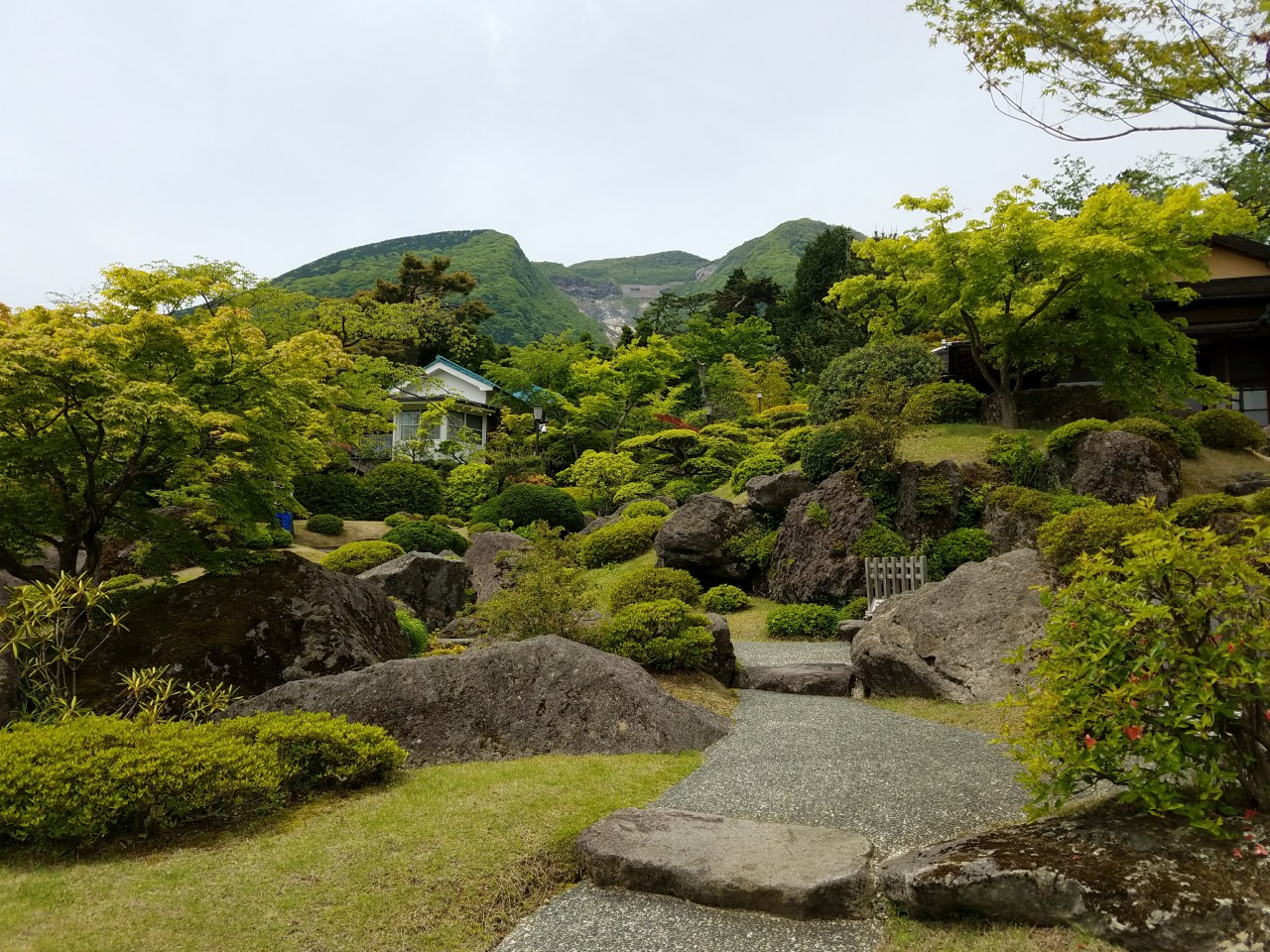
Apart from the moss garden, another section of the museum grounds is a traditionally-Japanese-style landscape garden, called Sekiraku-en (石楽園, lit. 'stone pleasure garden').  It is open only on weekends, holidays, and every day in November, when the maple leaves turn.  I was unaware of this restriction, so I sure lucked out coming on a Saturday when I did.  And it wasn't even all that crowded, either!  The volcanic valley Owakudani can be seen between the mountains in the back.  The sloping, rolling landscape really complements the looming presence of Owakudani; it's easy to imagine both pieces belonging to a single mountain.

There's also a bamboo grove because... this is Japan. I'd be surprised if there wasn't one.

Back at the top of the moss garden is a teahouse, where for ¥700, you can order a cup of green tea and drink it whilst gazing upon the green wonderland below.

The tea was very fine, specifically the powder-based matcha variety, if I'm not mistaken.  It was served with a sweet made from azuki bean paste (小豆餡, azuki-an).  For my first time (knowingly) trying azuki, I thoroughly enjoyed its mellow sweetness.

It reminds me of the time I visited Hokoku-ji in Kamakura.  Not as much bamboo this time around, but far more serene, with nobody else in the room, beyond the server, that I can remember.  After getting our fill of the museum and its scenery, we headed off to another, quite different, museum, which I'll share with you next time on Sekai Ichi!


Hours: Open from 9:30 AM to 4:00 PM; closes at 4:30 PM from April to October.  Admission ends 30 minutes before closing time.  Closed on Thursdays (except in November), 25-31 December, and 4-8 January.  The teahouse is open from 10:00 AM to 3:30 PM.

Costs: ¥900, or ¥700 with an active Hakone Free Pass.  A cup of tea costs ¥700.

Address: 1300 Gora, Hakone-machi, Ashigara Shimo-gun, Kanagawa-ken 〒250-0408

Access: From Hakone-Yumoto, take the Hakone-Tozan Railway to the end of the line, Gora (OH-57, 40 minutes, 4 per hour, ¥410), then take the Hakone-Tozan Cable Car to Koen-kami (OH-59, 3 minutes, 3-4 per hour, ¥170).

The museum is also accessible by bus.  From Hakone-Yumoto (platform 2), take the Hakone-Machi (H) line to Ninotaira-iriguchi ("二の平入口", 17 minutes, every 15-20 minutes, ¥590), then the Kanko-shisetsu Meguri (S) line to Hakone Bijutsukan ("箱根美術館", 10 minutes, every 20-30 minutes, ¥230).  The Hakone Free Pass fully covers both the bus and train routes.

Website(Japanese)

Tuesday, July 31, 2018

Introduction to: Hakone

Edit 10 October 2019: Updated prices to reflect the increase in Japan's national sales tax.

Hakone (箱根) is one of the most famous onsen resort towns in Japan.  Its stature grew from the Edo Period, when it served as a post town and checkpoint along the Tokaido trail between Kyoto and Edo (later Tokyo).  Situated only 90 kilometres (55 miles) southwest of Tokyo, Hakone makes up part of the Fuji-Hakone-Izu National Park.  Beyond bathing, Hakone offers a wealth of museums and unique natural settings, from the volcanic valley Owakudani to the wide Lake Ashi, from which one can view Mount Fuji.  A popular sightseeing itinerary is to take a round-course trip utilising the region's various trains, cable-cars, boats, and buses.

Main Attractions

1) Hakone-Yumoto: The central town, with the highest concentration of hotels and public bath facilities.

IMG_3383.JPG
By horschmology [CC BY 2.0], via Flickr
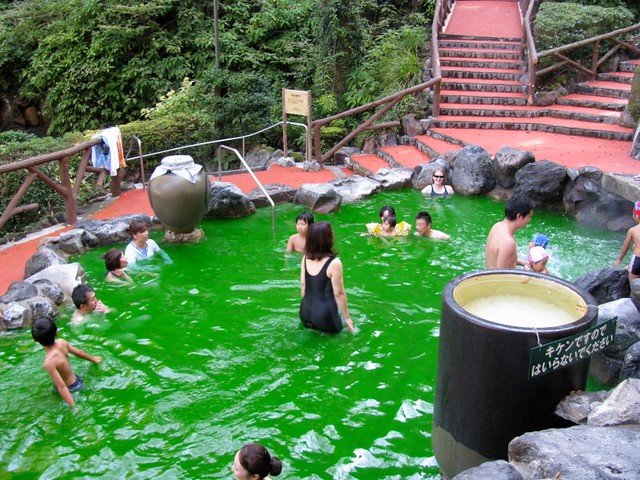
2) Yunessun/Mori-no-Yu: A public bath complex with many uniquely-themed pools.

leon&mae / CC BY
3) Hakone Open-Air Museum: A museum with sculptures and art installations strewn across its open grounds, as well as a permanent Picasso wing.

掬茶 / CC BY-SA
4) Gora Park: A Western-style garden park with floral decorations for every season.

5) Hakone Museum of Art: A collection of Asian and international artifacts, with a landscape garden.

6) Hakone Glass Forest: A museum park devoted to Venetian glass and other Italian trappings.

JiroS. / CC BY-SA
7) Little Prince Museum: A museum, evocative of a French village, about the famous fantasy novel by Antoine de Saint-Exupery.

Arian Zwegers / CC BY
8) Owakudani: A volcanic valley of sulfurous gas-vents, which are used to cook eggs; accessible by the Hakone Ropeway.

Quercus acuta / CC0
9) Lake Ashi: A long lake traversed by all manner of boats, including ones themed after pirate ships.

Hakone Komagatake Ropeway (31036105830)
Gin The Wanderer / CC BY
10) Komagatake Ropeway: A cable car leading up to a mountaintop Shinto Shrine.  (Not to be confused with the Hakone Ropeway to Owakudani.)

xezna / CC BY-SA
11) Hakone Shrine: A Shinto shrine with a torii gate situated on the shore of Lake Ashi.

12) Hakone Checkpoint Museum: A reconstruction of a checkpoint along the old Tokaido road.

The Ancient Cedar Road, a section of the Old Tokaido between Hakone-machi and Moto-Hakone.
Daderot / CC0
13) Old Tokaido Road: Sections of the old Kyoto-to-Edo road that can be hiked along, including a passage lined with old cedar trees.

Σ64 / CC BY
14) Odawara Castle: Located near Odawara Station, the closest castle keep to Tokyo.

Orientation

The major sites of Hakone are spread-out, and are connected by two bus networks.  The first is owned by Hakone-Tozan, a subsidiary of Odakyu Railway.  Their buses are covered by the Hakone Free Pass, which also covers the Hakone-Tozan Railway, the Gora Cable Car, the Hakone Ropeway, and Hakone Sightseeing Cruise boats.  It costs ¥4,600 for two consecutive days, or ¥5,000 for three days, when purchased from ticket machines within the coverage zone (starting from Odawara Station).  More information: (English)

To search for routes between spots in Hakone, using Hakone Free Pass-compatible transportation, visit the website "Hakone Transit Search" (English) (Japanese).

One popular route for getting around Hakone is the "Hakone Round Course", which goes as follows:
  1. Hakone-Tozan Railway from Odawara to Hakone-Yumoto Station (15 minutes, 3-5 per hour, ¥320)
  2. Hakone-Tozan Railway, from Hakone-Yumoto to Gora Station (35 minutes, 4-5 per hour, ¥410)
  3. Gora Cable Car, from Gora to Sounzan Station (10 minutes, 3-4 per hour, ¥430)
  4. Hakone Ropeway, from Gora to Togendai Station (30 minutes, 1 per minute, ¥1,480)
  5. Hakone Sightseeing Cruise, from Togendai to Hakone-Machi Port (30 minutes, 1-2 per hour, ¥1,050)
  6. Bus from Hakone-Machi to Odawara Station (45-75 minutes, 2-6 per hour, ¥1,200)
The Hakone Free Pass can save ¥290 when following this itinerary, not including any discounts presented by most sites when showing the pass at admission.  Of course, there are plenty of changes one can make to this plan, such as replacing certain legs with bus rides along other routes, or stopping overnight at a hotel along the way.

A second network of buses is run by the Izu-Hakone Railway.  The Hakone Free Pass is not valid on any Izu-Hakone-affiliated transportation, but they sell their own free-pass, the "Hakone Tabidasuke" (箱根旅助け).  It covers Izu-Hakone buses, the Komagatake Ropeway, and Izuhakone Sightseeing Boats.  It costs ¥3,000 for two consecutive days.  Passes covering only Izu-Hakone buses for one or two days are also available, costing ¥1,700 and ¥2,000 respectively.  More information: (English) (Japanese)

To search for routes using Izu-Hakone buses, there is a Japanese-only website available: (Japanese)

Access

The most direct train route to Hakone is by the Odakyu network.  From Shinjuku Station, take the Odakyu Odawara line to Odawara (90 minutes, ¥900), and transfer on the Hakone-Tozan line to Hakone-Yumoto (15 minutes, ¥320).  "Romancecar" limited-express trains make the journey from Shinjuku to Hakone-Yumoto without any transfers; they cost up to an additional ¥1,100 on top of the base fare.  From there, you can continue on the upper portion of the Hakone-Tozan line (transfer required), or take a bus.

Odakyu sells a version of the Hakone Free Pass which includes round-trip train fare from Tokyo.  This pass costs ¥5,700 for two days, or ¥6,100 for three days, and can be purchased at stations along the Odakyu line before Odawara.  It does not cover supplement fare for "Romancecar" limited-express services.

For Japan Rail Pass holders, the fastest route is to take the Tokaido Shinkansen from Tokyo or Shinagawa Stations to Odawara (Kodama/Hikari, 30-35 minutes, ¥3,810 reserved, JR Pass OK), and switch to the Hakone-Tozan line from there.  Taking the regular Tokaido Main Line between Tokyo and Odawara takes 90 minutes and costs ¥1,520.  The Japan Rail Pass does not cover the Hakone-Tozan line.